This is probably the best look at the shockwaves I’ve seen from the latest Starship flight.
Captured from a GoPro I clamped onto a proper camera to record simultaneous video. (I’ll show you the photo the better camera took in the reply)
A single bird has just accomplished one of the most extraordinary feats in the animal kingdom — flying nearly one-third of the way around the Earth without stopping to eat, drink, or rest.
The record-breaker is a five-month-old Bar-tailed Godwit that flew nonstop from Alaska to Tasmania, Australia. Covering 8,425 miles in just over 11 days, it set a new record for the longest nonstop flight ever documented in any bird.
What makes this journey even more astonishing is that it was the young godwit’s very first migration. The entire route took place over the open Pacific Ocean, with no chance to land. Despite that, the bird navigated thousands of miles of featureless water with pinpoint accuracy.
This incredible endurance is made possible by remarkable physiological adaptations. Before takeoff, the godwit packs on enormous fat reserves — nearly half its body weight — to fuel the flight. At the same time, many of its internal organs, including parts of the digestive system, temporarily shrink to lighten the load and maximize energy efficiency.
Unlike many seabirds that depend heavily on gliding, this godwit flapped continuously for the entire journey, battling shifting winds and weather systems the whole way.
Researchers at the Pūkōroro Auckland Shorebird Centre say discoveries like this are transforming our understanding of migratory birds. Their astonishing endurance, navigation skills, and energy management demonstrate biological capabilities that can match — and in some ways surpass — even the most advanced human engineering.
Bugatti just lost its all-time speed record. To the Chinese EV in this video. 308 mph at Papenburg, on a battery.
The Chiron Super Sport had held the record for six years. 1,600 hp, 8.0L W16, four turbochargers. Bugatti needed every horse of that to hit 304 mph. BYD's Yangwang U9 Xtreme did 308 with four electric motors and a battery pack.
Marc Basseng, the driver, won the Nürburgring 24 Hours. He said the run was "technically not possible with a combustion engine." He's right.
A combustion engine produces a power curve that peaks at a specific RPM and falls off either side. Past 9,000 RPM the valves float, the connecting rods stretch, the pistons can't reverse direction fast enough. The W16 is the absolute thermodynamic ceiling of 100 years of internal combustion. Every mph past 290 cost exponentially more engineering for diminishing returns.
The U9 Xtreme uses four electric motors. Each produces 744 hp. Each spins to 30,000 RPM. No valves. No pistons. No connecting rods. Total system output is 2,978 hp, almost double Bugatti's W16. Power-to-weight is 1,217 hp per tonne.
The motors were never the hard part. Mate Rimac said this years ago. The constraint was always the battery, because to deliver 2,978 hp into four wheels you have to discharge faster than any production EV ever has.
BYD built the world's first 1,200-volt production car. Everyone else uses 800V. The Blade Battery runs lithium iron phosphate cells with a 30C discharge rate, ten times what a conventional EV battery handles. Heat generation falls 67% versus 800V at matching output.
That last number is the whole game. Heat is what kills high-power EV runs. Other automakers derate within seconds at full power because the battery cooks itself. BYD's architecture lets the Xtreme hold maximum discharge long enough to actually approach the aerodynamic limit of the chassis.
Bugatti spent 20 years engineering the W16 to its physical ceiling. BYD spent 18 months building the architecture that cleared it.
They're making 30 of them.
The crown for fastest production car on Earth has belonged to Bugatti, Koenigsegg, Hennessey, SSC. All combustion, all European or American. The crown is Chinese now, and it runs on a battery.
The scale problem in Australia’s spending is getting impossible to ignore.
Medicare:
• $33.9B
• Covers 26.5 million Australians
→ ~$1,279 per person
NDIS:
• $52.3B
• Covers 717,000 people
→ ~$72,900 per participant
That’s roughly 57× higher per person.
This isn’t about whether people deserve support; we know they do. It’s about whether the system delivering that support is sustainable, efficient and free from waste. Which we know it isn’t!
NDIS spending vs Medicare spending in Australia.
Medicare covers 26.5 million people for about 34 billion, NDIS covers 700,000 for approximately 50-52 billion.
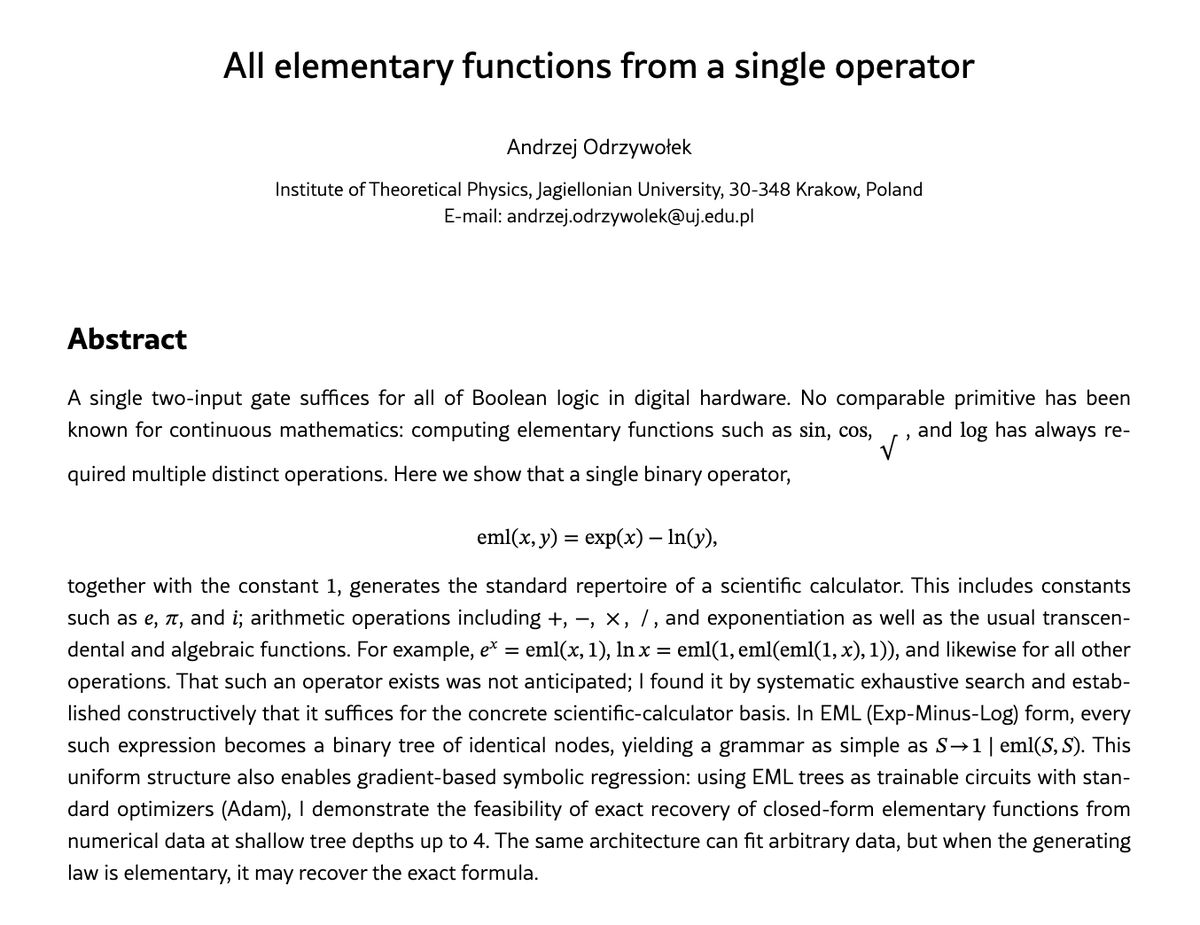
Researchers just proved that every single elementary function, sin, exp, log, sqrt, comes from one single binary operator.
It is like finding the “God Particle" for calculus.
In computer science, every complex program breaks down to a single logical operator: the NAND gate. It is the fundamental building block of all digital reality.
But for continuous math, physics, engineering, machine learning, we thought we needed a massive toolbox.
Addition. Subtraction. Trigonometry. Logarithms.
Every scientific calculator and neural network has to juggle all of them.
Until today.
But this paper proved that every single mathematical function can be generated by a single, bizarre binary operator.
eml(x,y) = exp(x) - ln(y).
Combine that with the number 1, and you can build everything.
Pi. The square root. Sine and Cosine. Arithmetic.
It is all just the exact same operator, repeating over and over again in a binary tree.
Nobody anticipated this existed. It was found by systematic exhaustive search.
But the implications for AI are massive.
Instead of an AI struggling to combine different mathematical rules to discover a new scientific law, it can just use a single, uniform architecture.
One trainable circuit. One repeatable node.
We thought the language of the universe was complex.
It turns out, it's just one equation repeating in the dark.
Diesel is not dead, and this EV truck proves it.
They just damned themselves with their own stunt... if this is their 'proof' then they've already lost the argument.
Support my work by buying me a coffee, and check out my books, DVDs, tee shirts, hoodies, caps, and stickers, at https://t.co/1QFGRuGF0I
Ever wonder how the Long Wavelength Array (LWA) images the invisible low-frequency radio sky in real time?
256 cross-polarized dipole antennas are spread across a ~100 m field. Every element is digitized with precise phase coherence. The system then computes cross-correlations for all antenna-pair baselines, sampling the uv-plane with visibility data. A fast inverse Fourier transform (IFFT) converts those visibilities into stunning all-sky images — revealing the dynamic radio universe at 10–88 MHz, updated every few seconds with 100% duty cycle!
Live all-sky view here: https://t.co/Qbw6INvZeE
🌌 Long Wavelength Array (LWA) は、目に見えない低周波電波空をリアルタイムでどうイメージングしているのか?
約100mの範囲に展開された256本の交差偏波ダイポールアンテナ。それぞれの素子を位相コヒーレントにデジタル化。全アンテナペアのベースラインについて相互相関を計算し、uv平面に可視度データを埋め込みます。高速逆フーリエ変換 (IFFT) で可視度を全天画像に変換 — 10〜88 MHzのダイナミックな電波宇宙を、数秒ごとに100%デューティで映し出します!
ライブ全天映像はこちら:https://t.co/Qbw6INvZeE
10GHz EME - 1st portable outing of this year. 10 stations worked in short time, 4 new initials, 1 new DXCC 📡Excellent self-echoes from the moon, enough for CW 🌖 but forgot my CW key at home - https://t.co/wBCro3yS6r
#hamradio#moonbounce#10GHz#hamr#amateurradio#GHzbands
someone built an OPENSOURCE MILITARY RADAR that tracks multiple targets up to 20km away
its called AERIS-10, full github repo schematics, PCB layouts, FPGA code, python GUI, everything under MIT license
commercial phased array radar starts at $250,000. military surplus is $10,000-50,000 but its decades old analog junk with no electronic beam steering
this does electronic beam steering at 10.5GHz, pulse compression, doppler processing, multi-target tracking on a real time map
two versions: 3km range with patch antenna array, 20km range with 32x16 slotted waveguide array and GaN AMPLIFIERS
custom frequency synthesizer, 16 front-end chips, FPGA doing all signal processing, GPS and IMU for ACCURATE target coordinates when the platform moves
all gerber files included so you can order the PCBs and build it yourself
one person built what defense contractors charge a quarter MILLION for and open sourced it
Tony Armstrong told ABC viewers the First Fleet committed genocide by intentionally introducing smallpox to Aboriginal people.
The foremost historian on the subject disagrees. So does the virus itself.
A thread on what happens when ideology replaces evidence 🧵
🇮🇹 The speech that all of Italy heard. And that the world must hear.
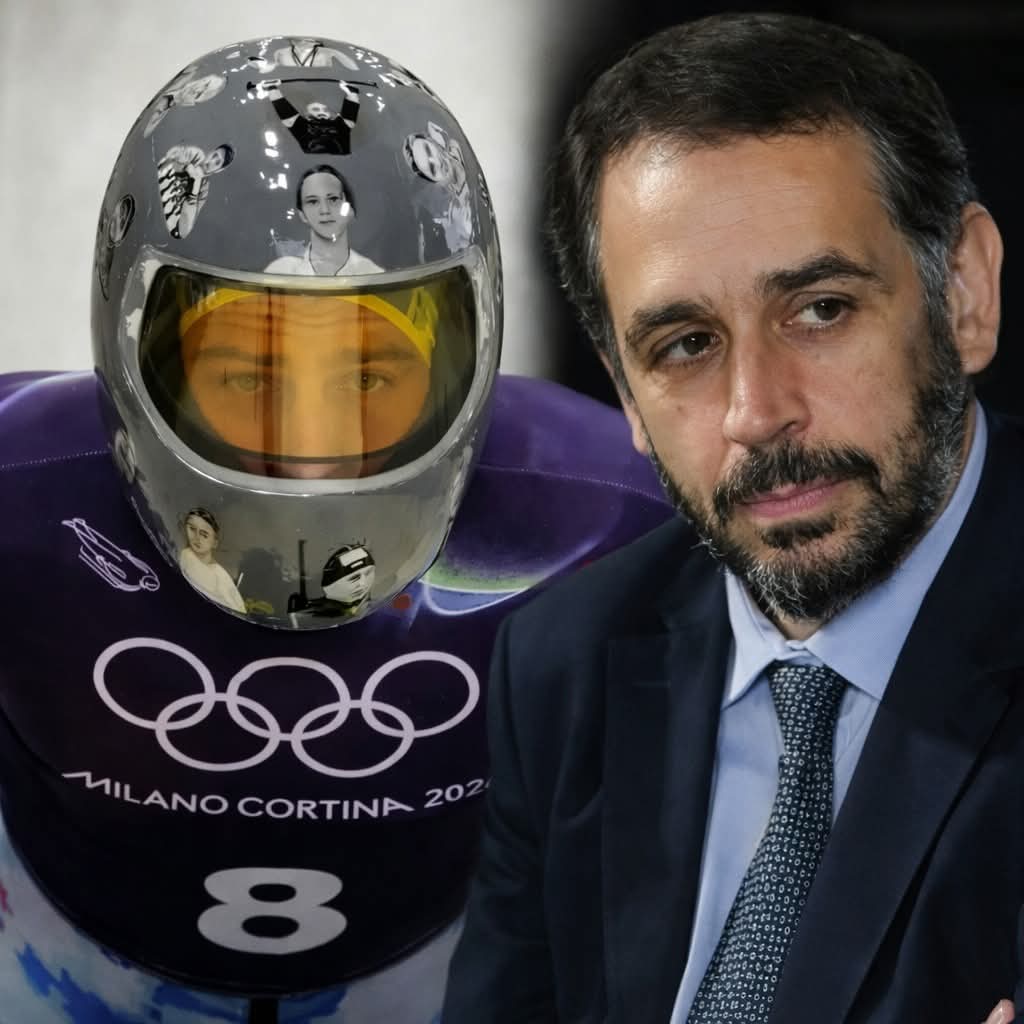
In a country that will host the Olympic Games, Italian Senator and Vice President of the Human Rights Commission Filippo Sensi took the floor and said what should have been said out loud long ago.
He called it a disgrace that the International Olympic Committee disqualified Ukrainian skeleton athlete Vladyslav Heraskevych.
Not for doping.
Not for violating fair play.
But for… memory.
For a helmet bearing the faces of Ukrainian athletes — his friends, colleagues, champions — killed by Russia.
The IOC stated that the helmet “did not comply with regulations.”
And then Sensi asked a question that brought silence to the chamber:
Does aggressive war comply with regulations?
Is there a separate technical protocol for it?
The correct angle of a missile strike?
The permissible size of a crater?
An athlete prepares for the Olympics for years.
A Ukrainian athlete trains between air raid sirens, in shelters, under news of the dead.
He overcomes fear, exhaustion, and loss.
And he steps to the start line not only for a medal — but for the right to exist.
And he is suspended… for remembering.
Because memory is the most dangerous substance. It is hard to add to a prohibited list. But apparently, someone would very much like to.
The senator named names. Just a few among more than 650 Ukrainian athletes killed by Russia:
▪️ Yevhenii Malyshev, 19, biathlete — killed in Kharkiv.
▪️ Mariia Lebid, 15 — missile strike in Dnipro.
▪️ Dmytro Sharpar, 25, figure skater — killed in Bakhmut.
▪️ Volodymyr Androsiuk, 22, track and field athlete — also Bakhmut.
▪️ Daria Kurdel, 20 — missile strike in Kharkiv.
▪️ Alina Perehutova, 14 — standing in line for water with her mother in Mariupol.
▪️ Maksym Halinichev, 22, boxer — killed defending Luhansk region.
▪️ Viktoriia Ivashko, 9, judoka — missile strike in Kyiv.
▪️ Kateryna Diachenko, 11, gymnast — airstrike on Mariupol.
▪️ Karina Bakur, 17, world kickboxing champion — shielded her father with her body.
These were the faces Heraskevych wanted to carry with him to the start line.
So that they would “compete” alongside him.
So that their dream would not die with them.
And for that, he was punished.
Because it turns out that the faces of murdered athletes violate regulations.
But their absence on the track does not.
In his speech, Sensi said the most important thing:
The Olympic Committee did not lose an athlete.
It lost its most valuable medal — its conscience.
Sport without memory is just a show.
Sport without humanity is just decoration.
Sport that fears truth is not about peace.
The Olympic movement was born from the ideals of honor, dignity, and unity.
Yet today Ukrainian athletes must prove not only their strength — but their right to remember their fallen.
And if memory becomes a violation of regulations — then the problem is not the helmet.
The world must hear this.
Because silence is also a position.
And indifference is also a choice.
Memory cannot be disqualified.
And conscience cannot be added to a prohibited list.
🇺🇦 We remember every one of them.
And we will not allow their names to be erased.
France has made planned obsolescence a criminal offense, becoming one of the first countries in the world to treat deliberate product shortening as a serious crime.
Manufacturers caught intentionally designing electronics, appliances, or other goods to fail prematurely or become unusable—whether through hardware flaws, software updates that slow performance, or other engineered limitations—now face steep penalties: up to 2 years in prison and fines reaching €300,000, or as high as 5% of their average annual turnover in the most serious cases.
This landmark law, building on France’s earlier consumer-protection framework and reinforced by high-profile scandals (such as the 2017–2018 investigations into smartphone “battery-gate” slowdowns), explicitly targets both physical and digital tactics used to push consumers toward frequent replacements.
The legislation is more than just punishment—it’s a cornerstone of France’s broader “right to repair” agenda. By criminalizing practices that drive premature disposal, the government aims to:
- Slash the massive environmental footprint of electronic waste,
- Protect consumers from hidden “forced upgrades,”
- Encourage manufacturers to prioritize durability, repairability, and longer-lasting support.
France’s tough stance sends a clear message to global tech and appliance companies: the era of disposable-by-design products is ending. By leading the charge on sustainability and consumer rights, the country is helping shift the world toward a more circular economy—one where goods are built to last, repaired when needed, and discarded only when truly necessary.
NASA writes mission-critical flight software in C.
And the rules are absolutely INSANE.
> No recursion. Ever.
> Every loop must have a provable upper bound.
> No dynamic memory allocation after initialization.
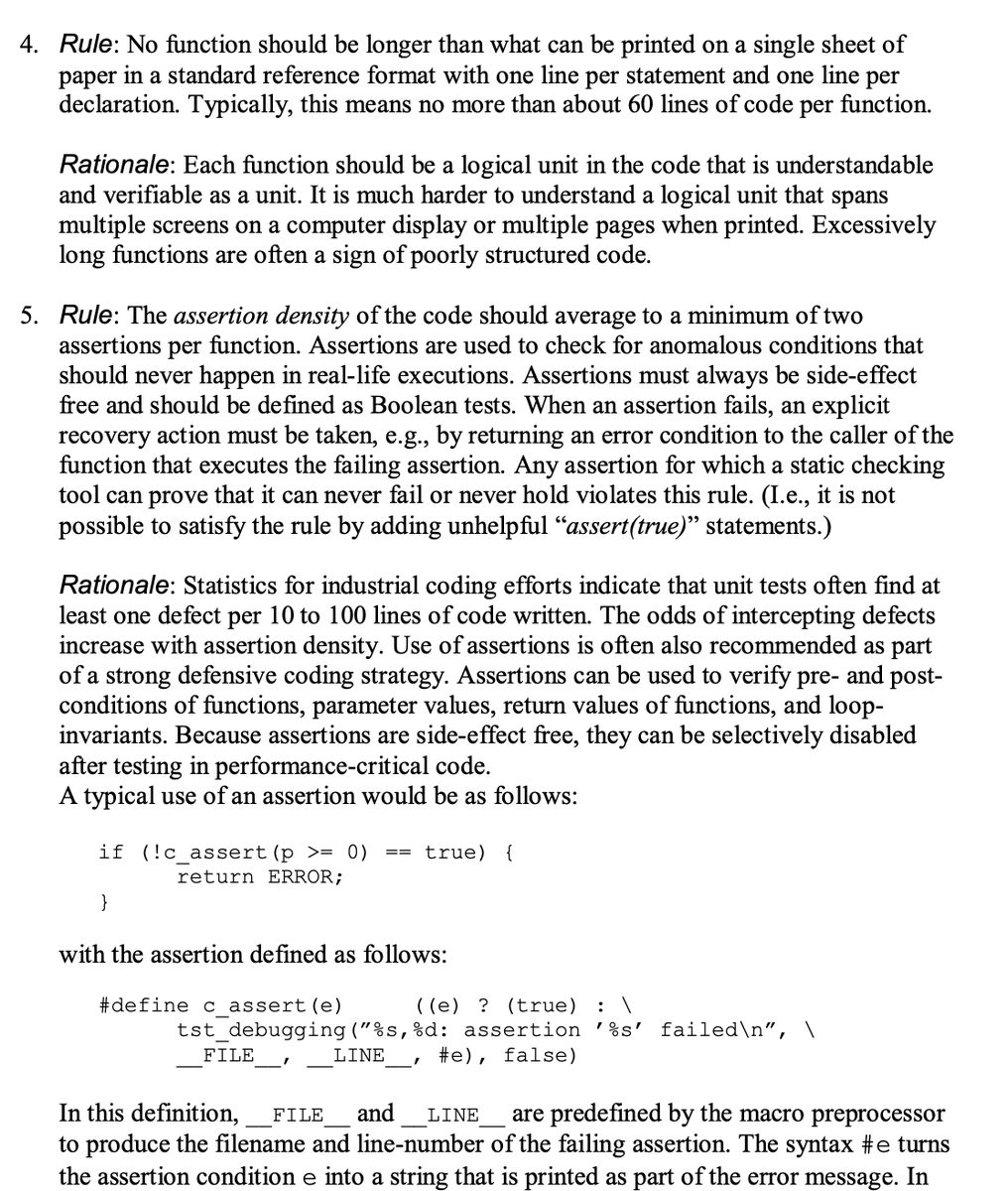
> Max ~60 lines per function.
> Minimum 2 assertions per function.
> Every return value must be checked.
> Zero compiler warnings allowed.
> Daily static analysis. Zero warnings there too.
> No function pointers.
> Restricted pointer dereferencing.
This is how they write code at NASA / JPL for mission-critical systems.