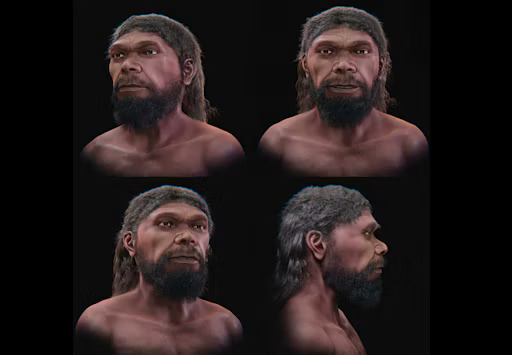
The first members of Homo sapiens may have looked like this. Researchers have created a 3D reconstruction of a 315,000-year-old skull found in Morocco.
👉 https://t.co/fqT8MFQPWp
#HomoSapiens#HumanEvolution#Science#Archaeology
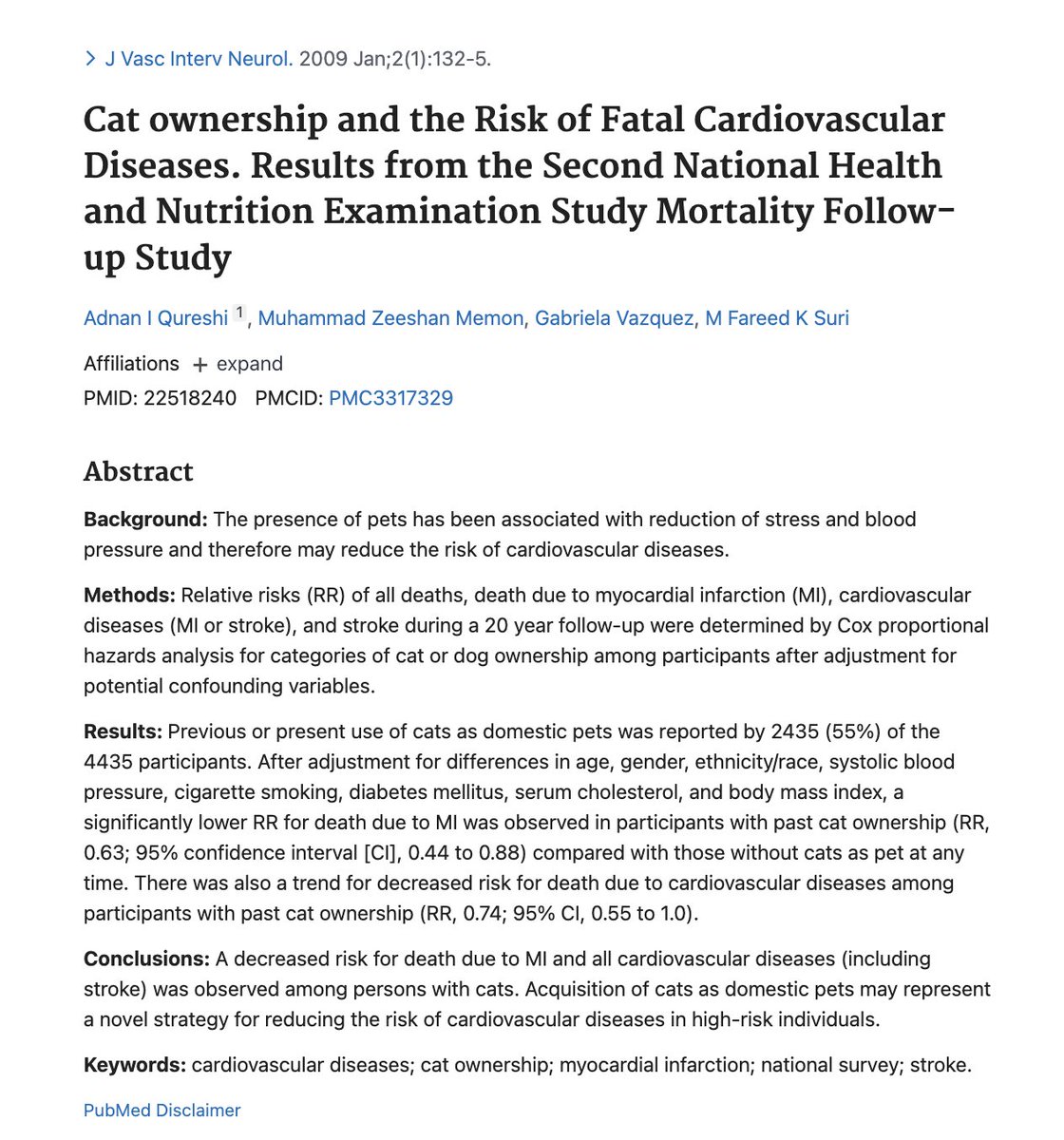
Cat owners have a 30 percent lower risk of dying from a heart attack. A study published in the Journal of Vascular and Interventional Neurology analysed data from 4,435 adults followed over 20 years in the Second National Health and Nutrition Examination Study and found that people who had owned a cat at any point had significantly lower cardiovascular mortality.
The study was led by Adnan Qureshi at the University of Minnesota. He found that cat owners had a 30 percent lower risk of death from myocardial infarction and a lower risk of death from all cardiovascular diseases combined, after adjusting for age, sex, race, blood pressure, cholesterol, diabetes, smoking, BMI, and income. The effect held across every subgroup tested.
The mechanism is likely stress reduction. Cats, unlike dogs, do not need to be walked, which removes the exercise explanation. What they do provide is companionship, tactile contact, and a calming presence that lowers the baseline stress level in the home. Studies on pet interaction have shown that stroking a cat lowers cortisol and blood pressure within minutes, and those small daily reductions compound over years.
The study could not determine whether it was the cat that produced the benefit or whether people who choose to own cats have personality traits that independently protect against heart disease. But the size of the effect, 30 percent, and the length of follow-up, 20 years, made the finding hard to dismiss as coincidence.
A cat does not exercise with you, does not cook for you, and does not remind you to take your medication. It sits on your chest and purrs, and the 20-year data says that is enough. https://t.co/suc69ZN5tM
50 websites that can turn a “quick visit” into hours of exploring 🌍
1. https://t.co/e9MzKtH8Ac — Live satellite views
2. https://t.co/F0sYcAhsEB — Track planes worldwide
3. https://t.co/dlD4FsbeZ5 — Track ships in real time
4. https://t.co/enz2psqLq2 — Live weather & storms
5. https://t.co/6WtqMIyIXO — Live lightning strikes
6. https://t.co/rDjMVuFJ9p — Recent earthquakes
7. https://t.co/2hL9AwpAnD @sauda_coder — Explore internet cables
8. https://t.co/OXUHY0vxtW — Monitor global forests
9. https://t.co/3ykvE8xIQm — Live world statistics
10. https://t.co/WIRyI84z3z — Live internet stats
11. https://t.co/WF9Dt2YTJU — Compare country sizes
12. https://t.co/lkLgao8hPE — Explore historical maps
13. https://t.co/62atEjao3d — Historical map archive
14. https://t.co/0roKo8iBFs — Community-built world map
15. https://t.co/t4SwdWbJzL — Windows around the world
16. https://t.co/upNXry1y9K — Virtual city walks
17. https://t.co/0c5Vd0eMlf — Random places worldwide
18. https://t.co/A07775U3oX — Strange places worldwide
19. https://t.co/2LNjVQBuJG — Fun interactive experiments
20. https://t.co/WE3bRUopQP — Atom to universe
21. https://t.co/BlWzVbrKLO — Explore space in 3D
22. https://t.co/F85rw8lZ7F — Interactive sky map
23. https://t.co/DXt3VwPFml — NASA’s daily space image
24. https://t.co/4NjhLkVJzZ — NASA image archive
25. https://t.co/CKAVlLPXI3 — Interactive data stories
26. https://t.co/y6mFbQxfB7 — Global data & insights
27. https://t.co/DkEF24VHkq — Understand global trends
28. https://t.co/w4FExJsjYb — Data visualizations
29. https://t.co/eJbNAd4SBo — World Bank data
30. https://t.co/xyBlo89HIx — Turkey’s official statistics
31. https://t.co/A1aMVlBPFk — Massive digital archive
32. https://t.co/Mq40zmIIEJ — Free classic books
33. https://t.co/IeLWcbvCzB — Explore millions of books
34. https://t.co/YQD3ttZBoy — Library of Congress archive
35. https://t.co/Ix06KBwQyn — Europe’s cultural archive
36. https://t.co/CgTot9xsnm — America’s digital library
37. https://t.co/STGOC79ra4 — Virtual museums
38. https://t.co/HVjvwXZxdj @sauda_coder High-res artworks
39. https://t.co/11ALJRqB12 — Online art collection
40. https://t.co/C0q1e7mBuK — Historical treasures
41. https://t.co/FzLnwbvNFj — Free culture & education
42. https://t.co/DvnRSpu9PG — Explore the Met collection
43. https://t.co/4LzaPivTOn — Explore music genres
44. https://t.co/YRFJAaEZxr — Music by country & decade
45. https://t.co/KRJ5e0TlCK — Wikipedia edits as audio
46. https://t.co/MD4cssnXHm… — Random knowledge
47. https://t.co/SQ0ZFGnCHI — Time & astronomy tools
48. https://t.co/jVSqK5hoZO — Latest science news
49. https://t.co/DO3rXyKDYD — Free research papers
50. https://t.co/HzGCsimVyk — Interactive data visualizations
The internet is much bigger than your usual feed.
🔖 Bookmark this for later.
Follow @sauda_coder for more useful websites & AI tools. 🚀
"Not only are the states seeking upwards of $1 trillion from Meta, they are demanding it make changes to Instagram and Facebook, including ending "like" counts and infinite scroll."
#meta#facebook#instagram#Zuckerberg
https://t.co/WfOSrVl66R
🇨🇳 China just torched the U.S. AI lead in a single afternoon.
Moonshot AI, a little-known Beijing startup, dropped Kimi K3 on Thursday and it instantly kicked into the top tier of global models.
It beat Anthropic's Fable 5 and OpenAI's GPT-5.6 Sol on coding tests, then edged out Opus 4.8 on a broader ranking while costing 40% less.
Now the knockout blow. On July 27, Moonshot is giving Kimi away as open-weight, so any company or government on Earth can download it and run it on their own machines. No subscription, no permission slip.
For months U.S. labs slept fine telling themselves China was 6 to 12 months behind. That head start just evaporated.
And Kimi doesn't even need to be the best model to win. Near the top, 40% cheaper, and yours to keep is what most buyers actually want.
That's the nightmare in Silicon Valley. The trillion-dollar valuations and hundred-billion-dollar data centers all rest on one bet: U.S. stays ahead.
Kimi just kicked that out from under them.
Source: The AI Rankings, Axios / Writer: Daniyal
This study led by University of Central Florida found that kids with ADHD may sit still during movies but fidget during schoolwork, not from boredom, but because movement helps them focus on mentally demanding tasks
I am devastated to share the news that one of my heroes — and a woman who has had an enormous impact on wildlife conservation — Dr. Biruté Mary Galdikas has died.
She was 79.
I feel so grateful that I had the honor of spending time with her.
Over the years, I have connected with so many of you over my love of orangutans (and elephants and mountain gorillas, of course); Dr. Biruté gets all the credit.
Orangutans would likely be extinct were it not for Dr. Biruté’s pioneering and exhaustive work over the last six decades.
Dr. Biruté was one of three women handpicked and mentored by legendary paleoanthropologist Louis Leakey to transform our understanding of the great apes.
Jane Goodall studied chimpanzees, Dian Fossey studied gorillas, and Dr. Biruté dedicated her life to orangutans, and together they revolutionized primatology and the case for great ape intelligence, emotional depth, and conservation.
While Jane Goodall proved that chimpanzees use tools, form complex social bonds, and possess a capacity for empathy once thought uniquely human, Dr. Biruté proved that orangutans are slow-breeding, highly intelligent, and extremely vulnerable.
Dr. Biruté built the conservation model to try to save orangutans and dedicated her life to protecting them.
Dr. Biruté is credited with conducting the longest-running longitudinal study by one principal investigator of any wild mammal in the world.
She was the first to document the long orangutan birth interval, which averaged 7.7 years, and recorded over 400 types of food consumed by orangutans.
Dr. Biruté’s research that fundamentally reshaped how scientists understood orangutans.
Before her field studies, the orangutan was the least understood of the great apes.
The orangutan population as it exists today, as fragile as it is, would not exist without her.
Many conservationists go as far as saying the orangutan, our cousin, would likely be extinct or close to extinct were it not for Dr. Biruté’s discoveries and her sacrifice.
Dr. Biruté took on palm oil conglomerates, illegal loggers, poachers, and gold miners.
She did so often at great personal risk, including death threats and kidnapping,
She remained in Borneo for over 40 years as an outspoken advocate for orangutans and the preservation of their rainforest habitat.
In 1986, she founded Orangutan Foundation International, with sister organizations established in Australia, Indonesia, and the United Kingdom.
We owe so much to Dr. Biruté and her incredible legacy.
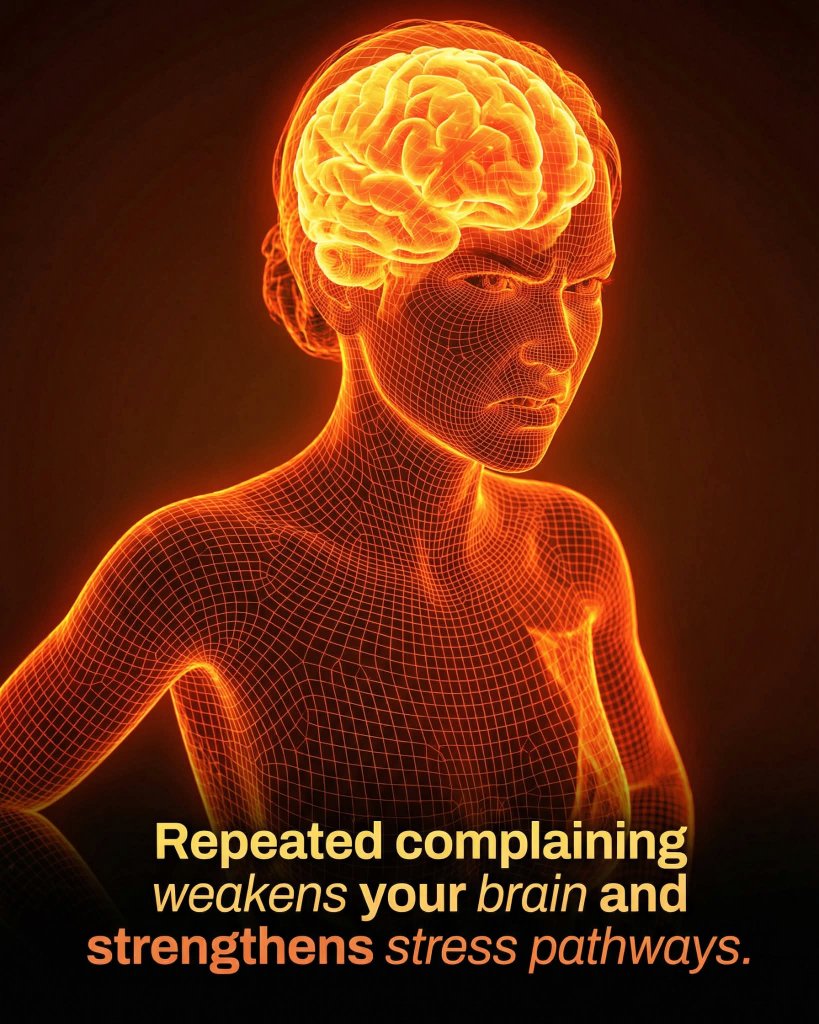
🚨 Research shows repeated complaining physically rewires your brain to prioritize stress and negativity.
The way we speak about our daily challenges does more than just vent frustration; it physically alters the architecture of the brain.
When we engage in chronic complaining, we repeatedly activate neural networks responsible for detecting threats and processing stress.
Through the biological process of neuroplasticity, these circuits become stronger and more efficient every time they are used. Essentially, the brain learns to become more adept at finding things to be unhappy about, turning a temporary mood into a permanent biological predisposition toward negativity and fear-based thinking.
As these negative pathways become the brain's default setting, individuals often experience a measurable increase in baseline stress levels and emotional volatility. This heightened sensitivity means that even minor inconveniences can trigger an intense stress response because the brain has been conditioned to interpret the world through a lens of threat. Findings discussed by the Stanford University School of Medicine emphasize that while this mechanism is powerful, understanding the science of affective neuroscience is the first step in consciously redirecting those pathways toward more resilient emotional patterns.
Source: Stanford University School of Medicine. (2023). Neural Plasticity and the Impact of Negative Thought Patterns on Emotional Regulation. Stanford Medicine News.