Lactate is toxic. Lactate causes fatigue. High lactate is bad.
We hear some version of this all the time.
But how much of it is actually true?
So we wrote a review separating what we know about lactate from what we’ve simply assumed for decades.
Led by our fantastic postdoc Bhavya Blaze! @Bhavya391554759
https://t.co/WRKW5Nm487
#Lactate #Metabolism #ScienceTwitter
🧵 the Krah Lab opens this month and our first preprint is live on bioRxiv!
This was a highly collaborative project with the Chaix Lab, @Dorrance_Lab and @RutterLab asking: does the modality of weight loss change how blood and inflammatory cells are made?
https://t.co/rW3MPbn6XA
Excited to share our new preprint on how mitochondrial membrane proteins incorporate threonine to balance targeting through the aqueous cytosol with membrane stability. https://t.co/UKRReHVRRQ
We are thrilled to share this new preprint from our awesome grad student, @Tarun579_599! Tarun discovered that mitochondrial membrane proteins have evolved to incorporate threonines in place of highly hydrophobic residues to assist in their transit from the cytosol to mitochondrial membranes.
Membrane proteins in mitochondria face a biochemical paradox: how to be hydrophilic enough to traverse the aqueous cytosol, yet remain hydrophobic enough to embed in the membrane. Evolution repeatedly solved this targeting problem by swapping aliphatic residues for threonine.
Happy to share our new preprint from @RutterLab. To understand how genes are controlled, we developed a method we call TRoUT-FISH, using CRISPR + RNA-FISH. We found that glycolytic gene expression is fine-tuned by lineage specifying transcription factors.
https://t.co/U3Hi1Ovozn
🚀 First paper from the Cluntun Lab!
Our invited Perspective is now out in @BiochemistryACS.
A framework for understanding lactate biology through subcellular routing and chemical form.
https://t.co/ItqQCyuidV
@ACSPublications@RutgersHealth
Congratulations @NichoOffei!
I'm excited to present a small method project of mine from @RutterLab! Here we designed a dual-purification system to isolate mitochondrial subpopulations based on their proximity to membranous organelles. All constructs will be available on Addgene soon!
https://t.co/h8D6bA9b6L
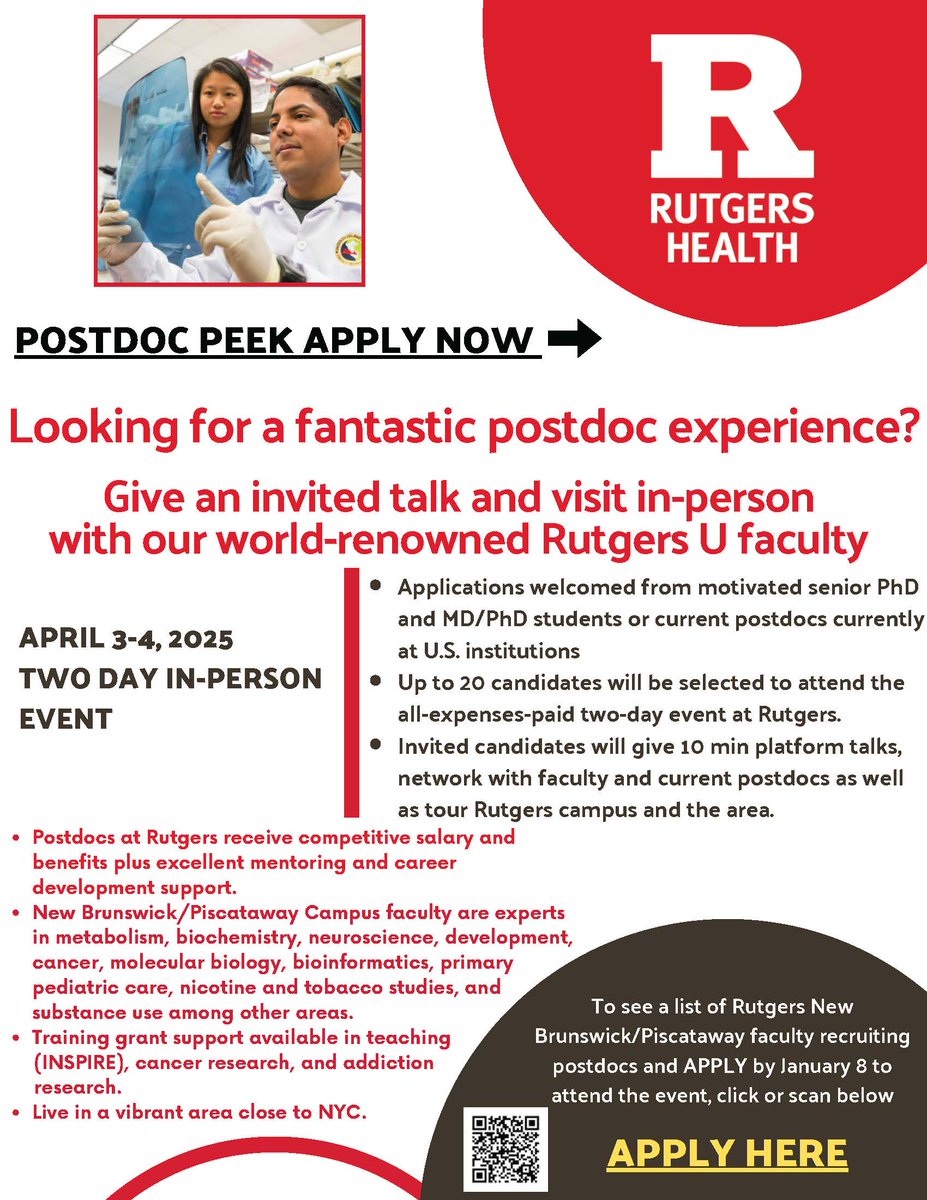
🚨 Announcing the Rutgers Postdoc Peek! 🚨
Are you a senior PhD or MD/PhD student (or a current postdoc) at a U.S. institution? This is your chance to explore an exceptional postdoc experience at Rutgers Health on the New Brunswick/Piscataway campus!
✨ Why Apply?
-All-expenses-paid event (April 3-4, 2025)
-Give a 10-min invited platform talk
-Meet world-class faculty in metabolism, biochemistry, neuroscience, cancer, and more (including myself)
-Network with postdocs and tour the vibrant Rutgers campus near NYC
-Work with leading schools & institutes like @RutgersCancer, Robert Wood Johnson Medical School @RWJMS, and @Waksman_Inst
💼 What You’ll Gain:
Competitive salaries, top-tier mentoring, and access to unique career development resources
🗓️ Apply by January 8, 2025
Don’t miss this opportunity to kickstart your career at @RutgersU!
📄 Application link: https://t.co/pfjDmQpyGa
#RutgersPostdocPeek #PostdocOpportunity #Rutgers
Plz RT and share!
🫡 The Cluntun Lab Wants YOU! 🫡
Are you ready to push the boundaries of heart science? To unlock metabolic mysteries and make breakthroughs that matter?
🎖 Join the ranks in one of our multiple postdoc positions
🪖 Or take the lead as our experienced lab manager
This is your chance to be part of high-impact research.
Apply today:
Postdocs
https://t.co/dJvgRhUCIx
Lab Manager
https://t.co/94XWD8WiYk.
For more details, visit our website https://t.co/TMK6su5q1Z
Answer the call— plz retweet and share! #HeartScience #ScienceFrontlines @RutgersU@RWJMS
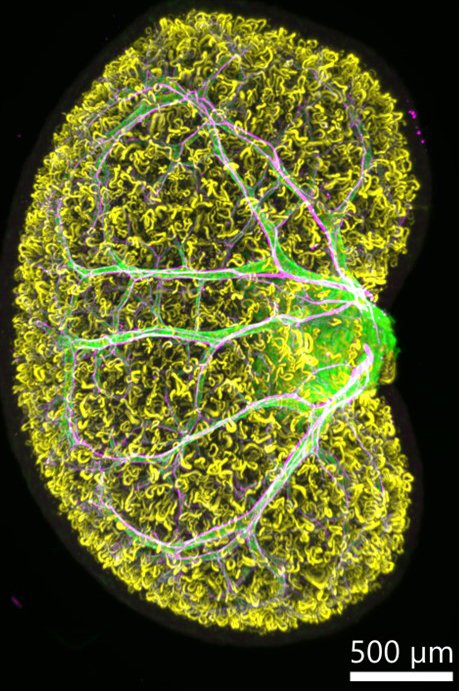
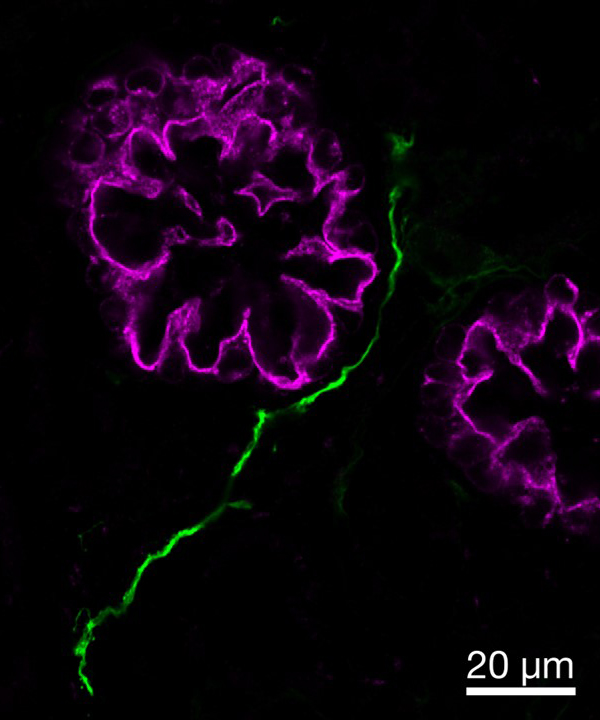
Happy to share our latest manuscript now out in Cell Reports! In lieu of a Tweetorial, I'll post amazing images from the manuscript and please check out the article for our spatiotemporal mapping of kidney innervation and new findings! https://t.co/OpxHafB3h8
🚨Thrilled to share our new preprint from my postdoc work in the @RutterLab! The latest outcome of our close collaboration with @gsducker and @StavrosDrakos labs, where we uncovered something big: mitochondria directly import lactate as fuel in the heart!
@HHMINEWS @UofUBiochem 🧵https://t.co/3s3B0VYdz3