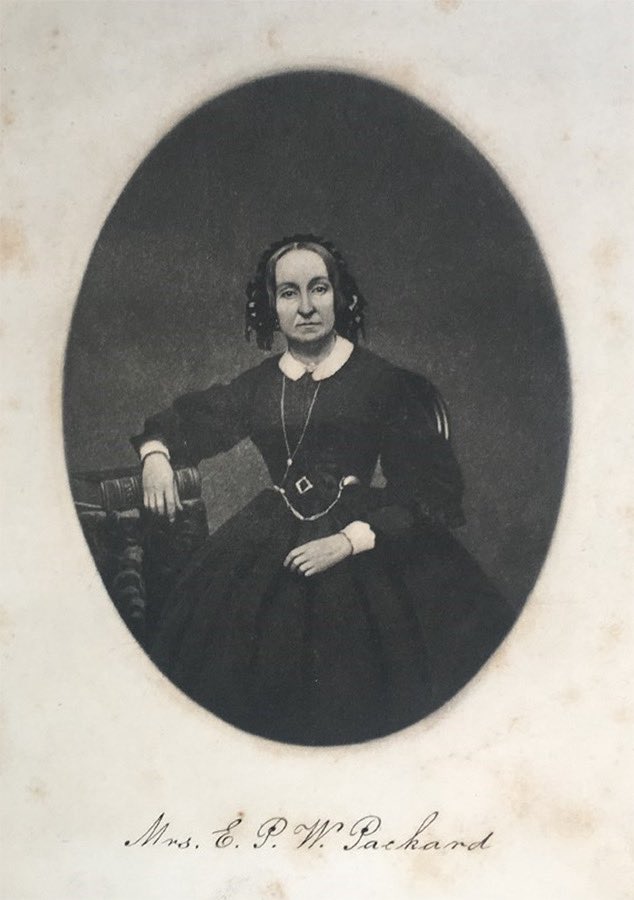
In June 1860, Elizabeth Packard kissed her six children goodbye.
She thought about the dinner she would cook later. She thought about the laundry. She thought about the quiet life of a mother in Illinois.
She had no idea that when the front door clicked shut, it would stay locked for three long years.
Her husband, Theophilus Packard, was a respected minister. To the neighbors, he was a man of God. Inside their home, he could not stand a wife who thought for herself.
Elizabeth liked to read. She liked to debate religion. She had her own opinions about life and faith. In the 19th century, a woman with a mind of her own was treated as a danger.
Theophilus decided to end the argument. He didn’t need a crime. He didn’t need a witness. Illinois law let a husband commit his wife to an insane asylum without evidence or a public hearing. He simply had to say she was “disturbed.”
One morning men arrived at her home. They did not listen to her logic. They did not care about her tears. They took her to the Jacksonville Insane Asylum.
Elizabeth was 43, perfectly sane, and suddenly a prisoner.
Inside she expected people who needed medical help. Instead she found a warehouse of “inconvenient” women: wives who argued about money, daughters who refused marriages they did not want, women who were simply too independent.
“This is not a hospital,” she realized. “It is a cage for the unwanted.”
Doctors tried to break her. They told her that if she admitted her husband was right and she was wrong, she could go home. They wanted her to say she was crazy for wanting her own thoughts.
She looked them in the eye and said, “I cannot buy my liberty by a lie.”
She did not give up. She wrote. She hid scraps of paper in the linings of her clothes. She tucked notes under floorboards. She recorded every abuse and every story of the women around her. She became a secret journalist inside a living nightmare.
After three years she was released. Her husband locked her in a room at home and planned to send her to another asylum in a different state.
This time friends helped her reach a judge. A trial was ordered.
The courtroom was packed. Theophilus was confident. He brought “experts” who claimed her religious doubts proved her mind was broken.
Elizabeth stood up. She did not shout. She spoke with the calm power of the truth. She explained her beliefs. She showed the jury that a different opinion is not a disease.
The jury needed seven minutes.
They came back with one word: Sane.
She walked out a free woman and found that her husband had taken the furniture, the money, and the children. She was alone and penniless.
Most people would have disappeared. Elizabeth did the opposite.
She spent the next forty years traveling the country. She stood before legislatures and demanded new laws. She said a woman’s mind is her own, and the law must protect it.
Because of her, states changed their laws. They made it illegal to lock a person away without a fair trial and a medical exam.
She turned private pain into a public shield for thousands of other women.
You can take a woman’s home, her money, and her children.
You cannot take her voice. 🌹
35 years ago today:
Great Britain shocked the USA to win 4x400m relay gold at the Tokyo World Championships.
Switching Roger Black to the first leg and Kris Akabusi to the anchor leg proved to be a tactical masterstroke.
One of the finest British track wins in history 🇬🇧🥇
Atlas Shrugged made simple:
1. Society runs on a small number of highly capable producers – industrialists, inventors, engineers – whose work everyone depends on but takes for granted.
2. The system starts rewarding need over achievement: the more capable you are, the more you’re expected to sacrifice for those who aren’t.
3. Success gets treated like a debt – taxed, regulated, resented – until the most capable start asking why they bother trying at all.
4. One by one, led by a man named John Galt, they simply withdraw – walking away rather than keep propping up a system that punishes them for producing.
5. Without them, the whole structure collapses, revealing that the “automatic” prosperity everyone assumed was actually being generated by specific, irreplaceable people.
6. Atlas is the Titan from Greek myth, condemned to carry the sky on his shoulders forever – Rand’s stand-in for the producer class, holding up civilization while getting blamed for it.
7. “Shrugged” is the whole argument in one word: Atlas doesn’t fight, doesn’t protest – he just quietly sets the weight down. Nobody realized the sky was being held up by anyone in particular, until the day it isn’t.
You don’t want us? We just go…🤷🏻♂️
Ni a Disney se le hubiera ocurrido una imagen más conmovedora: Un perro golden retriever permaneció abrazando y protegiendo a una gatita gravemente herida entre los escombros, mientras ladraba sin descanso hasta llamar la atención de los equipos de rescate. #Venezuela 🇻🇪
À ceux qui refusent de louer un logement à cause de la présence d’un chien… j’aimerais simplement dire ceci :
Je ne peux pas l’emmener à la plage, parce que ça vous dérange en vacances.
Je ne trouve pas de maison à louer, parce que “on ne veut pas d’animaux ici”.
Je ne peux pas prendre le bus ni le train, parce que “les chiens, ça embête les gens”.
Et pourtant…
C’est à lui que je pourrais demander de traverser des décombres après un tremblement de terre pour vous retrouver.
C’est lui qu’on envoie en montagne ou dans les bois quand quelqu’un est perdu sans réseau.
C’est encore lui qui plongera dans une eau glacée pour venir vous sauver, là où personne n’ose aller.
Oui, pour certains, ce n’est “qu’un chien”.
Mais si un jour vous avez besoin d’aide… ce sera peut-être ce chien-là qui viendra à votre secours.
Et il le fera.
Sans jamais vous demander si vous l’auriez laissé monter sur le canapé. 🐾
In the driest desert on earth sits a mountain of discarded clothes so vast you can pick it out from space. Most of it is the synthetic fabric sold as fashion's future.
Here is where your wardrobe goes to not die.
- Tens of thousands of tonnes are dumped in Chile's Atacama every year, shipped in from Europe and North America, much of it never worn, tags still on
- A great deal is polyester and acrylic, plastic made from petroleum, the very fibres marketed as the conscious choice
- The rich world sends it here precisely to keep the mess off its own soil. The donated and the unsold alike end up in the sand
- In the bone-dry air it cannot rot, so it is torched instead, the toxic smoke of burning polyester drifting into the poor towns nearby
- Buried or burned, it bleeds microplastics, dye and petrochemicals into the ground and air for two centuries.
Plastic clothing was sold as the planet-friendly option and became a mountain in a desert, glowing on satellite photos and smoking over people's homes. Wool would have gone quietly back into the soil. This just sits there, refusing to leave.
Vandalism and theft from a grave in Devon.
On Fathers Day we took our grandchildren to lay flowers on their Daddy's grave where his ashes were interred 11 months ago. It's a lovely cemetery in a small Devon town, just a couple of miles from their home. The children are aged 13 and 8.
Upon arriving we were met with the scene below.
The slab over his grave had been removed. The flowers and childrens ornaments had been taken off, the slab stolen and the flowers etc were put back haphazardly on the bare ground.
And it was just left in this state.
I quickly discovered that a nearby grave had recently had a memorial stone set on top of it.
On closer examination it was clear the slab upon which the memorial was placed was the one that had been on our sons grave.
It belongs to us. It had been stolen and used on someone elses grave, (I've blurred out the details).
But who would have committed this crime, (well actually it's at least 2 crimes and possibly 3)?
This morning I visited the stonemason company who carved the stone and mounted it on the (stolen) slab.
They admitted they had taken it.
They said they believed they had the right to randomly raid other people's graves if the grave they were installing a memorial on didn't have a slab upon which to place it.
They actually said this. They claimed the parish council had told them it was acceptable.
The clerk at the Parish council has confirmed that she would NEVER allow anyone to interfere with graves at their cemetery. She, like us, is absolutely disgusted, enraged and upset that this has happened.
I spoke to a Director of the company involved today. They told me it wasn't classed as "nicking" because they would have returned it.
THEY CEMENTED A MEMORIAL TO IT ON THURSDAY OF LAST WEEK.
The Director has asked me to "work with him" to resolve the situation.
1. They interfered with a grave.
2. They stole a fundamental element of the structure of the grave.
3. They placed it on someone elses grave.
4. They attached a memorial to it.
5. They walked away leaving my Sons grave looking looking like THAT.
There is a Police incident number. I'm awaiting a response from Devon and Cornwall Police.
In the meantime it's a crime scene.
The company have said they'll try to separate the slab and the memorial in order to return our property. But it may not be possible.
That's not good enough.
What do you think.
Social media trends have turned the world’s most beautiful places into endless bathroom lines at a concert, where everyone waits for hours just to take the same photo to show to people who couldn’t care less 🌎📸
Nothing captures the shallow decay of our time better than this
John Cross, a 62-year-old retired pharmacist was left paralysed by a neurological complication from the AstraZeneca Covid-19 vaccine. After being denied compensation through the government's Vaccine Damage Payment Scheme Mr. Cross took his own life https://t.co/zcqyzoobkJ
Dartmoor's hill ponies have grazed those commons for longer than there has been a country called England. Fewer than a thousand are left, down from six thousand a generation ago. The United Nations listed them as endangered in 2023. So, naturally, the body charged with protecting nature has decided to get rid of nine in ten of the survivors.
There is a process, obviously.
Natural England's new grazing contracts now count the ponies in the same bucket as the cattle and sheep. A commoner with a fixed quota has a choice: keep a semi-wild pony worth nothing at market, or use the slot for a lamb he can sell. Guess which one survives the spreadsheet. The rest are gathered in the autumn drifts, and with nowhere to put thousands of unhandled moorland ponies, the next stop is the abattoir.
Natural England would like it noted that it has not ordered a cull. It has merely built a machine whose only output is a cull, switched it on, and handed the bolt gun to a farmer so the fingerprints land elsewhere. Very tidy.
And now the funny part. The pony is the best tool on the entire moor for eating Molinia, the coarse purple grass strangling Dartmoor into a brown monoculture. Cattle and sheep won't touch it. The ponies hoover it down and clear the ground for the orchids, the wildflowers and the insects behind them. Remove the ponies and the moor chokes into precisely the lifeless scrubland the contract was meant to prevent.
So the conservation strategy, in full: protect the habitat by deleting the animal that maintains the habitat. A masterclass.
Better still, Natural England's own Fursdon review looked at this exact question and told them, in plain English, not to lump ponies in with cattle and not to cut pony numbers. They read it, praised it, said they fully supported it, then did the precise opposite.
Four thousand years these animals have run Dartmoor with no committee and no contract. They could be gone within one, and the people who did it will write it up as a win for nature.
GUILTY VERDICT: In Oregon, rainwater falling on your own land doesn’t actually belong to you.
Gary Harrington built 3 reservoirs on his 170-acre property to collect rainwater & snowmelt for fire protection.
The state demanded he drain every drop. “All water belongs to us.”
He refused.
They hit him with 9 misdemeanors, jailed him for 30 days, and fined him more than $15,000.
This is government claiming ownership of the sky.