Docere" (from the Latin to teach) attempts to:-
-Create an all age private "lay association if the faithful to:-
-Restore Catholic liturgical life
-Explain and teach Catholic doctrine
-Devotions - promote and resurrect their use
-Organise trips and pilgrimages
Michael Davies (1980) talks about how he wrote to one of the 6 Protestant ministers who helped in the creation of the New Mass and the response of the Novus Ordo priests is shocking!
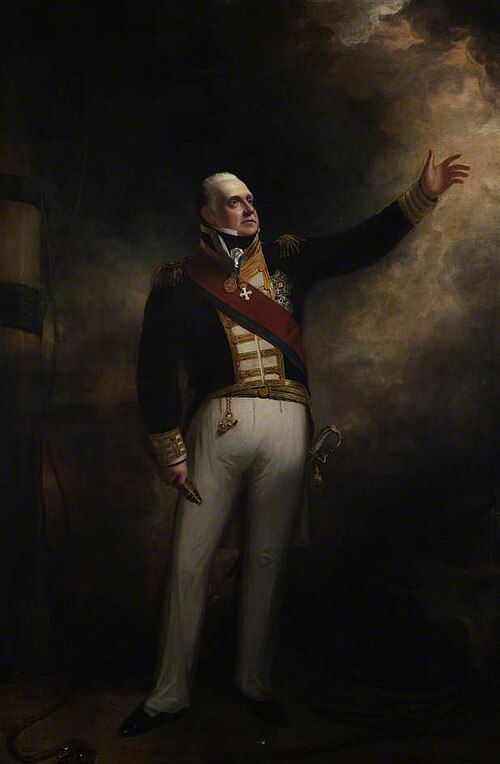
#OnThisDay 210 years ago in 1816 a Royal Navy fleet under Admiral Pellew, supported by the Dutch bombarded the port of Algiers to force them to cease the trade of Christian Slaves. The port was destroyed and over 1200 Christian slaves were freed.
How right Pope Benedict was when he diagnosed a spiritual pathology at the heart of the Church. When it is possible to say that you ‘hate’ the way the Church worshipped for a thousand years or more, giving us Martyrs, Saints, sublime architecture & art, you have a problem.
Samo to, że od blisko sześciu dekad trzeba jak mantrę powtarzać, że zniszczenie liturgii przez Pawła VI dokonało się „z najwyższym szacunkiem dla dziedzictwa Tradycji” oznacza, że się w ten sposób wcale nie dokonało.
W istocie, dewastacja liturgii wyrastała z ogromnej pychy rewolucjonistów, którzy uważali, że w ramach mechanizmów biurokratycznych są w stanie stworzyć coś, co będzie lepsze, niż dziedzictwo wszystkich wieków Tradycji Kościoła.
Z drugiej strony, wyrastała z przerażających błędów doktrynalnych liberalizmu, modernizmu i fałszywego ekumenizmu, które nie były spójne z katolicką liturgią. Jako, że lex orandi, lex credendi, rewolucjonistom była potrzebna nowa liturgia, która będzie wyrażała ich nowe credo.
Cardenal Ratzinger sobre la reforma de la Misa tras el Concilio:
“Erigir el misal como una nueva construcción, desestimando y prohibiendo lo que había crecido históricamente, hizo que la liturgia dejara de parecer un desarrollo vivo y se convirtiera en el producto de un trabajo académico y sancionado por la autoridad legal.
Esto causó un gran daño. Dio la impresión de que la liturgia era una ‘construcción’, no algo dado de antemano”.
(Aus meinem Leben)
Taking a child to Mass today is a brave and counter-cultural action that entails considerable sacrifice and social risk. Parents who do it should be welcomed unconditionally. If they need to be educated about behaviour, this can and should be done gently and respectfully.
“The Roman Catholic chaplains seemed to enjoy being where the fighting was. And we had never heard of one who failed to do all that was expected of him, and more.” - Captain Robert Graves, WW1
In WW1, British soldiers in Graves’ regiment had lost their faith. Only 1 in 100 men kept their religion. The fighting wore the soldiers down, and regimental chaplains had been under strict orders to stay behind the front lines and to not risk their lives, and they seemed glad to obey these orders.
The Colonel had cycled through 4 chaplains before trying out a Roman Catholic one, hoping it would inspire new faith in the men.
To their pleasant surprise, the new Catholic chaplains were on the front lines with the troops every day, sharing the struggle of the war with them, offering spiritual guidance, and even charging into gunfire to aid and pray with the wounded.
One Catholic chaplain, Fr. Francis Gleeson, when all officers of his company had been killed, stripped his noncombatant badge and took command of the unit in thick fighting until reinforcements arrived.
It is estimated that over 40,000 British soldiers converted to Catholicism during the course of the Great War, inspired by the bravery and camaraderie of the Catholic chaplain corps.
English football icon Kevin Keegan, who passed away at 75 after battling cancer, always credited Catholic nun Sister Mary Oliver from his school for recognizing his talent, and encouraging his passion for football
During tributes today in @UKHouseofLords to Ann Widdecombe I paid tribute to her principles, kindness and intelligence - grounded in her Faith and Patriotism. From different political traditions we celebrated when we agreed and when we disagreed we respectfully learned to handle differences without rancour. Ann became a great friend and was Godmother to one of my children. In the House of Commons she and Sir David Amess became close friends. I am deeply shocked that both have been murdered. I hope that justice will now prevail and that in a toxic climate of hatred and hate speech we will learn the importance of respecting difference.
Watch tributes in full:
https://t.co/ycVWgt8dG0
It appears that Ann Widdecombe, Catholic convert and former MP, was killed yesterday on the Feast of St. Thomas More in the old calendar. St. Thomas is, of course, the Patron of Statesmen / and women
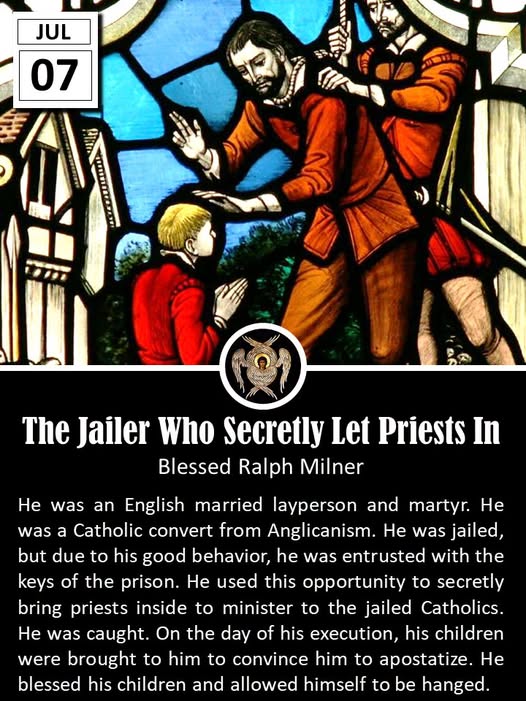
Blessed Ralph Milner was an English layman and martyr who lived during a time of intense religious persecution in the late sixteenth century. Born around the early 1500s in Slackstead or Flacsted in Hampshire, he spent most of his life as a simple, illiterate farmer working the land to support his wife and their eight children. Raised as a Protestant, he was struck by the contrast he observed between the devout lives of his Catholic neighbors and those around him. This led him to seek instruction in the Catholic faith and eventually convert.
His commitment to the new faith was tested immediately. On the very day he received his first Holy Communion, authorities arrested him for changing his religion and imprisoned him in Winchester. Despite years behind bars, Milner's good character and trustworthiness earned him unusual privileges. Jailers often granted him parole and even entrusted him with the keys to the prison. He used this freedom not for personal gain but to aid fellow Catholic prisoners, gather alms for them, and, most importantly, escort hidden priests through the countryside so they could secretly minister to scattered and persecuted Catholic communities.
Milner served as a guide and protector to missionary priests, including Father Thomas Stanney and later Father Roger Dickenson. His efforts helped sustain the faith in a dangerous era when practicing Catholicism could mean death. Eventually, he was recaptured along with Father Dickenson. During his trial, the judge, perhaps taking pity on the elderly farmer, urged him to attend a Protestant service even once to spare his life. Milner refused, declaring that such an act went against the teachings of the Gospel.
As he approached the gallows on July 7, 1591, his children were brought before him in a final attempt to weaken his resolve. Instead of yielding, he blessed them and expressed that he could wish them no greater blessing than to die for the same cause. He faced execution with courage and calm alongside his priestly companion. Both men were beatified together in 1929, recognizing their steadfast witness to the Catholic faith amid hardship.
Ralph Milner's story stands as a testament to quiet heroism. Though uneducated and of humble station, he embodied profound loyalty to his beliefs, using his limited freedom to serve others and ultimately giving his life rather than compromise his convictions.
Pilgrimage to Harvington Hall Saturday 22nd August 2026, organised by the Traditional English Association of Catholic History.
11.30am - Tour of house (optional)
3pm - Sung Mass in Old Rite (with permission of Archbp Longley).
For more details:-https://t.co/KwpoyQqhoi.
In 1251, a desperate prayer echoed in Aylesford, England. Saint Simon Stock, Prior General of the Carmelite Order, saw his brotherhood facing extinction. Driven from Mount Carmel and meeting heavy opposition, the order was collapsing. Simon fell to his knees and begged the Blessed Virgin Mary for a sign of her protection.
What happened next changed the world forever 🕊️
On July 16, Our Lady appeared in radiant glory. In her hands, she held a humble piece of woven brown wool. She extended it to Simon with words that would resonate through the centuries. She instructed him to receive this Scapular as a special privilege, promising that whoever died clothed in this garment would be preserved from eternal fire. It would be a safeguard in danger and a pledge of profound peace.
Eventually, the Church joyfully extended this heavenly gift to the laity.
The mystical meaning goes far beyond the physical fabric. Wearing the Brown Scapular is akin to wearing a miniature version of the Carmelite habit. It acts as a continuous, silent prayer of consecration to Jesus through Mary. When placed over your shoulders, you are spiritually wrapping yourself in the protective mantle of the Mother of God. The Scapular is never a magical charm. Rather, it is a profound covenant of mutual love. It signifies that you belong entirely to Mary, and she promises to guide your soul safely to the Sacred Heart of her Son.
Today, the Brown Scapular remains one of the most widely worn sacramentals in the Catholic Church ✨ In an era marked by spiritual warfare, millions of modern Catholics find comfort in this ancient garment. Saints and Popes, notably Saint John Paul II, wore it faithfully every single day.
For the modern believer, wearing the Scapular is a quiet rebellion against the illusions of the world. Hidden beneath everyday clothing, these two small pieces of wool stand as a physical shield. Every time the wool touches the skin, it whispers a timeless truth. We are deeply loved and held closely by a Mother who never abandons her children 🕊️
Today, 16th of May is the feast of the English Carmelite friar, St Simon Stock, to whom Our Lady entrusted the brown scapular and revealed the Sabbatine privilege of the Carmelite Order.
https://t.co/XwenAOjYFU
📷 This painting is in the Cathedral of San Cristobal de la Laguna in Tenerife.
The fruits of the Mass denote the spiritual benefits and graces that flow from the Eucharistic Sacrifice. As the unbloody re-presentation of Christ’s sacrifice on Calvary, the Mass possesses infinite value in its source yet applies its effects to humanity in a measured manner. This application depends upon the dispositions of the recipients and the intentions with which the Church and the celebrant offer the Sacrifice. The doctrine emphasizes that the Mass, while rooted in a single redemptive act, continues to produce abundant spiritual goods for the living and the deceased.
The Sacrifice of the Mass fulfills four principal ends. It offers adoration to God as Creator and Redeemer, expresses thanksgiving for His countless benefits, presents petitions for new graces, and serves as propitiation by appeasing divine justice and obtaining pardon for sins. The first two ends, directed toward God Himself, achieve infinite efficacy. By contrast, the latter two, which confer benefits upon humanity, constitute what theologians commonly term the fruits of the Mass. These fruits remain finite in their distribution, as they are received according to the faith, charity, and preparation of those who benefit from them.
Tradition divides these fruits into several categories to clarify their application. The general fruit extends to the entire Church and all its members through the Communion of Saints. Because the priest offers the Mass in the name of the universal Church, every member of the faithful receives some share in its graces, as do the souls in Purgatory who may obtain relief from temporal punishment. Those physically present or closely associated with a particular celebration typically receive a greater portion, in proportion to their devotion and attentiveness.
A second category, often called the special fruit, belongs primarily to the celebrating priest. Acting in the person of Christ, the priest offers the Sacrifice in a uniquely intimate manner and thus draws particular graces for himself. Participants who contribute actively, such as altar servers or those who provide for the liturgy, also share in this fruit to a lesser but still notable degree, according to their cooperation and piety.
The principal or ministerial fruit applies specifically to the person or intention for which the priest offers the Mass. This fruit corresponds to announced intentions or stipends offered for a living individual, a deceased soul, or a particular spiritual or temporal need. Its application rests upon the explicit intention of the celebrant. Although the intrinsic value of each Mass is infinite, the fruit allocated to any single intention remains determinate. Consequently, one Mass cannot exhaustively satisfy multiple entirely distinct obligations.
The distribution of these fruits follows important principles. The source of all grace remains Christ’s sacrifice on the Cross, rendered present in the Mass. Human receptivity limits the measure received. Greater devotion, a state of grace, careful preparation through prayer and contrition, and sincere union with the offering increase the benefits obtained. Even individuals unable to attend Mass may benefit from its general fruits by uniting themselves spiritually with the worldwide offering of the Eucharist.
The fruits of the Mass reveal the profound generosity of divine grace made available through the Church’s central act of worship. By participating in the Eucharist, whether through physical presence or devout intention, the faithful unite themselves more closely with Christ’s redemptive work and advance in holiness. This doctrine, rooted in Scripture and the constant teaching of the Church, invites believers to approach the altar with reverence and faith, confident that the Mass continues to bear abundant fruit for the salvation of souls.