This is the explanation of the wisdom of crowds I wish I'd had years ago. 787 strangers at a country fair guessed an ox's weight, most were off by 50 pounds or more, and their average missed by just 1 pound.
When people guess independently, their mistakes point in different directions and cancel out, and the more they disagree, the smarter the crowd gets. AI models learn from similar data and make the same mistakes, so asking five chatbots often gives you one opinion five times.
10 minutes. bookmark & watch today. a crowd is only as smart as its disagreements
Rowland Berry of @Payoneer says stablecoin adoption for B2B payments is maturing, with treasury use cases now emerging alongside demand from regions without dollar access.
He talks cross-border payments with @RemyBlaireNews at Money20/20 USA.
Nebius CEO Arkady Volozh on AI compute demand:
“The prices are still there. Demand is still there.”
Financing, construction and getting chips are tasks to solve.
The growing importance of AI in shaping the future was highlighted by H.E. Dr. Amal Abdelrahim, Assistant Undersecretary for the Support Services Sector and Chief AI Officer at the UAE Ministry of Climate Change and Environment, during the “Knowledge Exchange: AI, Digital Innovation & Future Economies” panel at the Forbes Middle East Sustainability Leaders Summit 2026 in Abu Dhabi.
🎥: @Forbes_MENA_@MoCCaEUAE
#ForbesMiddleEast #SustainabilityLeadersSummit #AbuDhabi #SustainableFinance
NVIDIA & VERTIV TARGET UP TO 30% MORE AI TOKENS WITH THE SAME CAPACITY
$NVDA and $VRT announced a new AI factory deployment approach at GTC Berlin that could cut the time from project kickoff to productive capacity from 120 days to just 48 days.
According to Vertiv's modeled estimates, this could result in up to 30% more cumulative AI token output in the first 12 months, without increasing installed computing capacity.
Here's how the new approach works:
• 10x Faster Design: NVIDIA's Vera Rubin DSX AI Factory reference design, Omniverse DSX Blueprint, and Vertiv's SimReady assets integrate with Dassault Systèmes' 3DEXPERIENCE platform to reduce configuration and validation time from 30 days to just 3 days.
• 50% Faster Deployment: Vertiv's prefabricated OneCore and SmartRun infrastructure could reduce on-site power and cooling deployment from 90 days to 45 days.
• 72 Days Saved: Combined, the approach could bring AI factories online approximately 10 weeks earlier, providing 317 productive days in the first year compared with 245 using conventional methods.
• Real-World Deployment: Polar Data Centers is applying Vertiv's factory-built approach to the first 41 MW phase of its AI data center in Herøya, Norway 🇳🇴, with plans to scale the facility to 100 MW.
• Factory-Built Infrastructure: Power, cooling, networking, and supporting systems can be designed and virtually validated before construction, with more assembly and testing completed off-site.
THIS GUY RAN A REPO THAT LETS CLAUDE READ 6 KINDS OF FINISHED SOFTWARE, AND REBUILT A SCREEN THAT NEVER HAD SOURCE CODE
Electron and JS apps, websites, .NET, APKs, firmware and native binaries all open up through REA, and it's MIT licensed
his target was a finished build of his own iPhone app, without a single source file near it
that same prompt without REA came back with a screen that looked right and behaved wrong
inspect → evidence → spec → rebuild → compare, and the compare at the end is what settles it
everything you need to run it, and the places this dead ends, is in the article below
For institutions getting into digital assets, step one is board-level a board-level approval.
John Hallhan, Head of Business Solutions and Advisory at @FireblocksHQ, tells @RaghdaIbraheem “every institution needs to have a strategy with board-level approval,” then define a “crawl-walk-run capability.”
Who is Bryan Pellegrino (@PrimordialAA), one of the minds behind LayerZero (@LayerZero_Core)?
From co-founding LayerZero to building Zero, a Layer 1 blockchain designed for institutional finance, Pellegrino is helping shape how blockchains connect and how global markets could operate on-chain.
Here’s his story👇
https://t.co/Qc5IHXpZNl
Recognizing the leaders advancing sustainability and environmental progress.
At the 4th edition of the Forbes Middle East Sustainability Leaders Summit, the Sustainability Leaders Awards recognized outstanding contributions to sustainability. The awards were presented by H.E. Dr. Amna Al Dahak, UAE minister of climate change and environment, and Khuloud Al Omian, CEO and editor-in-chief of Forbes Middle East.
🎥: @Forbes_MENA_@amnaaaldahak@MoCCaEUAE@ADPortsGroup@EMSTEELGroup@KhuloudAlOmian
#ForbesMiddleEastSustainabilityAndResilienceLeadersSummit #ForbesMiddleEastEvents #ForbesME #AbuDhabi
🤖 Your AI agent follows instructions. That's exactly the risk.
Before your AI agent touches anything that matters, ask three questions:
• What can it access? Only the tools it needs. Nothing “just in case.”
• What can it do alone? Read and draft, yes. Payments, deletions, and permission changes, not without approval.
• Who signs off? A named, verified person, every time it counts.
These align with OWASP's three root causes of Excessive Agency in AI applications: too much functionality, too many permissions, and too much autonomy.
The final question is where sAxess PRO comes in, linking critical approvals to an authorised person's fingerprint, verified on a secure element.
Let AI do the work. Keep humans in control of the decisions.
📖 @owasp guidance:
https://t.co/CIwRCxihn6
🔐 sAxess PRO:
https://t.co/9JrIB9caea
Anthropic turned a model loose on sequencing data nobody could classify and pulled out a virus that matches nothing on record
It was never looking for a virus. The question was what the leftovers are - the reads every pipeline throws away as junk.
> KEEP - the unclassified fraction of each dataset retained instead of discarded
> SHAPE - those reads assembled by structure, with no reference genome to lean on
> HOST - each assembly matched to what else was living in the same sample
Every sequencing run produces a pile that matches nothing. Standard practice is to delete it and move on.
That pile is not noise. It is mostly things with no close relative in any database, which is the definition of undiscovered.
Assembling without a reference is the hard part. You cannot align to something known when nothing known is close.
The host step is what makes it useful. A sequence alone says little; a sequence plus what it was living inside says a lot.
Most of the biosphere has never been catalogued, and the evidence has been sitting in discarded data for years.
The assembly method and what the samples contained are laid out underneath.
THIS IS A PURE F*CKING CODING JACKPOT
Anthropic built the most powerful Claude Code feature and hid it from us
Claude Code can now run a whole team of AI agents from one script, and almost nobody has switched it on
here's the idea: Opus 5.5 writes the plan as a script, cheap fast models do the grunt work in parallel, and Opus only reads the final result
the script holds the loop. not Opus. so your expensive model isn't burning context on a hundred agent chats
you turn it on like this:
claude --model opus --effort ultracode
here's how I'd split the work:
-> Opus 5.5 turns your goal into a workflow script
-> Haiku 5.5, the fastest Claude model right now, scans every file in parallel
-> Sonnet 5.5 makes each fix in its own isolated copy of the repo, so edits don't collide
-> separate checker agents try to knock down every finding before you see it
Opus only shows up three times:
-> writing the script before the run
-> reading what survived the checks
-> your final yes before anything goes to git
Opus plans. Haiku scans. Sonnet fixes.
and here's my twist: Jev is the same idea one level down. the tiny forks that don't need a thinker (which file, which tool, retry or stop) go to Jev in milliseconds, and the big models only get the hard ones
paste this into Claude Code:
"Rebuild my Claude Code setup around this:
1. Run the main session on Opus 5.5 with ultracode on
2. In every workflow, run read-only scan stages on claude-haiku-5-5 and edit stages on claude-sonnet-5-5, each edit in its own isolated copy
3. Add one rule to CLAUDE.md: every finding gets an independent checker agent before it's reported, and fix loops stop after two rounds with no progress
4. Send fast simple decisions (tool choice, path selection, retries) through Jev
Show me every change as a diff first. No edits until I say go."
the catch: ultracode spends a lot more tokens per request. great for big sweeps, overkill for a one-line fix
↳ https://t.co/GfeGsuBbr2
save it, you'll need it
As AI reshapes financial services, work and decision making, women’s expertise and leadership must help shape its future.
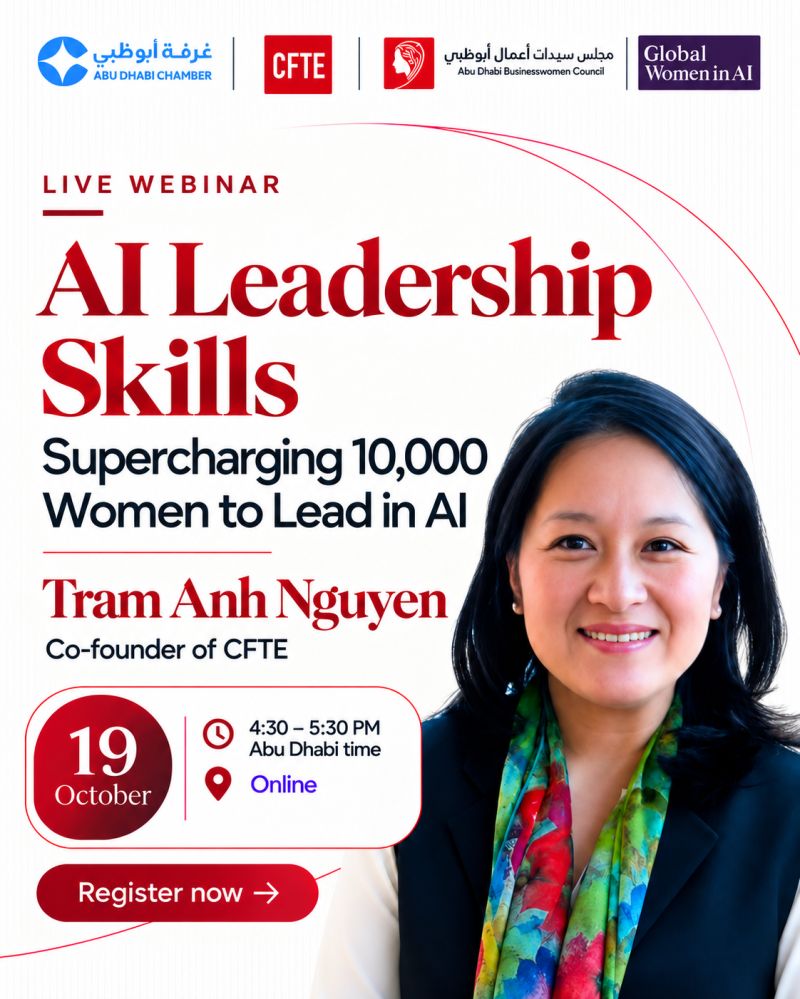
In partnership with the @adchamber Abu Dhabi Chamber of Commerce and Industry, Abu Dhabi Businesswomen Council, @CFTE_Edu CFTE Centre for Finance, Technology and Entrepreneurship and Global Women in AI, we are excited to present “AI Leadership Skills: Supercharging 10,000 Women to Lead in AI”, with TRAM ANH NGUYEN, Co-founder of CFTE.
The session will explore how leaders can better understand AI, ask the right questions, assess risks and apply human judgement. These capabilities help women influence how AI is designed, deployed and governed within their organisations.
Drawing on CFTE’s experience in delivering AI and technology transformation at scale to professionals, institutions and public-sector stakeholders globally, Tram Anh will share how structured learning, practical capability-building and community can help leaders move from awareness to confident action.
She will also introduce Global Women in AI’s ambition to equip 10,000 women with the knowledge, confidence and networks to lead in AI.
Join us to explore how women can help organisations create value with AI responsibly and inclusively.
Date: Monday, 19 October 2026
Time: 4:30pm Abu Dhabi | 1:30pm London | 8:30pm Singapore
Format: Live online webinar followed by Q&A
Register here : https://t.co/UMd9DLj1vd
#GlobalWomenInAI #AILeadership #WomenInAI #ResponsibleAI #CFTE #AbuDhabiChamber #AbuDhabiBusinesswomenCouncil @CFTE_Edu
£100,000 is the new £20,000
In 1980, If your parents earned £20,000, you’d need to earn £100,000 now to afford the same lifestyle, not even a better one. £100 only buys 18.6% of what it could buy back in 1980
Another reason the U.K. is done
this one's a straight up f*cking goldmine
10 GitHub repos with 690K+ combined stars to run your own solo shorts studio
one tool per step, from a 1-hour video to a stack of ready vertical clips
(1/10) yt-dlp
pull your long video and its audio from almost any platform
▸https://t.co/bRl1Wys2Qb
(2/10) Whisper
turn every spoken word into text, on your own machine
▸https://t.co/MKcw1tGbyN
(3/10) WhisperX
get word-level timestamps and speaker labels, so captions land on the exact word
▸https://t.co/ZkFeozwQ3f
(4/10) Ollama
run a local model over the transcript and let it pick the moments with a real hook
▸https://t.co/s3W8Y3U1yn
(5/10) DeepFilterNet
strip the background noise out of the voice track
▸https://t.co/EPU1Bex5Cn
(6/10) auto-editor
cut the silences and dead air based on audio loudness
▸https://t.co/sltG0QeKgy
(7/10) PySceneDetect
find every camera cut so no clip starts mid-shot
▸https://t.co/jvM9pVnFB1
(8/10) MediaPipe
track the speaker's face so the 9:16 crop follows them
▸https://t.co/YF3z5ifjnk
(9/10) Remotion
burn in word-by-word captions and assemble every short in code
▸https://t.co/2MnpZQrLlw
(10/10) FFmpeg
encode the 1080x1920 files and check the video and audio streams
▸https://t.co/bfqyckTvNL
the loop:
source → transcript → word timing → hooks → clean audio → cut dead air → scenes → reframe → captions → export
then hand the whole loop to Claude Code and let your AI employee run the studio ↓
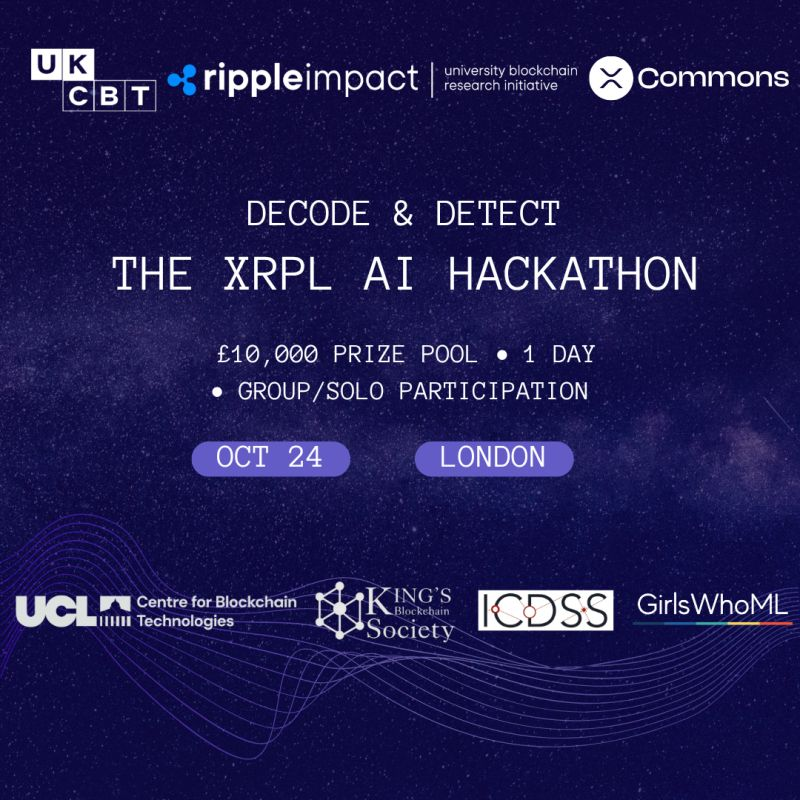
UK students are getting a shot at building the future of fraud detection on the XRP Ledger.
£10,000 prize pool. AI/ML. One day. London.
The question is: what will they build?
🚨WARNING: Up to 80% of independent AI cloud operators could face bankruptcy or consolidation, according to Gartner.
Dan Niles warns of a “huge wave of bankruptcies” as AI overinvestment leaves smaller providers with massive debts and excess capacity.
Yet, he predicts Microsoft, Google, and Amazon will emerge as the biggest winners.