Join our growing network of Tech Enthusiasts and Help Redbridge Central Library develop our Hub where you can meet, create, learn, collaborate and innovate.
@lynxter_3d Silicone 3D printing is transforming biomedical engineering and robotics research.
At CRIStAL in Lille, it’s used for realistic surgical training models and advanced soft robotics with lifelike behaviour.
👉Discover more: https://t.co/GPemV9Wz65
Coming with the release of Star Trek Online: Undiscovered on PC tomorrow, the new Undiscovered Mini-Bundle offers gorn-tastic items!
👉 https://t.co/oKfxH5tDv5
Tomorrow, at 11am PT, it's time to celebrate the launch of Star Trek Online: Undiscovered! Join our designers, executive producer, narrative team and more for behind the scenes stories and a celebration! (This stream was previously announced as being at 9am PT.)
https://t.co/EezHRkHnSP
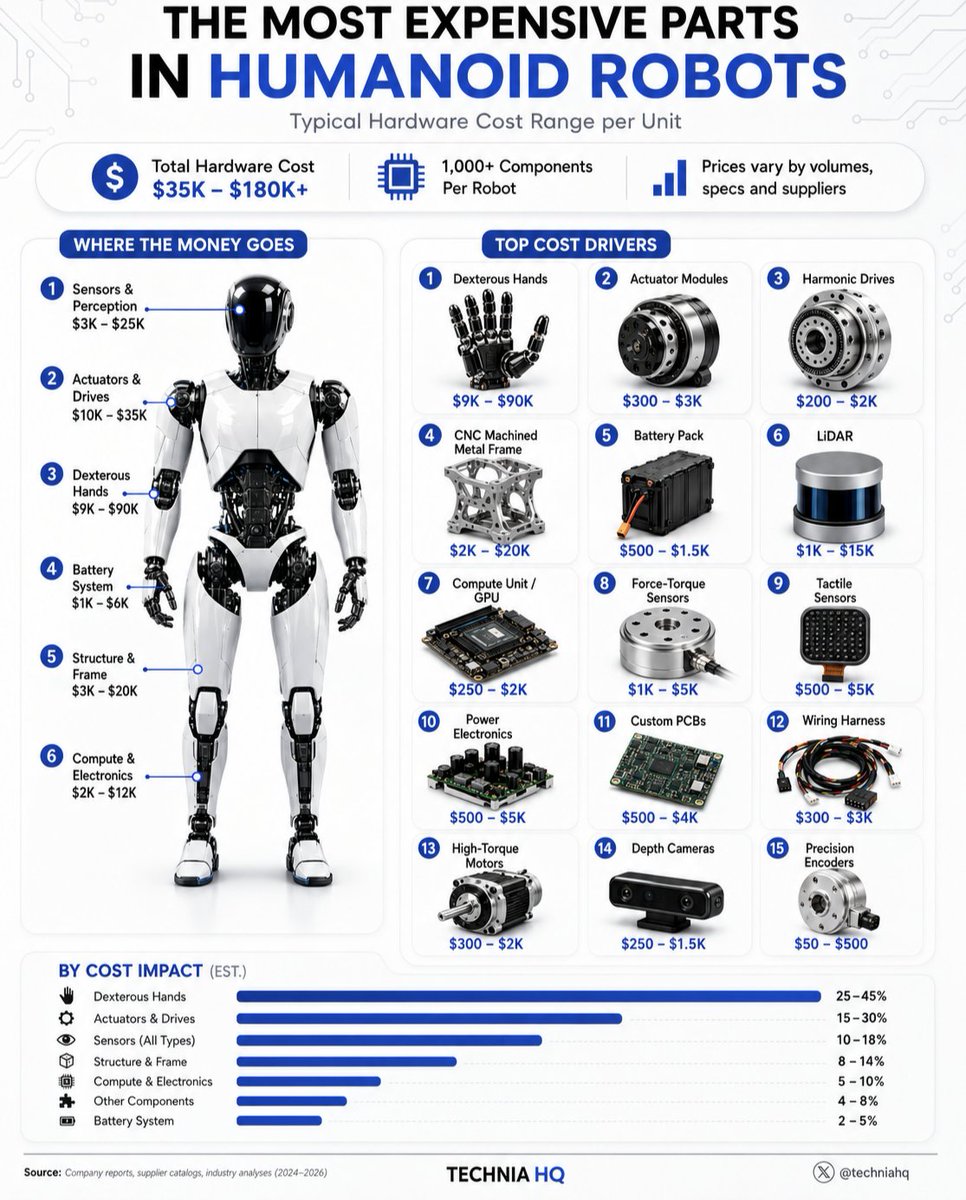
The most expensive parts in humanoid robots are not the cameras.
The real hardware cost is hidden in the parts that move, carry load, survive impact and repeat the same motion thousands of times without failing.
Typical hardware cost range per humanoid robot:
• Dexterous hands
➝ $9K–$90K
The hardest part to make cheap. Each hand needs small actuators, tendons or linkages, tactile sensing, finger joints, wiring and control boards packed into a very small space.
• CNC metal frame
➝ $2K–$20K
The skeleton must hold motors, batteries, electronics and impact loads. Low volume machining makes this expensive, especially for torso, hip, shoulder and leg structures.
• LiDAR
➝ $1K–$15K
Used for mapping, navigation and obstacle detection. Cost depends on range, resolution, scan type and whether the robot needs outdoor reliability.
• Force-torque sensors
➝ $1K–$5K
Critical for balance, manipulation and safe contact. These sensors help the robot measure pressure through wrists, ankles or joints.
• Tactile sensors
➝ $500–$5K
Needed when a robot must grip soft, fragile or uneven objects. The cost rises fast when sensors cover fingers, palms or large skin-like surfaces.
• Actuator modules
➝ $300–$3K each
One of the biggest cost drivers. A humanoid can use dozens of actuators across legs, arms, waist, neck and hands. Torque, cooling, gearbox quality and control electronics change the price fast.
• Battery pack
➝ $500–$1.5K
The battery must deliver high current while staying compact. Weight is a major constraint because every extra kilogram makes the legs work harder.
• Compute / GPU
➝ $250–$2K
The robot needs onboard compute for vision, control, planning and sensor fusion. Higher autonomy requires more compute, better thermal design and more power.
• Harmonic drives
➝ $200–$2K each
Used where compact high torque is needed. They are expensive because precision, backlash and durability matter in knees, hips, shoulders and wrists.
• Power electronics
➝ $500–$5K
Motor drivers, converters, protection circuits and power distribution decide how stable the robot is under heavy motion.
• Wiring harness
➝ $300–$3K
Humanoids have cables moving through arms, legs, torso and neck. Bad routing means broken wires, noisy signals and hard maintenance.
• Precision encoders
➝ $50–$500 each
Every joint needs position feedback. Better encoders give smoother motion, better balance and more accurate manipulation.
A serious humanoid robot can still carry $35K–$180K+ in hardware before software, assembly, testing, repair stock, certification and support.
That is why the cheapest demo robot is not always the cheapest robot to deploy.
Titanium was once considered too costly for production.
Using the @Meltio3D M600 system, ExxonMobil cut lead times from 4–6 weeks to 58.8 hours and reduced costs by 42%.
👉Read more: https://t.co/Bf9PXNGhfp
The University of Michigan put their entire robotics degree on GitHub.
Not one course. The whole curriculum.
ROB 101 — Computational Linear Algebra for Robotics
ROB 311 — How to Build Robots and Make Them Move
ROB 501 — Mathematics for Robotics
ROB 530 — Mobile Robotics
Every lecture video on YouTube. Every textbook on GitHub. Every problem set, every exam, every line of code.
Professor Jessy Grizzle said it best when they launched it:
"Linear algebra has become the language of computer vision, machine learning, robotics, and autonomy."
So instead of making students wait four semesters of calculus before touching a robot... they built a curriculum that starts with the math that actually matters, applied to real robotics problems from day one.
This is what open education looks like when a top-10 engineering school decides to mean it.
Free. GitHub. YouTube.
📌 [https://t.co/3STu1hzAz2]
Follow for more robotics resources!
——
Weekly robotics and AI insights.
Subscribe free: https://t.co/9Nm01QUcw3
9th @techilford Annual #TechShowcase is today! 13/6/26. Come see the past, present & the future of STEAM engagement with a family focus. See you there! https://t.co/sIxOAW8YbB
9th @techilford Annual #TechShowcase is today! 13/6/26. Come see the past, present & the future of STEAM engagement with a family focus. See you there! https://t.co/sIxOAW8YbB
Most people think AI runs on GPUs.
That's like saying the internet runs on browsers.
Modern AI is powered by an entire ecosystem of processors:
🧠 CPU → Coordinates everything
⚡ GPU → Trains massive models
🔷 TPU → Accelerates tensor operations
📱 NPU → Brings AI to phones & laptops
🚀 LPU → Delivers ultra-fast LLM responses
🌐 DPU → Handles networking, security & data movement
The interesting part?
Every AI breakthrough depends on ALL of them working together.
A trillion-parameter model is useless if:
• Data can't reach it fast enough
• Inference is too expensive
• Edge devices can't run it
• Infrastructure can't scale
The next AI race won't be won by the best model.
It'll be won by whoever builds the best compute stack.
Models get the headlines.
Chips run the world.
Which processor category do you think will see the biggest growth over the next 5 years? 👇
Machine learning Cheat Sheet
Machine learning is built step by step. Start with programming and statistics, understand core ML concepts, learn essential libraries, evaluate models properly, and apply your skills through real projects. Consistency matters more than speed.
#MachineLearning #Python #AI #DataScience #Analytics
🤖 Every robot movement starts with a joint.
From Revolute and Prismatic joints to Spherical and Planar joints, each type provides unique motion capabilities and degrees of freedom.
A quick visual guide to the fundamental joints used in robotics and industrial automation. 🚀
#Robotics #Engineering #Mechatronics #Automation #RobotArm #STEM #Technology #MechanicalEngineering





![IlirAliu_'s tweet photo. The University of Michigan put their entire robotics degree on GitHub.
Not one course. The whole curriculum.
ROB 101 — Computational Linear Algebra for Robotics
ROB 311 — How to Build Robots and Make Them Move
ROB 501 — Mathematics for Robotics
ROB 530 — Mobile Robotics
Every lecture video on YouTube. Every textbook on GitHub. Every problem set, every exam, every line of code.
Professor Jessy Grizzle said it best when they launched it:
"Linear algebra has become the language of computer vision, machine learning, robotics, and autonomy."
So instead of making students wait four semesters of calculus before touching a robot... they built a curriculum that starts with the math that actually matters, applied to real robotics problems from day one.
This is what open education looks like when a top-10 engineering school decides to mean it.
Free. GitHub. YouTube.
📌 [https://t.co/3STu1hzAz2]
Follow for more robotics resources!
——
Weekly robotics and AI insights.
Subscribe free: https://t.co/9Nm01QUcw3](https://pbs.twimg.com/media/HKywBztXIAAKMZV.jpg)


