If Stevens were motivated solely by her own high self-regard, she probably wouldn’t be in such voluminous company.
Indeed, the Democrats who are beating their breasts over her betrayal appear to have missed the last several months in which El-Sayed bled support — with all apparent deliberation — from lifetime Democratic voters. https://t.co/rfEfBRTRgd
(Warning: Long post about Israel. Possible slow-motion crash out. Might want to skip this one.)
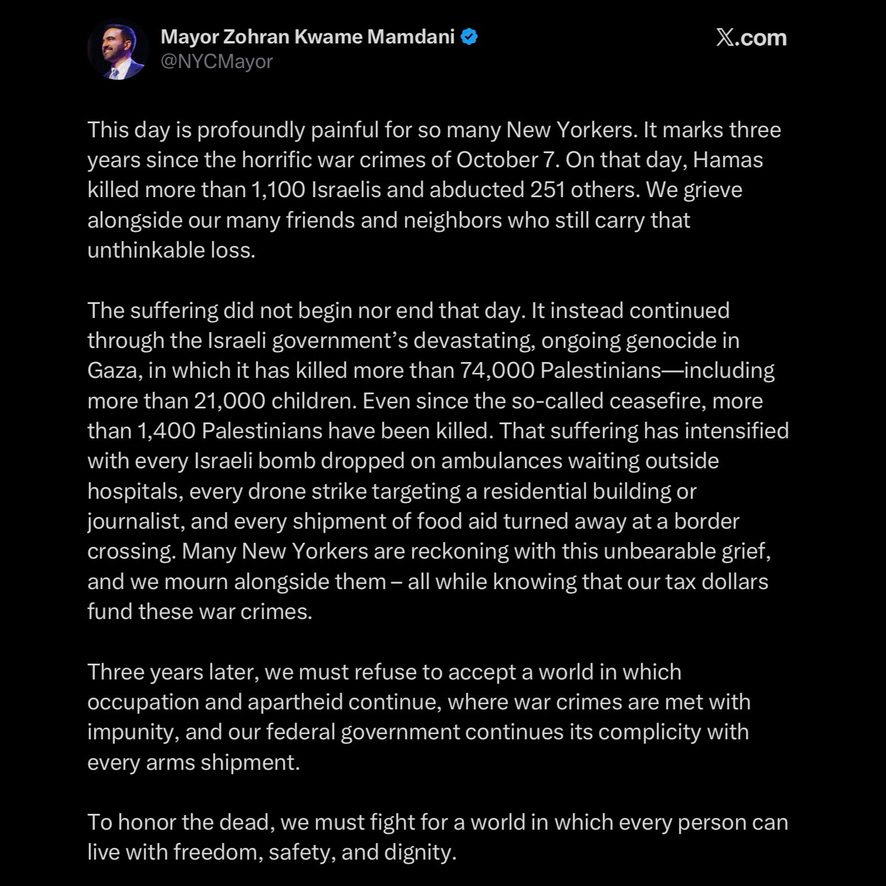
This statement from @NYCMayor is evil.
There’s no other way to describe it. “Despicable” isn’t nearly strong enough; “lamentable” implies that it’s something over which we might feel sorrow, rather than the outrage it demands.
“Evil” is the only word for it. Deeply, profoundly evil. Perhaps the most vile statement a prominent US elected official has ever released.
On the third anniversary of the worst loss of Jewish life since the Holocaust, Mayor Mamdani—leader of the city with the world’s largest Jewish population outside of Tel Aviv—has released a statement that minimizes the attacks, ignores the severity and depravity of Hamas’s crimes, and—in a manner with just enough skillful subtlety to provide necessary levels of plausible deniability—inverts the day’s attackers and victims, even obliquely blaming the victims themselves. A statement that references the attacks’ perpetrators, Hamas, but once, and the attacks’ target, the Jews of Israel, not at all.
Let me repeat that: The mayor of a city with nearly one million Jews spread across its five boroughs can’t find it within himself to use the word “Jew” on the anniversary of the worst loss of Jewish life since the genocide of Nazi Germany.
Mamdani dedicates one—and only one—paragraph in his statement to the attacks themselves. One perfunctory, halfhearted paragraph; a token gesture of mourning that conveniently omits the savagery of Hamas’s crimes, the widespread sexual violence of the day, the glee with which terrorists butchered young and old alike, and the deplorable conditions in which 251 innocent victims of kidnapping were kept in subterranean tunnels in Gaza.
One paragraph. That’s all. And, with that out of the way, with that box conveniently checked, Mamdani is able to get to his real aim: Condemning Israel.
And this he does with detail and gusto, without pause, reservation, or equivocation.
The entire second paragraph is worth reviewing line by line, for it is rich in subtle but deliberate manipulation.
Sentence 1: “The suffering did not begin or end that day.”
This is the classic Marxist rhetorical tactic of “contextualizing,” in which any actions that might reflect poorly on The Cause (e.g., the mass rape, murder, and kidnapping of innocent Israeli civilians) are positioned in the context of information meant to mitigate their severity, deflect blame, and shift responsibility from the victim to the offender.
In this case, Mamdani wants the reader to subconsciously think that Hamas’s acts of terrorism can only be viewed in the context of Israel’s historical and ongoing oppression of Palestine (hence “did not begin…that day”). And, with that context established, how could anyone hold Hamas at fault? After all, they didn’t start this war; they were only responding to “suffering [that] did not begin…that day.” If anything, it’s Israel that’s at fault, right?
If this sounds like reversing the victim and the offender—the RVO in the DARVO acronym used to describe the gaslighting of domestic violence victims—it’s because it is. It’s subversive, it’s diabolical, and it’s only the first sentence of the paragraph.
Let’s keep going.
Sentence 2: “It instead continued through the Israeli government’s devastating, ongoing genocide in Gaza…”
Hamas’s terrorism was not a de novo act, occurring without cause or justification; rather, it was merely the “ongoing” continuation of a long chain of “suffering” whose origin and fault lie with the state of Israel.
Also, note the choice of the words “devastating” and “genocide” and compare them to Mamdani’s first paragraph. He is condemning Israel’s response to the attacks with language far more forceful than that used to decry the attacks themselves.
Sentence 2, continued: “…in which it has killed more than 74,000 Palestinians—including more than 21,000 children.”
This is additional contextualization. The reader is directed to compare 74,000 dead Palestinians with the aforementioned 1,100 Israelis and come away with the interpretation that Israel is orders of magnitude more violent than Hamas. Note that Mamdani also includes a body count for Palestinian children but not for Israeli children.
Left unsaid, of course, is the proportion of those 74,000 dead Palestinians who were active Hamas fighters. Or whom Hamas was using as human shields. Or who were—unfortunately—collateral damage from being in the vicinity of the Israeli military’s justified airstrikes on Hamas fighters who deliberately intersperse themselves among the civilian populace of Gaza.
Sentence 3: “Even since the so-called ceasefire, more than 1,400 Palestinians have been killed.”
This is more contextualizing. The implicit message is that Israel has killed more Palestinians “since the so-called ceasefire” than Hamas killed in total. Israel’s response must therefore clearly be disproportionate.
Sentence 4: “That suffering has intensified with every Israeli bomb dropped on ambulances waiting outside hospitals, every drone strike targeting a residential building or journalist, and every shipment of food aid turned away at a border crossing.”
Setting aside factual errors and omissions of relevant context (ironic, given all the false contextualizing elsewhere!), note the specificity with which Mamdani condemns Israel. Israel’s response to October 7 warrants vivid detail—its bombs fall on ambulances, its drone strikes target residential buildings and journalists, its soldiers turn away food shipments—while the details of Hamas’s attacks on October 7 are described with…
Nothing.
No mention of the murders. The rapes. The desecration of bodies. The smiles on the terrorists’ faces; their laughter while livestreaming the carnage on social media and while calling their own parents.
Not one word.
When Israel responds to terrorism, graphic details are called for; when Hamas commits the underlying acts of terrorism in the first place, though, it warrants only a cursory mention in the introduction to the statement, no details necessary.
Sentence 5: “Many New Yorkers are reckoning with this unbearable grief, and we mourn alongside them – all while knowing that our tax dollars fund these war crimes.”
Note the similarities in language between this sentence and the final sentence of the first paragraph. The reader is meant to draw parallels between Israel’s dead civilians and Hamas’s dead fighters. The parallel language is meant to convey a false moral equivalence between the two.
Also note the reference to “our tax dollars”: You paid for this. You are morally complicit. Therefore, if you object to the mayor’s statement, you are just trying to willfully ignore your own guilt. How dare you.
The last two paragraphs (yes, he keeps going) are more of the same. More moral equivocation, more inversion of responsibility, more criticism of Israel. The word “apartheid” is thrown in for good measure, of course, because no statement on the anniversary of the worst day in modern Israel’s history would be complete without undermining the nation’s very existence.
Every word of this is shameful, every sentence detestable, every paragraph overflowing with covert lies and overt moral cowardice.
But we should expect nothing less of Zohran Mamdani, a man whose only talent is the ongoing profanation of an office he doesn’t deserve, in a great city he will slowly—or maybe not so slowly—destroy.
This statement—and the man behind it—are worthy of nothing but our scorn and should warrant nothing but our contempt.
Zohran Mamdani’s tweet on Oct. 7 “has caused me to drop my objection to people calling him anti-Semitic because he’s not a stupid guy,” says @MarkHalperin. The mayor’s statement denouncing Israel’s role in Gaza “ignores the fact that Hamas puts its offices in hospitals and where civilians are. Hamas is the reason that this has happened. And like I said, if people want to call that guy anti-Semitic now, it’s okay with me. And that’s a big change for me.”
Fourteen moves in eight days
The psyop to create hysteria to manipulate Congress into regulating AI.
Almost everyone involved is affiliated with Coefficient, Open Philanthropy, Anthropic, and/or OpenAI -- all who serve to benefit financially from creating regulation.
@TimSweeneyEpic@ParkerThayer I think the groundwork for this psy op (for lack of a better term) has been prepared for a long time. This was just the match that lit the fire.
Jensen calls Jacob Coxon comments outlandish & “deeply untrue.” Said the labs are great, but his comments were wrong, arrogant, and ignorant of all the work being done around the industry to drive safety. 🧐🧐
Mark Carney was close enough to signing a deal that he had asked provinces to start putting U.S. liquor back on the shelves.
Then he walked away. From what?
We still don’t know.
He must release the deal he was about to sign. Trump has seen it. Carney has seen it.
Let Canadians see it.
Some thoughts on Dario’s post:
1. Dario does not actually address Gavin Baker’s account of what he said – something he could easily deny if it were inaccurate.
2. Dario claims his critics live in a “bubble” where all regulation equals regulatory capture. He calls this an overly simplified view and notes that “Many people outside this bubble think of regulation as something that constrains corporate power and benefits ordinary people.” This argument is a straw man. Of course treating all regulation as capture would be overly simplified – but almost no one holds that view. I have repeatedly argued for strong antitrust enforcement to keep industries competitive, especially Big Tech. If Anthropic continues toward monopoly or duopoly status, I would be among the first to demand those rules apply.
3. Regulatory capture is not vague or in the eye of the beholder. Nobel laureate George Stigler defined it as regulation acquired by an industry and designed and operated primarily for its benefit. Stigler challenged the traditional view that government regulation arises from a benevolent state protecting the public from market failures. Rather, industry groups have concentrated stakes and pour resources into influencing regulators, whereas the public’s stake is diffuse and unorganized. The revolving door between companies and the agencies that regulate them compounds the problem. Anthropic understands these dynamics: it has hired multiple senior Biden AI-policy officials and built a substantial government-affairs operation plus a network of aligned organizations to push its preferred frameworks at state and federal levels.
4. Dario has consistently pushed for a new federal agency to review and approve frontier models prior to release – a proposal framed variously as an “FDA for AI,” an “FAA for AI,” and most recently a “FINRA for AI.” I call it a “DMV for AI” because a review process modeled on the FAA or FDA (which takes years) or FINRA (which issues rules for a staid industry widely seen as protecting incumbents) will create long queues as AI models wait for testing and approval. This process will only become more labyrinthine as rules accumulate to prevent theoretical harms. This would handicap the U.S. relative to China, which will not adopt the same constraints. It would also undermine Anthropic’s own business model, whose pricing power depends on remaining ahead of open models. Whatever Dario states today, it is difficult to believe the company would simply accept outcomes that erase that advantage.
5. Anthropic is on track to become one of the most valuable companies in history, with the resources to navigate any approval process and shape the rules while competitors wait. Dario wants open models under heavier scrutiny – he has called them dangerous in Senate testimony, criticized them for not being centrally monitored or withdrawn, and linked them to IP theft. He says he has never sought a ban, but he could achieve a similar result by insisting that identical rules apply to both open and closed models. The U.S. risks becoming an island of costly closed models while the rest of the world races ahead with broader choice.
6. Dario acknowledges that AI is structurally centralizing but attributes this mainly to chips and scaling laws. Access to compute matters, but the deeper risk is who decides which capabilities are available to whom. His preferred pre-deployment testing and FAA/FINRA-style oversight would place that gatekeeping power in a federal bureaucracy working hand-in-glove with a small number of frontier labs – reinforcing centralization rather than countering it.
7. The second part of Dario’s post assumes we have amnesia about Anthropic’s well-orchestrated campaigns hyping AI fears. His May 2025 claim that AI would wipe out 50 percent of entry-level knowledge jobs within five years still lacks supporting evidence fifteen months later. Similarly Anthropic breathlessly promoted its heavily contrived “blackmail” study on 60 Minutes. Yet Dario blames public negativity on a long-standing loss of trust in institutions rather than his own messaging.
8. These narratives have done more than anything to shape public fear. People are left asking the same question Mark Zuckerberg posed: why race to build a future you describe in such negative terms? Thomas Sowell’s "The Vision of the Anointed" captures the mindset – elite intellectuals convinced that only they are enlightened enough to control the outcome. As Zuckerberg notes, concentrating power in the hands of an enlightened few has rarely produced the promised results; the practitioners turn out to be less enlightened in practice than in self-conception.
9. Gavin Baker summarized the disagreement cleanly on our pod: Dario believes frontier AI is too powerful to distribute; we believe it is too powerful to centralize. Dario appears to believe, sincerely, that safety and progress are best served by centralizing authority in a marriage of corporate and state power. The weight of human history gives us reason to fear that outcome.
Ro Khanna has repeatedly called for and voted for ending all U.S. aid to Israel, including defensive systems such as Iron Dome, while supporting continued assistance to many other recipients.
No comparable public record exists of him calling for, writing about, or voting to end all aid to other recipients that face ongoing conflicts, human-rights concerns, or governance challenges, including Jordan, Egypt, Ethiopia, the Democratic Republic of the Congo, Nigeria, Sudan, Kenya, Somalia, South Sudan, Yemen, Afghanistan, Syria, Pakistan, Lebanon, and the West Bank/Gaza/Palestinian territories.
This absolute position applies only to our ally Israel.
Media people assume that just because RFK is odd that he's dumb. He isn't. He knows this stuff with the acumen of a hyper-engaged superfan and you can't B.S. someone like that by handwaving "studies! experts!" anymore.
This misreporting by @politico gets to the heart of the covid response disaster. If governments had not suspended free speech, and the media not abetted devastating takedowns of scientists for the crime of contradicting government scientists, so much harm could have been avoided.