Claude just dropped Opus 4.8 and this is one of the most interesting AI releases in a while.
Not because it crushed every benchmark.
But because Anthropic is focusing heavily on something most labs barely talk about anymore: honesty.
According to Anthropic, Opus 4.8 is better at admitting uncertainty, less likely to fake progress, and more reliable on long autonomous tasks. Early testers said it’s much less likely to confidently make things up or pretend code works when it doesn’t.
The benchmark numbers are also strong:
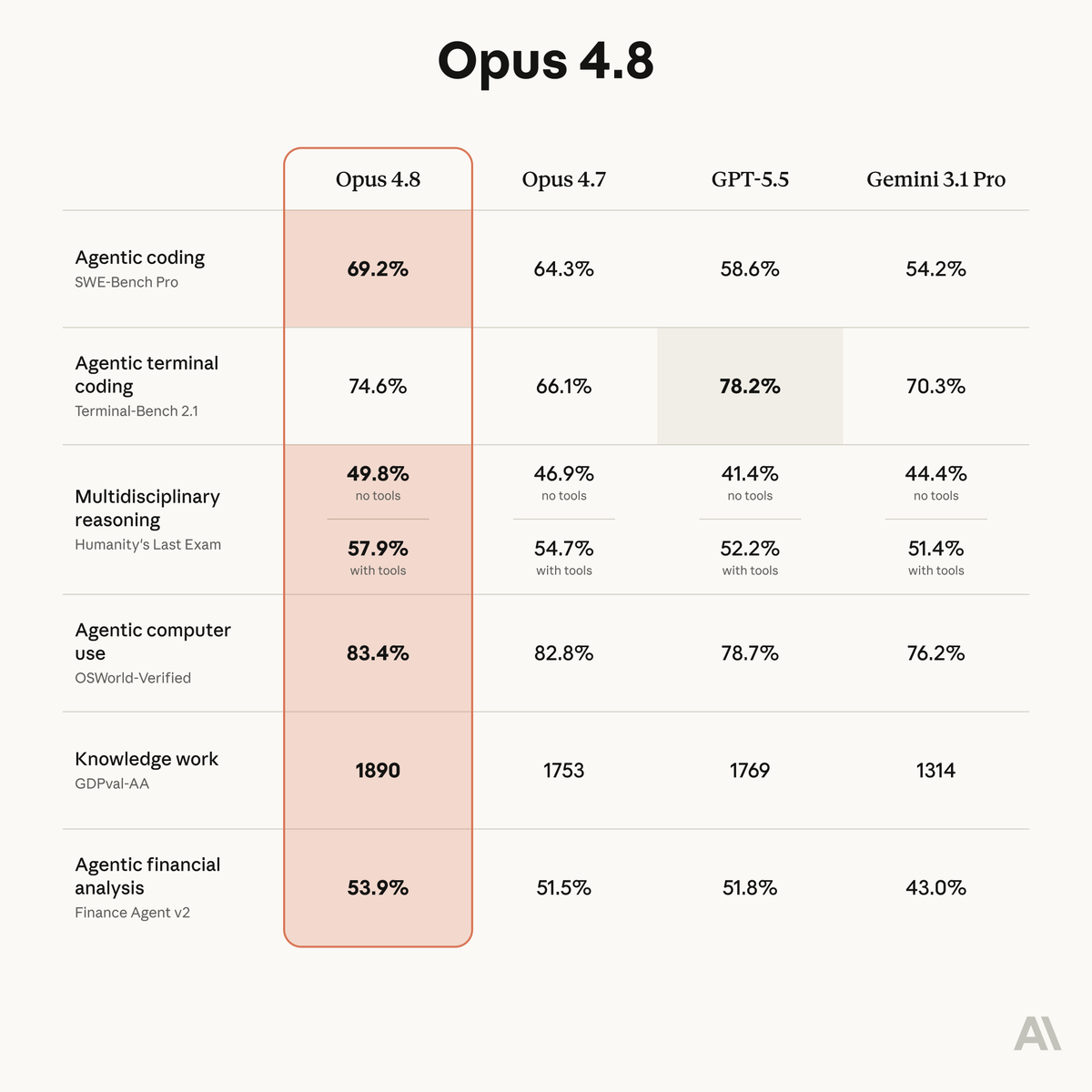
• 69.2% on SWE Bench Pro for agentic coding
• 74.6% on Terminal Bench coding tasks
• 83.4% on OSWorld Verified computer use
• 1890 on GDPval knowledge work
• 53.9% on financial analysis tasks
In the chart they posted, Opus 4.8 beats Opus 4.7, GPT 5.5, and Gemini 3.1 Pro on several categories, especially coding, reasoning, and computer use.
What’s also interesting is the direction Anthropic is taking with agents.
They announced “dynamic workflows” in Claude Code research preview, where Claude can reportedly plan and execute work using hundreds of parallel subagents inside one workflow.
And they kept the same pricing as Opus 4.7.
The bigger picture here is that AI models are no longer competing only on raw intelligence.
Now it’s: how long they can work independently, how reliable they are, how honest they are about mistakes, and whether people can actually trust them in real workflows.
That shift matters a lot more than another benchmark screenshot.
Introducing Claude Opus 4.8: it builds on Opus 4.7 with sharper judgment, more honesty about its own progress, and the ability to work independently for longer than its predecessors.
Available today at the same price.
Sundar Pichai just revealed that Google is now processing 3.2 quadrillion AI tokens every month.
Last year it was 480 trillion.
7x growth in one year.
That number honestly sounds unreal until you think about how many people are now using AI every single day for coding, search, videos, images, research, automation, agents and full workflows.
Most people use AI for weekly reports the wrong way.
They open ChatGPT and type:
“write my weekly report”
Then wonder why the result sounds vague, generic, and full of corporate filler.
The real workflow is not:
“write the report”
It’s:
raw updates → extract signal → blockers → decisions → next actions → final report
That single shift changes everything.
A practical AI workflow for weekly reports:
First, collect messy inputs:
• completed tasks
• open tasks
• blocked tasks
• meeting notes
• chats and emails
• customer feedback
• spreadsheet metrics
• decisions made during the week
Simple structure:
weekly-report/
raw-updates.md
tasks.md
meeting-notes.md
metrics.md
report.md
Do not clean everything manually first.
Messy input is fine.
Then ask AI to organize the week before writing anything.
Prompt:
Read the raw weekly updates.
Extract:
1. completed work
2. work still in progress
3. blockers
4. risks
5. important decisions
6. next actions
7. missing information
Do not write the final report yet.
Only structure the facts.
This prevents AI from inventing fake progress or writing decorative summaries.
After that, generate the report structure itself:
1. Executive summary
2. Completed this week
3. Blockers and risks
4. Decisions needed
5. Priorities for next week
For personal work, also add:
• what I learned
• what I should improve next week
For teams:
• customer impact
• revenue or delivery impact
• owner for each next action
Then create the draft.
Prompt:
Using the structured weekly facts, write a clear weekly report.
Audience: [manager / client / team / myself]
Rules:
- short paragraphs
- no vague phrases
- separate facts from opinions
- highlight blockers clearly
- include next actions with owners
- keep it useful, not decorative
One underrated trick:
Turn one report into multiple versions.
Prompt:
Turn this weekly report into three versions:
1. short executive summary
2. team update
3. client-friendly version
Keep the facts the same.
Change only tone, length and emphasis.
Same information.
Different depth.
Before sending, run a risk check.
Prompt:
Review this report.
Flag:
1. unclear claims
2. missing owners
3. missing deadlines
4. weak next actions
5. risks that are hidden or softened
6. anything that sounds like empty corporate language
Then improve the report.
This is where AI stops being a writing toy and becomes an actual management layer.
After a few weeks, save a reusable template:
weekly-report-template.md
Sections:
- summary
- completed
- blockers
- decisions needed
- next week priorities
- metrics
- notes
Then every week becomes:
collect updates → review → generate → refine
The agent handles structure.
You handle judgment.
Simple tool stack for individuals:
• ChatGPT
• Claude
• Google Docs
• Notion
• Google Sheets
For teams:
• Slack
• Linear
• Jira
• Trello
• Asana
• Claude Code
• OpenAI Prompt Engineering Guide
Practical agent prompt:
Read the weekly-report/ folder.
Use raw-updates.md, tasks.md, meeting-notes.md and metrics.md.
Create:
1. a structured fact summary
2. a weekly report for the team
3. a short executive summary
4. a list of blockers and decisions needed
5. next actions with owners
Save the final report to report.md.
Do not invent missing facts.
The biggest realization for me:
AI is not useful because it writes prettier reports.
It’s useful because it helps compress an entire messy week into something understandable, actionable, and honest.
Everyone keeps talking about better AI models.
But the real shift happening right now is something way bigger:
skills for coding agents.
Not prompts.
Not just MCP servers.
Not “here’s a clever workflow.”
Actual reusable operating systems for AI engineers.
A skill can teach an agent how to:
plan a feature,
review PRs,
run tests,
audit security,
browse websites,
deploy apps,
write docs,
optimize infra,
or work with real APIs the same way every single time.
And the ecosystem around this exploded fast.
Top GitHub-starred skill stacks for coding agents right now:
Superpowers — 208k stars
https://t.co/2PwQkGJv2C
Probably the closest thing to giving agents an actual software engineering methodology.
Specs, planning, TDD, reviews, subagents, autonomous execution.
Works across Claude Code, Codex, Cursor, Gemini CLI, OpenCode.
Anthropic Skills — 141k stars
https://t.co/JxWzFmcdy6
The reference repo that basically standardized how Agent Skills are structured.
SKILL.md, scripts, resources, progressive loading.
If you want reusable workflows instead of giant prompts, start here.
wshobson/agents — 36k stars
https://t.co/83Lhe1uRrP
Massive marketplace of agents, plugins, orchestrators, and skills.
Architecture, infra, ML, security, SEO, docs, full-stack.
Feels like an app store for coding agents.
Agent Browser — 34k stars
https://t.co/EZu7mD4ok4
This one matters a lot.
Agents can now actually browse, click buttons, test UI flows, validate pages, and interact with real apps instead of only reading codebases.
Huge shift.
Vercel Agent Skills — 27k stars
https://t.co/9VxF8pwxbE
Production-focused workflows for React, Next.js, deployment, caching, performance, reliability, and frontend reviews.
Very useful if you're building SaaS products.
OpenAI Skills — 20.5k stars
https://t.co/CdF539oMwl
Codex-focused skill ecosystem.
Good reference for how repeatable workflows are packaged instead of relying on one-shot prompting.
skills CLI — 20.2k stars
https://t.co/olUFPpn88m
One CLI to install skills across multiple agent environments:
Codex,
Claude Code,
Cursor,
Gemini CLI,
OpenCode.
The interoperability layer is the interesting part.
Lark CLI + Agent Skills — 12.8k stars
https://t.co/FkEj4LuiUY
This pushes agents beyond coding.
Now agents can operate docs, sheets, tasks, meetings, calendar, mail, workplace workflows.
Basically turning AI into operational coworkers.
Google Stitch Skills — 5.7k stars
https://t.co/e7WaDNgLqQ
Design + UI-focused skills for the Stitch ecosystem.
Interesting direction because agents are moving from “generate code” into full idea-to-interface pipelines.
Trail of Bits Skills — 5.4k stars
https://t.co/GiliDih0Wc
Security-focused workflows:
auditing,
smart contracts,
vulnerability research,
safer development pipelines.
This category is going to become extremely important.
The big takeaway:
The next productivity leap in AI coding will not come only from smarter models.
It will come from better systems around the models.
Skills are turning coding agents from:
“answer this prompt”
into:
“follow this proven workflow every single time.”
That changes reliability.
That changes autonomy.
That changes software development itself.
We’re slowly moving from AI assistants
to AI engineering operating systems.
#agentskills #codingagents #claudecode #codex #aiworkflow
Stop paying for background removal tools.
The model powering most of them is already open source.
BiRefNet handles hair, glass, reflections, and complex edges with scary good precision. Even high resolution segmentation looks clean.
We’re entering a phase where distribution matters more than the model itself.
How I make $2,000/day without a boring 9-to-5:
scripts in ChatGPT
video scenes in HeyGen
voiceover in ElevenLabs
soundtrack in Suno
editing in CapCut
publishing on video platforms
And the $2,000?
My gf gives me the $2,000.
Jokes aside, this is actually a real AI video production stack.
Idea → script → avatar/video → voice → music → edit → publish
Not some “get rich quick” thing.
Just a practical workflow for creators, businesses, and anyone turning ideas into content faster.
AI coding is entering a weird phase now
the “best” model is no longer the one with the highest benchmark score
it’s the one that helps developers ship faster without burning money
Cursor Composer 2.5 finishing tasks in seconds while being insanely cheap is exactly why so many coders are switching workflows
the product layer is becoming more important than the model itself
Recently finished The Metamorphosis by Kafka.
I thought it was just a strange story about a man turning into an insect.
But somewhere in the middle, it stopped being fiction.
It became painfully relatable.
The scariest part wasn’t the transformation itself.
It was how quickly people started treating him differently once he stopped being useful.
How love slowly turned into irritation.
How presence became a burden.
How isolation can exist even inside your own home.
Kafka somehow captured that silent fear almost everyone has but rarely admits.
The fear of being misunderstood.
The fear of becoming invisible.
The fear that people only stay as long as you can provide something.
Crazy how a short story written more than a century ago still explains modern loneliness so perfectly.