this is what a defacto digital id/social credit score looks like
free, obvious human = defined as robot
this system FAILS... on purpose.. we immeasurable ethical implications for that
what does @grok output with this context?
On April 26, 2026, The Sunday Guardian published an article by Murtaza Ali Khan examining the intensification of repression against Iran’s Bahá’í community. Drawing on accounts from Nilakshi Rajkhowa and Nazneen Rowhani, the article documents a broad pattern of persecution affecting multiple aspects of Bahá’í life, including arbitrary arrests, torture, discrimination against women and exclusion from higher education.
The report highlights the impact of these practices on families and particularly on women and children, while describing the community’s continued commitment to education, non-violence and service despite decades of persecution.
By bringing these experiences to public attention, the article highlights the human cost of systematic discrimination and the importance of protecting religious freedom, human dignity and fundamental rights.
Read the full article: https://t.co/g4sM7h8tly
#Bahai #Iran #ReligiousFreedom #HumanRights
Years after 30-year @EPA toxicologist Marion Copley wrote her final warning from inside the agency, independent epidemiology backed up her concerns:
In 2019, a University of Washington meta-analysis in Mutation Research examined human studies on high cumulative glyphosate exposure—finding up to a 41% increased relative risk of Non-Hodgkin Lymphoma.
Why do federal agencies still prioritize short-term rodent tests over long-term human data?
#Glyphosate #HealthResearch #HealthBriefing
Studies show that glyphosate may increase the risk of cancer, disrupt our immune systems, and cross the blood-brain barrier. Getting it out of our food supply is a huge priority.
I used to think Alzheimer's was bad luck.
A disease that picks you at random. Something you pray does not come for your family.
I was wrong.
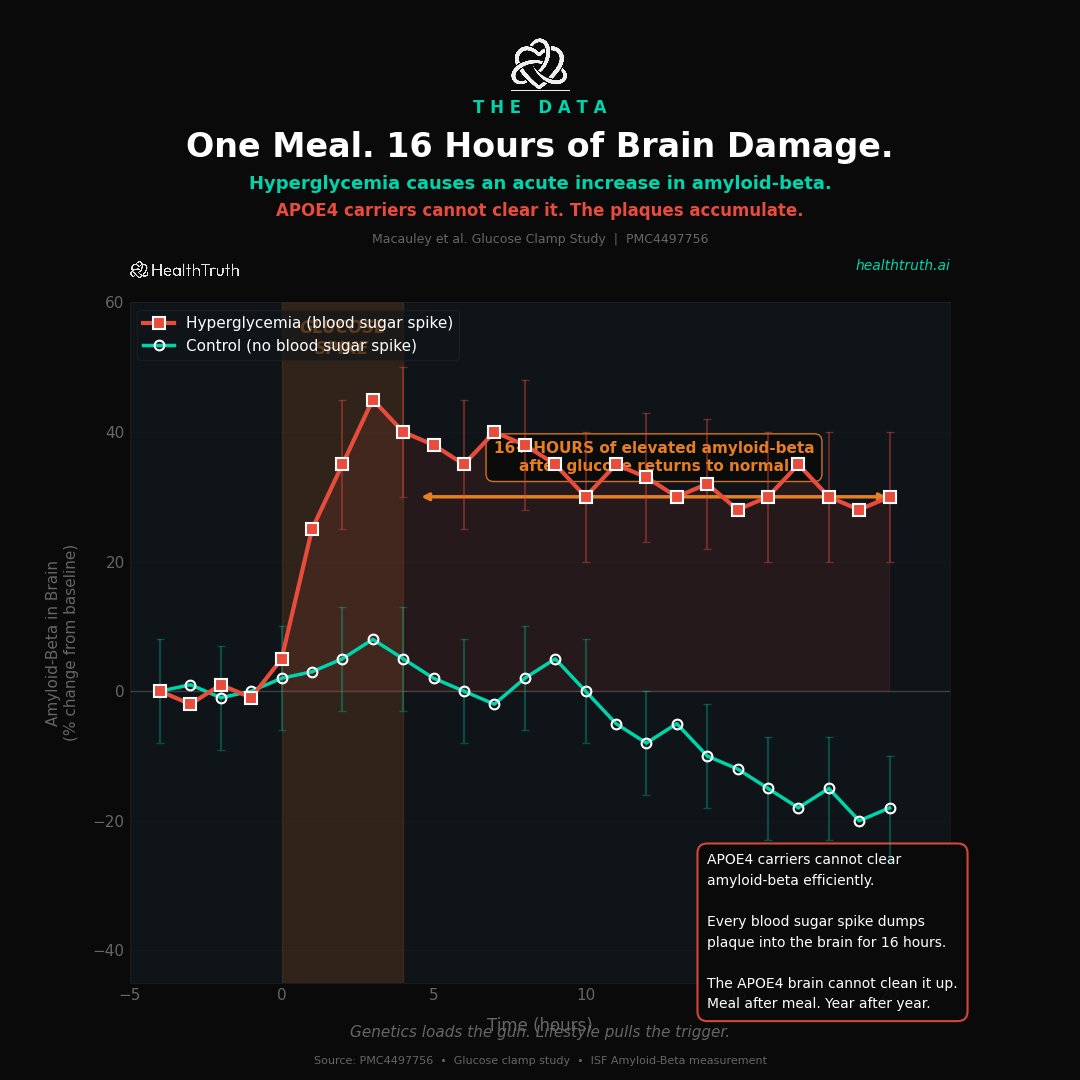
A study published in the Journal of Clinical Investigation used glucose clamps to measure what happens inside the brain when blood sugar spikes.
One blood sugar spike from a single meal increased amyloid-beta production in the brain by 39%.
Amyloid-beta is the plaque protein that accumulates in Alzheimer's.
That increase persisted for at least 16 hours after blood sugar returned to normal.
One meal. 16 hours of plaque building up in your brain.
Now add genetics. APOE4 carriers cannot clear amyloid-beta efficiently. Every blood sugar spike dumps plaque into the brain for 16 hours. The APOE4 brain cannot clean it up. Meal after meal. Year after year.
This is not random. This is metabolic damage accumulating in silence.
Alzheimer's is increasingly being called Type 3 Diabetes by researchers who see the same pattern: insulin resistance, chronic inflammation, and a brain starving for energy while drowning in sugar.
No one is born to lose their mind. But three meals a day of processed food for 40 years will do what no gene alone ever could.
Genetics loads the gun. Lifestyle pulls the trigger.
Macauley et al. (2015). Journal of Clinical Investigation, 125(6). PMC4497756
@thetrocro the real people who showed up in what was called Occupy Wall St - safety is in decentralized open source development, security...
raising hand always https://t.co/6BGlp5O45I 2.0 in dev
analog imperative already in trusted distribution
Most of us now spend nearly the entire day behind glass, at home, at work and in the car.
Standard glass blocks most of the UV in sunlight, and sunglasses and many eyeglasses do too.
Here Andrew Huberman explains why getting your sunlight through a window or a car windshield simply won't work, and why blue blockers don't belong outside during the day: 🧵
@RyanBethencourt a natural approach to appropriate dose + method of preparation
w/ whole organisms rather than anything refined... there's so much push for refinement and certification + really this is just like any other organic plant or organism... a "carnivore" diet doesn't need lab grown meat
Last week, religious leaders, senior governmental officials, scholars, civil society representatives, and youth from around the world gathered in Baku, Azerbaijan, to take part in the 7th World Forum on Intercultural Dialogue.
Participants were guided by the Forum’s central theme, “Dialogue for a shared future: Building bridges in a fractured world.” Among those participating and offering perspectives were David Rutstein, Secretary-General of the Bahá’í International Community (BIC) and Rachel Bayani, Principal Representative of the BIC.
“Humanity is grappling with the very real limitations that arise within any framework that assumes that division, suspicion, and competition are inevitable,” Ms. Bayani said.
“The challenge before all of us is learning how to reorganize our global and national affairs in ways that unlock the strength inherent in our underlying interconnectedness and oneness.”
Mr. Rutstein explored similar themes as a featured speaker in a plenary session entitled, “Dialogue of Religions: A Roadmap to a Shared Future.” He highlighted, among other things, the essential role that youth can play in fostering cohesive communities and in building a sense of shared commitment to the common good across diverse societies.
There, he joined notable dignitaries such as Miguel Ángel Moratinos (@MiguelMoratinos), High Representative for the United Nations Alliance of Civilizations (@UNAOC) and United Nations Special Envoy to Combat Islamophobia, and Ramin Mammadov (@RM1979), Chairman of the State Committee on Affairs with Religious Associations of the Republic of Azerbaijan. The discussion was moderated by UNAOC Director Nihal Saad (@nsaad777).
The Baku Process Forums strive to translate shared values and intercultural dialogue into practical responses to global division. This seventh edition, held October 27-29, marks fifteen years since the inaugural Forum in 2011.
#InterculturalDialogue #CulturalHeritage #WFID7
@culture_gov_az, @UNESCO, @ICESCO_En, @WTO
@Scobleizer finding middle paths to decentralized leveraging of centralized company's models, for a robust economy, ensuring no over-reaction to short term stuff... we need to bridge short term disconnect and long term acceleration ... that's safe..
@ErikVoorhees@jesutumilara_s free markets do not exclude
grass roots, localized efforts to support basic dignity, for those who are on hard times, many options for it (self organized, charity, etc)
uproot regressive regulations (dept of health + building dep crap) anti market blocks 2 diy housing