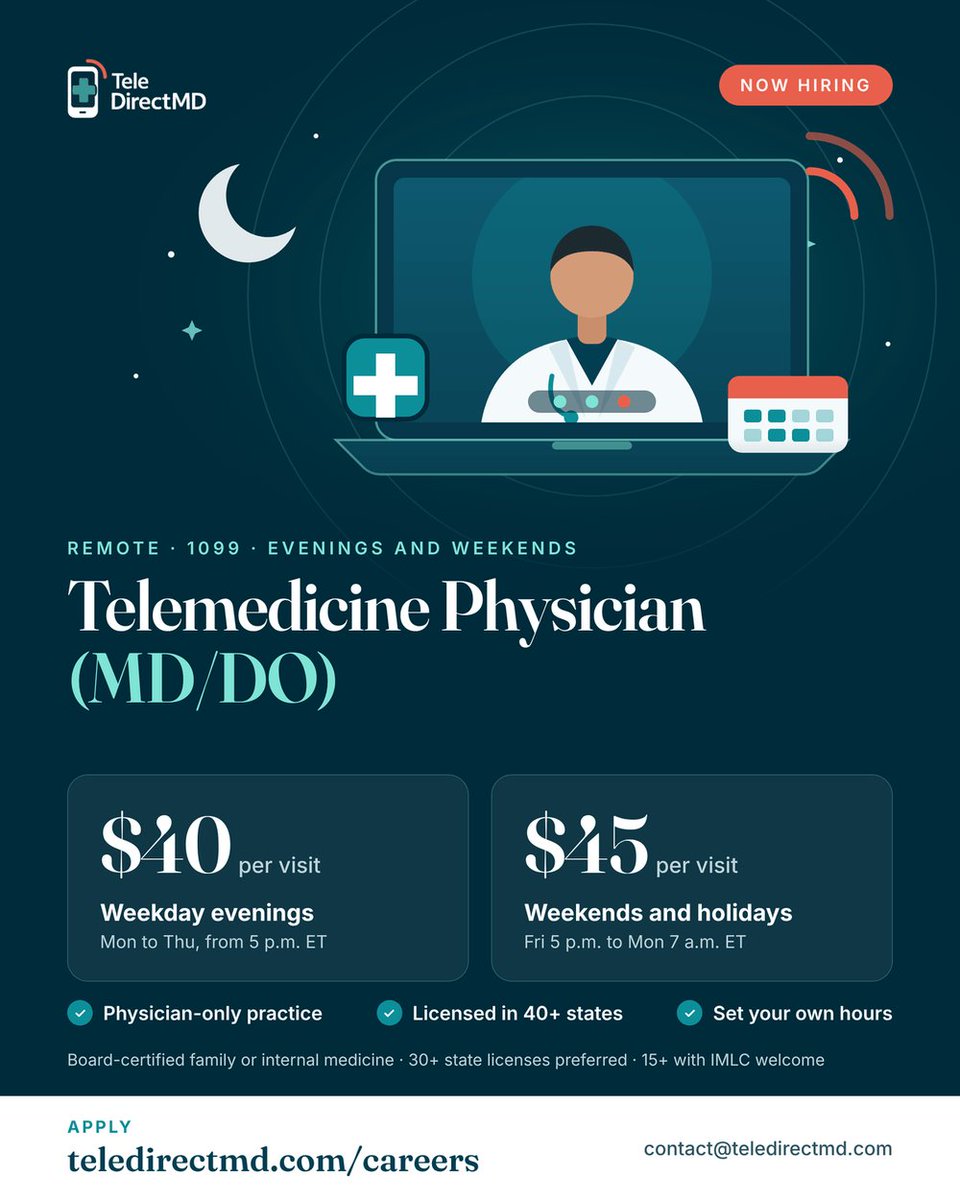
I'm hiring an MD/DO for evenings and weekends at TeleDirectMD.
Remote, 1099, 15-minute video visits. $40 per visit weekday evenings, $45 per visit weekends and holidays.
Physician-only practice, no NPs or PAs. Details and how to apply are on the graphic.
@PeterDiamandis Planes have been flying on autopilot for the majority of the flight path for years, would you trust to fly a plane without a pilot? Exactly.
@DrDiGiorgio Low rent, a small team, and a price on the door. Overhead is the real lever. A clear price helps insured patients too, since coverage doesn't always tell you what you'll owe before the visit.
Much of how flu feels is your immune system fighting back: cytokines turn up your thermostat, then killer T cells clear infected cells. Most people recover in days to under 2 weeks. Trouble breathing, chest pain, confusion, or a fever that returns worse? Get care right away.
@mattpavelle Same internet that powers the AI doctor already lets rural patients video-call a real one.
The barber selling robot clippers isn’t solving access, he’s just selling the robot.
@kevinmd Even kind doctors run out of minutes. Hard news needs a second conversation: time for questions, a written plan, and a clear way to reach someone after. That part is a scheduling choice as much as a bedside skill.
@statnews Verification is the right layer to build. In a small practice, AI helps most with intake and paperwork, and the physician still owns the answer. A tool that shows its sources makes that check faster, not optional.
@tjparker Small-practice view: for a defined visit, upfront is easy. Our self-pay price is posted before booking. The hard part is plan patients mid-deductible, where the true number depends on real-time eligibility data. Fix that and upfront gets real.
A doctor's visit shouldn't take a calculator. TeleDirectMD: $79 flat video visits with a board-certified family physician. No membership, FSA/HSA cards accepted, 40+ states. Adults 18+. (AI-generated narration)
@MohamedEMansour One question I would love the panel to address: how does a patient move from virtual care to a local exam without starting over? That handoff, and keeping their primary care doctor informed, is where the model becomes practical.
@DGArmstrong The handoff matters as much as the video connection. I would want a virtual service to make it clear what can be assessed remotely, what needs a hands-on exam and how the local care team stays informed.
@MayoClinicGIHep Virtual visits are most useful when they connect the team: the specialist, the primary care doctor and local services. Patients should leave knowing who follows up and where to go when an in-person assessment is needed.
@mcuban Patients need more than a different corporate chart. They need a real choice of practices, a clear price before booking and a doctor who can explain the plan. Physician-owned options belong in that conversation.
@statnews The heart-drug misses are a useful pause on AI hype. In clinic I use the same test: does the tool help with intake or paperwork, and does a physician still own the decision when the demo ends?
@SurgeryCenterOK A posted price at a physician-owned facility is what makes comparison real. Self-funded plans and families can see the number before they book, and that can sit alongside coverage. Knowing the price and having insurance aren't opposites.
@AtlasMD The delay is the part I keep seeing: coverage with a high deductible can still leave people putting off care. A posted price before you book, and a physician you can reach directly, can sit alongside insurance for the bigger things.
@BeckersHR For rural communities, I would put the handoff between virtual and local care on that agenda. A video visit can be useful, but patients also need a clear next step when an exam, testing or a procedure has to happen in person.
@TheSGEM@alandrummond2@NightShiftMD@OntariosDoctors@SherOnHealth Being on a patient list and being able to see your doctor are different things. I would want access measured by how soon someone can get appropriate care, with a clear route to higher level of care when needed.
@nikillinit The people who can map the messy workflow before building the tool are worth watching. In a small practice, I would start with intake, scheduling and documentation. The test: does the doctor get more time with the patient?
@costplusdrugs Transparent Rx pricing only works if the visit is clear too. Posted drug prices plus a posted visit price is the full picture patients can actually plan around.
Physician take-home is about 8.6% of U.S. health spending (Gottlieb et al., QJE 2025). Red flag when a pitch says AI alone will fix affordability. Most dollars sit in prices, hospitals, admin, and drugs. AI helps access and paperwork; a physician still owns the visit.