@_ToddBeane@ussoccer Completely agree.
I’d add that this mindset is also deeply cultural. In the U.S., many players grow up influenced by sports like the NFL, where success is measured by gaining ground every play. That instinct carries over—forward becomes the default, even when the odds are bad.
“Footballers from the street are more important than trained coaches.” (Johan Cruyff)
Why does street football develop such technically skilled players?
How can we bring back Street Football? ⬇️
📝 Series: Technique training by playing Football.
If you missed part 1, I examined traditional assumptions about technique training.
You can read it on my profile.
In part 2 I will talk about the effects of street football and how we can apply the principles to training.
⚫️Street Football & Futsal
Technique training by playing football is not a new concept. The best footballers have always come from the streets and futsal:
"Everything I have achieved in football is due to playing football in the streets with my friends" (Zinedine Zidane)
“As a little boy in Argentina, I played Futsal on the streets and for my club. It was tremendous fun, and it really helped me become who I am today” (Lionel Messi)
“Futsal was important in helping to develop my ball control, quick thinking, passing. […] also for dribbling, balance, concentration. […] Futsal was very, very important, no doubt” (Pele)
“Football and Futsal have a lot in common. There are different tactics and moves, but there is the same essence of mastering the ball, combining and making quick decisions.” (Andres Iniesta)
“I needed extremely good feet, because you're always attempting to beat opponents in the minimum of space. I loved the challenge of playing on such a small pitch.” (Ronaldo)
“Futsal is an extremely important way for kids to develop their skills and understanding of the game. My touch and my dribbling have come from playing Futsal.” (Ronaldinho)
“During my childhood in Portugal, all we played was Futsal. The small playing area helped me improve my close control, and whenever I played Futsal I felt free. If it wasn’t for Futsal, I wouldn’t be the player I am today.” (Christiano Ronaldo)
We could continue this list forever.
Why do “street football” and Futsal have such a positive effect on technique?
1. Players do what they love. And when you do what you love, you do it a lot. And to become great at something, you have to do it often.
2. Street football offers endless different, unpredictable situations. Different goals. Different players. Different surfaces. Or they even play barefoot. These challenges lead to a high level of motor variability in the players.
3. Small spaces forces players to adapt. They develop tight ball control, quick thinking, and quick footwork.
Johan Cruyff talked about it:
”Everything for me started in the street. […] from as early as I can remember we played football everywhere we could.
It was here I learned to think about how to turn a disadvantage into an advantage. You see that the kerb isn’t actually an obstacle, but that you can turn it into a teammate for a one–two. So thanks to the kerb I was able to work on my technique. When the ball bounces off different surfaces at odd angles, you have to adjust in an instant. Throughout my career people would often be surprised I shot or passed from an angle that they weren’t expected. But that’s because how I grew up.
The same thing is true for balancing. When you fall on the concrete, it hurts, and of course, you don’t want to get hurt. So when playing football, you’re also busy trying not to fall. It was learning to play like this, when you had to react to the situation all the time, that taught me my skills as a footballer. That’s why I am great advocate of making young people play football without studs. They miss the hours I had in the street, the hours practicing how not to fall. Give them flat soles and help them keep their balance better.”
Naby Keita said about street football:
“I was bumped so many times, but I kept going because I never wanted to lose possession. Nothing could separate me from the ball and I learnt so much from my experiences on the street.”
“We played with whatever we could and I would have nothing on my feet, or sometimes, play with old, damaged shoes”
“I didn’t have boots and treasured football shirts that were given to me. All that has helped me be better prepared for anything now as a professional and I’m also not scared of anything on the pitch.”
“I was quite small and so I had to fight for everything: the chance to play, for the ball, to get respect and that’s why not even cars could stop me. It’s where the aggression in my game, which is so important for my position, comes from.”
⚫️The problems today.
1. No challenges anymore.
Nowadays, we tend to over-organize. We take away the challenges from the players. Not just in football, but also in their everyday lives. We try to make their lives as easy as possible. The phenomenon of "helicopter parents" reflects the issue well. Even if the intention is good, children don't learn to solve problems on their own.
“The problem today is a lot of the coaches are thinking for [the players].” (Johan Cruyff)
Thomas Tuchel agrees:
“Overcoming obstacles is the most important thing. [..] I always wanted the best environment for my players. I wanted everything to be perfect. If I had to go back into youth coaching I would say that half a pitch, one TV and one video recorder are enough. And the pitch does not have to be the best condition. The players should deal with difficulties and play regardless of the environment. […]
And there is one unforgettable thing I heard from a youth director of FC Barcelona. When Iniesta joined the academy he told his youth coaches: ‘Don’t try to improve him. Just take care of him.’ ”
2. Too little time to play.
Most teams train two or three times a week. We cannot compare this to playing for endless hours on the street.
“I trained 3-4 hours a week at Ajax when I was little but played 3-4 hours every day on the street. So where do you think I learned football?” (Johan Cruyff)
In the book "The Goldmine Effect", it says about Brazilian football: "95% of our [top players] come from the street corners of the favelas. Just think about how many times a Brazilian boy who plays on the street for hours every day touches a ball. That gives him exactly the kind of advantage that cannot be caught up.”
⚫️How to implement street football in our organized environment?
Unorganized Street Football is almost non-existent. As coaches, we can do very little to change the overall situation. Let's focus on what we can control, and that is training. So we have to make training as efficient and effective as possible. That means reducing wasted time and replacing ineffective drills with more effective games.
1. Train in Context
Humans are complex systems. A player is the result of interactions between his elements. And if we isolate one element, we take away the interaction. It is impossible to reduce the effect (action) to a clear cause. In complex systems, there is no clear cause and effect. The effect is the result of complex interactions. So we have to improve the effect (action). The elements adapt accordingly.
In football training we overload the action (e.g. passing or dribbling) and the player adapts. Learning by playing football is the rule. All three elements of a football action must be included (C,D,E). Everything else is the exception. Some other advantages of technique training with games:
1⃣ The brain is specific. The closer the context is to the game, the faster the transfer.
2⃣ Respect the individuality. Each player has his unique movements. All players do the same actions (passing/shooting/dribbling, etc.), but everyone moves differently. Ronaldinho and Messi are both strong dribblers, but the way they do it is very different. There is no good or bad, only the result of the action matters.
3⃣Developing adaptability. During a game, the situations are constantly changing. We repeat without repeating the same and develop motor variability.
4⃣ Carrot and Stick: People learn through reward (”carrot”) and punishment (”stick”). The faster the feedback after an action, the more likely we are to connect the feedback to the action. The game provides immediate feedback after each action. The player knows if the action was good enough.
5⃣Creativity. We don’t want to develop a replica of other players. We want players with their own style, so we have to give them the freedom to experiment. Without decisions, no creativity.
6⃣Games are more appealing to intrinsic motivation. With monotone training, the brain switches to autopilot. We stop learning. Drills rely on external motivation.
In the long run, intrinsic motivation is much more sustainable. Development is always a long-term process. If you don’t love it, you won’t do it all the time. And if you don't do it a lot, you’ll never master it.
Johan Cruyff: ”I officially joined the Ajax youth System in 1957 […]. I am sure if I had signed up now that they would have put me through all sorts of exercise routines. But I had none of that, and would hated it. [..]
I just did what I always done, which was spend all my free time playing football, either at the club, or on the street with my friends. What has been important to me was not only football, but enjoying it. [..] As I always said, if you work in football it’s not work. You have to train hard, but you have to have fun as well.”
7⃣Social-affective Skill. Players must learn to communicate with each other and collaborate effectively. They must identify cues from the environment. This is something players don’t learn without context.
8⃣Mentality. Games generate an emotional intensity. The joy of a successful game, the frustration of failures, and external pressure are part of the game. Players must be able to execute their actions despite it. We need exercises that simulate this to help players learn to control their emotions.
2. Top-Down Process
When we have little time to play, we have to make the most of it.
One part is to minimize waste. This includes starting on time, minimizing interruptions, efficient organization, and clear communication.
The other part is to guide the process top-down. Street Football is a random bottom-up process. Improvements happen randomly. There is no coach who guides the players in a certain direction. If the environment doesn't demand it, the player won't learn it. A bottom-up process is not targeted, and therefore inefficient.
🔑 Street Football is effective, but inefficient.
Our job as coaches is not to take the challenges away from the players but to guide the challenges systematically. We turn the random bottom-up process, into a targeted top-down process.
The coach can top-down change the environment to provoke a certain behavior. But instead of being an instructor, the coach sets the framework within which the player can improve. This makes the learning process more efficient.
The problem is that we tend to take the challenges away from the players. We tell them what to do, instead of letting them think for themselves. But football is a game of uncertainty. We must prepare our players for that. Charlie Munger explained the difference between real and pretend knowledge:
“I frequently tell the story of Max Planck, when he won the Nobel prize and went around Germany giving lectures on quantum mechanics.
The chauffeur gradually memorized the lecture and he said, “Would you mind, Professor Planck, just because it's so boring staying in our routines, would you mind if I gave the lecture this time and you just sat in front with my chauffeur's hat?” And Planck said, “Sure.”
And the chauffeur got up and he gave this long lecture on quantum mechanics, after which a physics professor stood up in the rear and asked a perfectly ghastly question. And the chauffeur said, “Well, I'm surprised that in an advanced city like Munich I get such an elementary question. I'm going to ask my chauffeur to reply.”
Well, the reason I tell that story is not entirely to celebrate the quick wittiness of the protagonist.
In this world, we have two kinds of knowledge. One is Planck knowledge — the people who really know. They've paid the dues, they have the aptitude. Then, we've got chauffeur knowledge — they have learned to prattle the talk and they have a big head of hair. They may have fine timbre in the voice. They really make a hell of an impression. But in the end, they've got chauffeur knowledge.”
Many coaches teach “chauffeur”-knowledge. The coach teaches them what he knows, and the players memorize it through lots of repetition. If we want “Planck” Knowledge, which means that the player can solve unexpected problems, we have to take a different approach.
In the story, the audience asks a question to the chauffeur. In football, the game “asks” questions to the player in the form of football problems. A player with “chauffeur”-knowledge cannot solve the problem.
When we translate it to technique: We don’t want a body who can only solve problems he knows. The game is unpredictable. We need a body, that can adapt to unique situations. We want self-regulating players.
That is what we do in training. The coach asks questions in the form of exercises. Let’s say we want to improve the passing technique. Instead of telling them what to do better, we create a game like a 3v1 Rondo. We overload the action we want to improve (passing). The coach guides the learning process top-down. We present the player with a challenge, and the player improves by overcoming it.
🔑 Systematic street football is about asking questions in the form of games. The coach sets the boundaries. Within this framework, the player can develop freely and individually.
Thank you for reading.
Next part:
What questions can we "ask" to systematically improve technique?
Refreshing to hear someone paying attention to the problem of "gold rush like" chase of knowledge to get athletes better (or better say to give us coaches the edge). Specially problematic in youth soccer : "Sometimes the more you know the less you see"! Thank you @CarlWoods25
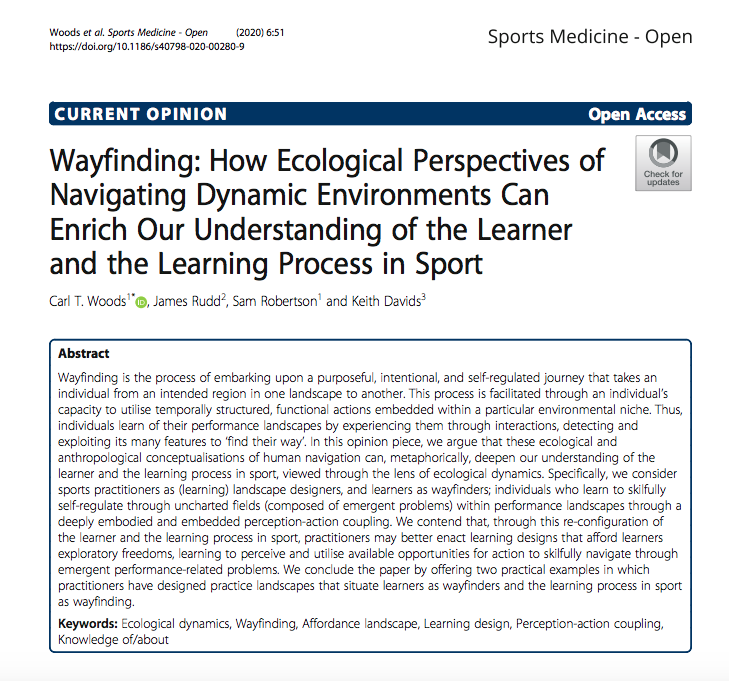
NEW: Wayfinding
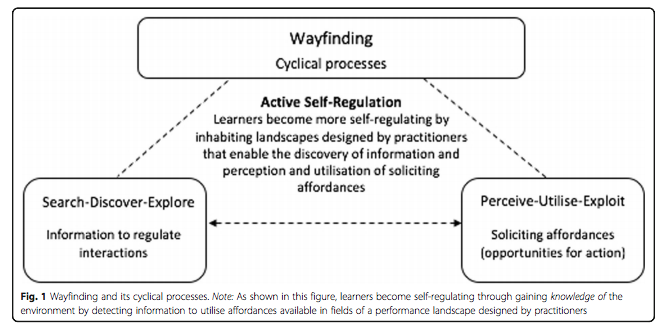
In this open access paper, we (@JamesRRudd, @Robertson_SJ, and Keith) show how ecological perspectives of navigating dynamic environments can enrich our understanding of the learner and learning process in sport.
https://t.co/WY7FrxSnxb
Luis Enrique message to the coaches of the academies: ¨Concern about the development, not the results. All children should play in all positions.
Prioritize the development of the child, not your own coaching career.¨😍
Follow me for more football videos with English subtitles!
You don’t need expensive tutors to learn.
You don’t need a fancy gym to work out.
You don’t need to be ready to get a job.
You don’t need a reason to be kind.
You don’t need alcohol to have fun.
You don’t need to be rich to invest.
You don’t need motivation to start.
“From the ten coaches I had when I was a youth player, one made me a better player, three didn't do any harm, and if I'd listened to the six others I would have never Become a Professional Footballer" ~ Marco van Basten