🚨La Crescita Verde🚨
My @Harvard_Press book ‘Growth for Good’ is coming out in Italian 🇮🇹 on 24 May
Many thanks @EdAmbiente for believing in this project, and to Prof Enrico Giovannini for the preface ✍🏻
Pre-order 🔗 https://t.co/vB05DGwVZi
La lotta globale al cambiamento climatico è sempre più messa a rischio da divisive misure di politica industriale e istanze di sicurezza nazionale. Aspettando le scelte di Trump 2.0. che fare?
Di @terzibus https://t.co/YERghnjI3E
As world leaders descend on Baku for #COP29, @terzibus analyses the national priorities, economic rivalries and the pressures of domestic politics at this year's conference for @LSEforBusiness. https://t.co/KlWAQ28SMP
@LSEnews First, @terzibus writes on @LSEforBusiness that "climate nationalism" is getting in the way of international cooperation like a globally coordinated #CarbonTax, stringent cross-border #decarbonisation commitments, and large-scale resource transfers. https://t.co/lyrw0Yiu4z
Climate change is deepening global divisions, with rising nationalism hindering cooperation. #COP29 may yield pragmatic solutions to balancing national interests & global climate goals. Success lies in fostering innovation & adaptation, writes @terzibus
https://t.co/omAegJ2Qaf
Climate change is a planetary crisis that demands international cooperation.. But national priorities, economic rivalries and domestic politics derail global action.
#COP29@terzibus
https://t.co/EsGWI24dRC
Climate change will likely worsen nationalism by increasing tensions between countries, warns @terzibus
As climate-related uncertainties rise, people may seek protection from their nation-states, strengthening national identities & economic nationalism.
https://t.co/HNJNtzFUZE
Almost half of all industrial policies around the world target electric vehicles-related sectors.
Since 2008 those industrial policies have substantially increased innovation activity (e.g., patents) at the country and firm level.
https://t.co/c3fwKLyVFp
In a new paper, @terzibus examines how climate change is likely to exacerbate tensions both between & within countries, & how global coordination & technological innovations could help address climate change & resource scarcity & mitigate these strains.
https://t.co/HNJNtzFUZE
The #economics of #space is no longer science fiction. A variety of concepts from standard economics can be applied to space, including resource scarcity, incentives, transaction costs, externalities, and economies of scale.
@terzibus@FrancescoNicoli
https://t.co/zIKEiMJYL5
By 2100, atmospheric mortality could quadruple from today. Temp. attributable mortality will increase faster than air pollution mortality, making it a more important health risk factor for at least 20% of global pop. @MaxPlanckChem; @CyprusInstitute https://t.co/s6VeUwr0kK
Degrowth: is there any consensus on whether it might be a good idea? by @eoinaldo (@HWUEconomics) - JUST PUBLISHED on the Economics Observatory https://t.co/Cfzg6mHlLy #degrowth#EconTwitter
Electric vehicles are cheaper, more convenient, more powerful, and quieter than combustion cars, and they require much less maintenance.
This is simply a better technology than what came before.
https://t.co/e5C4SaRcU0
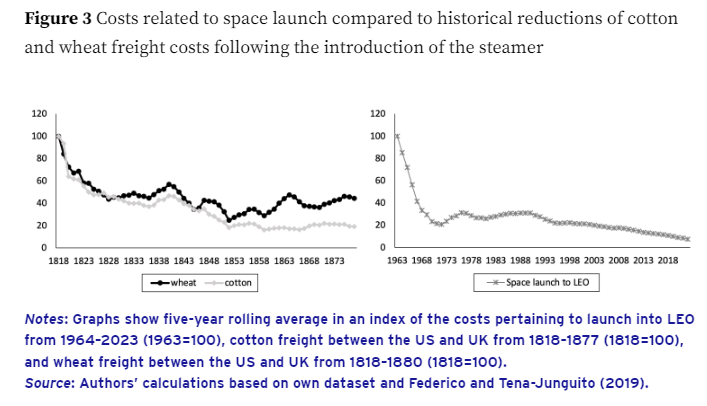
As rocket launch costs continue to plummet, the global space economy will expand, unlocking a vast array of economic opportunities - according to @terzibus & @FrancescoNicoli@voxeu
https://t.co/AeJUw2FZWy
Thanks @Cambridge_Uni for showcasing my work on green growth, and in the illustrious company of @l_diaz_anadon, @KamiarMohaddes and Sir Partha Dasgupta!
https://t.co/kmGnMuXbXp
The #economics of #space is no longer science fiction. A variety of concepts from standard economics can be applied to space, including resource scarcity, incentives, transaction costs, externalities, and economies of scale.
@terzibus@FrancescoNicoli
https://t.co/zIKEiMJYL5
Thanks, @elonmusk! "Space launch cost reductions are quantitatively larger in scale than those associated with the introduction of the steamer, which effectively paved the way for the first wave of globalization. There are reasons to expect that costs ... will decline further."
As launch costs continue to plummet, the global space economy will expand, unlocking a vast array of economic opportunities. It's high-time for economists to start paying attention.
My latest @voxeu piece with @FrancescoNicoli
https://t.co/7A8ujHNb5z