Checking that a major mathematical proof is correct can take years. Formalization—converting the mathematical reasoning into a form computer proof assistants like Lean can verify—can help.
Last month, Claude completed the first formalized proof of Fermat’s Last Theorem, one of the most famous theorems of all time. This was a project experts thought would take many years. It is the largest Lean proof ever written.
Fermat’s Last Theorem was first proven in 1995 by Sir Andrew Wiles, more than 350 years after it was conjectured. Our proof, which totals over 13 million lines of code, provides machine verification. More importantly, it proves over 29,000 other theorems that the proof requires, across many areas of math which had never before been formalized.
We see this as a major step in the long process of firming up the core of mathematical knowledge, building on work from three centuries of mathematicians and hundreds of contributors to Lean and Mathlib. We are optimistic that AI-assisted verification of mathematical proofs will help reduce the burden of refereeing mathematics in an era where more proofs are being produced than ever before.
You can read about the process on our Science Blog: https://t.co/ryYnDEAU6J
And see the complete proof on GitHub: https://t.co/wlYMXYnofz
Today marks 2+ weeks of daily updates to the open-source X algorithm.
We’ve also integrated a first public contribution — a small update based on a Pull Request submitted to our GitHub repository, now live on X: https://t.co/nbpnaQG9pN
Thank you to everyone submitting PRs.
Introducing Project Redwood 🚀🚀
@architectlabs is a frontier AI lab bringing together talent from Anthropic, xAI, Google DeepMind, and seasoned leaders across the hardware industry. We've raised a $24M seed round to build AI systems for chip design.
我們 Architect Labs 是一個 frontier AI lab ,由各家 Anthropic, xAI, Google DeepMind 還有各種硬體專家們組成,我們在做的是 ai system for chip design,目前募資 seed round $24M
-
Today, every major hardware company has its own chip design workflow—but these organizations and processes have become so large and entrenched that truly revolutionary change is difficult. We’re starting from first principles to create an AI-native chip design workflow—one that enables chip development to finally move at the speed of AI.
現在每家大硬體巨頭都有自己的晶片設計流程,但很多都大到不能做革命性的流程改動;我們在做的是從零思考,創造 ai native 的晶片設計流程,讓晶片設計真正跟上 AI 的速度。
-
Project Redwood - from a single specification, our AI system designed, verified, and deployed a chip in under two weeks—delivering 3.4× better performance per watt than NVIDIA Jetson on billion-parameter models including Llama, Qwen, and Kimi. It autonomously generated the RTL, verification, firmware, drivers, and kernels, co-designing the model, software, and silicon in one optimization loop. We acknowledge that silicon is the ultimate ground-truth. We’re taking our approach all the way to GDS. We intend to tape-out multiple improved families of Redwood co-designed for various use-cases, on TSMC.
Project Redwood - 一份規格書,我們的 AI 系統在兩週內完成晶片的設計、驗證與部署。在 Llama、Qwen 和 Kimi 等模型,其 performance per watt 比 NVIDIA Jetson 高出 3.4 倍。從 RTL、驗證、韌體、驅動到核心 kernels,全部由 AI 自己寫,並在同一個 loop 中自主設計模型、軟體與晶片。當然,流片才是最終的驗證標準。因此,我們會將這套方法一路推進至 GDS,並計畫採用台積電製程,針對不同應用場景協同設計多個持續改良的 Redwood 晶片系列並完成流片。
-
Full report on Redwood architecture and its autonomous design. Follow @architectlabs on X
我們有公開 Redwood 架構及其自主設計流程,歡迎去看論文~
Today’s For You release is in the open-source repo.
Notable updates:
• How ranking weights actually work
• A new filter required for Brazil’s 2026 election
All the details: https://t.co/rdPoHOvJbd
Cursor is now part of @SpaceX.
Today, we have officially closed our acquisition. We will join the @spacexai team to help make Grok the world's most useful AI and improve Grok Build, Grok Bot, Grok API, Cursor, and more.
SpaceX has built some of the most inspiring and impressive technology in the world, and we’re grateful for the opportunity to become part of such a special company. Onwards.
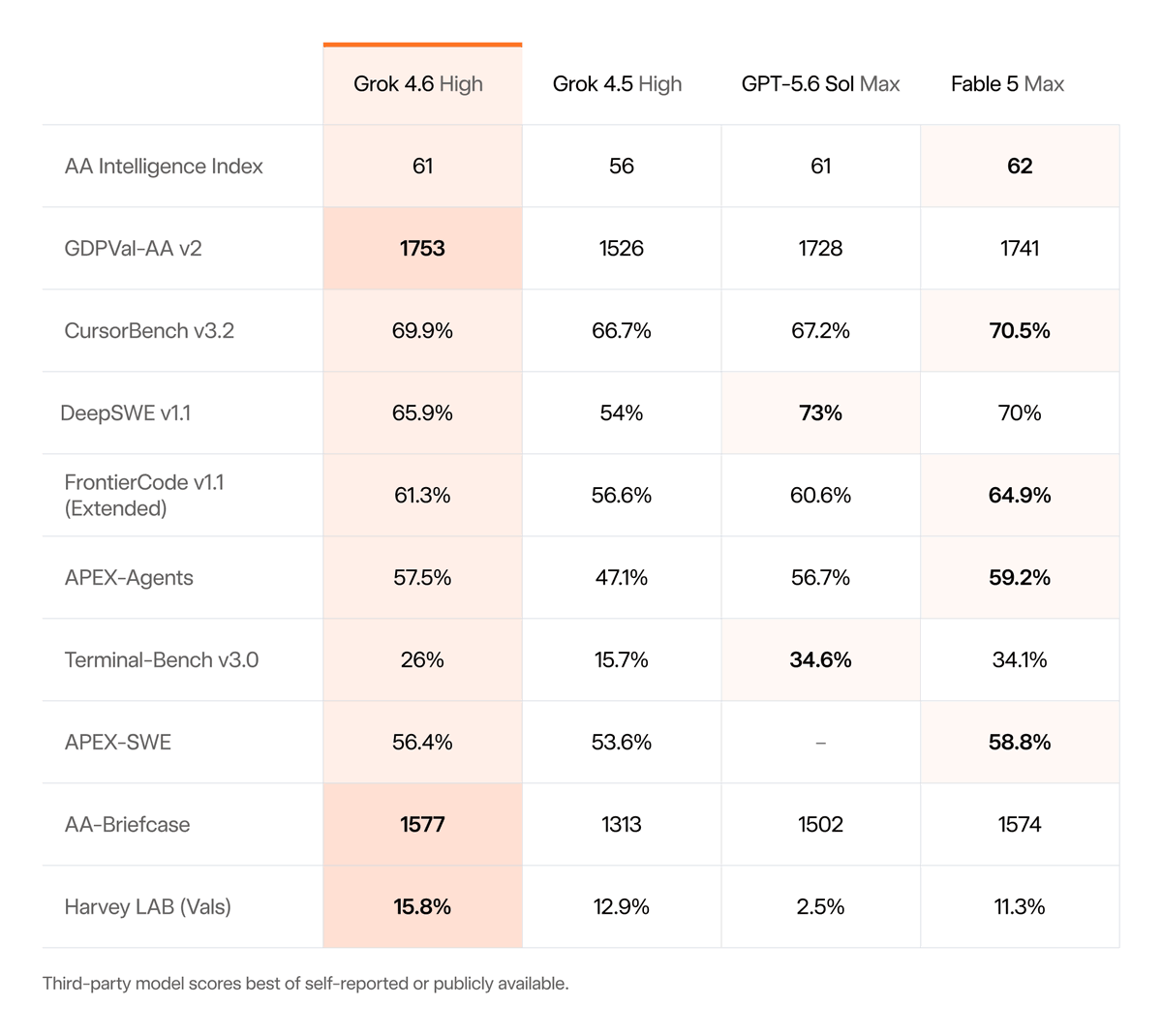
SpaceXAI's Grok 4.6 scores 61 on the Artificial Analysis Intelligence Index, joining the frontier in line with GPT-5.6 Sol, with standout agentic performance at lower cost
Grok 4.6 gains 5 points over Grok 4.5 on the Intelligence Index just over one month after its release, or +23 points compared to Grok 4.3. This brings SpaceXAI back to the intelligence frontier alongside OpenAI, behind only Anthropic.
Key takeaways:
➤ Grok 4.6 joins the frontier of the Artificial Analysis Intelligence Index: It scores 61, in line with GPT-5.6 Sol (max), behind Claude Opus 5 (max, 63) and Claude Fable 5 (max with fallback, 62), and just ahead of Kimi K3
➤ Strong agentic performance: Grok 4.6 achieves a GDPval-AA v2 Elo of 1753, behind only Claude Opus 5 and with overlapping confidence intervals with Claude Fable 5 and Qwen3.8 Max. It scores 50.7% on 𝜏³-Banking, among the top two scores alongside Qwen3.8 Max (51.3%), and 88.4% on Terminal-Bench v2.1, in line with the leading models
➤ Frontier-level intelligence at lower cost: Headline pricing is unchanged from Grok 4.5 at $2/$6 per 1M input/output tokens, 60%+ below Claude Opus 5 ($5/$25) and GPT-5.6 Sol ($5/$30). It cost $0.84 per task, the same as Kimi K3 with slightly higher intelligence, placing it on the Intelligence vs. Cost per Task Pareto frontier
➤ Grok 4.6 sits at Fable 5-tier on AA-Briefcase, our private benchmark of long-horizon agentic knowledge work tasks, with an Elo of 1577 - behind the Claude Opus 5 family. It is notably turn-efficient, completing tasks in ~53 turns and ~0.5B input tokens on average vs. ~103 turns and ~2.0B input tokens for Claude Opus 5 (max)
Other model details:
➤ Context window of 500k tokens (unchanged from Grok 4.5)
➤ Pricing of $2/$6 per 1M tokens of input/output; cache hits discounted to $0.5 per 1M tokens, an increase over Grok 4.5’s $0.3 per 1M tokens for cache hits
Congratulations to @spacexai and @elonmusk on the release!
Ladies and gentlemen, it's time to pass the torch and demote myself to my natural state: a poster. I'll be stepping back from leading product for 𝕏 and will continue on as an advisor.
Serving the X community has been the privilege of a lifetime. X is, and will remain, the most important communication technology in history. But running this app is a 24/7 job and it's now time for me to take a breather.
The app is seeing unprecedented growth in new users & engagement. We continue to break records every month. We've climbed 70 spots in the App Store since this time last year.
And in the last 400 days, we rebuilt almost every aspect of X: the Timeline, the Android app, onboarding, notifications, chat and more.
We also launched nearly 30 new products while protecting the integrity of the town square: becoming the first app to show Country-of-Origin on profiles and mounting defenses against AI bots. There's certainly much more work to be done, but our foundation is stronger than ever.
None of this would have been possible without the incredible team here. The next leaders will take X to even greater heights with @benjitaylor on design, @singhai on core product engineering and @dinkin_flickaa on mobile engineering -- among many other great people.
Thank you to Elon and the X team for welcoming me into the company. See you on the Timeline.
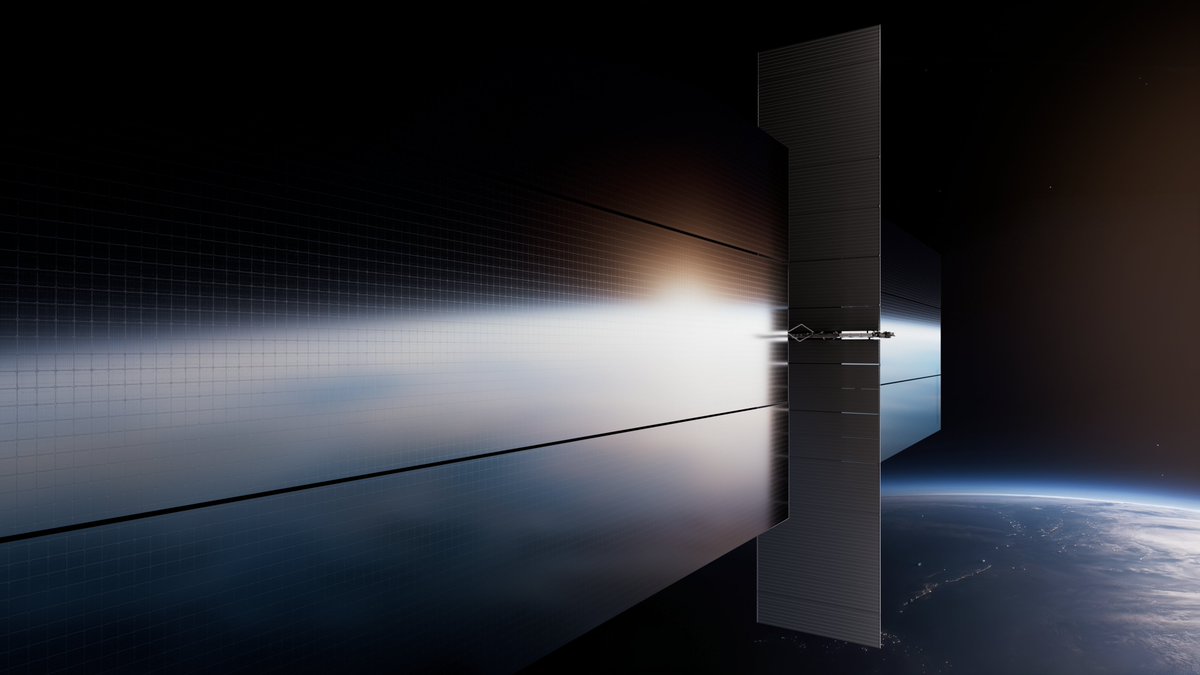
SpaceX is partnering with @Nvidia to design the Starmind AI1 satellite compute payload.
Each of the Starmind satellites will include NVIDIA Rubin GPUs and Vera CPUs for datacenter class space compute → https://t.co/4MOQv0DvTQ
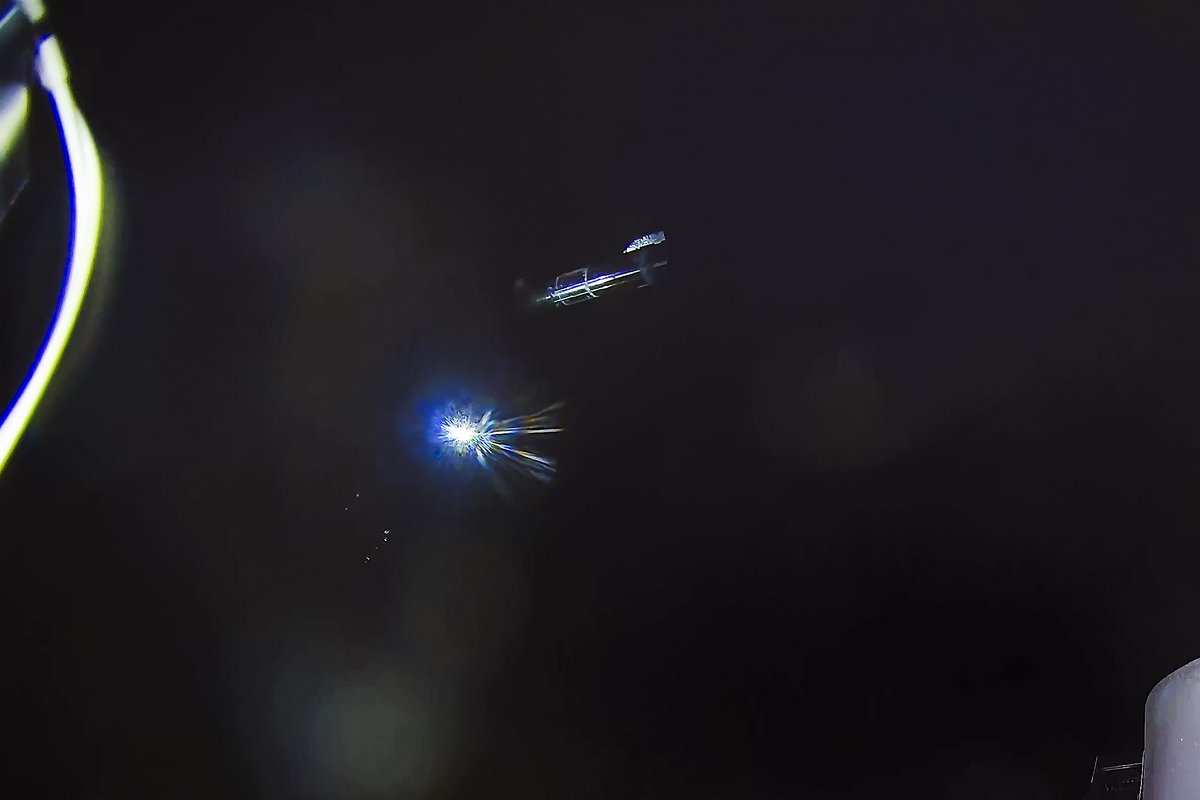
The first Starlink V3 satellites in space successfully deployed their solar arrays, fired their thrusters, established connections with the Starlink constellation using radio frequencies and laser links, and captured imagery of Starship