#Retraction is not the end of a fraudulent paper.
My latest #report for @the_hindu explores why retractions alone may not be enough to protect the #scientific record.
Read: https://t.co/s4V2Jk4eI8
The interesting question isn’t whether science journalism is ‘dying,’ bt whether its old gatekeeping model still wrks in 2day’s information ecosystem. A 40-year comparison is useful precisely bcoz credibility failures aren’t new the scale, speed and incentives surrounding thm are
CSIR-IITR celebrates another research milestone! Dr. D.K. Patel & team have developed a scalable, sustainable LC-MS/MS method for screening of 44 PFAS in soil with ultra-low detection limits and rapid microextraction. Congratulations to team @CSIR_IND@DrJitendraSingh@PMOIndia
A research paper can be retracted, but its influence may survive. India’s scientific record faces a harder question: can retraction truly undo what follows? Read: @TheHindu
Scholars agree that the way retractions happen at present raise thorny challenges to preserving the integrity of the scientific record. Correcting the published literature alone is not enough: experts said when a retraction can be said to have achieved its purpose is itself ‘very difficult’ to say
✍️Rohan Singh
https://t.co/eLqZjjO9aA
Scholars agree that the way retractions happen at present raise thorny challenges to preserving the integrity of the scientific record. Correcting the published literature alone is not enough: experts said when a retraction can be said to have achieved its purpose is itself ‘very difficult’ to say
✍️Rohan Singh
https://t.co/eLqZjjO9aA
@IamRajat_Pandit@Chethan_Dash What is driving these resignations—salary, career advancement opportunities, working conditions, or the growing appeal of the private space sector? If those underlying issues are not addressed, can making the resignation process more restrictive truly prevent talent attrition?
The issue is not whether #noise#pollution is inherently bad; the issue is how we #measure it, and whether those measurements are sufficient in #indiaa
Read The Hindu scientific report: https://t.co/Q4z3cIr6l5
#TrustedByIndia#JioOTTPass
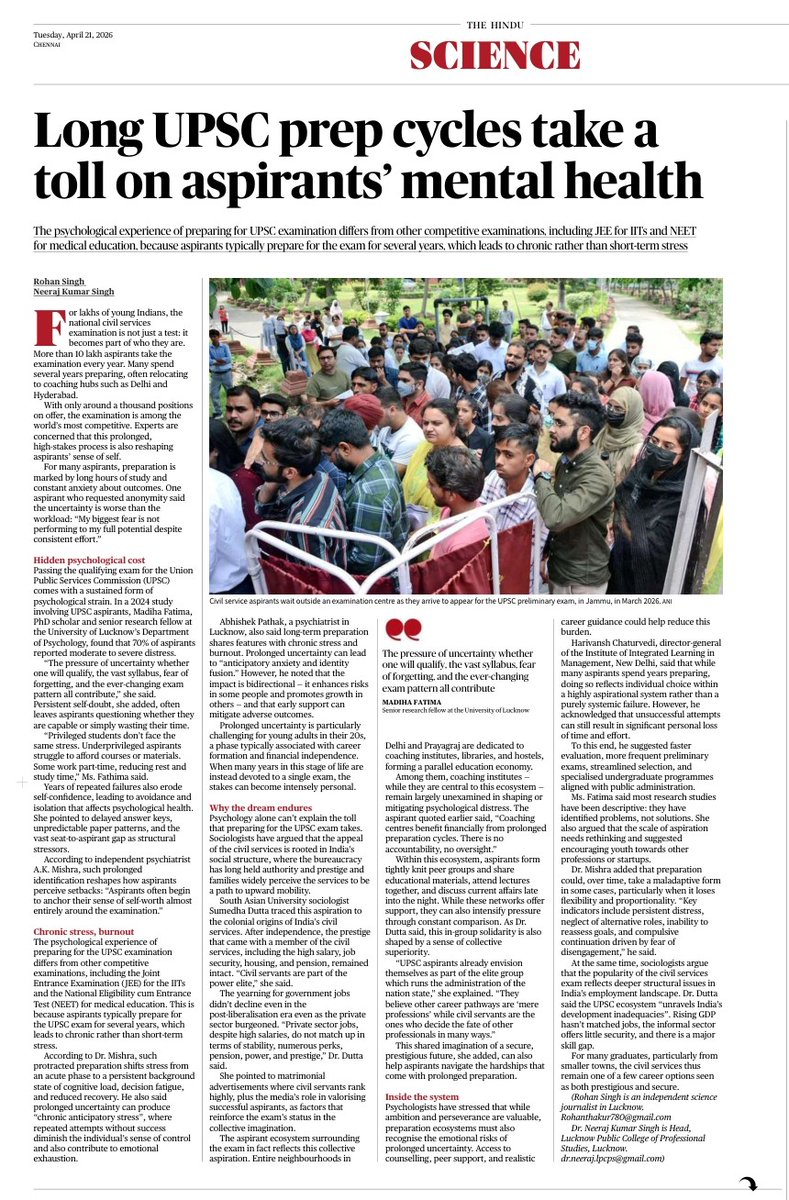
This is a very very important Topic touched by The Hindu on Civil Services Day
Indeed,#UPSC Preparation is such a huge burden on aspirants in terms of its outcomes.
We have to bring some changes to reduce the burden of mental/ emotional burden on lakhs of aspirants preparing for civil services examinations.
#civilservices
This is a very very important Topic touched by The Hindu on Civil Services Day
Indeed,#UPSC Preparation is such a huge burden on aspirants in terms of its outcomes.
We have to bring some changes to reduce the burden of mental/ emotional burden on lakhs of aspirants preparing for civil services examinations.
#civilservices
The arrest of Mudavath Devula, a senior airworthiness official at the Directorate General of Civil Aviation, by the Central Bureau of Investigation in a bribery case is deeply disturbing. When those entrusted with certifying airworthiness are compromised, it strikes at the very core of aviation safety and public trust.
If the Central Bureau of Investigation extends its probe into noise pollution compliance and certification by the @DGCAIndia@CPCB_OFFICIAL@moefcc & @iitdelhi - particularly concerning conditions at Indira Gandhi International Airport—it may uncover serious discrepancies between reported compliance and on-ground reality, potentially opening a Pandora’s box.
This is not merely a case of corruption—it represents a grave threat to regulatory integrity and aviation safety, demanding strict accountability, transparent investigation, and urgent systemic reform.
It is time to recognise artificial lighting at night as a legally defined form of disturbance in the Environmental (Protection) Act, 1986, and mandate light impact assessment for all development activities, writes Nafin K.S.,Pramod G. Krishnan
https://t.co/L8u9HXGl1k
The average Indian urban traffic reportedly routinely reaches 80-100 dB, exceeding the World Health Organization’s recommended 70 dB limit, creating a recognised risk of hearing loss, writes Rohan Singh,Harish C. Phuleria
https://t.co/25lWXEWRLA
The average Indian urban traffic reportedly routinely reaches 80-100 dB, exceeding the World Health Organization’s recommended 70 dB limit, creating a recognised risk of hearing loss, writes Rohan Singh,Harish C. Phuleria
https://t.co/25lWXEWRLA