@PTarantinoMD@NatureMedicine Here is my take on the issue of time-of-day immunotherapy - the jury is still out - I hope you like the Roman "connection" https://t.co/l9i462KBdX
Be in the room for one of the most valuable conversations of EHE 360. The popular 'Ask the Expert' Panel! These trusted EHE experts are taking time to address the questions that matter most. ❤️🙋
https://t.co/FKipBstVSv
📅 Thursday, 4/30 - Friday, 5/1
⏰ 10am ET - 1pm ET
@EHEfoundation Delighted to be part of this event on epithelioid hemangioendothelioma, which brings together education and patient advocacy! Thanks for the invitation. @DanaFarberNews
This is the experience of Yale and Penn using Doxil and doxorubicin for Soft tissue sarcoma. No OS benefit and different toxicity profiles. This provides reassurance to clinicians to choose what is best for their patients.
https://t.co/uLTOhidRbU
Calling all Minneapolis-Area Oncology Care Teams!
Join us Saturday, April 25 in Minneapolis, MN for ESMO USA in Focus: Lung & Sarcoma.
Learn More at https://t.co/s3FNZ3hasw
Total Health, along with our Program Chairs
Dr. @BeverlyMoy and Dr. @Thalcin, invite you to the 2026 Best of ASCO® Boston conference taking place this summer!
Save your spot today at: https://t.co/oD81ECci9u
#OncologyEducation#FreeCME#TotalHealth
Calling all Minneapolis-Area Oncology Care Teams!
Join us Saturday, April 25 in Minneapolis, MN for ESMO USA in Focus: Lung & Sarcoma.
Learn More at https://t.co/s3FNZ3hasw
Very pleased to share an online piece brought to you by the CAP Personalized Health Care Committee. By Drs. Jeremy Ward and Matthew Hiemenz. Navigating Discordant MMR/MSI Test Results! #PathTwitter#molpath#surgpath@Pathologists
https://t.co/rkkwYOV2Ak
Peer review work often goes unnoticed. So when the editor of a top-tier journal such as @JAMAOnc wrote to call me a « top reviewer », I felt acknowledged. Thanks for the opportunity to review great papers in Sarcoma and GI Oncology! @DanaFarberNews , @DanaFarber_CGCM@JCO_ASCO
🆕Special article in press: ESMO (@myesmo) Adaptation of Lines of Systemic Therapy (EnLiST): a consensus framework for standardising the designation of lines of therapy in solid tumours
https://t.co/hkTPfjOhEE
Privileged to co-chair with @BeverlyMoy this official Best of ASCO program. Speakers from Boston and beyond. After ASCO 2026, our event is an occasion to continue the discussion about updates in our specialty. Open to all health professionals. https://t.co/mlhrp6onmP
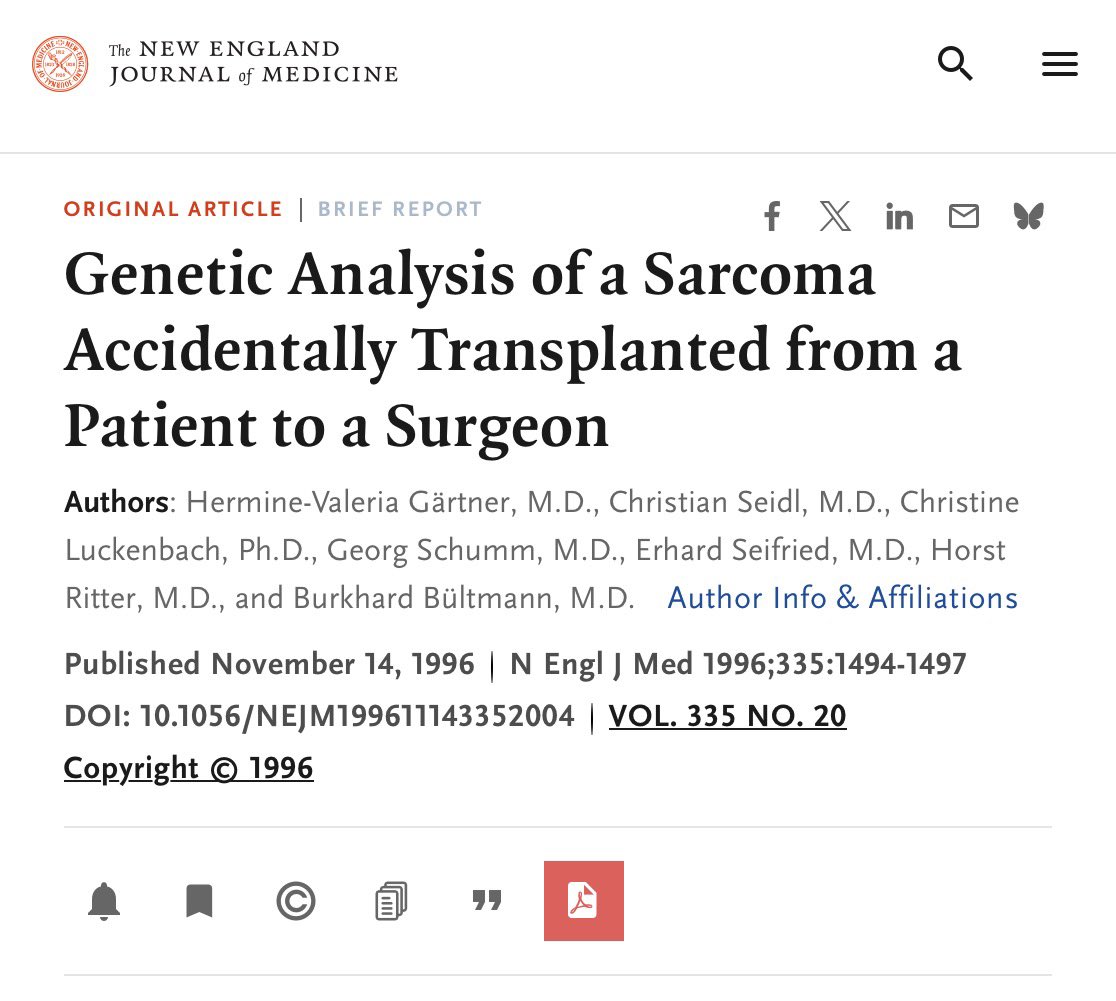
A rare case where a surgeon accidentally developed his patient’s cancer
Cancer is not considered contagious. If cancer cells from another person enter your body, your immune system is supposed to destroy them.
But in very rare situations, biology doesn’t follow the rules.
A 32-year-old man underwent emergency surgery for an aggressive soft-tissue cancer called malignant fibrous histiocytoma. Sadly, he died shortly after the operation due to complications.
During the surgery, the 53-year-old surgeon accidentally injured the palm of his left hand while placing a drain. The wound was small, immediately cleaned, and properly dressed. No one thought much of it.
Five months later, the surgeon noticed a hard lump growing at the exact spot where his hand had been injured. It slowly enlarged to about 3 cm, roughly the size of a large coin.
The lump was surgically removed.
The diagnosis was shocking.
It was malignant fibrous histiocytoma, the same rare cancer the patient had.
The surgeon was otherwise healthy. Tests showed no immune deficiency. So how could this happen?
The DNA answered the question
Pathologists compared both tumors under the microscope and found them to be identical in appearance. But the real proof came from DNA testing.
Using genetic markers and HLA typing (a way of identifying tissue origin), doctors showed that the tumor in the surgeon’s hand carried genetic material from the patient.
This meant only one thing:
👉 The cancer had been accidentally transplanted from patient to surgeon during surgery.
Cancer cells likely entered through the small hand injury and managed to survive long enough to form a tumor.
Fortunately, the tumor was completely removed.
At two-year follow-up, the surgeon was healthy, with no recurrence and no spread.
Why this case is so remarkable:
This case does not mean cancer spreads through touch or casual contact. It shows that direct implantation of living cancer cells, under very specific conditions, can rarely lead to tumor growth, even in a healthy person.
It’s a rare exception that reminds us:
- Cancer isn’t contagious, but biology has loopholes
- The immune system is powerful, not perfect
- Medicine still encounters situations that challenge long-held beliefs