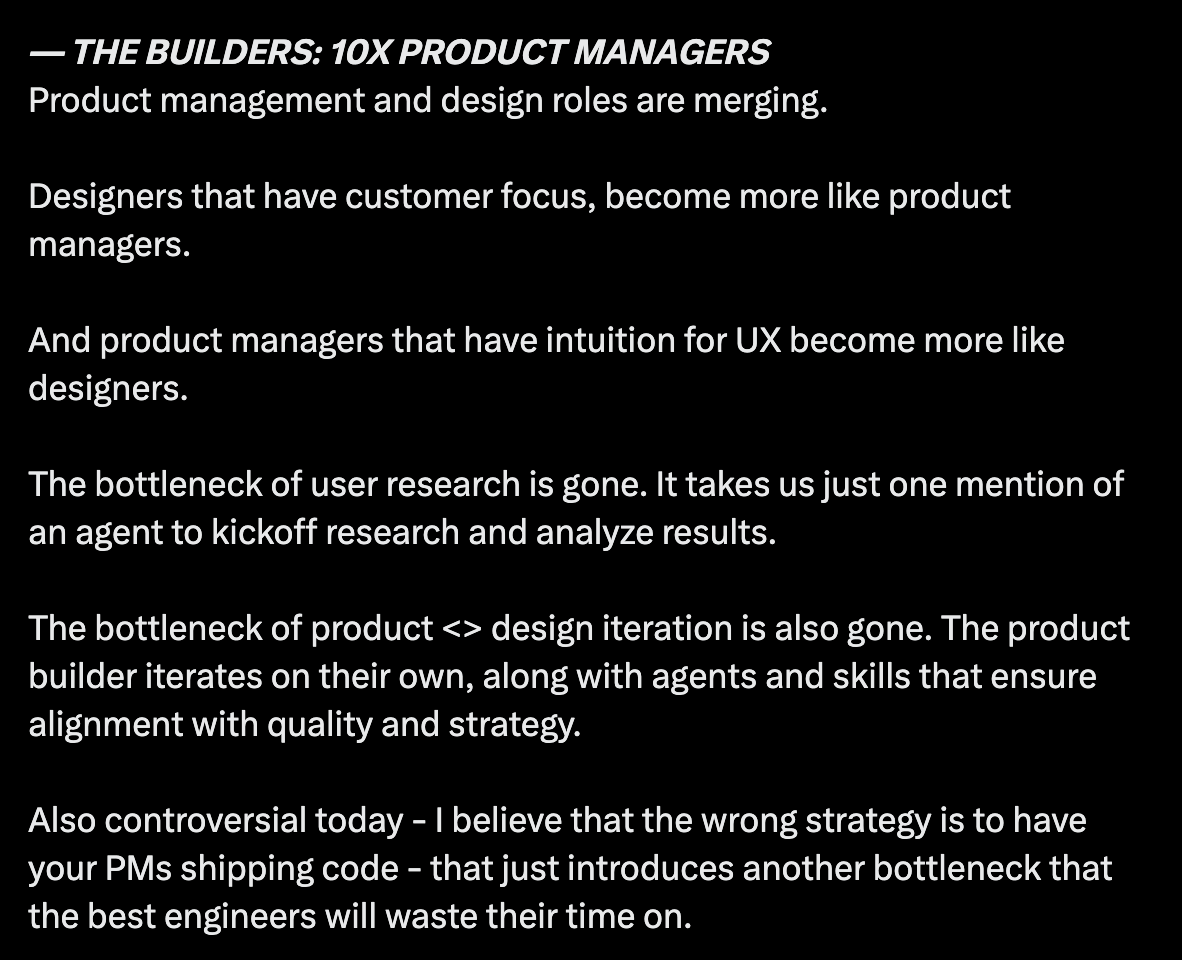
Our new product, Operator, is prototypical of how all B2B software will be built.
Say what you want and leave the rest to us.
These 3 demos show case Operator doing analysis and synthesis, with dynamic UI, and inline collaboration.
It's very, very, cool.
Most of us spend years trying to change outcomes without examining the internal framework producing them.
This article gets to the root by examining and then stripping away the conditioning that keeps you from becoming fully yourself and finding your bliss.
Great read @thedankoe !
I love @adityaag’s point here on why patience is still critical in the age of AI: “The most valuable professional assets (judgment, relationships, domain expertise) compound. Cut the timeline short and you never reach the part of the curve where the returns become extraordinary.”
I’m (quietly) doing this but I’m much more expensive than an AI native 22 year old because I know what being an exec actually looks like.
Can’t design the system if you don’t know the job.
Booked until mid summer, but I guess DM me?
WorkOS just raised $100M at a $2B valuation. For a company that sells SSO and directory sync, that’s a sentence that should make you pause.
The valuation only makes sense when you look at who’s paying. OpenAI, Anthropic, xAI, Cursor, Perplexity. Every company building the next generation of enterprise software already runs on WorkOS infrastructure. That customer list is a bet on the entire AI application layer.
Grinich announced $20M ARR and 1,000+ customers last June. The company had 200 paying customers three years earlier. That growth trajectory on what is essentially enterprise plumbing tells you the AI wave is pulling authentication demand forward at a speed nobody in the identity space has seen before.
This tells you everything about the actual go-to-market. Every AI startup that closes an enterprise deal activates WorkOS connections. Enterprise buyers require SSO, SCIM, permissions, and audit logs before they’ll start a pilot. Not month six. Day one. So OpenAI’s enterprise sales team is, functionally, WorkOS’s enterprise sales team. Anthropic’s is too. The customer base sells for them.
$199M total raised across all rounds. Founded in 2019. Six years from zero to $2B valuation selling authentication APIs. The capital efficiency is real because the product distributes through the growth of its own customers, not through a 200-person sales org burning cash.
Now layer in the agent thesis Grinich is making in the announcement. When autonomous software starts executing actions inside organizations, every action still needs authentication and authorization. The identity layer becomes the control layer. WorkOS is already embedded in the companies that will ship agents first.
Meritech and Sapphire are betting authentication becomes to AI what Stripe became to e-commerce. Stripe took over a decade to become the default. The AI adoption curve is compressing that timeline, and WorkOS already has the client list that matters locked in.
Agile Has Broken Your Company
The Agile Manifesto was signed in 2001 by 17 developers trying to fix broken software projects. It worked…until it didn't. Twenty-five years later, Agile has become a $20B+ industry, and the software it produces is getting worse.
The Four Principles
The Manifesto prioritized:
- Individuals and interactions over processes and tools
- Working software over comprehensive documentation
- Customer collaboration over contract negotiation
- Responding to change over following a plan
These aren't wrong in isolation but the problem is what they became in practice.
"Responding to change" became an excuse to never finish anything. Stanford researchers found scope creep was institutionalized and rebranded as "sprint replanning," one of the top drivers of cost overruns.
"Working software over documentation" quietly gutted institutional knowledge. A 2023 GitLab survey found only 12% of developers felt their codebase was well-documented. In other words, technical debt became structural.
"Velocity" replaced quality. Story points. Burn-down charts. Throughput. None of these measure whether the software is any good. The Manifesto said build software that works, and a focus on velocity forgot that.
The Numbers Are Damning
McKinsey found technical debt now consumes 20–40% of engineering capacity in most large organizations.
The Consortium for Information & Software Quality estimated poor software quality cost U.S. companies $2.41 trillion in 2022, with $1.52 trillion from operational failures alone. Agile has been the dominant methodology for most of that period.
The Standish Group's CHAOS Report found that in 2020, only 31% of software projects were considered successful.
What You Don't Notice Until It's Too Late
Current software development best practices have killed systems thinking.
When your planning horizon is two weeks, you don't design systems anymore, you assemble features. The result is a mess of fragmented architectures, microservices sprawl, and codebases no single engineer fully understands.
The "Product Owner" role that was supposed to represent the customer became a bureaucratic proxy. A layer between engineers and business outcomes, distorting requirements at every handoff.
The Alternative: Software Factory
The best engineers have always known what actually works. They write specs. They think in systems. They document decisions. They go slow to go fast.
At 8090, we call this approach Software Factory. We look at software delivery like a production system with defined inputs, quality gates, and measurable outputs. Architecture is a first-class citizen from day one, not something you refactor into after 40 sprints. Documentation is built in, not bolted on.
Quality Is Speed
Every hour spent on rework, incident response, and technical debt is an hour that could have gone into upfront design or testing. Speed and quality don’t need to be in tension - it’s a false choice in modern mythology.
If your team still measures success in story points and sprint velocity, ask yourself: What's your defect rate? Your documentation coverage? Your time to onboard a new engineer? Your incident frequency?
If you don't like the answers, it's probably time for a different model.
Try Software Factory at https://t.co/fkfTXgdfXK
PM portfolios are becoming the new PM certificate: something candidates spend weeks polishing that hiring managers spend 5 seconds skimming.
I've talked to over a dozen AI PM hiring managers in the last 6 months. Not one mentioned portfolios as a differentiator. Every single one mentioned GitHub. The shift happened quietly but the logic is obvious.
A portfolio is a slide deck about what you did. It's retrospective. It's polished. It's unfalsifiable. You can write "I identified the core user pain point and drove a 30% improvement in activation" and nobody can verify whether you actually did the analysis or your data science team did.
A GitHub is working code you can inspect in real time. The commit history shows when you built it. The README shows how you think. The tradeoffs section shows your judgment. The contribution graph shows consistency. Every claim is verifiable.
Portfolios optimize for looking good. GitHubs optimize for proving capability. When an interviewer asks "walk me through how you built this," a portfolio gives you a polished narrative. A GitHub gives you specific architectural decisions, failure modes you discovered, and iterations you made. One sounds rehearsed. The other sounds real.
The 17% of candidates with portfolios invested in the 2022 playbook. The 24% with GitHubs invested in the 2026 playbook. Both numbers will shift, but they'll shift in opposite directions.
Portfolios aren't worthless. They're just no longer the edge. The edge is shipping something a hiring manager can clone, run, and evaluate. That's what GitHub provides and portfolios can't.
When a team is underperforming, most people's first instinct is to blame the people. That's almost always wrong.
After 20+ years at @Meta, @Google, and @CZI — and advising leaders at @Stripe, @AnthropicAI, @OpenAI, and more — @molly_g has learned that blaming people for structural problems is one of the biggest leadership traps there is.
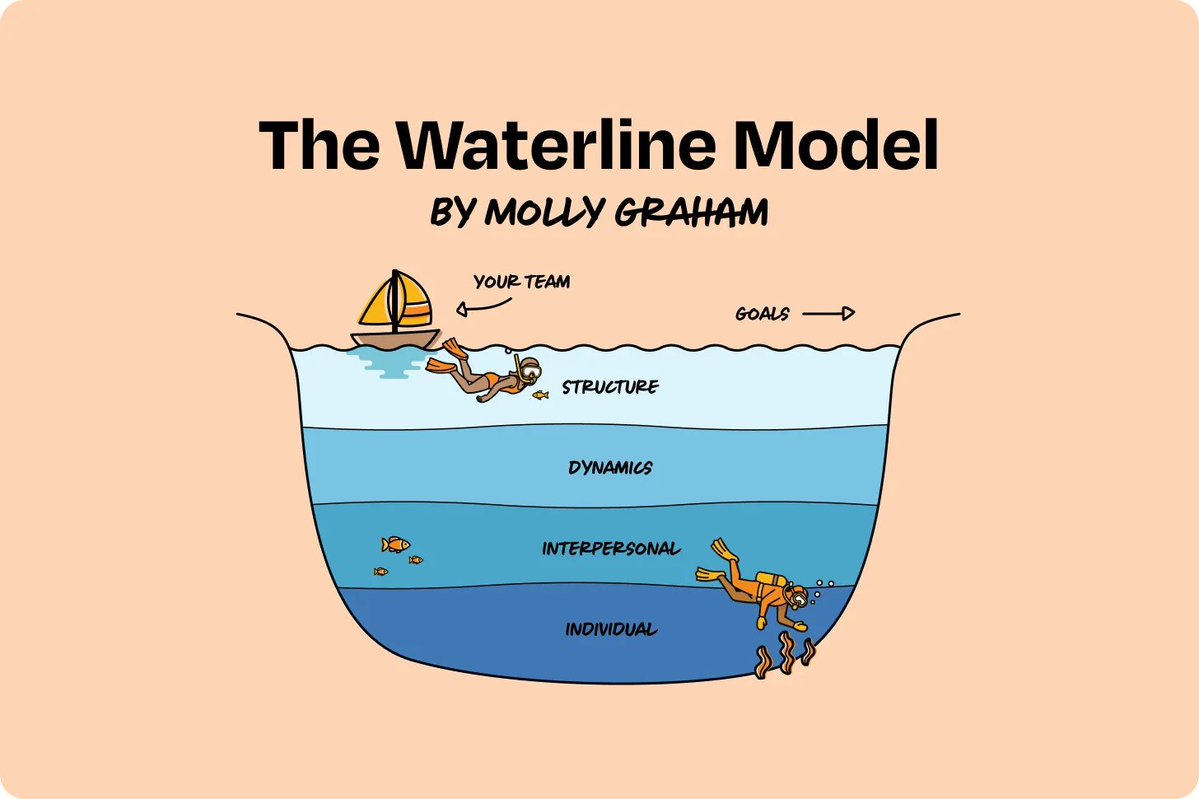
In her powerful guest post, she shares a simple diagnostic tool she's used since leading wilderness expeditions in Patagonia at age 22: the Waterline Model.
The Waterline Model helps you answer one question: What's going on below the surface that's making things harder than they should be?
In other words, "snorkel before you scuba."
Read it here (and share it with your manager): https://t.co/iKDJRSCouN
SPEC IS BECOMING THE PRODUCT
An Anthropic engineer gave Claude a spec, pointed it to an Asana board and left for the weekend.
Claude broke it into tickets and spun up a team of agents. The agents started picking up tasks on their own. No one told them to.
They just did.
Most data teams are still building dashboards nobody looks at.
We killed 1,400 of ours.
Replaced them with a semantic layer you can talk to. Built custom AI tooling that replaced SaaS we were paying six figures a year for. Every person on this @Opendoor data team has unlimited tokens and AI agents running alongside them daily.
Real estate is the largest asset class on earth and the transaction still feels like 1997. That's the data problem we wake up to. Pricing millions of homes. Optimizing tens of millions in ad spend. Building models that move real dollars, not slide decks.
Our CEO's (@nejatian) mandate is "default to AI." Not a slogan. How we actually operate. Opendoor might be the most AI-native public company you haven't been paying attention to.
Small team. Absurd talent density. Embedded across the entire C-suite. You touch pricing, marketing, product, sales, operations — all of it!
We're hiring across Agentic Analytics Engineering and Data Science. Seattle or Toronto.
If this is the kind of data team you've been looking for, stop scrolling and apply:
Agentic Analytics Engineering: https://t.co/rvld2dRSCJ
Data Science: https://t.co/hEH9UefNGK