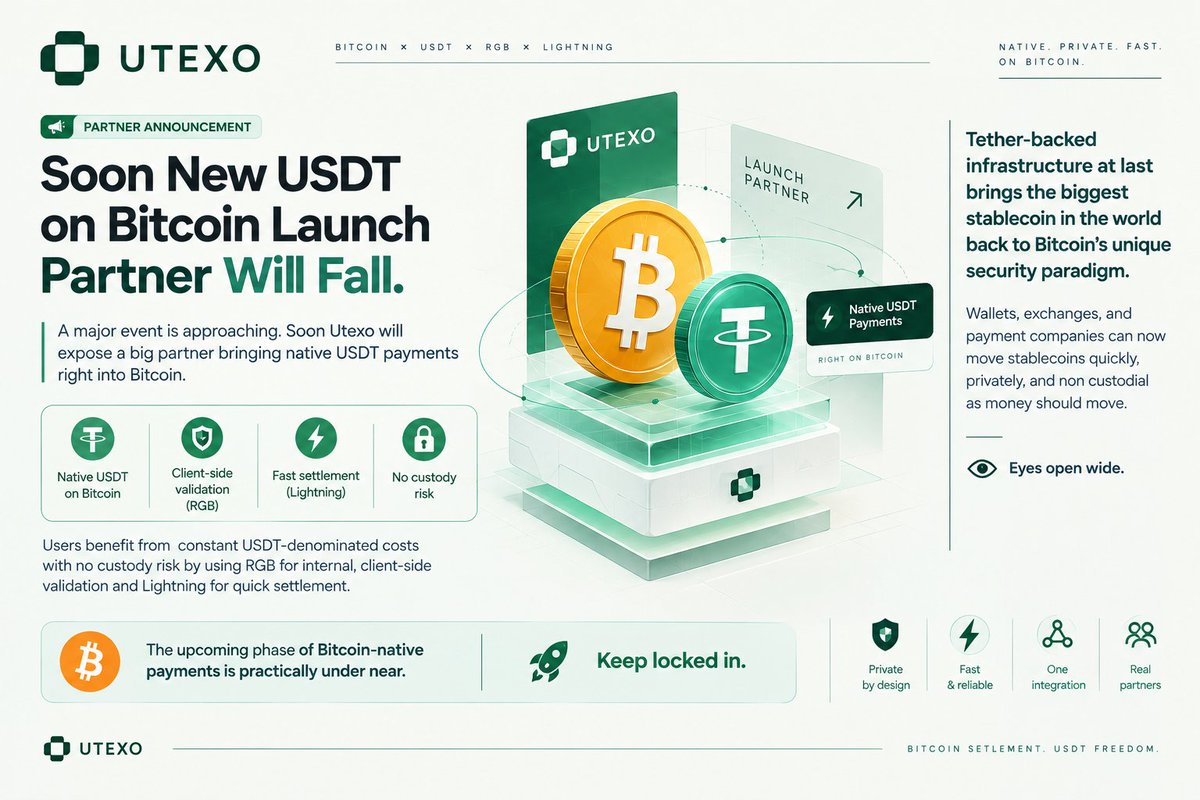
Soon New USDT on Bitcoin launch partner will fall.
A major event is approaching. Soon Utexo will expose a big partner bringing native USDT payments right into Bitcoin.
Users benefit from constant USDT-denominated costs with no custody risk by using RGB for internal, client-side validation and Lightning for quick settlement.
Tether-backed infrastructure at last brings the biggest stablecoin in the world back to Bitcoin's unique security paradigm. Wallets, exchanges, and payment companies can now move stablecoins quickly, privately, and non custodial as money should move. Eyes open wide.
The upcoming phase of Bitcoin-native payments is practically under near. Keep locked in.
@utexocom@Utexoasia@RGB_Hub
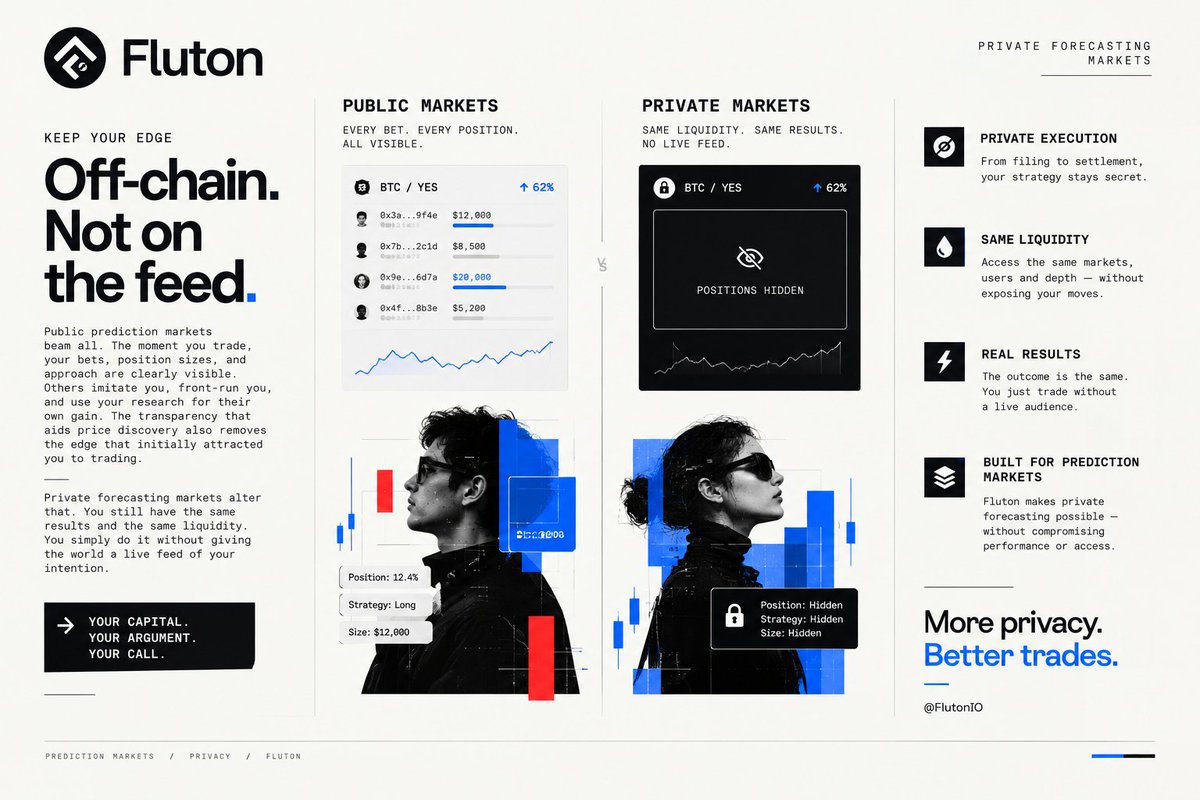
Keep your edge off-chain.
Public prediction markets beam all. The moment you trade, your bets, position sizes, and approach are clearly visible. Others imitate you, front-run you, and use your research for their own gain. The transparency that aids price discovery also removes the edge that initially attracted you to trading.
Private forecasting markets alter that. You still have the same results and the same liquidity. You simply do it without giving the world a live feed of your intention. Stay yours in bets. Positions remain concealed. From filing to settlement, the strategy remains secret.
@FlutonIO is made for this: private execution so that prediction markets can remain relevant without requiring every trader to operate in the open. Privacy ought to be the default rather than a luxury.
Your capital.
Your argument.
Your call. Not everybody else's.
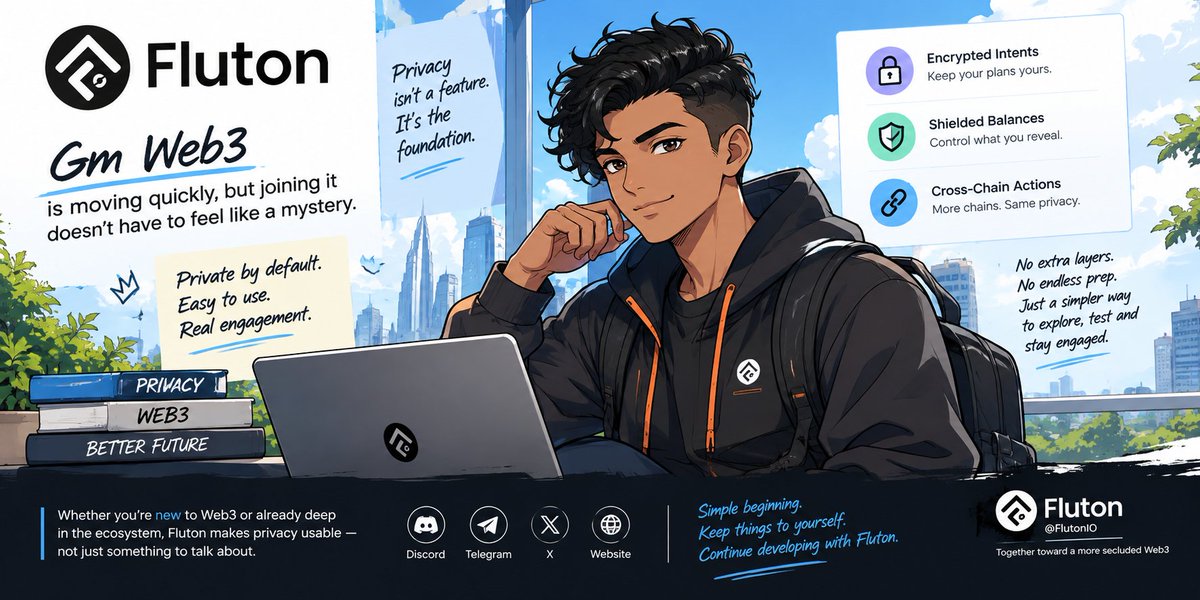
Gm Web3 is moving quickly, but joining it doesn't have to feel like a mystery.
@FlutonIO is designed for a better beginning: private by default, easy to use, and focused on real engagement instead of noise. Encrypted intents, shielded balances, and cross-chain actions are intended to remain functional without revealing strategies or converting every step into homework.
No additional layers simply to appear occupied.
Learning doesn't require countless preparation.
Simply a more straightforward route to explore, test, and remain engaged.
Every successful trip still starts the same way: appear, finish tasks, review the updates, and maintain consistency with the community. Fluton is presenting privacy as something that you can really utilize, not just discuss, regardless of whether you're new to Web3 or well entrenched in the ecosystem.
Stay near Discord, Telegram, X, and the official website. The effort is underway in testnet missions, ecosystem notes, and community discussions.
Simple beginning. Keep things to yourself. Continue developing with Fluton.
@FlutonIO | Together toward a more secluded Web3
@oirruy@QMSNetwork Building native post-quantum security from day one is the right move. Proof-of-Useful-Work and QUBO optimization take efficiency to a whole new level.
@oirruy@RialoHQ Reasoning is just the beginning building the infrastructure to turn those decisions into secure, verifiable actions is where the real value lies.
Privacy is not merely a season. It’s the feature of money that isn’t there.
USDT originated on Bitcoin. It then moved to less expensive, more public rails. Native Americans are now bringing it home. Not covered. Not bridged. Issued via RGB, settled above Lightning, anchored to the UTXO model of Bitcoin.
That mix offers what payments have always lacked and what most stablecoin rails still lack: fast finality, fees you can price in advance in USDT, and transactions that don't reveal balances or counterparties to the whole network.
Wallets, payment service providers, exchanges, and retailers only integrate once. Users maintain their keys. The cost structure is managed by operators. No additional layer of custody. Gas spikes are not surprising. No public record exists that rivals could use to map customer flow by scraping.
Here, privacy isn't a marketing pitch. Client-side validation, new addresses, and off-chain Lightning settlement make it much more difficult to rebuild the payment graph than with account-based chains. Compliant, functional, designed for volume rather than for seclusion from the world, but rather for transporting value in the manner in which banknotes and bank transfers were intended to operate.
This isn't private season. This is how USDT should travel on Bitcoin: immediately, secretly, with no shocks.
Handle stablecoins as you would cash.
@utexocom@Utexoasia@RGB_Hub
🔥 Utexo Bangladesh AMA is BACK Week 6 🔥
After 2 weeks off due to technical issues, we’re live again this Saturday.
📅 Date: Saturday, 19 September 2026
🕘 Time: 9:00 PM
💬 Where: Discord 🇧🇩Bangladesh
This week’s topic is the hottest one yet:
✨ RGB Wallet Live Explanation + Demo
✨ Internal Bridging System Deep Dive
✨ Lightning Network internals
✨ Casual community AMA / Q&A
Missed last week? No problem those topics will be covered again too.
If you’re in the BD community, don’t miss this one. RGB wallet + bridging from the inside is going to be fire.
See you Saturday night on Discord.
Updates: https://t.co/ALYtB5DwTP
@utexocom@Utexoasia
Gm Web3 is moving quickly, but joining it doesn't have to feel like a mystery.
@FlutonIO is designed for a better beginning: private by default, easy to use, and focused on real engagement instead of noise. Encrypted intents, shielded balances, and cross-chain actions are intended to remain functional without revealing strategies or converting every step into homework.
No additional layers simply to appear occupied.
Learning doesn't require countless preparation.
Simply a more straightforward route to explore, test, and remain engaged.
Every successful trip still starts the same way: appear, finish tasks, review the updates, and maintain consistency with the community. Fluton is presenting privacy as something that you can really utilize, not just discuss, regardless of whether you're new to Web3 or well entrenched in the ecosystem.
Stay near Discord, Telegram, X, and the official website. The effort is underway in testnet missions, ecosystem notes, and community discussions.
Simple beginning. Keep things to yourself. Continue developing with Fluton.
@FlutonIO | Together toward a more secluded Web3
Fluton runs two contracts on every supported chain, not one.
Intent Pool handles general encrypted intents. Bridge is divided out since it is the most often used and performance-critical intention type. Keeping it apart saves gas, shortens execution paths, and enables the team to improve the hot path free of general pool bloat.
For FHE calculations on encoded data, both contracts still use Zama and Fhenix coprocessors. From submission through settlement, amounts, locations, and logic remain confidential. Relayers and solvers never view plaintext.
One pool for the general case. One committed lane for the traffic that really arrives most often.
Gas declined. More direct route. Same privacy
@FlutonIO
🔥 Utexo Bangladesh AMA is BACK Week 6 🔥
After 2 weeks off due to technical issues, we’re live again this Saturday.
📅 Date: Saturday, 19 September 2026
🕘 Time: 9:00 PM
💬 Where: Discord 🇧🇩Bangladesh
This week’s topic is the hottest one yet:
✨ RGB Wallet Live Explanation + Demo
✨ Internal Bridging System Deep Dive
✨ Lightning Network internals
✨ Casual community AMA / Q&A
Missed last week? No problem those topics will be covered again too.
If you’re in the BD community, don’t miss this one. RGB wallet + bridging from the inside is going to be fire.
See you Saturday night on Discord.
Updates: https://t.co/ALYtB5DwTP
@utexocom@Utexoasia
New original post you can use:
50+ launch partners is the easy screenshot.
Turning that list into a rail that actually works at volume is the part most people skip.
A wallet can show USDT on Bitcoin and still fail the first real payment if inbound liquidity isn’t already sitting where it needs to be. Routing gets messy. Fees stop being predictable. A PSP can’t sell a clean checkout if settlement sometimes just doesn’t land.
That’s the old Lightning problem wearing a new RGB jacket.
The hard work isn’t announcing another logo. It’s pre-funded channels, managed routing, one integration surface instead of three separate codebases, backups that don’t require a PhD, and mint/swap paths that don’t lose to Tron on speed or trust.
Signed ≠ live.
The next milestone isn’t partner #51.
It’s when partner #50 and partner #200 fail the same way, retry the same way, and settle at the same quoted cost.
That’s when USDT on Bitcoin stops being a pipeline and starts being infrastructure.
@utexocom@Utexoasia@RGB_Hub
Fluton runs two contracts on every supported chain, not one.
Intent Pool handles general encrypted intents. Bridge is divided out since it is the most often used and performance-critical intention type. Keeping it apart saves gas, shortens execution paths, and enables the team to improve the hot path free of general pool bloat.
For FHE calculations on encoded data, both contracts still use Zama and Fhenix coprocessors. From submission through settlement, amounts, locations, and logic remain confidential. Relayers and solvers never view plaintext.
One pool for the general case. One committed lane for the traffic that really arrives most often.
Gas declined. More direct route. Same privacy
@FlutonIO
Fluton is creating a more private and safe means of engagement with the decentralized world.
Encrypted Intent, a notion meant to safeguard what you want to do before your activities are carried out, is at the core of this vision.
Your goal is unique. Your activity should not become a cause of needless exposure or tracking. Fluton seeks to help you keep your intentions private while simultaneously enabling users more interaction control over on-chain systems.
Adopting a privacy-first strategy helps one to have a basic goal:
Maintain a secret intention for yourself.
Keep your data theirs.
Retain management of your activities.
Privacy ought to be part of the basis rather than an afterthought as Web3 develops.
@FlutonIO is working toward that future.
$ already runs the world.
₿ is the only network no one can shut down.
Utexo puts them together.
Native USDT on Bitcoin.
RGB for privacy. Lightning for speed.
Fixed fees. No custodian. Settlement in under a second.
The money people actually use, on the network that can’t be stopped.
@utexocom@Utexoasia
Other businesses open with noise and go away as the story changes. Bitcoin stays. Sixteen years of continuous running, great security, and a culture that counts time in decades instead of cycles.
That is @utexocom's motive here.
We are building quick, individual USDT rails that settle inherently on Bitcoin. No bridges. No wrapped tokens. not deviating from the most resilient network constructed. Together, RGB and Lightning offer client side validation, sub-second settlement, and privacy things public ledgers cannot. Partners route reliable coins with fixed costs and total control once and fit.
Tether's support and a $7.5 million seed round confirmed the theory: the biggest stablecoin in the world should be on the chain it first came from, reconstructed on framework that at last works at scale.
We are not pursuing the following chain. We are here for the long term as the only layer worth building on now is the settlement layer that will be functioning in 2040.
Handle stablecoins as money ought to flow. Straightaway.
Secretly.
Regarding Bitcoin.
@Utexoasia@RGB_Hub
Everything you would do with a dollar, you will soon do on Bitcoin.
@utexocom brings native USDT home to the most secure network in the world. Payments immediately under one second. Completely private transfers never exposing counterparties or amounts on a public ledger. Fixed costs paid in USDT, which are known in advance and not impacted by congestion.
No bridges. No wrappers. Do not leave Bitcoin.
Exchanges settle without locking capital. Wallets allow native BTC-USDT swaps and yield. Each payment company sets its own margins. Platforms handle deposits and payouts of any amount right away.
Built on Bitcoin for finality, Lightning for speed, and RGB for client-side privacy. Tether-backed rails meant for operators moving money at scale.
USDT debuted on Bitcoin in 2014. Years apart, the two most important digital assets work again together.
Move stablecoins the way money is supposed to move: instantly, privately, with no shocks.
Bitcoin holds the key to the future of settlement.
Fluton is creating a more private and safe means of engagement with the decentralized world.
Encrypted Intent, a notion meant to safeguard what you want to do before your activities are carried out, is at the core of this vision.
Your goal is unique. Your activity should not become a cause of needless exposure or tracking. Fluton seeks to help you keep your intentions private while simultaneously enabling users more interaction control over on-chain systems.
Adopting a privacy-first strategy helps one to have a basic goal:
Maintain a secret intention for yourself.
Keep your data theirs.
Retain management of your activities.
Privacy ought to be part of the basis rather than an afterthought as Web3 develops.
@FlutonIO is working toward that future.
Everything you would do with a dollar, you will soon do on Bitcoin.
@utexocom brings native USDT home to the most secure network in the world. Payments immediately under one second. Completely private transfers never exposing counterparties or amounts on a public ledger. Fixed costs paid in USDT, which are known in advance and not impacted by congestion.
No bridges. No wrappers. Do not leave Bitcoin.
Exchanges settle without locking capital. Wallets allow native BTC-USDT swaps and yield. Each payment company sets its own margins. Platforms handle deposits and payouts of any amount right away.
Built on Bitcoin for finality, Lightning for speed, and RGB for client-side privacy. Tether-backed rails meant for operators moving money at scale.
USDT debuted on Bitcoin in 2014. Years apart, the two most important digital assets work again together.
Move stablecoins the way money is supposed to move: instantly, privately, with no shocks.
Bitcoin holds the key to the future of settlement.
RGB Lightning now has a clear developer map. Utexo CTO Renat Skitsan just published a walkthrough of the wdk-rgb-lightning module that packages RGB assets over Lightning for Tether’s Wallet Development Kit.
The module wraps @RGB_Hub Lightning Node behind WDK’s manager and account interfaces. Native code ships in two forms: a Node.js binding for servers and desktops, and a statically linked Bare package for mobile worklets. Signing stays isolated through an in-process Validating Lightning Signer, so the private key never enters the module itself.
On top of ordinary Lightning payments, it adds LSP-assisted channel opening, Lightning Address flows, and VSS backup. The release is still beta, yet test coverage rose from about 15 percent to nearly 98 percent.
Any wallet built on WDK can now move Bitcoin and RGB assets through the same channels without assembling the stack from scratch. The on-chain RGB module remains separate, so each keeps its own state and identity.
Read the full architecture piece on https://t.co/6N0lV9yI4g.
@utexocom@Utexoasia
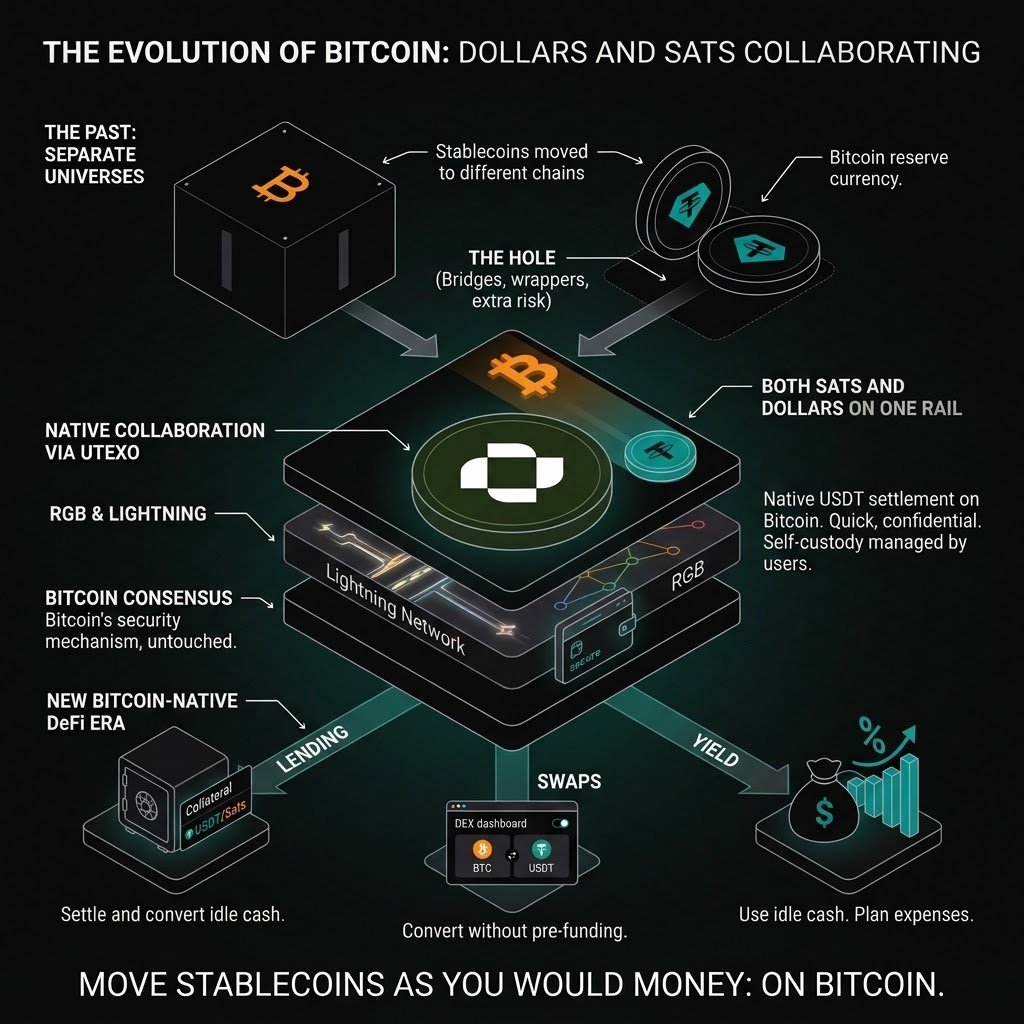
Lending, swaps, and yield are dollars and sats, at last collaborating on Bitcoin.
USDT and Bitcoin stayed in different universes for years. Stablecoins were moved to different chains. Bitcoin remained the reserve currency. The hole was filled by bridges, wrappers, and extra risk. That separation is narrowing.
Native USDT settlement comes to Bitcoin via Utexo using RGB and Lightning. Payments are quick and confidential. Expenses can be planned in advance. Users manage self-custody. Leave Bitcoin's security mechanism alone.
That very stack now handles more than only basic transfers. With both USDT and sats on one rail, lending, swaps, and yield become feasible. Wallets, exchanges, and payment companies may settle, convert, and use idle cash without pre-funding or public transaction graphs.
USDT was born on Bitcoin. Usable infrastructure was the missing component. Native sats and private dollars coexist on the same network influences the operation of DeFi and settlement.
Move stablecoins as you would money: on Bitcoin.
@utexocom@Utexoasia@RGB_Hub