📢Meet Qwen3.8-Max — our most capable model to date.
Next week, the open weights of Qwen3.8-Max will be released, and Qwen3.8-27B is also going open-weights to meet you all!🎉
Qwen3.8-Max, a new bar for coding and cowork at 2.4T parameters:
- Autonomous coding: 10+ days of self-evolving development, from empty folder to production without hand-holding, complete project trace in the GitHub:https://t.co/iVHZWQoeSo
- Real work, real results: Production-quality deliverables across hundreds of professions.
- Long-horizon mastery: System-level autonomous planning with closed-loop adaptive learning, driving 500+ turns of chip design optimization and 365 days of e-commerce strategy.
- Native multimodal intelligence: Vision isn't just input — it's a continuous feedback loop for planning, execution, and self-correction.
💰Pricing:
Input: $2.0 / M tokens
Output: $6.0 / M tokens
Implicit Caching: $0.25 / M tokens
Start building with Qwen3.8-Max! 🚀
📖 Blog: https://t.co/iwjmQxLBof
✅ Qwen Studio: https://t.co/4V2pFvDovG
⚡ API: https://t.co/gAGqaLQGbN
Xiaomi founder @leijun latest car sales pitch.
Forget horsepower, just keep loading tall Chinese guys into it until the internet agrees there’s enough legroom. 😂
Can this car fit the entire basketball team?
#Xiaomi#LeiJun#ChinaEV#ElectricVehicles#AutoTech
It's rare to see a company go IPO right after Series B.
We reported on their last round funding back in February 2026 (6 months ago).
AI² Robotics 智平方 (AGI’s native robot) raised RMB 1 billion ($143M) Series B led by @Baidu_Inc, CRRC Capital and Dubai Capital.
Read more here 👉
https://t.co/gPknjCdxFq
#funding #robotics #chinatech #IPO #Chinatechnews
Chinese robot maker AI² Robotics is considering a Hong Kong IPO, sources say, as it looks to tap investor interest in the growing sector https://t.co/v3HfL0nImQ
The robots have officially entered the noodle business. 🤖
Shenzhen now has a fully autonomous noodle shop serving a bowl for just RMB 6 — less than $1 — in 48 seconds!
🍜🍜🍜
#Shenzhen#ChinaTech#Robotics#Automation#FutureOfFood
𓅣 The Crane Weekly Brief. 85 China startups raised $4.36B last week. 🇨🇳💰
The week was dominated by foundation models, AI chips and healthcare, with Moonshot AI accounting for more than 80% of disclosed funding.
Top 5 deals:
🥇 Moonshot AI 月之暗面 (foundation model) — $3.5B Series F
🥈 Aixin Semiconductor 埃芯��导体 (AI chip manufacturing) — $143M Series B+ led by China Reform Fund and SMIC Capital
🥉 SenseCare 商汤医疗 (medical world model) — $100M Series B
4️⃣ SemiDrive 芯擎科技 (automotive SoC chips) — $100M Series B+ backed by China Reform Fund, Kunpeng Capital, GL Ventures, SMIC Capital
5️⃣ Likai 励楷科技 (neuro-interventional medical devices) — $71.4M Series D led by Shanghai Science and Technology Investment Corporation and Minhang Financial Investment
#ChinaAI #AI #ChinaTech #Startups #VentureCapital #DeepTech #Semiconductors #Healthcare #LLM #TheCrane
4/ CXMT is challenging one of the world’s most powerful oligopolies AND could reshape the economics of the global memory industry.
Its main competitors are:
🇰🇷 Samsung
🇰🇷 SK Hynix
🇺🇸 Micron
Together, these companies have dominated global DRAM for decades.
CXMT has now emerged as the world’s fourth-largest producer—but it still trails the leaders in advanced products such as high-bandwidth memory.
Its rapidly expanding production could increase supply, trigger price competition and compress margins across the entire DRAM market.
#Samsung #SKHynix #Micron
1/ China just produced one of the wildest semiconductor IPOs in history.
CXMT makes DRAM—the working memory inside nearly every modern computing device. Its chips power:
• AI servers
• Smartphones
• PCs and laptops
• Cars
• Tablets
• Internet-of-things devices
CXMT’s mega IPO was historic.
CXMT raised $8.6 billion, then surged 466% on its first trading day—briefly reaching a market value of nearly $488 billion.
A thread 🧵
#CXMT #ChinaTech #Semiconductors
3/ The founder, Zhu Yiming, is not a first-time semiconductor entrepreneur.
Before CXMT, he founded GigaDevice, one of China’s leading fabless chip companies, best known for NOR flash memory and microcontrollers.
He then took on a far more ambitious challenge: building China’s own large-scale DRAM manufacturing champion.
#FounderStory #DeepTech
Washington unintentionally create the a new chip alternative ecosystem to Nvidia.
With all the Nvidia chip supply restrictions:
- Chinese labs have no choice, but to invest in Huawei and domestic accelerators.
-Chinese labs are building software like TileLang on Apache TVM to make high-end model training viable on non-Nvidia hardware.
- Few companies would volunteer to absorb transition costs.
Once switching costs are paid, some demand may not return to Nvidia.
No. they backfired. China got the best Nvidia chips anyway.... and export controls just gave them more urgency to build its own hardware.
something to keep in mind as Washington figures out its approach to open source AI
🏦💰 Innolight Technology just priced its ~$6.9B Hong Kong IPO - largest HK IPO since Alibaba in 2019
Here's what you need to know 🧵👇
💡 What is Innolight
World's leading high-speed optical transceiver maker—called the "AI optical module champion." Their components convert electrical signals to light signals, moving massive data through fiber-optic cables powering data centers, AI computing, and 5G networks .
Think of them as the plumbing for the entire AI boom.
👨💻 Founded by who & when?
Co-founded in 2008 by Sheng Liu (Chairman & CEO), a engineer with deep optical industry experience at Agere Systems, Pine Photonics, and Opnext .
The company was later acquired in 2016 by Wang Weixiu's Shandong Zhongji Electrical Equipment in a $396M deal, becoming today's Zhongji Innolight .
🌍 Why this IPO matters:
The largest HK IPO since Alibaba in 2019
Symbol of the "AI hardware gold rush"—optical modules have become strategic assets in the AI era, with GPU-to-module ratios jumping from 1:3 to 1:12
62% of sales in the U.S. —shows hardware supply chains cross geopolitical lines, even as trade tensions rise
🏢 Who are their customers?
🤖 Nvidia, Google, Amazon, Microsoft, Meta, Alibaba, Tencent, Baidu - everyone!
With a 25% global market share, Innolight is powering the infrastructure behind the AI revolution—from both sides of the Pacific 🌊 .
#Innolight #IPO #HongKong #AI #Semiconductors #OpticalModules #DataCenter #Nvidia
𓅣 The Crane Weekly Brief
48 China startups raised $879M last week. 🇨🇳💰
Generative AI is back in force, accounting for more than 80% of disclosed funding. The AI stack continues to attract capital—from foundation models and video generation to memory operating systems and data infrastructure.
🇨🇳💰 Here are the top 5 deals:
🥇 Meshy (3D generative AI) — $400M Series B led by IDG Capital, Matrix Partners China and Monolith Management
🥈 https://t.co/BKBpYodrca (智象未来) (foundation model) — $214M Series C led by National Social Security Fund
🥉 @Flovaai (AI video creation agent) — $80M seed backed by HongShan Capital, IDG Capital
4️⃣ MemTensor (记忆张量) (AI memory OS) — $14.3M Pre-A backed by Huawei Hubble, Honor Investment, SenseTime Guoxiang
5️⃣ Jinglianwen (景联文科技) (real-world AI training data infrastructure) — $14.3M Series A backed by Binjiang Financial Investment, Hangzhou Financial Investment
#ChinaAI #AI #GenerativeAI #Startups #VentureCapital #DeepTech #3DAI #WorldModels #ChinaTech #TheCrane
China’s economy is built on an extraordinary savings surplus:
China’s gross national savings rate stands at ~43% of GDP, the highest among the world’s largest economic blocs.
This is more than double the US' rate of ~18%.
China’s savings rate has remained above 40% for nearly the entire century while the US has not exceeded 20% over the same period.
Meanwhile, Japan’s savings rate is ~32% of GDP, while the Eurozone’s is ~24%, both well below China.
A high savings rate provides a larger pool of domestic capital that can be used to finance investment, expand manufacturing capacity, and strengthen its industrial base.
China’s savings surplus is a powerful source of investment capacity.
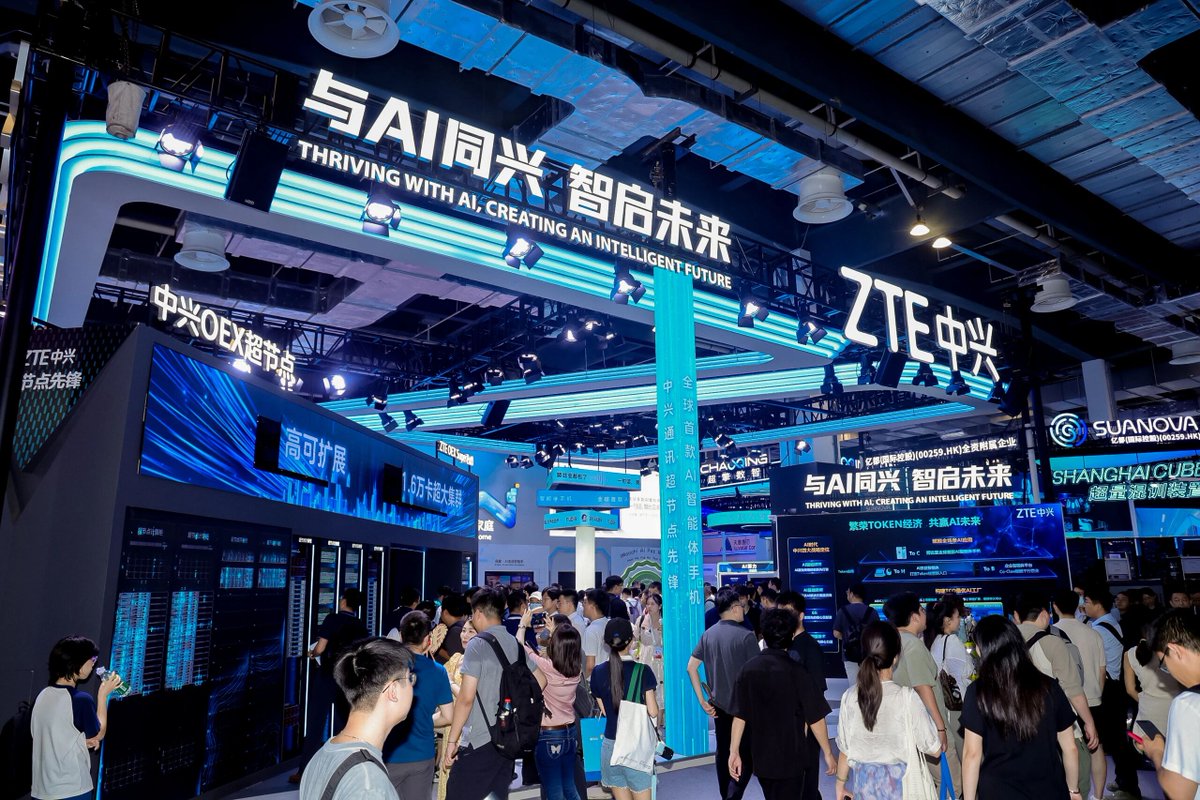
ZTE at World Artificial Intelligence Conference (WAIC) 2026: Thriving with AI, Creating An Intelligent Future 🤖✨
We showcased our full-stack AI lineup—from core computing to end-user devices:
🔹 OEX SuperNode – next-gen intelligent computing
🔹 World's first AI agent smartphone
🔹 New Start AIOS + multi-form humanoid robot matrix
Our "AIOS + AI Factory" framework connects the full AI value chain—from Token production to real-world deployment—scaling AI across industries. Guided by "All in AI, AI for All", we're powering the digital economy forward. 🌐🚀
#ZTE #WAIC2026 #AIforAll #IntelligentComputing #AIAgent