Investor since 2017. Studied Finance & Accounting @ The Harvard Business School. My posts are NFA. Bullish on #DeFi $AAVE $BTC $ETH #AI#MicroCaps so much more!
Noah got drunk.
Jonah ran away.
Moses stuttered.
Abraham was old.
Lazarus was dead.
Paul was a murderer.
Sarah was impatient.
Elijah was depressed.
Thomas was a doubter.
Yet, they were chosen by God.
Dear son, God doesn’t call the qualified; He qualifies the called.
from todays filing, @bstrco and $CEPO have agreed to work together on and are currently discussing a potential revised structure and amended terms for their previously announced proposed business combination, intended to opportunistically better capitalize on market conditions.
Standard Nuclear (NYSE: STDN) is officially a public company. 🇺🇸
The advanced nuclear fuel that will power America is now backed by the public markets. @NYSE
$SLNH I firmly believe that Soluna Holdings need to re-brand to Soluna Infrastructure or Soluna Power because as @jbelizaireCEO stated, @SolunaHoldings is no longer a Bitcoin Miner but a infrastructure company - see quote below from @jbelizaireCEO
“We are no longer a Bitcoin miner. We haven’t been for a while. We’re a data center infrastructure company powered by renewables.”
$SLNH
How Soluna Plans to Finance Billion-Dollar AI Campuses
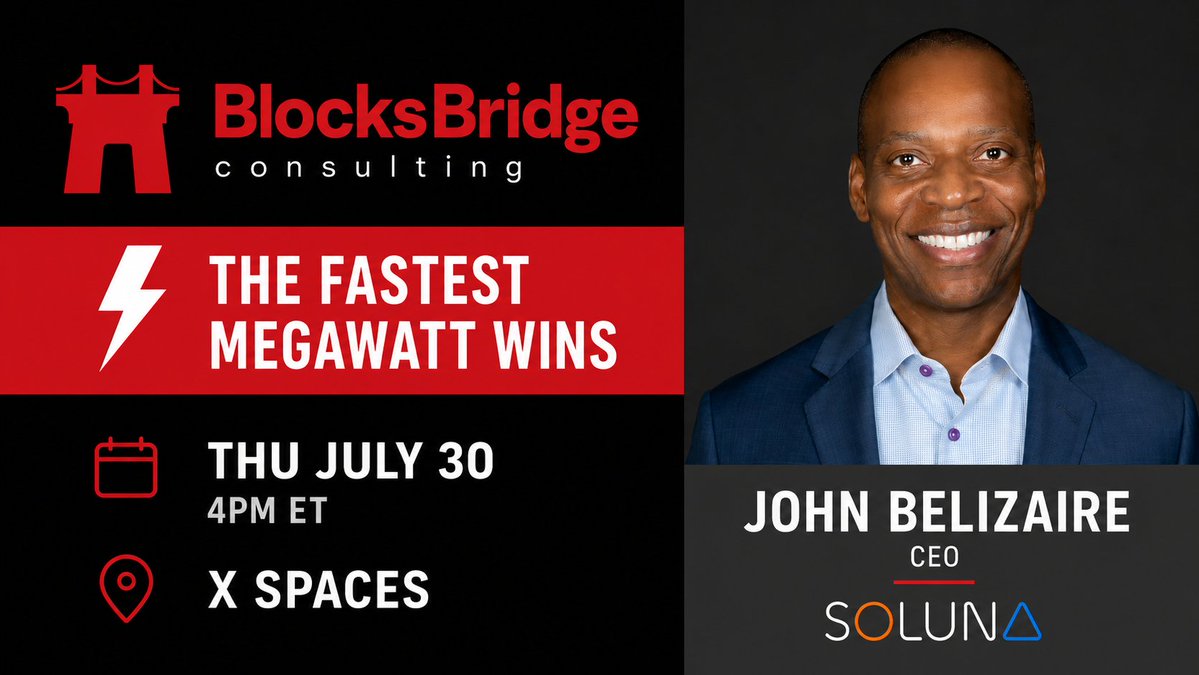
During the recent @BlocksBridge_ X Space, The Fastest Megawatt Wins, Soluna @jbelizaireCEO laid out the capital architecture behind the company’s AI buildout and why projects such as Kati 2 should not be measured against Soluna’s balance sheet alone.
“We are an infrastructure company,” Belizaire said. Over eight years, Soluna has built what he called a “flexible and multilayered” program combining project-level debt, project-level equity and capital raised at TopCo.
That blueprint is now being carried into AI.
For a 100-megawatt project costing roughly $1 billion, Soluna’s working target is:
- about 80% project debt
- about 20% project equity
- equity shared between TopCo and outside investors
- parent capital used for development, land and sponsor equity
“On $1 billion, you’re talking about $800 million of debt, $200 million, give or take, on equity.”
The bridge between a development site and that capital stack is the tenant contract.
"You either have a credit-worthy contract or you don’t.”
A long-term lease with a hyperscaler or strong neocloud converts future AI demand into underwritable cash flow. Lenders can size debt against net operating income, while equity investors can value the project as long-duration infrastructure rather than a speculative technology build.
Belizaire pointed to several capital pools: green banks, bond investors seeking contracted yield, data-center funds taking project equity and public-market investors funding Soluna at TopCo.
The equity layer can use a waterfall. An outside investor may initially receive more cash flow until its capital and target return are recovered. After that, Soluna can participate more heavily through common ownership and a developer promote.
That means ownership need not be binary. Soluna may hold a majority stake in one asset and a minority stake in another. The relevant question is how much value it creates for each dollar of sponsor capital invested.
Belizaire stressed that this is established infrastructure finance.
“Data centers have been financed this way for decades. We’re not reinventing something.”
That distinction matters because traditional investors struggled to underwrite Bitcoin. AI data centers with contracted tenants are familiar assets.
“Data centers, people know what that is. They know exactly how to underwrite it.”
He also made Soluna’s repositioning explicit:
“We are no longer a Bitcoin miner. We haven’t been for a while. We’re a data center infrastructure company powered by renewables.”
That identity can open a broader capital market once a project carries a creditworthy lease, defined construction plan and credible delivery team.
Belizaire described future equity as potentially “accretive, not dilutive.” New shares still increase the share count. His argument is that capital can create more value per share when it funds contracted assets worth materially more than the equity contributed.
He framed the scale directly: deploying $100 million to $200 million into infrastructure that could become worth several billion dollars over three to five years creates an opportunity particularly when one project could dwarf Soluna’s current market value.
The sequence is the key here:
Develop the site ---> Sign the lease ---> Form the project company ---> Raise debt and equity ---> Build ---> Energize.
One successful financing at Kati 2 or Dorothy 3 would do more than fund a campus. It could establish the lender relationships, investor waterfall and underwriting template for the wider 4.3-gigawatt pipeline.
That is the leverage inside Soluna’s model. The company is not trying to finance billion-dollar campuses alone. It is trying to originate them, secure the power and customer, attract the right capital and retain enough of the economics to make each project meaningful for shareholders.
$SLNH
How Soluna Plans to Finance Billion-Dollar AI Campuses
During the recent @BlocksBridge_ X Space, The Fastest Megawatt Wins, Soluna @jbelizaireCEO laid out the capital architecture behind the company’s AI buildout and why projects such as Kati 2 should not be measured against Soluna’s balance sheet alone.
“We are an infrastructure company,” Belizaire said. Over eight years, Soluna has built what he called a “flexible and multilayered” program combining project-level debt, project-level equity and capital raised at TopCo.
That blueprint is now being carried into AI.
For a 100-megawatt project costing roughly $1 billion, Soluna’s working target is:
- about 80% project debt
- about 20% project equity
- equity shared between TopCo and outside investors
- parent capital used for development, land and sponsor equity
“On $1 billion, you’re talking about $800 million of debt, $200 million, give or take, on equity.”
The bridge between a development site and that capital stack is the tenant contract.
"You either have a credit-worthy contract or you don’t.”
A long-term lease with a hyperscaler or strong neocloud converts future AI demand into underwritable cash flow. Lenders can size debt against net operating income, while equity investors can value the project as long-duration infrastructure rather than a speculative technology build.
Belizaire pointed to several capital pools: green banks, bond investors seeking contracted yield, data-center funds taking project equity and public-market investors funding Soluna at TopCo.
The equity layer can use a waterfall. An outside investor may initially receive more cash flow until its capital and target return are recovered. After that, Soluna can participate more heavily through common ownership and a developer promote.
That means ownership need not be binary. Soluna may hold a majority stake in one asset and a minority stake in another. The relevant question is how much value it creates for each dollar of sponsor capital invested.
Belizaire stressed that this is established infrastructure finance.
“Data centers have been financed this way for decades. We’re not reinventing something.”
That distinction matters because traditional investors struggled to underwrite Bitcoin. AI data centers with contracted tenants are familiar assets.
“Data centers, people know what that is. They know exactly how to underwrite it.”
He also made Soluna’s repositioning explicit:
“We are no longer a Bitcoin miner. We haven’t been for a while. We’re a data center infrastructure company powered by renewables.”
That identity can open a broader capital market once a project carries a creditworthy lease, defined construction plan and credible delivery team.
Belizaire described future equity as potentially “accretive, not dilutive.” New shares still increase the share count. His argument is that capital can create more value per share when it funds contracted assets worth materially more than the equity contributed.
He framed the scale directly: deploying $100 million to $200 million into infrastructure that could become worth several billion dollars over three to five years creates an opportunity particularly when one project could dwarf Soluna’s current market value.
The sequence is the key here:
Develop the site ---> Sign the lease ---> Form the project company ---> Raise debt and equity ---> Build ---> Energize.
One successful financing at Kati 2 or Dorothy 3 would do more than fund a campus. It could establish the lender relationships, investor waterfall and underwriting template for the wider 4.3-gigawatt pipeline.
That is the leverage inside Soluna’s model. The company is not trying to finance billion-dollar campuses alone. It is trying to originate them, secure the power and customer, attract the right capital and retain enough of the economics to make each project meaningful for shareholders.
🚨 @keelinfra_ Power Pipeline Takes Shape 🚨
⚡ 341 MW energized — capacity already delivered by utilities and live on site
⚡ 430 MW secured — executed utility agreements locked in for future delivery
⚡ 1.5 GW expansion — under application or being evaluated for on-site behind-the-meter generation
⚡ 2.2 GW total pipeline — the full build-out across energized, secured, and expansion capacity
Power is the moat. Deals are inevitable as per @CaptainKeel 👇👇👇 $KEEL
Good look at @FortitudeMining's Zcash $ZEC strategy in @DecryptMedia today. Owned power, planned low-cost production, and a path to the public markets
$HSCS $TUDE
https://t.co/QnQNW9lwSJ
Tomorrow, at 4 PM EST, @solunaholdings's CEO @jbelizaireCEO will join us to talk about owned generation, speed to power, and $SLNH 's AI buildout
Tune in 👉 https://t.co/XlAkdEFi0K
$GLND @GL_Energy_Co could be a chance of a lifetime opportunity if the company is successful at obtaining drilling permits and strikes oil in Greenland. Not Financial Advice.
$GLND Based upon the valuation of the most recent and largest discovery of 11 billion boe at Guyana's Stabroek Block in 2015, our valuation here would be $100 billion in market cap size with a discovery of 3 billion boe.
Still a lot of folks don't understand the
magnitude of the sheer and immense amount of treasure that lies beneath the Jamison Land Basin.
It's an exciting time for @DeepFission. ⚛️
What if the biggest barrier to expanding #nuclear energy isn't the reactor, but the way we deploy it?
In this overview video, our CEO and co-founder Liz Muller shares about our deployment-first approach and progress toward commercialization, leveraging proven technology in a new way to help meet urgent demand for reliable, affordable power.
Watch ⬇️
@MPtherealmvp@aave@MPtherealmvp How do I purchase some @aave merchandise? I have been trying to get my hands on some official merchandise for awhile now but have not had any luck.
@MPtherealmvp@aave Hey Guys! How do I purchase some @aave merchandise? I have been trying to get my hands on some official merchandise for awhile now but have not had any luck.
What is the likelihood of @mikealfred joining the @SolunaHoldings board? @mikealfred is a credible name in the AI HPC energy space. Also, what is the likelihood of @SolunaHoldings re-branding to Soluna Infrastructure or Soluna Energy or something that helps encompass the business that @SolunaHoldings is building?