Technical writer, photographer, videographer, author of fantasy. For more artistic and creative content, follow me @quillways.
#Science#Photography#technology
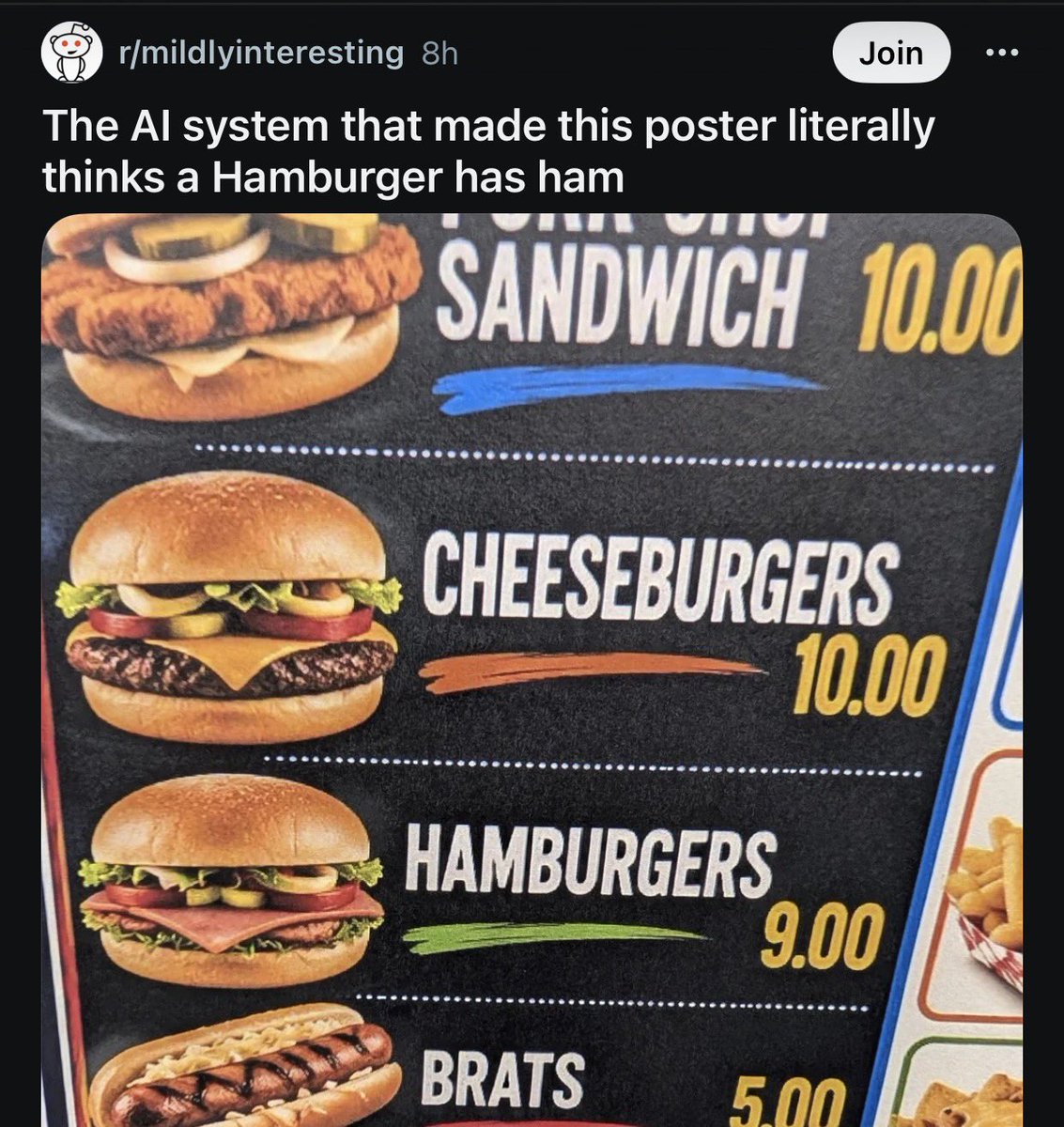
I was at a food festival this weekend and the amount of stalls that used AI images is depressing. There are laws against using computer generated images for food for a reason.
The Spectator’s John Power and @WTMAtkinson have exposed the “Dark Green Lobby” — “a complex web of interlocking charities, think tanks, advocacy groups and campaign outfits, often funded through foreign channels” — which is pushing the net-zero agenda in Britain at the expense of free speech.
This lobby has been remarkably successful at shaping policy, but it has also sought “to distort the energy debate by de-legitimising opponents”. To that end, it contributes financially to “tackling what it calls ‘climate disinformation’ – or what anyone else might think of as informed free speech”.
Read more below in @spectator 👇
Positional hold without an encoder. 8.5714285714 degree accuracy.
Not perfect yet... detent + hall trigger overlap with poor hall resolution make this trickier than encoder driven! But ill get it.
One of my all time favorites! This #infographic helps you to visualize geologic time. Earth came into being at the shoulder, single cell organisms started at the forearm, humans only rocked up at the tip of the finger nail. Source: https://t.co/zo0IzlYoVk
Something that keeps me up at night is the amount of miscompiled software running in the wild.
There’s a famous story, “the Core 59 problem” from Facebook where seemingly random files were missing in one of their Spark databases.
After herculean levels of debugging, they narrowed the problem down to a single worker box, on a single CPU core, that was literally doing math wrong.
The initial bug-reproducer was 430k(!) lines of code. Eventually they managed to create a 60-line snippet of assembly that reproduced the issue 100% of the time.
What spooks me out is the possibility of an accidental durable artifact getting propagated to clean machines via compilation. Some (small) % of CPU cores in the wild are just plain bad, bad cores can compile static programs, said static programs can get signed and distributed, thus spreading an “infection” to perfectly healthy machines!
Tonight at 4pm PT, Valar Atomics will initiate a SCRAM and subsequently a Loss of Forced Cooling event on the Ward 250 plant. This will be our most important safety demonstration to date, showcasing how far advanced nuclear has come in fundamental safety.
Loss of cooling has always been the central challenge behind some of the most serious historical reactor incidents; it’s what caused the meltdowns in both Fukushima and Three Mile Island. After a reactor shuts down, the recently split atoms continue to give off heat as they work down their decay chains, causing temperatures to rise in the core. In traditional reactors, this means that it is necessary to continue running the cooling pumps for several days after a shutdown. In the case of both TMI and Fukushima, forced cooling of the core failed, causing meltdown.
So why are we going to initiate a Loss of Forced Cooling event tonight?
Because the Ward series of reactors are fundamentally different from the reactors of prior generations. We designed this reactor to be inherently and intrinsically safe, also called “walk-away” safe. Tonight, we’re going to demonstrate that.
After commanding a SCRAM of the reactor, our Senior Reactor Operator (SRO) will command the reactor operator to shut down the main circulator, turning off forced cooling. But the SRO will not stop there—we are going to simulate total electrical failure of the plant. In addition to shutdown of the coolant loop, we will shut down the chiller, the RCCS pump, and both building and nuclear HVAC systems.
This will leave the reactor without any active cooling of any kind, giving us a complete demonstration of the passive safety of this architecture. Over the next 24 hours, we will see the decay heat in the core safety distribute through the system and leave through the RCCS via passive circulation.
We are not going in to this blind. We did this test in Hawthorne late last year at much higher temperatures and with a simulated decay heat input more than 100x higher than we’ll be demonstrating today. But tonight, we’ll be doing it with real nuclear decay heat.
Join us live at 4pm PT / 7pm ET on the Valar Atomics X account!
Anyone who can't see what is happening is blind.
1) Banning of the ability to have privacy with a cellphone
2) Banning of the ability to own a foreign router (which may not "comply" with future "required" legislation )
3) Identity checks at the OS, App Store and Service provider levels.
4) Ability to restrict individuals access to the internet, to given types of content, etc
5) Forced front and center "official" news media forced into online services.
6) Control over AI algorithms
7) Control over algorithms for visibility/sharing of content
8) Control over peoples cars (remote kill switches, embedded biometrics, automated reporting to LEO, inebriation checks).
9) Forced biometrics to login to computers, phones, etc
10) Digital ID to replace physical ID.
11) Digital cash to replace physical cash
12) Millions of biometrics and license place cameras + millions of "gun shot detection" systems
13) Banning of mobile applications and endpoint software the government deems wrong, dangerous, or incorrect, etc. (Tiktok, Kaspersky, etc)
14) AI being embedded in every processor, mobile device, desktop OS, etc.
15) Laws demanding "backdoored" encryption.
16) Laws demanding client side scanning.
17) Laws demanding control over speech deemed harmful, violent, dangerous, upsetting, etc
18) Charges and convictions against anyone releasing privacy focused software (tornado cash).
19) AI predictive policing and predictive dissent detection
20) Centralizing of all healthcare, psychological, financial, online, offline, travel and government records.
21) Forced biometrics collection to travel, attend public events, etc
Quite a coincidence that every country in the western world is simultaneously proposing similar censorship agendas over the internet at exactly the same time
@ActivePatriotUK stirring up the soil and trying to make more of it available to get to more grounddwelling organisms, which serve as food for the swans.
If this works, the energy debate will be over.
This is actual fusion energy, about to go commercial, not just a science experiment to study the behaviour of science.
We’ve raised a $465 million Series G funding round at $15.5B post-money valuation to accelerate the commercial deployment of fusion.
Read more here: https://t.co/y67OAnQlah
We’ve raised a $465 million Series G funding round at $15.5B post-money valuation to accelerate the commercial deployment of fusion.
Read more here: https://t.co/y67OAnQlah
According to data from the World Bank, the share of the population living in extreme poverty ($3/day PPP) is now higher in the United States than in China.
The evolution of European cannons had less to do with a choice between size and mobility and much more to do with the available materials in Europe.
If you look at early cannons, they were usually made of bronze, and cast bronze was strong enough to build large cannons, such as those used by the Ottomans in the siege of Constantinopole (1453) and onwards. Bronze cannons could be made larger and more reliable.
However, Christian powers of Europe did not have enough bronze to economically field large artillery cores. As a result, iron cannons became a cheaper, yet inferior, alternative. The cast iron of that era was too brittle for cannon making, which led these European cannon makers to use wrought-iron strips hammered together like a wine barrel (held together with metal hoops). These had a smaller caliber because the iron was too brittle and heavy for larger cannons.
Naturally, this led to improvements in iron (and later steel) making, as cannon makers wanted to create better, more reliable cannons. In 1543 an English cannon maker was able to produce a cast-iron cannon for King Henry VIII. These cannons were still inferior, as they were heavier and less reliable, but they only cost a third to a tenth of a bronze cannon's price.
The idea of portable cannons only came to be under the reforms of the Swedish king Gustavus Adolphus, AKA the Lion of the North. The Swedes were embroiled in European conflicts and copied the smaller calibers of their rivals; however, they used bronze cannons, as Sweden is blessed with large quantities of copper (one of the ingredients of bronze). Embroiled in a war with the Polish-Lithuanian Commonwealth, the Swedes needed a counter for the Polish winged hussars. The traditional cannons of that era could fire at massed armies, but aiming at a small squad of elite mobile cavalry that can attack from any direction was impossible.
This would eventually lead to an increase in lighter cannons and trials to lower the costs via leather cannons (using a copper or bronze tube reinforced with iron hoops and leather). Eventually those would be employed by Gustavus Adolphus as he joined the 30 Years' War against the Catholics of the Holy Roman Empire.
Even then, pure bronze cannons remained the best option and would be preferred by land armies, while navies and fortifications would opt for cheaper, heavier iron cannons, as portability was less of an issue for those. The shift would only be complete when the Bessemer process was invented (1856), as it would allow for the creation of completely reliable iron and steel cannons.
Spins can be deadly. In the earliest days of aviation, nobody knew how to get out of one. If you got in a spin, you just died.
Then in 1912 or 1916 (date varies), a British mathematician / pilot came up with an idea to get out of a spin.
A test pilot volunteered to try. Risky, but it worked…then he climbed back up, spun his plane in the opposite direction & recovered that, too, in front of an awed audience.
During WWI, British pilots were taught to deliberately enter a spin if they found themselves on the losing end of a dogfight. German pilots would break off the attack, expecting to see their prey auger in…but to their surprise, the British pilots would recover. By then, they were out of range of the German airplane.
Your tooth enamel is the hardest thing your body makes, harder than steel. It is also the one part of you that never grows back. The cells that build it die the moment your teeth come in, so every chip and cavity you pick up after that stays for life.
This is the reason a dentist can't just heal a bad tooth. There is nothing left to regrow it with, so they drill out the decay and plug the gap with metal or resin. The plug holds, but the tooth never makes new enamel on its own again. And this kind of damage hits close to half the people alive.
In November 2025, a team at the University of Nottingham showed a way around it. They made a gel out of proteins copied from the ones a baby's body uses to grow enamel in the first place. You paint it on a worn tooth, and it lays down a tiny frame. The frame then pulls minerals out of your own spit, and fresh enamel crystals start growing on top, locking onto the old ones. The tooth ends up growing its own enamel back.
Tested on real human teeth in a lab, two weeks of the gel grew back a layer that took chewing and acid as well as natural enamel does. The honest part is the size of it. That new layer is about as thin as a sheet of kitchen foil, while the enamel that takes the beating when you chew is roughly 200 times thicker. And so far it has only worked on teeth sitting in a dish, never in a living mouth.
A milder version is already real. A Swiss treatment called Curodont, which uses a similar protein-based trick, has spent years patching the chalky white spots that appear just before a cavity forms. Nottingham wants to rebuild a thicker layer than that, and its new company hopes to sell a first product in 2026, around the time human testing begins. The real promise is smaller than the headline but more useful. It works best before there's a real cavity, catching a tooth while the damage is still small, so you never reach the day you're staring at the drill.
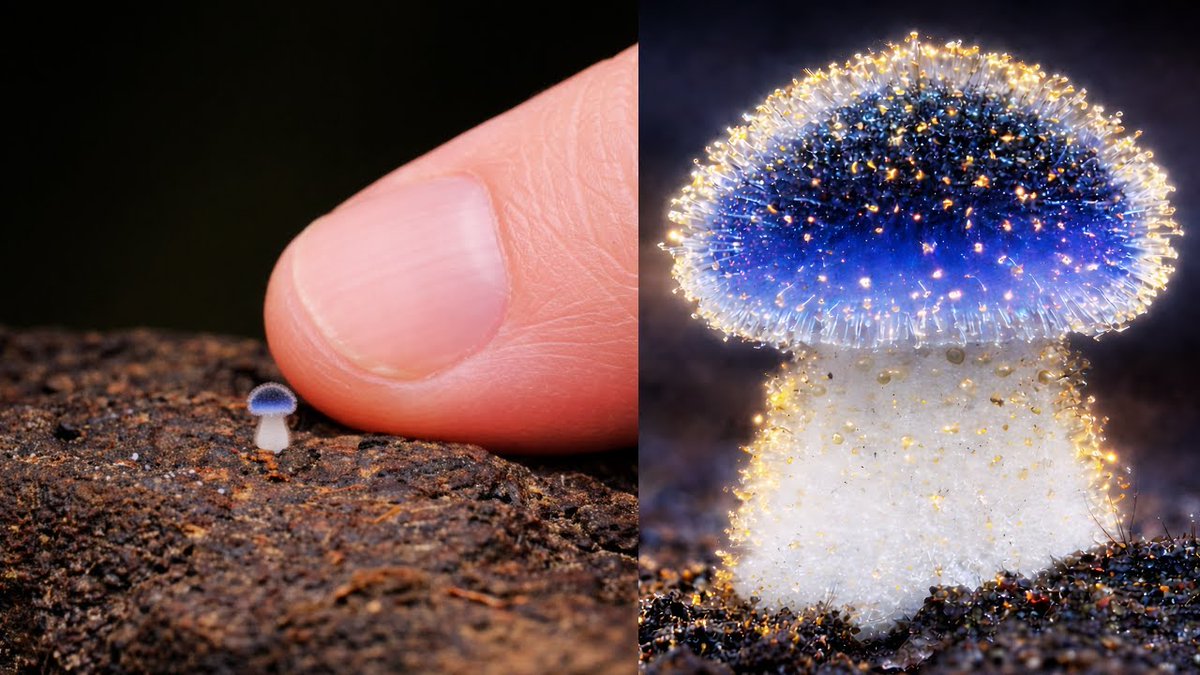
A pharmacist in Taipei walked off a trail in 2022 and photographed a 1mm blue mushroom on a piece of wood. It turned out to be one of the smallest mushrooms ever described.
The mushroom is now called Mycena subcyanocephala. It grows on decaying wood in Taiwan's subtropical lowland forests. Its cap is about 1mm wide, the whole fruiting body just a few millimeters tall. When young, the cap is intensely blue and fuzzy. As it matures, the blue fades to a pale whitish color. It has been formally documented in the wild only a handful of times.
Eric Cho, the man who found it, is a working pharmacist in Taipei. His friend told him there was a "special tiny mushroom" on a trail in Shilin District. He went looking, found one on a piece of wood, took it home, and was initially disappointed because it wasn't glowing in the dark like he'd hoped. He posted the photos to iNaturalist anyway.
The images went viral globally. Mycologists at Taiwan's Academia Sinica formally described the species in 2023, citing Cho's photographs as part of the documentation.
Most new species described in the last decade have not been found by professional biologists in remote jungles. They have been found by amateur naturalists with smartphones, posting to platforms like iNaturalist, in places like trails behind suburbs in Taipei.
The forest behind your house may still be full of things nobody has named yet.