RichMd: rich Markdown for Dear ImGui
* C++ & Python
* Selectable & searchable
* Math and diagrams, drawn natively
* Tables, code, images, TOC
It works with stock Dear ImGui 1.92+, and it is the same as in Dear ImGui Bundle.
Try it in your browser:
https://t.co/njRppyKbAb
We're excited to announce Zeiger! a fast, free image viewer for Windows and macOS, from the Blick team. Now in public beta.
Sharp pixel zoom, quick edits, a color picker, EXIF, GIF scrubbing, and more!
Completely FREE for personal and commercial use, link in comments.
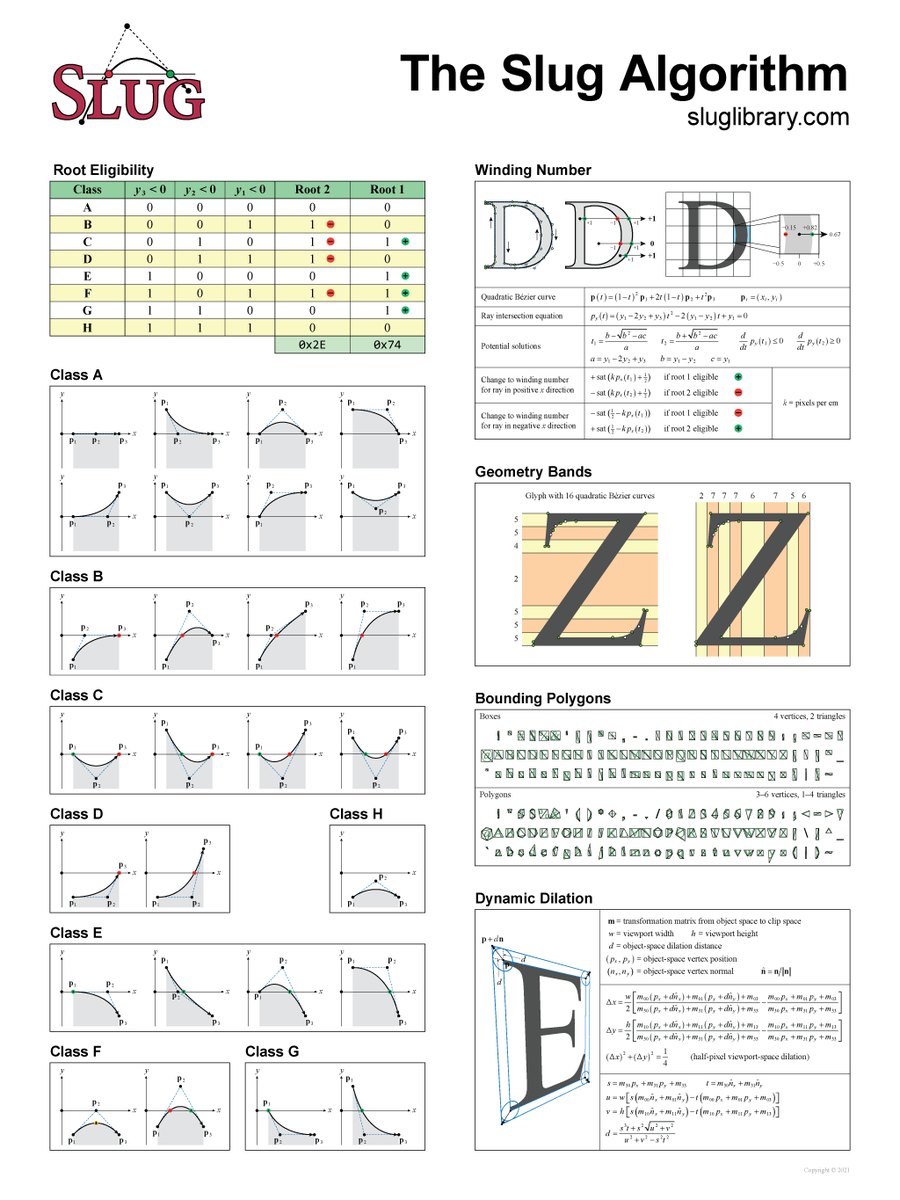
New blog post: A Decade of Slug
This talks about the evolution of the Slug font rendering algorithm, and it includes an exciting announcement: The patent has been dedicated to the public domain.
https://t.co/xWEz0q2c4N
Imagine you're John Carmack
you're 22 years old and you just wrote a 3D engine in assembly that runs at 35fps on a 486
Doom drops. Quake drops. Half the planet is playing your code.
you're the reason GPUs exist. you're the reason your friend Jensen has a yacht today.
then in 2009, you sell id Software. people call it betrayal. you call it "they made an offer I couldn't refuse."
VR obsession. Oculus. Meta buys it for $2B. you're CTO.
but Meta thinks you're a liability. your demos are "too intense." your emails are "too long." your focus on frame timing is "slowing us down."
2022. they push you out. not fired officially. just "restructured."
the media writes "end of an era." some crypto bro calls you "washed up."
silicon valley moves on.
but you don't.
you don't write a book. you don't start a podcast. you don't collect speaking fees.
you go completely quiet.
you take the money. you buy a warehouse in Texas. you hire 10 engineers. and you start coding.
not games. not VR.
AGI.
two years. radio silence. no tweets. no conference talks.
while everyone's debating ChatGPT, you're debugging CUDA kernels at 3AM, testing world models.
then in 2025, Keen Technologies pivots hard. you're not "exploring" anymore. you're building it.
here's what people get wrong:
everyone calls it a comeback. a redemption arc. "revenge on Meta."
it's none of that.
you're a 54-year-old engineer who still codes 12 hours a day because you genuinely can't stop.
most CTOs would have bought an island. most legends would have written memoirs.
you just kept typing.
the most dangerous person in any codebase is the one who goes quiet and never stops shipping commits.
karma doesn't need to be real.
but obsession is.
welcome back, Carmack.
Fred Brooks in 1999: «Well over half of the time you spend working on a project (on the order of 70 percent) is spent thinking, and no tool, no matter how advanced, can think for you. Consequently, even if a tool did everything except the thinking for you—if it wrote 100 percent of the code, wrote 100 percent of the documentation, did 100 percent of the testing, burned the CD-ROMs, put them in boxes, and mailed them to your customers—the best you could hope for would be a 30 percent improvement in productivity. In order to do better than that, you have to change the way you think.»
How much of your work can be outsourced to AI? It is a test. It tells you much about what you have been doing.
I write code almost every day. I am also an early adopter of Copilot (AI) to help me code. I probably started using it nearly when it came out. It is great because it helps me do routine work much faster.
It is not changing what I do very much.
Why not?
Because what I did was never, primarily, typing code. I mostly do R&D. It is a fancy way of saying that I mostly try to do “new things”, develop ideas that have not been fully worked out in the past. Even when I use well-understood ideas, my work has to do with testing ideas carefully in practice.
It is like my posts here on X. I try to contribute with my original voice. I am enough of a programmer that I could hook up some AI to my account and have it generate daily posts. I could probably do it well enough that a lot of people would be fooled… they would think it is me typing. But that would defeat the purpose. I am trying to push the envelope, to go further than others have gone. It is not, in the least, that I think that I am smarter than others… it is that the value of the information you produce is directly related to its novelty. Repeating what everyone is saying contributes little value.
Here is how I imagine software is going to go from now on. You are building your software. There is a well-understood idea that you did not implement for lack of time or lack of people. You go ask AI to implement it, and it will do so quickly. The idea is well understood and the AI has plenty of related training material and references.
Done.
You, as the developer, have not done nothing even then. You made the choice to adopt this idea, this new technique. Was this a good idea in your context? It is up to you. You take the responsibility.
In effect, the “me too” angle in software is a solved problem. You can quickly copy or emulate well-understood ideas.
This should impact the software industry in interesting ways. Many software companies have mostly boring code. They have a large stack implementing mostly routine, well-understood ideas. In at least some cases, they should expect to face new and previously unexpected competition. A small team with enough AI power can now reproduce most of their stack.
And that's a good thing: innovate or die.
But what I also predict is that people who have an “original voice”, people who never just coded what everyone coded, people who went further… these people will do better than ever. For one thing, they will be freed from doing so much routine work. They will have fewer boring coworkers and thus fewer boring meetings.
Thus, I predict, people who do R&D will do well.
We are not yet seeing the benefits. We don’t see this R&D creating new tangible results… but I think that the “AI wave” will eventually reconfigure enough of the economy, and enough people will figure out the new game, and then we will see something resembling a golden age for innovation.
Maybe. I can’t predict the future. But that’s what I imagine.
Brief introduction to a number of OIT techniques: "Advances in Order Independent Transparency for Real-Time & Virtual Production Workflows" https://t.co/3r9JlMAHVG
Here's a cool new paper on an energy-preserving version of the Oren-Nayar model for a rough diffuse BRDF. By @jamportz, @pzkutz, and @self_shadow!
https://t.co/GchEQrDaKB
@BarryRevzin I find the Magnum graphics library excellent in content and fully generated from source. However, there's also a huge amount of info for each class that is essentially equivalent to hand-written docs, just kept in-source. Example: https://t.co/sH1yYBDkFe
@lefticus @jntrnr @rustlang Really enjoyed Jonathan's teaching style of letting Jason run into issues and discussing the compiler errors, so much better than just showing the right solution! keep at it!
@richgel999 This library might be a good start if you would consider vulkan: https://t.co/rYplUpTQXk
I remember the authors talking about porting their whole GUI library to Vulkan as the ultimate goal..
@jasoncalvert@UnrealEngine Wow this looks great! Any chance we can try this somewhere, or some pointers on where to start reproducing something similar?