The single biggest recurring failure in Western foreign policy: Mirror Imaging. Assuming the other side thinks like you do, values what you value, and will respond to incentives the way you would.
When the #US says "deal," they mean a transactional exchange with measurable deliverables. When the #IRGC hears "deal," they hear capitulation dressed in diplomatic language. Those two words don't occupy the same conceptual space. Witkoff and Kushner walk in thinking they're closing a real estate negotiation. #Iran side walks in thinking they're defending a civilizational position.
Please someone get to the West a Duolingo course in post 1979 Farsi language...
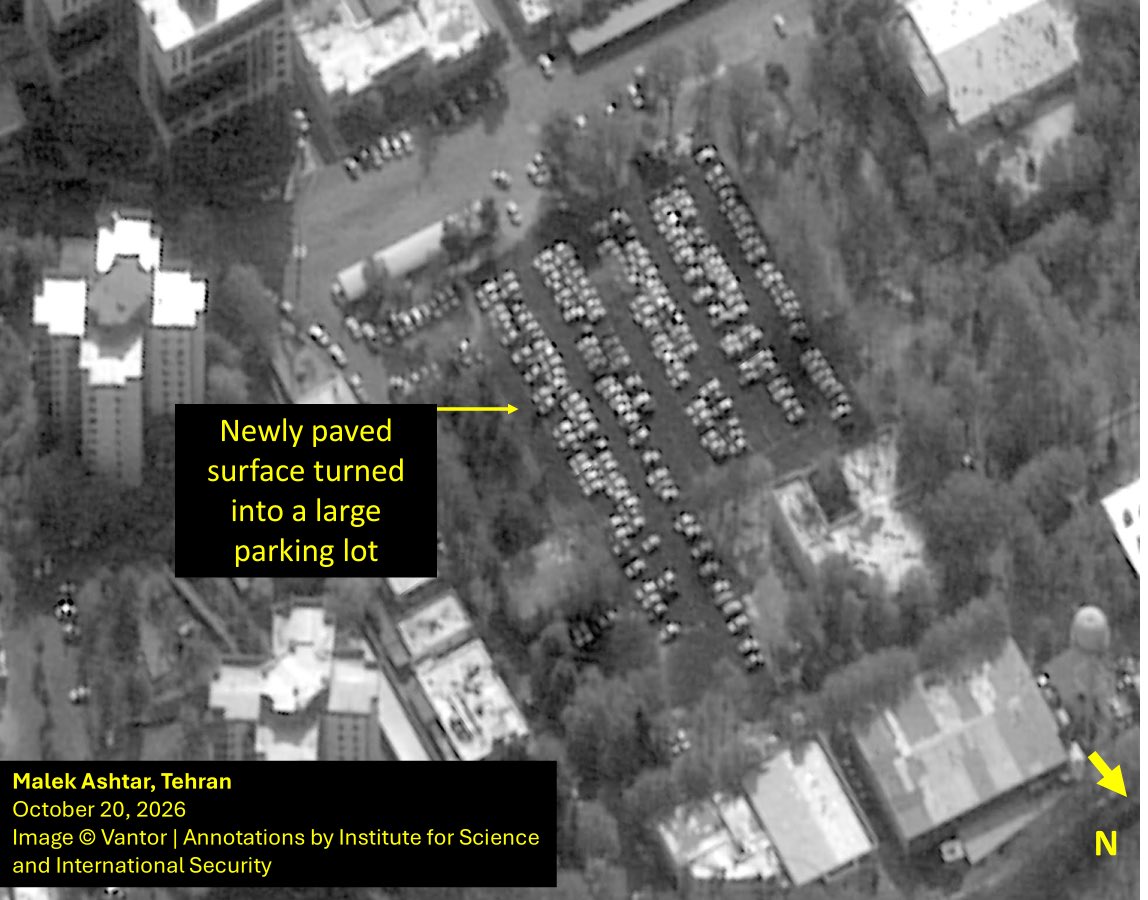
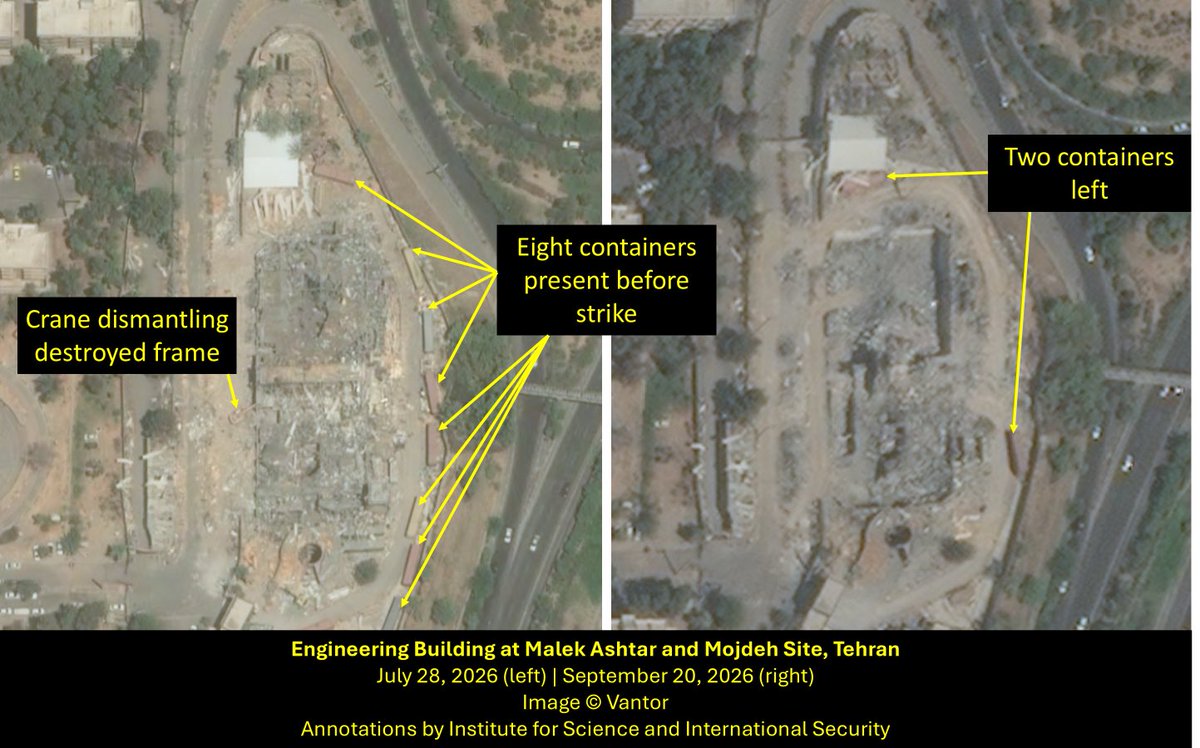
NEW imagery update: Various levels of cleanup activities were observed at the three sites related to Mojdeh / Lavizan 2 following the March 2026 attacks: The main Mojdeh site was previously attacked in June 2025 and was undergoing rapid cleanup efforts, which the follow-on strikes in March 2026 appear to have effectively ended. After several months of little activity, the attacked, large engineering-type building just north of the main Mojdeh site is currently in the process of being fully dismantled and cleared. In the process, six containers that were stationed alongside the building before the attack were removed. The remnants of the destroyed large building cluster at Malek Ashtar University have been fully cleaned up and the space was turned into a large parking lot accommodating the many personnel vehicles on site. See the figures for an overview of the area after the June 2025 war but before the attacks in the March 2026; the various levels of cleanup activity around the area as of mid-September; and close-ups of the Mojdeh site, the engineering-type building, and the cleaned up area at Malek Ashtar University.
Read the full report here: https://t.co/Ps1QABU4eQ
Pickaxe Mountain Imagery Update:
Vantor Technologies imagery from October 7, 2026, shows that the Eastern tunnel entrances remain blocked by earth. The earthen mound roadblocks leading to the Western tunnel portals also remain in place. See Figures 1 and 2. The two-month-long restricted access reinforces the assessment that the facility is currently neither operational nor continuing major construction. It supports public reporting that the facility contains valuable equipment and/or materials, such as centrifuges and centrifuge components, believed by Israeli intelligence to have been moved into the tunnel facility following the 12-Day War, as reported by the Wall Street Journal in July 2026.
Regarding an attack on the site, a combination of what was done at Natanz and Fordow in June 2025 and at Shahid Boroujerdi in Spring 2026 appears to make the most sense — using a series of bunker busters to target vulnerabilities in the mountain, such as ventilation shafts, coupled with collapsing entrances and destroying utilities and other support infrastructure outside of the tunnel. We have identified both a probable and a possible ventilation shaft location at Pickaxe mountain using satellite imagery. That said, it is possible that the U.S. government decides, based on the information it has on the tunnel site, that the MOAB, which is not a bunker buster but creates the most powerful non-nuclear shockwave, is best to inflict damage on the site. According to CNN reporting this is being considered. While Iran has a lot of experience building military tunnels and commonly adds blast traps by the entrances to prevent shockwaves from traveling down into the facility, these methods are designed to protect against much smaller shockwaves compared to the massive one created by the MOAB. Such an attack could place Pickaxe mountain in the same category that Natanz and Esfahan have been in for more than a year now: Forced, monitored closure, with lack of information about extent of damage inside.
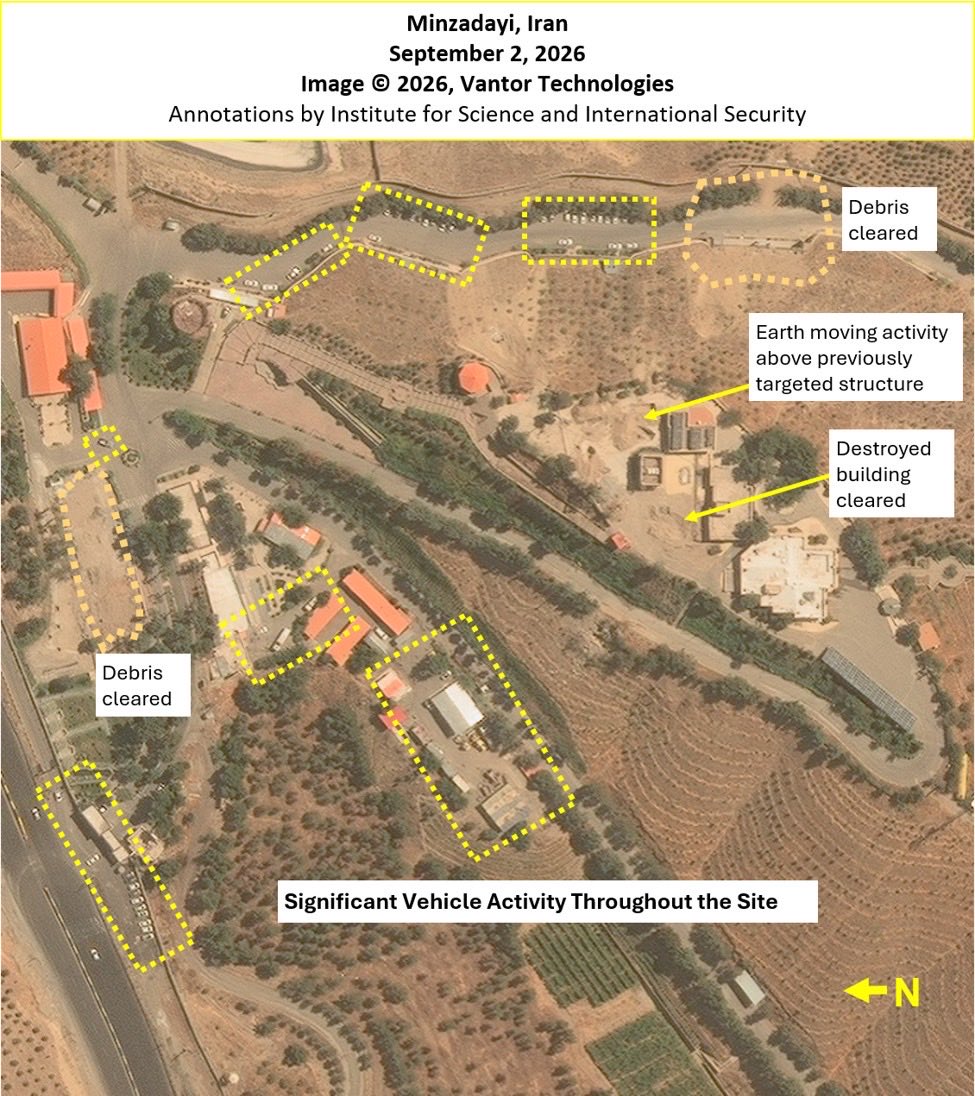
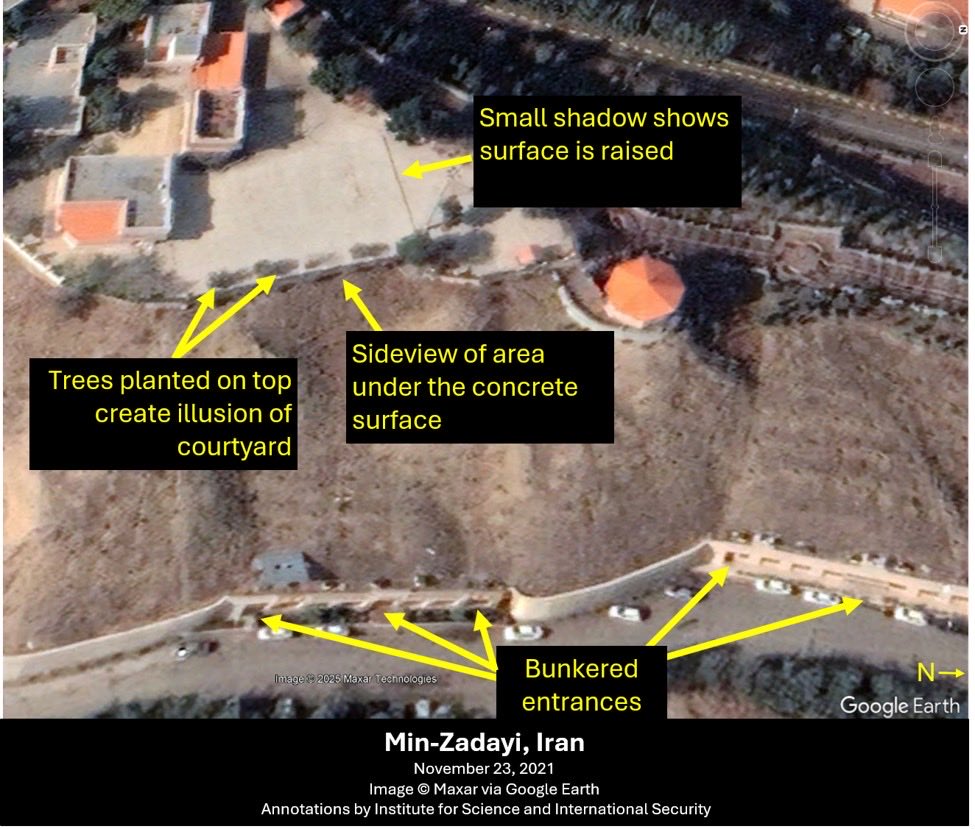
In addition to the earlier reported high levels of vehicle activity, we noticed the repair of a probable water tank and the addition of a new, small building nearby in the northern part of the Minzadayi site. This again points to Iran's efforts to not just clean up the site, which was attacked by Israel in March 2026 for its nuclear weapons connection, but to resume regular activities. See our earlier report here: https://t.co/SXt9waDSER
NEW Report: Significant Activity Identified at Minzadayi, an Iranian Nuclear Weapons Development Site
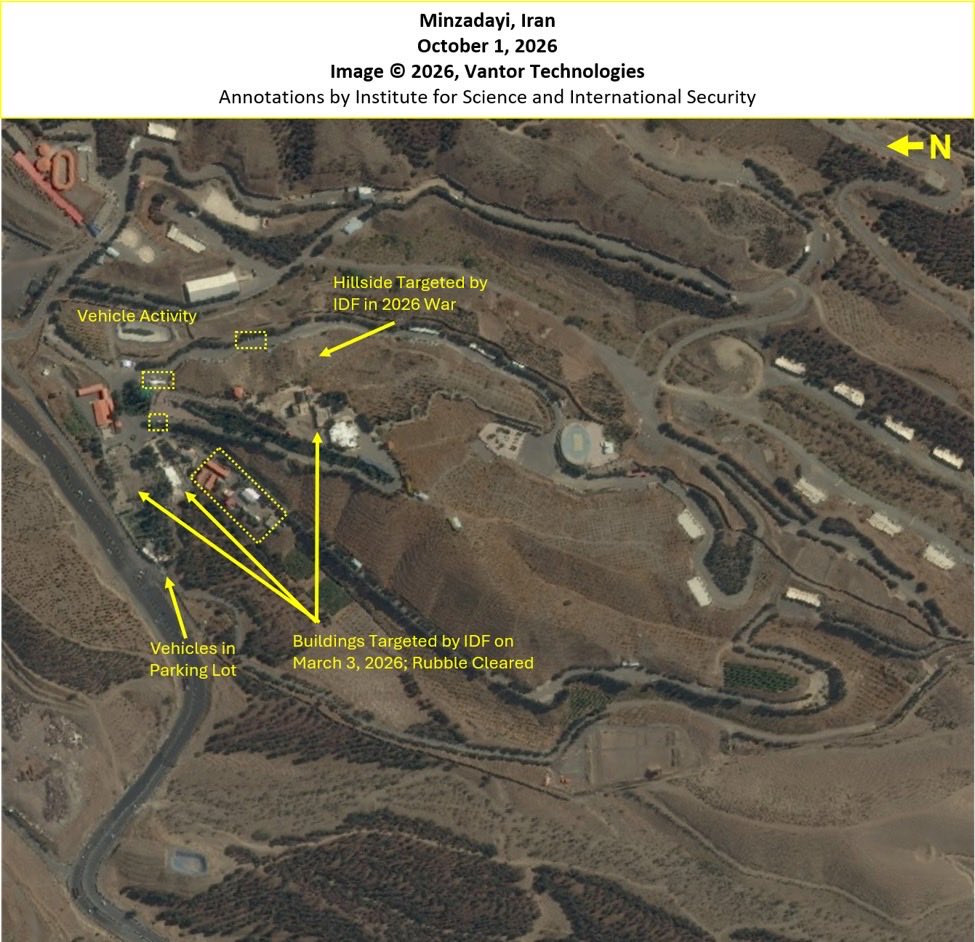
High resolution @vantortech satellite imagery from September and October 2026 shows significant renewed activity at Minzadayi, a nuclear weapons development compound northeast of Tehran revealed by Israel during the 2026 war. The compound was attacked by Israel on March 3rd, 2026, destroying several buildings and likely underground structures. The recent satellite imagery indicates a return to regular vehicle activity around the site post extensive cleanup operation that included the clearing of rubble and debris and repair of damage on the hillside. One area attacked in March 2026 shows ongoing earth moving activity. The earth moving activity is occurring at a surface made to look like a courtyard where multiple craters could be seen following the attacks on the site in March 2026. Significant vehicle presence can be seen throughout the site between early September and early October 2026. Cars are parked outside the security perimeter in the parking lot, and many passenger vehicles and trucks can be seen inside the perimeter. Given what is known about this compound, this activity may be indicative of an effort by Iran to reestablish a nuclear weapons development capability and to reconstitute what was lost in the attack on the compound.
Based on public reporting and statements released by the IDF, the nuclear weapons work carried out here likely involved research and development on nuclear warheads. The IDF originally stated, that a “group of nuclear scientists operated covertly to develop a key component in the nuclear weapons system,” adding that “the complex is designed to enable the restoration of the required technology and the advancement of capabilities for the development of nuclear weapons.”
@IntelliTimes, released additional information on the compound. In a post from September 24, 2026, it states that the nuclear weapons related infrastructure was established in 2022 and “absorbed part of the means from the nuclear warehouse,” a common reference to the Turquz Abad site revealed by Israeli Prime Minister Benjamin Netanyahu in September 2018. Netanyahu revealed the site following Iran’s removal of more than a dozen shipping containers from the site that were assessed to hold nuclear material and equipment relevant to Iran’s nuclear weapons capabilities.[4] When the IAEA visited Turquz Abad in March 2019, it found evidence that nuclear material or contaminated equipment had been present at the site and the IAEA Board has since been pressing Iran to answer the IAEA’s questions about the current whereabouts of said material and/or equipment. @IntelliTimes indicates Iran did not simply move the material and/or equipment to a new long term storage site but used the new site in northeast Tehran, aka Minzadayi, to establish an” industrial nuclear headquarters for the reconstruction of research, development, and adaptation infrastructure for nuclear warheads,” including the means to “produce cores of enriched uranium and the explosive material required to cast into them the detonation chain.”[5] The current renewed effort underway at this highly secure compound suggests that the work being conducted here is of top priority.
Read the report here: https://t.co/SXt9waDSER
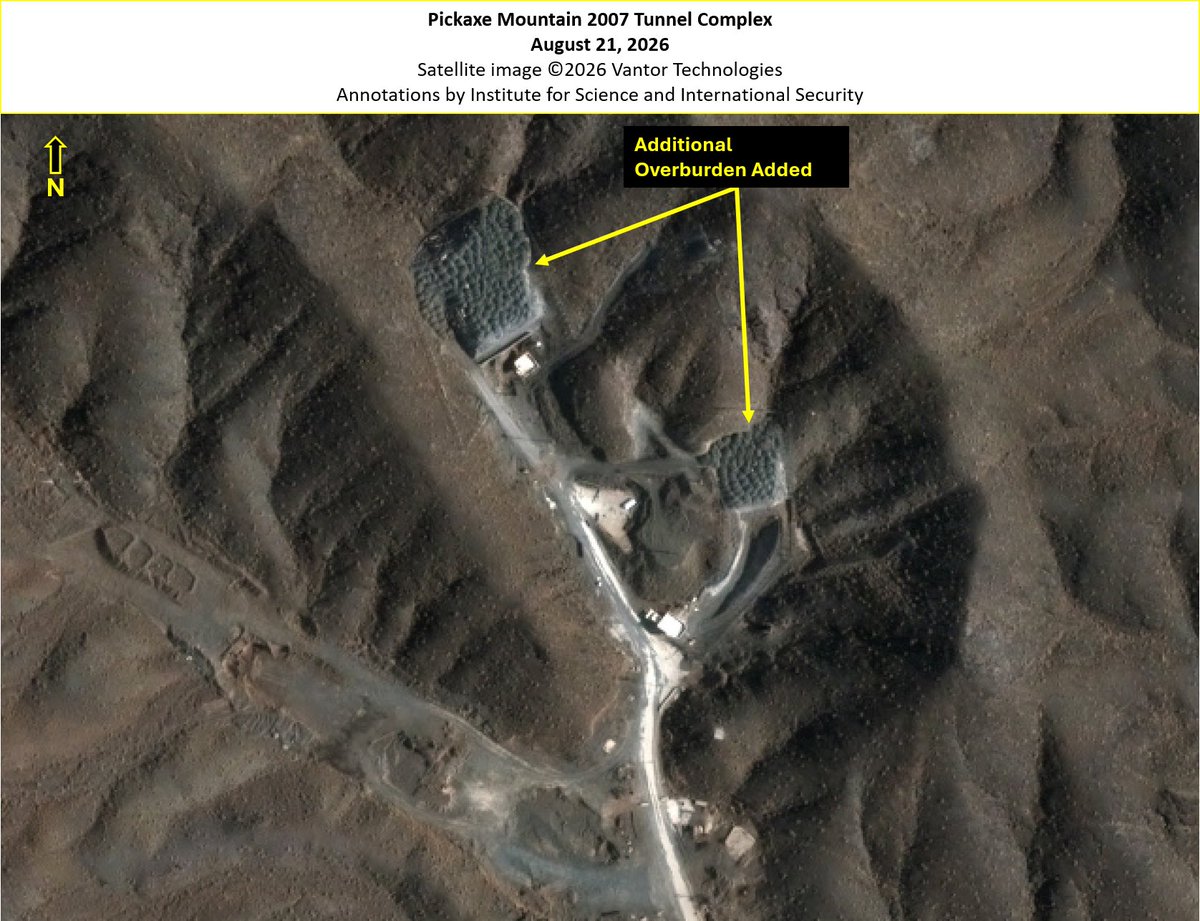
Update on passive defense measures at Pickaxe Mountain: @vantortech imagery from September 11, 2026, shows that the earthen mound roadblocks are still in place, blocking ground vehicle access to the Western tunnel portals. The week-long restricted access reinforces the assessment that the facility is not currently used for operations, but that it does contain valuable equipment and/or materials. The clearly visible roadblocks mean a return to regular access and activity at the Western tunnel entrances should easily be detected by U.S. intelligence and visible on commercially available imagery. Together with the previously blocked Eastern tunnel entrances, the new roadblocks effectively established a status quo inside the facility starting in early August.
Earthen mounds were also placed over one western tunnel portal and over a nearby cluster of portals first built in 2007 that have been expanded and rebuilt in recent years. The added soil increases overburden and helps harden the entrances against aerial bombardment.
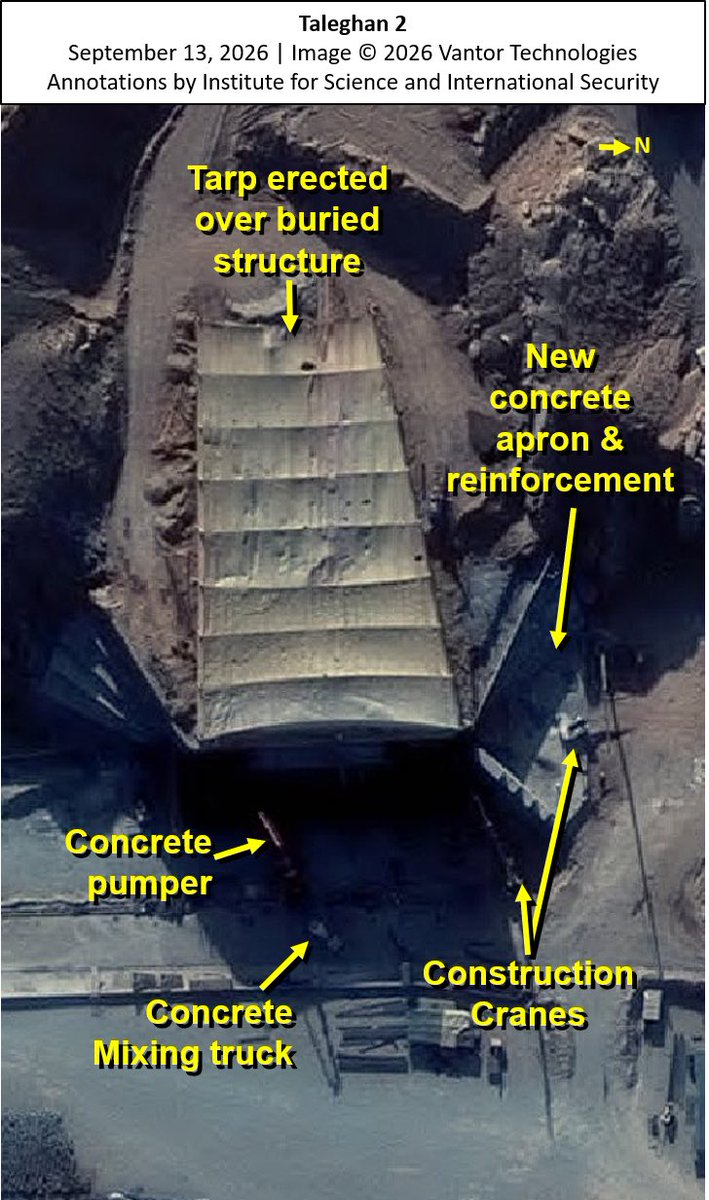
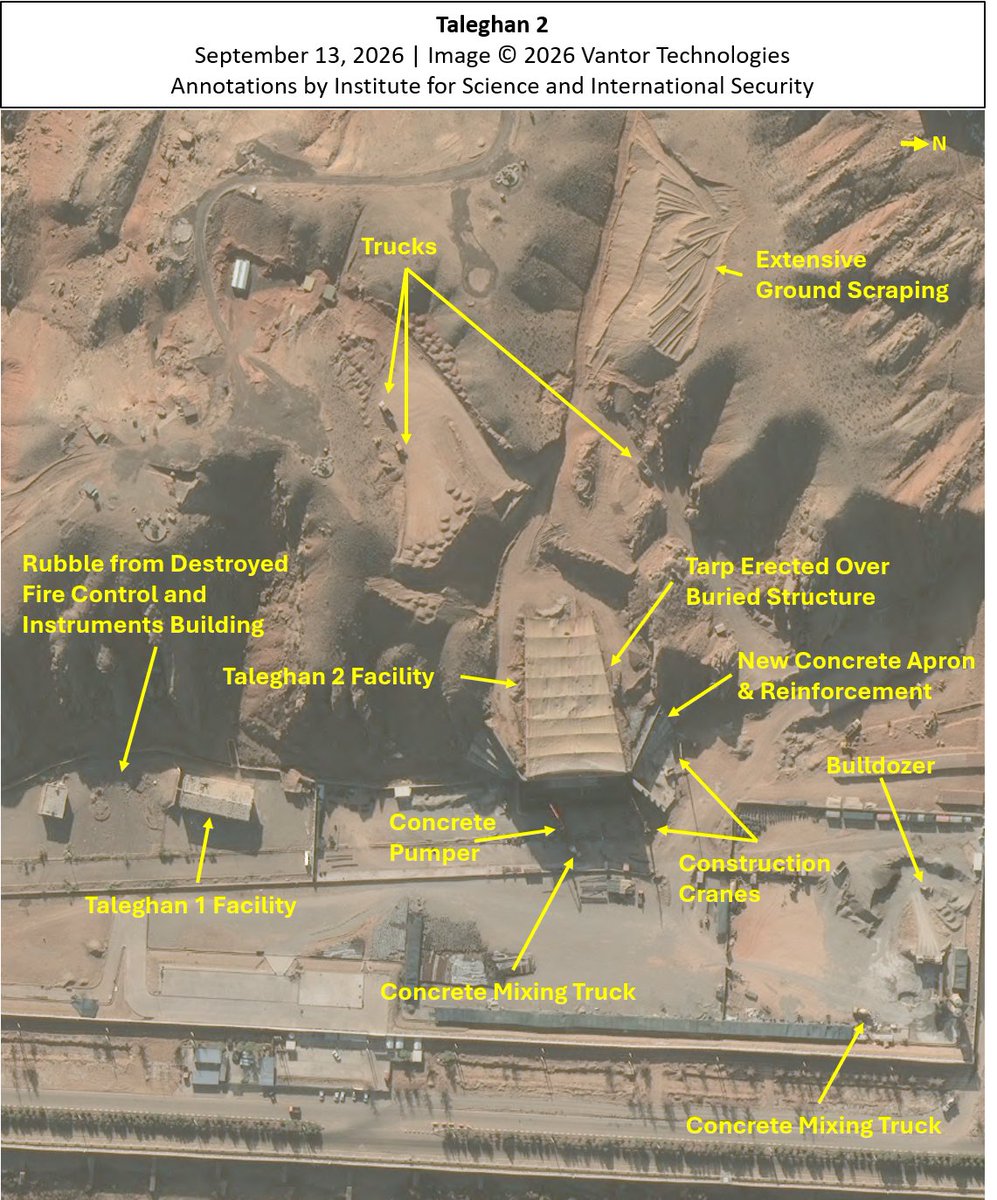
New Imagery Update: Iran is Rapidly Reconstructing Taleghan 2
@vantortech satellite imagery from September 13, 2026, shows that Iran is rapidly moving forward with the reconstruction of the Taleghan 2 facility located at the Parchin military complex. Iran has erected a tarp above the destroyed hardened buried facility, hiding the reconstruction activity that is occurring underneath from satellite view or aerial reconnaissance. Significant activity can be seen throughout the construction site. Construction vehicles, including dump trucks, bulldozers, concrete pump trucks and concrete mixers, and cranes, are actively working to rebuild the facility. Repair and rehabilitation work began in June 2026, first with Iran repairing and placing concrete caps over the penetration holes caused by the multiple bunker buster weapons dropped on the facility. Iran has also built a new concrete apron reinforcement on the right side of the facility, the one on the left side that we noted in our July 2026 update now appears complete. This will provide additional blast protection from an aerial attack.
Link to our full report here: https://t.co/0j4sJwBMlB
NEW 🚨: The IAEA and Syria have achieved major breakthroughs this summer in bringing Syria back into compliance with its safeguards obligations over its undeclared nuclear reactor, a fuel fabrication plant, and stored uranium metal fuel and scrap. The secret Al Kibar reactor at the Dair Alzour site was nearing completion when bombed by Israel in 2007, bringing to an end a major nuclear weapons effort based on plutonium that Syria was steadily advancing with the assistance of North Korea. Yet, despite the significant progress on Syria coming into compliance, which is to be commended, Syria has not yet come clean about its nuclear weapons ambitions under the old regime.
The recent breakthroughs follow years of denials by the previous Syrian government that the site contained a nuclear reactor. With a new government, these breakthroughs became possible. The IAEA stated in its September 1, 2026, NPT Safeguards Implementation report on Syria that it has been able to clarify and resolve the Agency’s questions concerning the outstanding safeguards issues previously reported to the Board.
However, the report does not state that the IAEA has received from Syria a complete nuclear declaration or that verification activities are finished. Information absent in the report includes:
The planned scope, location, and schedule of the facility to separate plutonium from fuel that was to be irradiated in the reactor. This activity is referred to as “reprocessing” in the IAEA report;
North Korea’s cooperation in building the reactor and providing associated technologies and facilities needed to operate the reactor, make the fuel, and separate plutonium;
Any discussion about nuclear weaponization Syria may have conducted, with or without North Korean assistance.
Moreover, the new information reflects what has been reported by the IAEA and others, such as the U.S. and Israeli governments, Süddeutsche Zeitung (on uranium conversion), and the Institute, about Syria’s undeclared nuclear activities. The new revelations provide confirmation and new details of certain activities and facilities, but they do not provide any surprises or fill in the missing information about the entire scope of the reactor and reprocessing project and Syria’s cooperation with North Korea.
As such, the recent breakthroughs should be celebrated, but they do not yet achieve the transparency achieved in prior such cases, such as in South Africa, Taiwan, and Iraq in the 1990s. The IAEA should seek additional information from Syria with the aim to ensure the Agency has received and verified a complete declaration of Syria’s previously undeclared nuclear efforts.
The report contains several bulleted findings of the new information on the ongoing issue of Syria’s NPT safeguards compliance contained in IAEA report on Syria and provides context for this information.
Our report also contains several recommendations:
The IAEA Board should adopt a resolution commending Syria’s new government’s effort but require the IAEA to ensure Syria’s nuclear declaration is complete.
Syria should resolve additional questions on the context and framework under which the secret plutonium production reactor was built, i.e., on its role within a secret nuclear weapons program and other nuclear weapons relevant activities that took place.
The uranium metal fuel should be removed for safety and security reasons. Key, single-use equipment related to uranium conversion and fuel manufacturing, as well as plutonium separation, should be located and rendered unusable or removed as well.
The report can be found here: https://t.co/CkhCRguR2W
Recent high resolution Vantor and Airbus satellite imagery from July and August 2026 shows the establishment and ongoing construction of dozens of large lattice towers surrounding the Shahed (Geran) production facilities and other buildings involved in supplying drone production. The defensive system consists of two layers of towers: an inner perimeter consisting of shorter towers directly surrounding the key production facilities, and an outer perimeter consisting of taller towers surrounding the wider area.
The tall red-and-white towers are evenly spaced and surround the buildings, suggesting that they are part of a passive defensive structure, possibly to hold a metal wire mesh of cables to enclose the facilities. This will make it more difficult for cruise missiles and explosive laden drones to target the production complex.
Alabuga began erecting the towers sometime after May 18, 2026, based on available satellite imagery. Imagery from early July 2026 shows the inner perimeter surrounding the main production facilities completed. By late July, Alabuga had made significant progress also on the outer security perimeter consisting of larger towers. This outer security perimeter includes the Alabuga-Fiber production facilities, an important source of carbon fiber used in Shahed drone production. An image from early August showed that several additional towers were also constructed then. Cranes and staging areas assembling the towers can be seen around the site.
This likely passive defensive measure adds additional layers of security to the Alabuga SEZ. Surrounding Alabuga are several air-defense positions, each consisting of a position for a self-propelled anti-aircraft vehicle and manned lattice towers where weapons and electronic warfare systems can be stationed. The construction of the new passive defensive structures comes at a time when Ukraine is increasingly targeting facilities across Russia using large swarms of long-range strike drones and domestically produced FP-5 cruise missiles. This effort further highlights the importance of the Shahed drone production facilities at Alabuga to Russia’s war effort.
link: https://t.co/xIEDiaUrli
Author: @SFnuclear and the Good ISIS Team
NEW: Probable Uranium Storage Facility Identified at the Natanz Nuclear Complex
The Institute has identified a separately enclosed, partially below-ground, bunkered building at the Natanz Nuclear Complex that was likely intended to serve as uranium hexafluoride (UF6) storage facility to support large-scale uranium enrichment at the Natanz Fuel Enrichment Plant. The bunkered structure was constructed between 2010 and 2017, with the bulk of construction occurring between 2015 and 2017.
Given Iran’s focus on enriching its low enriched uranium to highly enriched uranium and decision to store large amounts of the HEU at locations other than Natanz, it is unclear how the building was used before the June 2025 war. It is also unclear what role it has had since.
The building has ample room to store a significant number of UF6 30B, 48 X, and 48 Y cylinders, far more storage than is required for the amount of UF6 Iran produced.
The floor space is more than enough to house Iran’s pre-June 2025 inventory of uranium enriched to less than 5 percent, as well as depleted uranium that has resulted from pre-JCPOA and post-2018 enrichment. The building has ample room to store a significant number of UF6 30B, 48 X, and 48 Y cylinders, far more storage than is required for the amount of UF6 Iran produced. At 1500 square meters, with a conservative half to two-thirds of the amount used for storage and the other half to one-third for clearance, operations, and handling, the facility could dedicate 750 - 1000 square meters to the storage of UF6 cylinders.
To put this into perspective, the storage of current enriched uranium stocks and depleted uranium tails is estimated to take up at most about 150 square meters. This represents about 10 percent of the total estimated floor space, or up to 20 percent of the total available storage floor space. The floor space lines up better with planned enrichment scenarios. For example, the available space matches the storage requirement for the annual product plus accumulated tails for 10 years of operation at 100,000 kgU swu/yr, if cylinders are stored in a single layer.
There has not been any observable activity at this facility in imagery dating back to June 2025.
Read the full report linked below for a full understanding and breakdown of the possible storage capabilities of this bunkered facility.
Link: https://t.co/6j8pi3OMyb
As per the recent news concerning "hidden nuclear stocks in Syria at Site 99 that are leftover from Al Kibar reactor project," (@DAVIDHALBRIGHT1) the Institute has identified a possible contender for the location of where the nuclear material may be held. Available evidence points towards the Tal Qartal "Project 99/CERS" underground missile complex, which was heavily damaged in an Israeli airstrike carried out in September 2023 (with four probable underground tunnel entrance buildings destroyed in a second attack in December 2024). The latest imagery of the site, from July 17, 2026, only shows that the debris from the destroyed buildings had been removed, with no other activity visible at that time. We will be waiting for further information from the IAEA to confirm that this is the location and that nuclear material was successfully removed from Syria.
Watching the #US-#Iran strike-no-strike cycle, two comfortable readings are on offer: a hidden masterplan, or pure improvisation.
One implies someone's in control, the other implies it's all noise.
Reality is usually the uncomfortable middle: coherent instincts, incoherent execution, real consequences.
there are no guardrails to restore trust. it's about Google compromising the tool and destroying trust in its product, on top of satellite image providers enhancing resolution by using ML, blurring/manipulating images to hide sensitive places, shifting coordinates, etc.. already
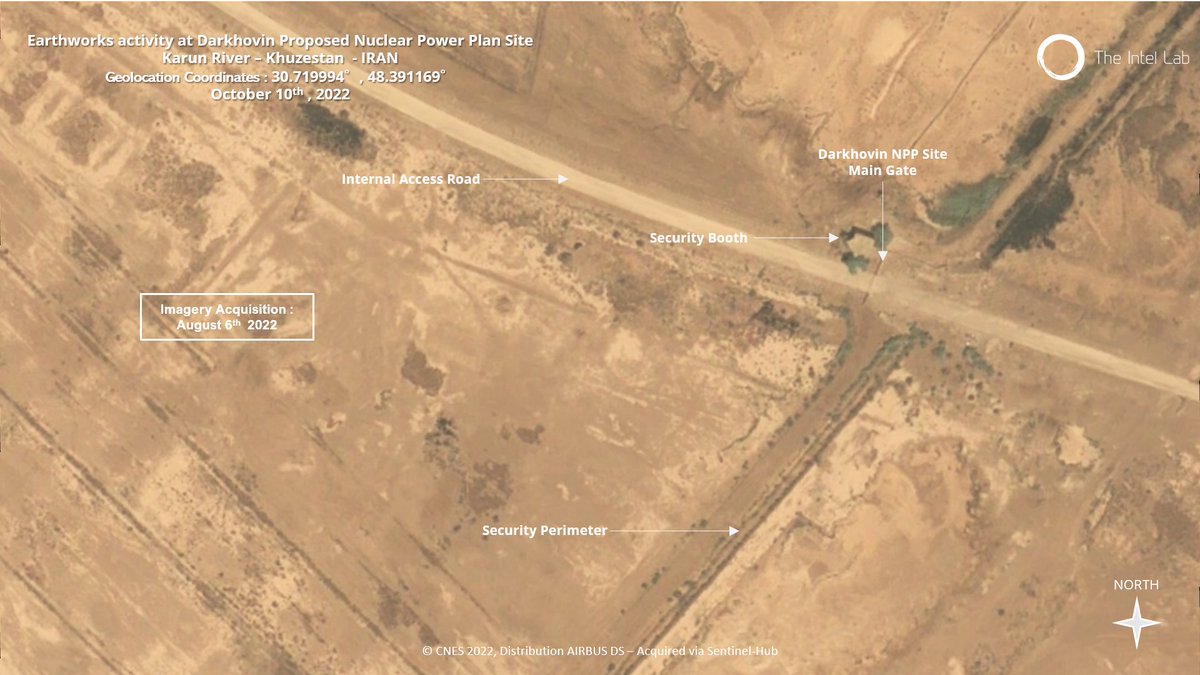
Darkhovin #Nuclear PP chosen site in #Iran is seeing new earthworks activity during the last month. In April 2022, #AEOI's current chief Mohammad Eslami stated "This year we started another project to build a completely Iranian nuclear power plant with a capacity of 360 MWe."
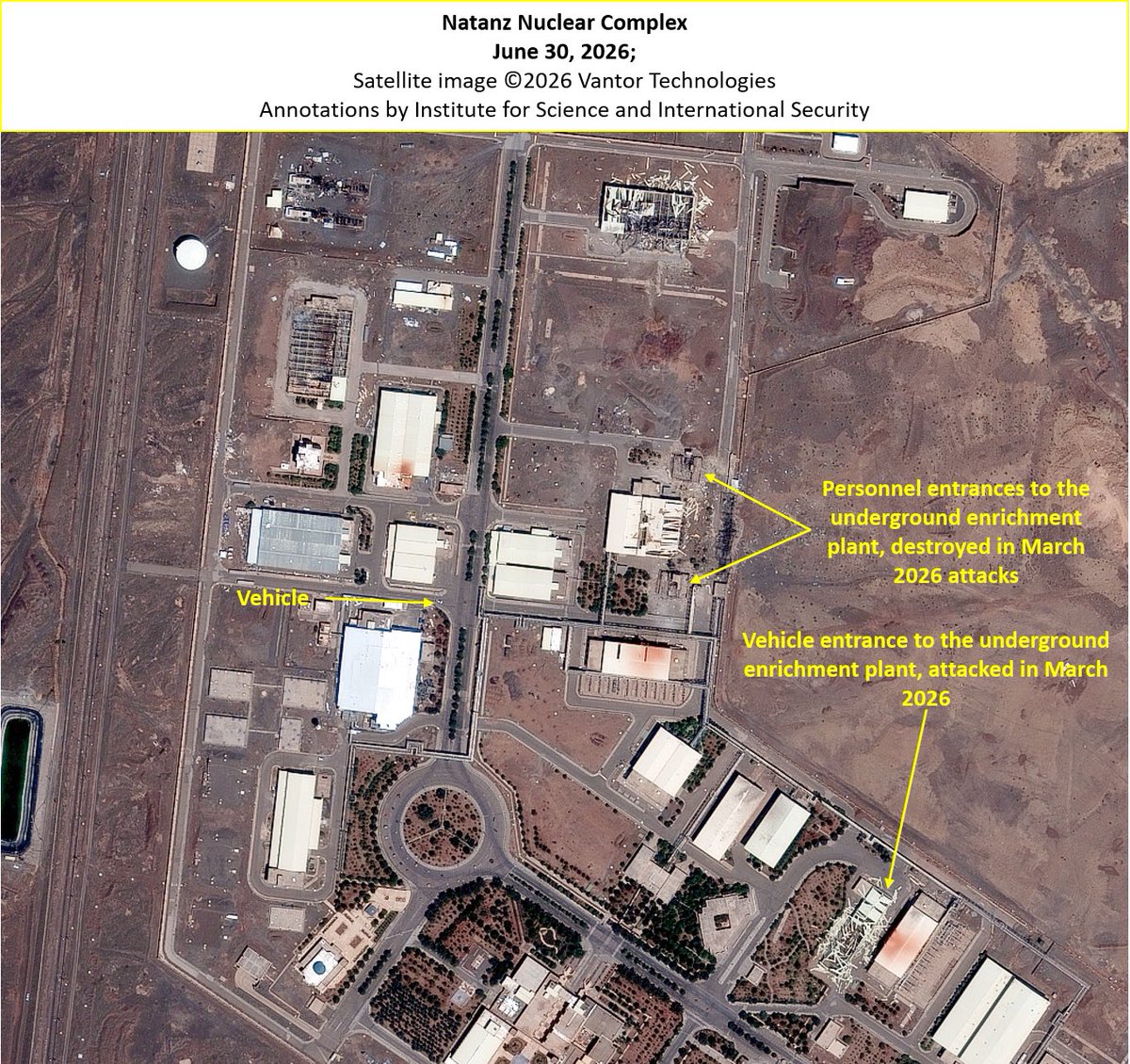
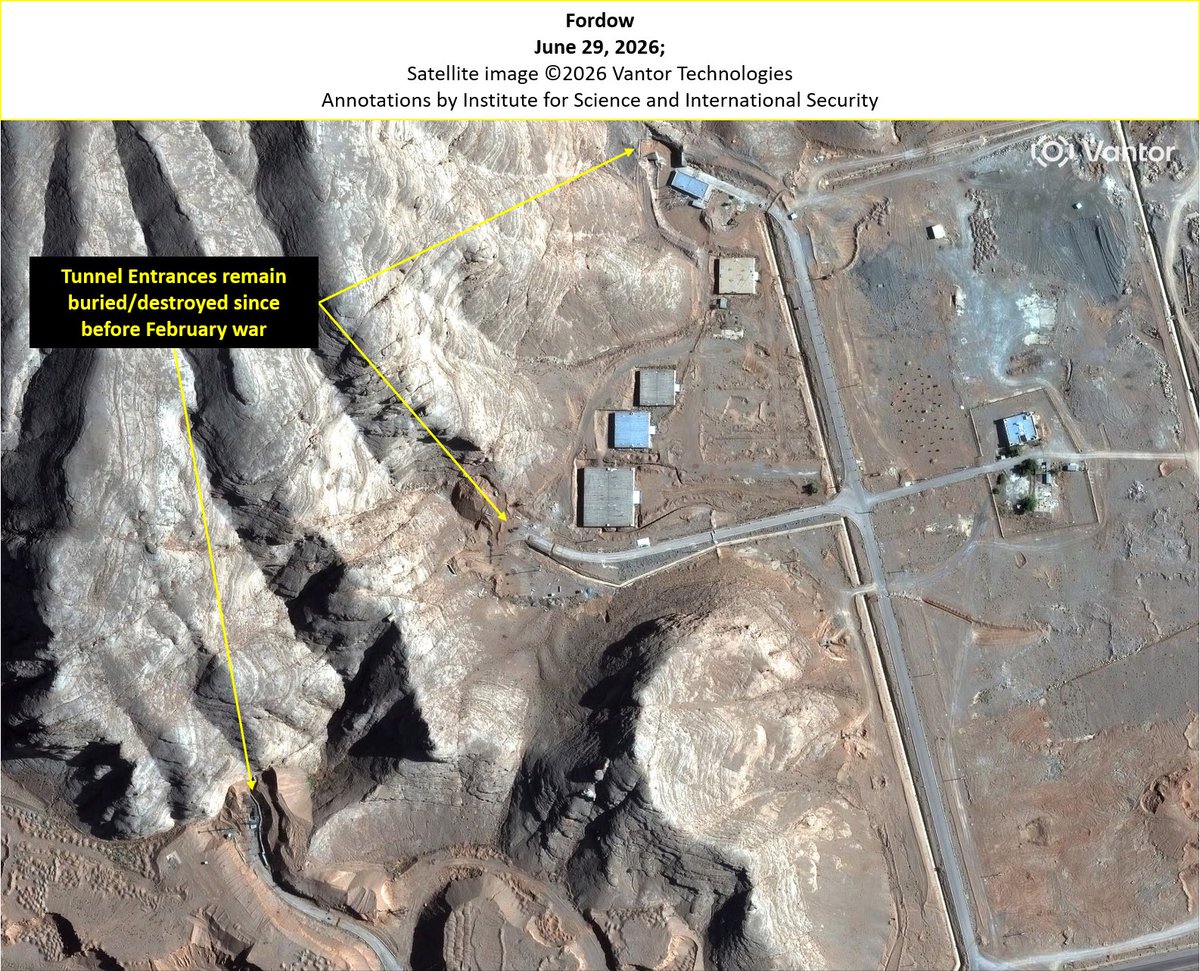
Recent satellite imagery from late June 2026, of the Natanz Nuclear Complex and the nearby Pickaxe Mountain facility, Fordow, and Esfahan, were provided to the Institute by @vantortech.
At Natanz, little activity can be seen. The access points to the below ground enrichment halls have not been repaired. The personnel entrances remain destroyed and vehicle entrances remain severely damaged. A single vehicle can be seen on the road outside of the Pilot Fuel Enrichment Plant (PFEP), which was destroyed in June 2025, but was covered by Iran after. The HVAC chillers remain displaced throughout the complex and the primary and backup power systems remain destroyed.
At Pickaxe Mountain, vehicle activity can be seen on the roads leading to the open set of Western tunnel portals, indicating that construction inside the tunnel complex, as well hardening of the tunnel entrance, are ongoing. The MOU signed between the United States and Iran requires that Iran maintain the status quo which should prohibit construction at any nuclear related facility, including Pickaxe Mountain. As first reported by the Institute in early May (see: https://t.co/nTs0oIiUYY ), the Eastern set of tunnel portals remain partially backfilled with dirt, making them inaccessible to ground vehicles. This was likely done to prevent rapid ingress and egress to the tunnel entrances.
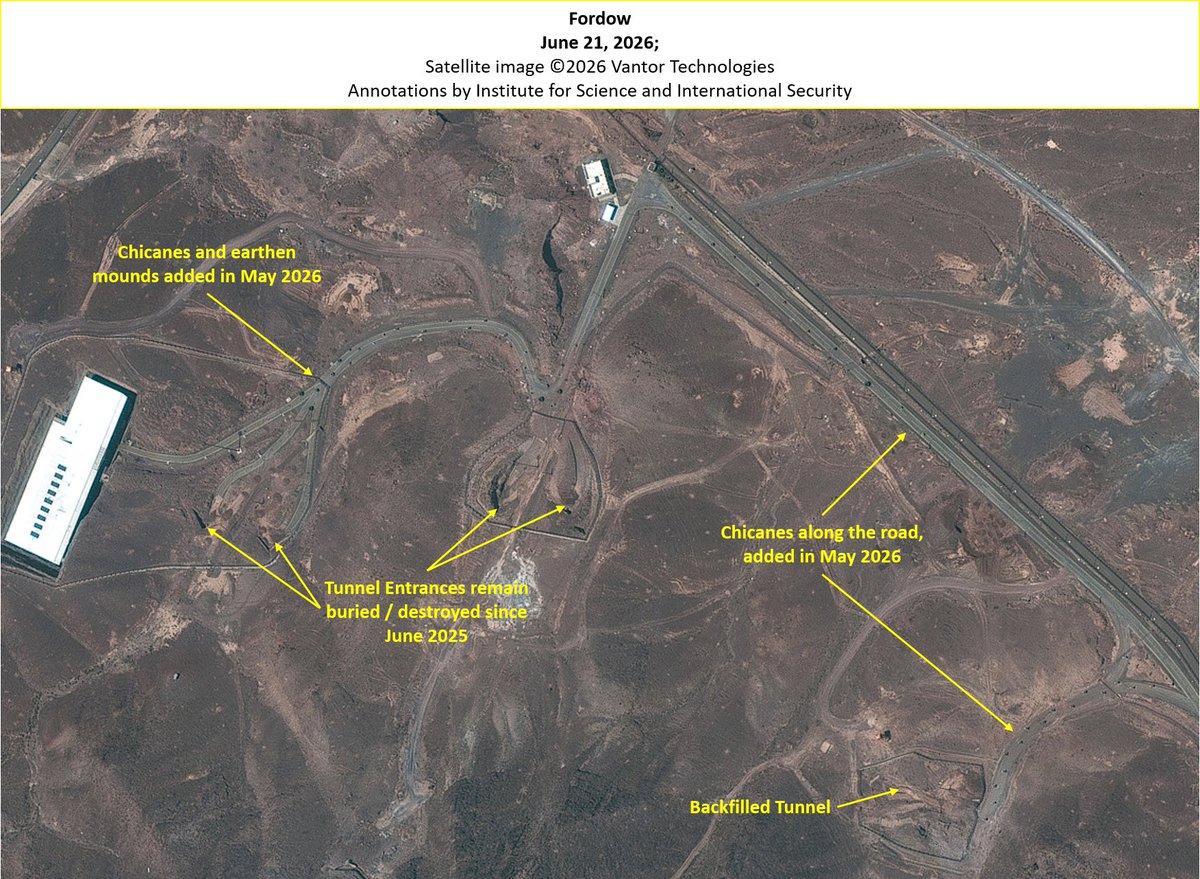
At Fordow, as earlier reported by the Institute, between May 10 and May 18th, Iran added passive defensive measures in the form of earthen/rocky mounds and other objects on the roads leading to the tunnel entrances. The alternate placings of the piles/objects are very precise, which creates a series of chicanes, indicating they are not intended as obstructions, but rather to prevent rapid ingress and egress by any vehicle towards the tunnels. The June 21 Vantor image shows that the objects along the road remain there. The tunnel portals also remain backfilled with dirt.
As of June 29, 2026, there is no observed activity at Esfahan. The tunnel portals remain backfilled with dirt.
The Institute will continue to monitor these sites for any developments.
Read more about the recent activity at the sites here: https://t.co/1oer7whmPu, and here: https://t.co/33GqYDyXBd
Analysis by @DAVIDHALBRIGHT1, @SarahBurkhard, and @SFnuclear
The single biggest recurring failure in Western foreign policy: Mirror Imaging. Assuming the other side thinks like you do, values what you value, and will respond to incentives the way you would.
When the #US says "deal," they mean a transactional exchange with measurable deliverables. When the #IRGC hears "deal," they hear capitulation dressed in diplomatic language. Those two words don't occupy the same conceptual space. Witkoff and Kushner walk in thinking they're closing a real estate negotiation. #Iran side walks in thinking they're defending a civilizational position.
Please someone get to the West a Duolingo course in post 1979 Farsi language...
Time to remember that for some, war is nothing but a game where political survival is the objective, and human lives are treated as expendable pieces on the board. #IranWar#Nuclear#OperationEpicFury#OperationLionsRoar
The single biggest recurring failure in Western foreign policy: Mirror Imaging. Assuming the other side thinks like you do, values what you value, and will respond to incentives the way you would.
When the #US says "deal," they mean a transactional exchange with measurable deliverables. When the #IRGC hears "deal," they hear capitulation dressed in diplomatic language. Those two words don't occupy the same conceptual space. Witkoff and Kushner walk in thinking they're closing a real estate negotiation. #Iran side walks in thinking they're defending a civilizational position.
Please someone get to the West a Duolingo course in post 1979 Farsi language...