Back in the early 1900s, before electricity was common everywhere, a Swiss company called E. Paillard & Co. engineered a clever solution-a fully mechanical wind-up fan. Instead of wires or batteries, it used a tightly coiled spring motor, just like a clock. Once wound, the stored energy slowly released through gears, spinning the blades and producing a gentle breeze for up to 30 minutes.
These fans were specially designed for tropical regions and remote areas where electricity simply didn't exist. Lightweight, portable, and surprisingly efficient, they offered comfort in hot climates without any power consumption. It was a perfect example of early innovation-simple physics turned into practical everyday technology.
Even today, many of these fans still work after more than a century, showing how durable and well-crafted they were. In a world now chasing sustainable solutions, this old invention feels ahead of its time-a reminder that sometimes the smartest tech doesn't need electricity at all.
The oldest known photograph in Texas history. Taken in 1849, it shows the Alamo Mission just 13 years after the famous battle in which James Bowie, Davy Crockett, and William B. Travis were killed.
The Alamo Mission was originally founded as a Spanish mission in the early 18th century before becoming the site of one of the most famous battles in American history. From February 23 to March 6, 1836, a small Texian force defended the mission against a much larger Mexican army led by Antonio López de Santa Anna. After a 13-day siege, the defenders were overwhelmed, and nearly all were killed.
The battle soon became a powerful rallying cry for the Texas Revolution. Just six weeks later, Texian forces led by Sam Houston defeated Santa Anna at the Battle of San Jacinto, securing Texas independence.
By 1849, when this photograph was taken, the Alamo had already become a symbol of Texas identity. The building looked noticeably different from how it appears today, as the iconic curved parapet above the chapel façade had not yet been added. That feature was constructed later in the 1850s by the U.S. Army.
The image is especially remarkable because it was captured just 10 years after the invention of practical photography and only 13 years after the battle itself. Some people who fought at the Alamo, survived the Texas Revolution, or personally knew Davy Crockett and William B. Travis were still alive when this photograph was taken, creating an unusually short connection between a defining historical event and the earliest era of photography.
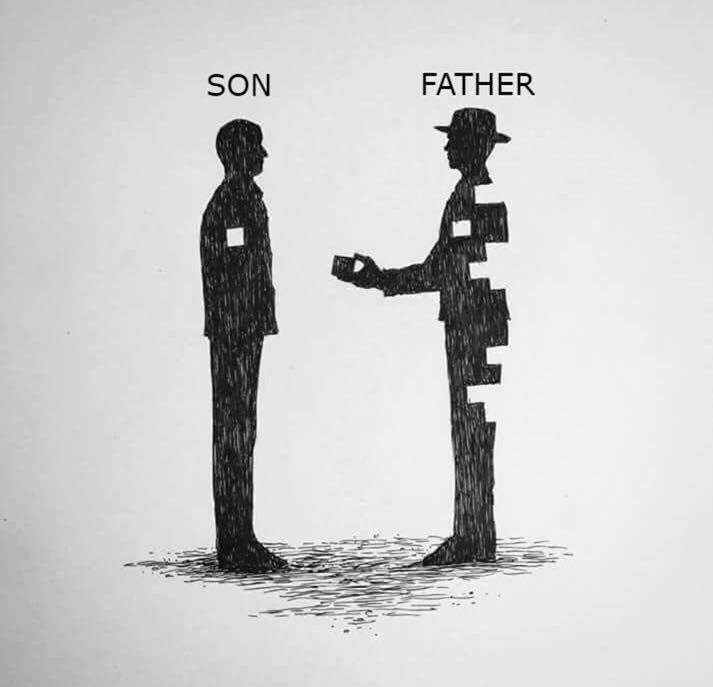
This is one of the better collections of advice I’ve seen in a while. Really resonated with me. @DearS_o_n this is one for the list of things for sons.
RULES FOR SONS:
1. Never shake a man’s hand sitting down.
2. Don’t enter a pool by the stairs.
3. The man at the BBQ Grill is the closest thing to a king.
4. In a negotiation, never make the first offer.
5. Request the late check-out.
6. When entrusted with a secret, keep it.
7. Hold your heroes to a higher standard.
8. Return a borrowed car with a full tank of gas.
9. Play with passion or not at all…
10. When shaking hands, grip firmly and look them in the eye.
11. Don’t let a wishbone grow where a backbone should be.
12. If you need music on the beach, you’re missing the point.
13. Carry two handkerchiefs. The one in your back pocket is for you. The one in your breast pocket is for her.
14. You marry the girl, you marry her family.
15. Be like a duck. Remain calm on the surface and paddle like crazy underneath.
16. Experience the serenity of traveling alone.
17. Never be afraid to ask out the best looking girl in the room.
18. Never turn down a breath mint.
19. A sport coat is worth 1000 words.
20. Try writing your own eulogy. Never stop revising.
21. Thank a veteran. Then make it up to him.
22. Eat lunch with the new kid.
23. After writing an angry email, read it carefully. Then delete it.
24. Ask your mom to play. She won’t let you win.
25. Manners maketh the man.
26. Give credit. Take the blame.
27. Stand up to Bullies. Protect those bullied.
28. Write down your dreams.
29. Always protect your siblings (and teammates).
30. Be confident and humble at the same time.
31. Call and visit your parents often. They miss you.
32. The healthiest relationships are those where you’re a team; where you respect, protect, and stand up for each other.
The Hoover Dam was completed in 1936.
Its concrete is still curing.
Concrete doesn't "dry." It undergoes a chemical reaction called hydration — calcium silicate crystals grow and interlock over decades.
In thin pours, hydration completes in weeks.
In mass concrete — pours measured in thousands of cubic yards — the reaction continues for centuries.
The Hoover Dam contains 3.3 million cubic yards of concrete.
The deepest internal sections have never fully hydrated.
Engineers knew this when they built it.
They designed around it — using cooling pipes, joint systems, and a pour sequence that let each section partially cure before the next was added.
The dam gets marginally stronger every year.
It will reach peak strength sometime around the year 2500.
Something built by humans in 1936 will still be actively becoming what it was designed to be in 2500.
That's what engineering for permanence looks like.
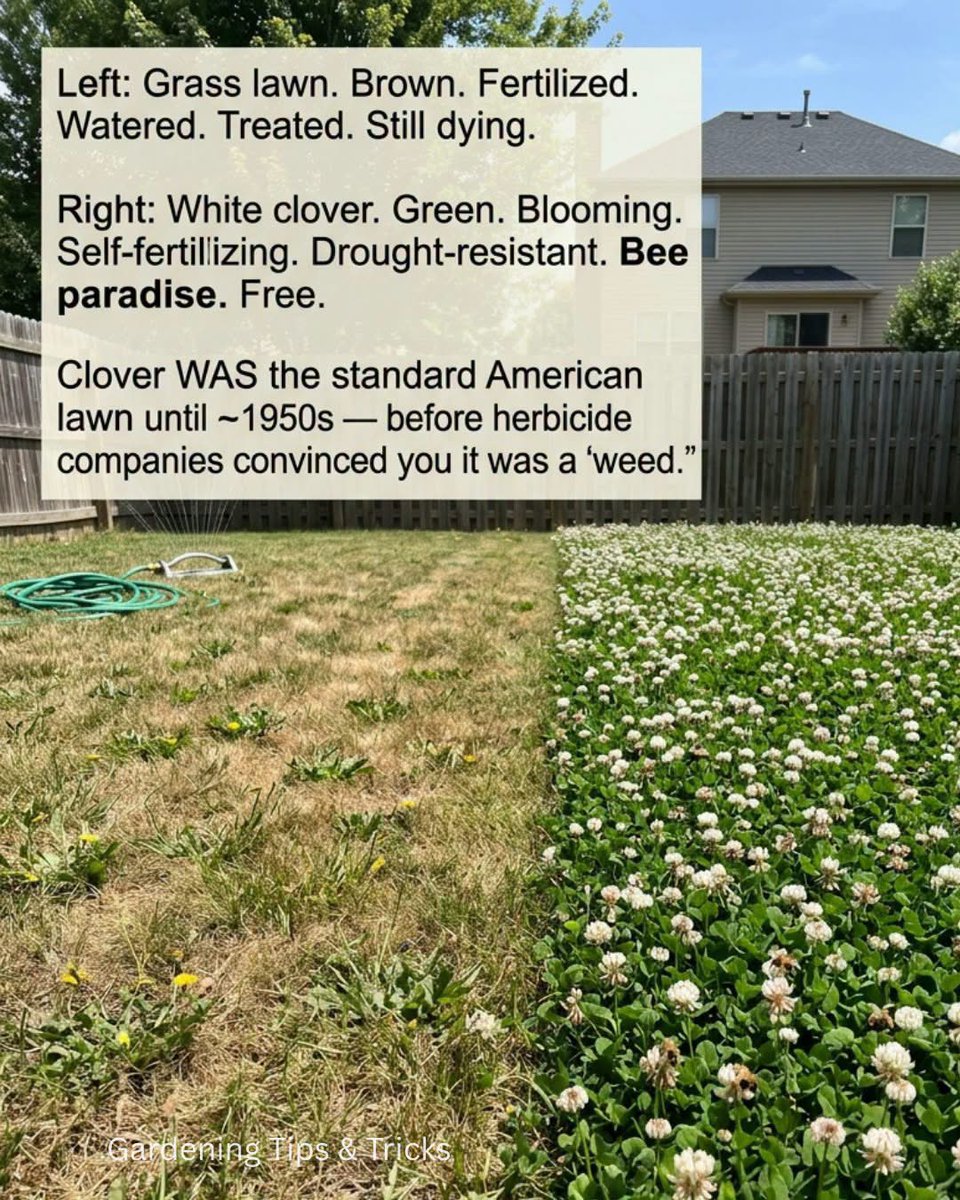
Before the 1950s, clover was a STANDARD component of American lawns.
Seed mixes included it on purpose.
Then broadleaf herbicides were invented.
They killed clover along with "weeds." So the chemical companies rebranded clover as a weed — to sell more herbicide.
That's it. That's the whole story.
Clover is not a weed. It's the future of your lawn.
White Dutch clover (Trifolium repens):
Self-fertilizing — fixes nitrogen from the air into the soil. No fertilizer needed. EVER.
…and it feeds the grass around it for free.
Drought-resistant — stays green when grass goes brown.
Bee paradise — constant blooms from May to frost.
Chokes out weeds — dense growth shades out weed seeds.
No mowing needed (stays 4-6 inches) — or mow monthly.
Soft underfoot — kids love it.
Costs $5-10 to overseed 1,000 sq ft.
How to add clover to your existing lawn:
Overseed in spring or fall.
Scatter seed (2 oz per 1,000 sq ft).
Water lightly for 2 weeks. Done.
Stop using broadleaf herbicides (they kill clover).
Stop fertilizing (clover makes its own).
Mow at 3-4 inches.
The lawn industry told you clover was a weed so they could sell you chemicals.
Take your lawn back.