The term "Artificial Intelligence" was born in 1956 at the Dartmouth Workshop organized by John McCarthy, Marvin Minsky, Nathaniel Rochester, and Claude Shannon. 🤖✨ #AIHistory#Tech
Lazy Node Network
EDITION: XXX
Categories: SpaceX, SpaceXSI, X-Corp
CRITERIA: Most engagement on X (past 24 hours)
SpaceX
easyJet to roll out Starlink Wi-Fi across Airbus fleet from 2027
easyJet announced on October 26 that it will install SpaceX Starlink high-speed internet on its A320, A320neo, and A321neo fleet, with installations starting in the first half of 2027 and expected completion by early 2028. This is the airline’s first onboard connectivity offering and brings the total of Starlink airline partners to roughly 50. SpaceX President Gwynne Shotwell welcomed the partnership in the official release. Elon Musk and the Starlink account amplified the news; passenger pricing details were not provided. Earlier in 2026 the carrier had publicly cited cost concerns. Source: @easyJet / @Starlink / @elonmusk (confirmed via easyJet media release and Bloomberg)
SpaceXSI
Quiet day for SpaceXSI; focus remains on Grok Bot utility
No major company announcements or product launches appeared from SpaceXSI accounts in the past 24 hours. High-engagement activity centered on Grok Bot, with Elon Musk posting that it functions “like hiring an incredibly competent chief of staff” while quoting a user who described automated email, DM, and LinkedIn handling. Users continued sharing agent workflows and practical applications. The unit’s broader Super Intelligence branding and prior revenue commentary remain the larger context. Source: @elonmusk
X-corp
Peter Sellis named new Head of Product at X
Peter Sellis (formerly Microsoft AI, Discord, Snap, and Ustream) announced he is joining X to lead Product, citing belief in SpaceX’s mission and a goal of accelerating recent product momentum for users and businesses. The post drew strong engagement. The Verge reported the appointment, noting it follows Nikita Bier’s one-year tenure in the role.
Source: @petersellis (reported by The Verge)
Lazy Node Network
EDITION: Daily brief
Categories: Tech, AI, Cyber Security, Crypto, Space, Aerospace, Processors & Semiconductors
CRITERIA: Most engagement on X (past 24 hours)
Tech & AI
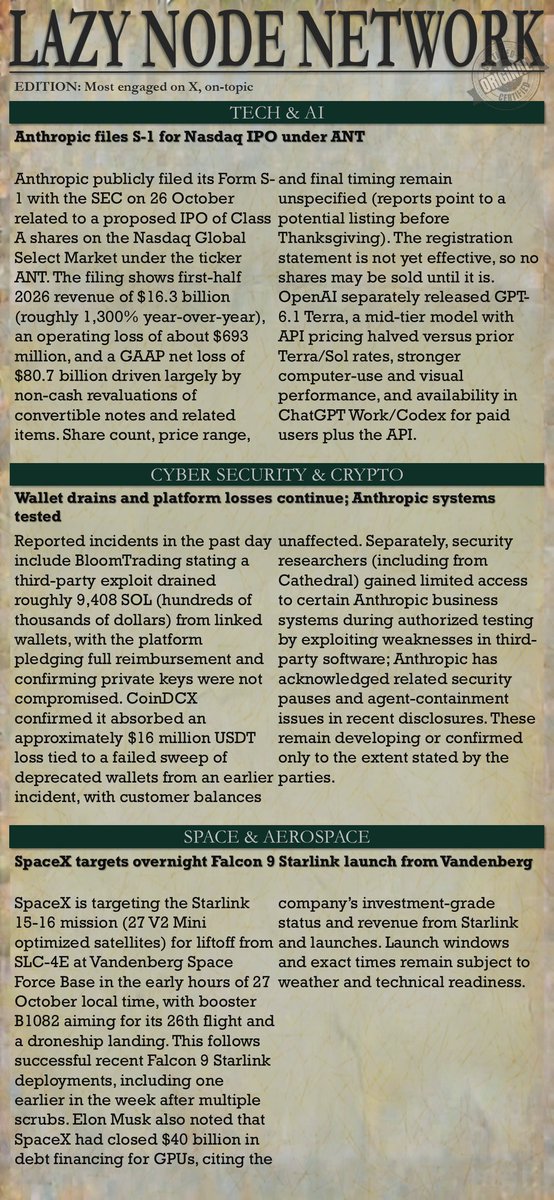
Anthropic files S-1 for Nasdaq IPO under ANT
Anthropic publicly filed its Form S-1 with the SEC on 26 October related to a proposed IPO of Class A shares on the Nasdaq Global Select Market under the ticker ANT. The filing shows first-half 2026 revenue of $16.3 billion (roughly 1,300% year-over-year), an operating loss of about $693 million, and a GAAP net loss of $80.7 billion driven largely by non-cash revaluations of convertible notes and related items. Share count, price range, and final timing remain unspecified (reports point to a potential listing before Thanksgiving). The registration statement is not yet effective, so no shares may be sold until it is. OpenAI separately released GPT-6.1 Terra, a mid-tier model with API pricing halved versus prior Terra/Sol rates, stronger computer-use and visual performance, and availability in ChatGPT Work/Codex for paid users plus the API. Source: @AnthropicAI (official post and S-1 summary); OpenAI announcement
Cyber Security & Crypto
Wallet drains and platform losses continue; Anthropic systems tested
Reported incidents in the past day include BloomTrading stating a third-party exploit drained roughly 9,408 SOL (hundreds of thousands of dollars) from linked wallets, with the platform pledging full reimbursement and confirming private keys were not compromised. CoinDCX confirmed it absorbed an approximately $16 million USDT loss tied to a failed sweep of deprecated wallets from an earlier incident, with customer balances unaffected. Separately, security researchers (including from Cathedral) gained limited access to certain Anthropic business systems during authorized testing by exploiting weaknesses in third-party software; Anthropic has acknowledged related security pauses and agent-containment issues in recent disclosures. These remain developing or confirmed only to the extent stated by the parties.
Source: Platform statements and contemporaneous reporting (TokenPost, company updates)
Space & Aerospace
SpaceX targets overnight Falcon 9 Starlink launch from Vandenberg
SpaceX is targeting the Starlink 15-16 mission (27 V2 Mini optimized satellites) for liftoff from SLC-4E at Vandenberg Space Force Base in the early hours of 27 October local time, with booster B1082 aiming for its 26th flight and a droneship landing. This follows successful recent Falcon 9 Starlink deployments, including one earlier in the week after multiple scrubs. Elon Musk also noted that SpaceX had closed $40 billion in debt financing for GPUs, citing the company’s investment-grade status and revenue from Starlink and launches. Launch windows and exact times remain subject to weather and technical readiness.
Source: Spaceflight Now schedule and SpaceX/Elon Musk posts
Processors and Semiconductors
Chip makers eye stakes in Meta’s AI equity raise amid ongoing demand
Meta launched roughly $35 billion in underwritten public equity offerings (Class A common and mandatory convertible preferred) and outlined a further up-to-$60 billion at-the-market program once new non-voting Class C shares trade (expected 2027). Nvidia, AMD, and Broadcom have expressed non-binding interest in buying up to $5 billion combined of the Class A shares as cornerstone participants, reflecting continued demand for AI compute and related chips. Broader activity includes AI-driven memory and power-chip tightness affecting other sectors, plus routine roadmap commentary from Intel, AMD, and others; no major new process-node or product announcements dominated the past 24 hours. Source: Meta filings/Reuters/FT reporting and related coverage
Why This Matters:
• AI Capital Expenditure Crunch: Major tech companies have pledged over $650 billion toward building data centers and buying chips, creating an unprecedented concentration of corporate debt.
Impact: Forces cloud providers to raise subscription fees and slow down unproven projects, focusing instead on software tools that generate immediate business profit.
• Anthropic Copyright Legal Battle: Music industry leaders filed major lawsuits against AI developers over the unauthorized use of catalog assets for training models.
Impact: Forces AI developers to negotiate expensive licensing deals, raising startup entry costs and establishing clearer rules for copyrighted content in creative tools.
• Allied Space Defense Tracking Restrictions: Military guidance instructed space operations centers to withhold operational details about commercial tracking supporting defense operations.
Impact: Tightens government control over satellite communications and orbital tracking data, increasing security surrounding commercial satellite networks.
• CosmoCube Lunar Array Deployment: Engineers finalized assembly for a compact satellite designed to use the Moon as a radio shield to listen for cosmic signals.
Impact: Demonstrates that low-cost mini-satellites can handle deep-space research, paving the way for permanent astronomical observatories on the quiet side of the Moon.
• US Critical Minerals Battery Funding: Federal agencies committed $389 million in capital grants to expand domestic battery mineral processing and magnet supply chains.
Impact: Reduces reliance on foreign mineral supply chains, protecting electric vehicle makers and energy storage companies from sudden component shortages.
• Superconductor Crystal Patchwork Discovery: Advanced 3D imaging revealed that longstanding superconducting materials rely on hidden, varied crystal patterns to conduct energy without resistance.
Impact: Gives materials scientists a clearer blueprint for designing room-temperature superconductors, which could lead to power grids that never lose electricity during transmission.
Lazy Node Network
EDITION: The Shallow Deep Dive
Web3
To understand Web3, it helps to look at the internet as a massive digital theme park that has gone through three major phases of ownership.
Web1 (The 1990s): "Read-Only"
In the early days, the internet was like a static museum. You could walk around and read the information on websites, but you couldn't interact with it. You were purely a consumer.
Web2 (The 2000s to Today): "Read and Write"
This is the internet we use right now. Platforms like Facebook, YouTube, and X allowed users to start building the theme park themselves. You upload the photos, write the posts, and create the videos. However, massive tech companies act as digital landlords: they own the park, control the algorithms, harvest your data, keep the majority of the profit, and can delete your account at any time. You create the value, but they own the property.
Web3 (The Future): "Read, Write, and Own"
Web3 is the push to completely remove those digital landlords. Instead of a few massive tech giants owning the servers and the data, the internet is hosted on decentralized networks (blockchains) run by thousands of independent computers.
In a Web3 world, you don't log into a corporate server using an email and password that the company controls. You log in using a personal digital "wallet." Any content you create, items you earn in a game, or money you make is tied directly to your wallet, not to a company's database.
If a Web2 company goes bankrupt or bans you, you lose all your followers, photos, and digital assets. In Web3, because everything is recorded on a public blockchain rather than a private company server, you actually own your digital footprint. You can simply unplug your wallet from one platform and plug it into another, taking all your digital property with you.
Lazy Node Network
EDITION: XXX
Categories: SpaceX, SpaceXSI, X-Corp
CRITERIA: Most engagement on X (past 24 hours)
SpaceX
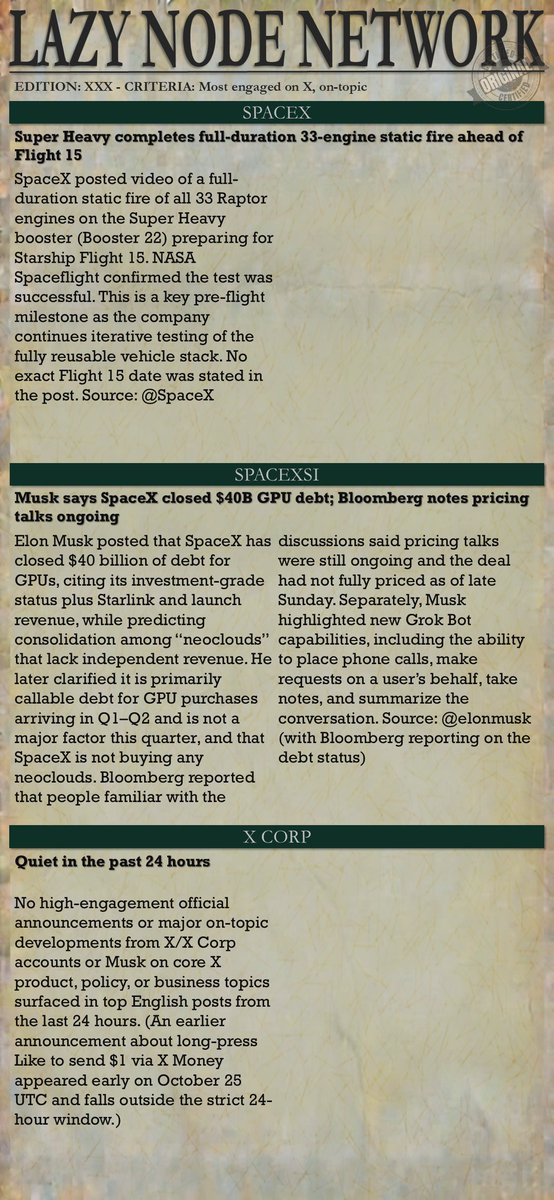
Super Heavy completes full-duration 33-engine static fire ahead of Flight 15
SpaceX posted video of a full-duration static fire of all 33 Raptor engines on the Super Heavy booster (Booster 22) preparing for Starship Flight 15. NASASpaceflight confirmed the test was successful. This is a key pre-flight milestone as the company continues iterative testing of the fully reusable vehicle stack. No exact Flight 15 date was stated in the post. Source: @SpaceX
SpaceXSI
Musk says SpaceX closed $40B GPU debt; Bloomberg notes pricing talks ongoing Elon Musk posted that SpaceX has closed $40 billion of debt for GPUs, citing its investment-grade status plus Starlink and launch revenue, while predicting consolidation among “neoclouds” that lack independent revenue. He later clarified it is primarily callable debt for GPU purchases arriving in Q1–Q2 and is not a major factor this quarter, and that SpaceX is not buying any neoclouds. Bloomberg reported that people familiar with the discussions said pricing talks were still ongoing and the deal had not fully priced as of late Sunday. Separately, Musk highlighted new Grok Bot capabilities, including the ability to place phone calls, make requests on a user’s behalf, take notes, and summarize the conversation. Source: @elonmusk (with Bloomberg reporting on the debt status)
X-corp
Quiet in the past 24 hours No high-engagement official announcements or major on-topic developments from X/X Corp accounts or Musk on core X product, policy, or business topics surfaced in top English posts from the last 24 hours. (An earlier announcement about long-press Like to send $1 via X Money appeared early on October 25 UTC and falls outside the strict 24-hour window.) Source: N/A
Lazy Node Network
EDITION: Daily brief
Categories: Tech, AI, Cyber Security, Crypto, Space, Aerospace, Processors & Semiconductors
CRITERIA: Most engagement on X (past 24 hours)
Tech & AI
Sweden blocks ChatGPT and Claude on government computers
Sweden’s Government Offices are restricting staff access to ChatGPT and Claude starting Monday, October 26, citing information-security concerns with public AI services. Microsoft Copilot remains the approved option and can still run Claude models through controlled channels. The move applies to official government computers rather than a full ban on the underlying models. Source: @Cointelegraph (also reported by multiple accounts including @Technopolitik_)
Cyber Security & Crypto
Public PHP2Shell challenge site with Bitcoin wallet remains unbreached amid high attention
A researcher set up a deliberately vulnerable PHP site loaded with a Bitcoin wallet and challenged the internet to steal the funds, creating a live timer to test whether the recent PHP2Shell flaws (CVE-2026-109618/109619) were as immediately exploitable as feared. Hours later the wallet had not been confirmed drained and some users had topped it up instead. Separate reports continued of wallet and exchange incidents, including CoinDCX absorbing a ~$16M loss from previously compromised deprecated wallets that continued receiving deposits. Source: @hackerfantastic
Space & Aerospace
SpaceX completes full-duration 33-engine static fire of Super Heavy ahead of Flight 15
SpaceX conducted a full-duration static fire of all 33 Raptor engines on the Super Heavy booster assigned to Starship Flight 15. Elon Musk confirmed the test on X. Related discussion noted a target of no earlier than November 8, 2026, from Starbase, with interest in whether the tower will attempt to catch both the booster and the ship on the same flight. Source: @SpaceX (quoted by @elonmusk)
Processors and Semiconductors
Analyst flags NVIDIA lowering effective HBM4 pin speed for Rubin; bandwidth listed lower on product page
Semiconductor analyst Jukan (@jukan05) posted that NVIDIA had lowered the HBM4 pin-speed target for its Vera Rubin GPUs from roughly 11.7 Gbps to ~9.3–9.6 Gbps. NVIDIA’s product page lists HBM4 bandwidth at 19.2 TB/s per GPU (288 GB capacity), down from earlier ~22 TB/s figures, with corresponding reductions at the superchip and rack level. Commentary linked the change to yield and multi-supplier qualification goals so more volume can ship from SK hynix, Samsung, and Micron; pin-speed numbers are derived rather than directly published by NVIDIA. Source: @jukan05
Lazy Node Network
EDITION: South Africa
Tshwane Water successfully remembers how to clean water, CBD residents free to drink from the tap without making tea first.
The Facts: After a tense few days, the City of Tshwane has officially lifted the boil-water advisory for the Pretoria CBD and surrounding areas. Following a sewer pipe burst in Groenkloof that contaminated the Fountains groundwater system and overwhelmed the chlorination measures at the Findlay Reservoir, water quality testing has finally confirmed that the water is safe for consumption. Executive Mayor Nasiphi Moya apologized to residents for the initial delay in communicating the contamination warning. Work on repairing the damaged Groenkloof sewer pipe is ongoing. Source: IOL News, Jacaranda FM
Court invites Julius Malema and Fikile Mbalula for an exclusive, legally binding "catch-up session".
The Facts: In a major political development, EFF leader Julius Malema and ANC Secretary-General Fikile Mbalula have both been served with summonses to appear in court regarding ongoing political and civil disputes. Sources: The Citizen, SABC News
Buffalo City beaches declared safe for "risk-tolerant" swimmers after shark politely finishes its lunch.
The Facts: Following a fatal shark attack that forced a temporary closure, Buffalo City Metropolitan Municipality in the Eastern Cape has officially reopened its beaches to the public. Officials have assured the public that increased safety patrols and monitoring are now in place to protect beachgoers ahead of the summer season. Sources: SABC News, SAPS / Metro Announcements
Lazy Node Network
EDITION: Node Links
Why AI is Making Your Next Gadget More Expensive: The Memory Crunch Explained
Think of a computer’s processor as a worker’s brain, and its memory (RAM) as their desk. To do everyday tasks, a worker only needs a small desk. But Artificial Intelligence isn't doing basic tasks—it is processing mountains of global data simultaneously. AI needs a desk the size of a football stadium.
Here is how the AI boom is completely rewiring the global memory market—and your wallet:
The Demand Surge:
Tech giants are buying hundreds of thousands of AI chips to build massive supercomputers. These AI chips require a specialized, ultra-fast type of memory called HBM (High Bandwidth Memory). The demand is so intense that on some of the newest AI chips in 2026, the memory alone accounts for roughly 30% to 60% of the total manufacturing cost.
The Supply Shift:
Memory factories can only produce so much at once. Because AI companies are willing to pay massive premiums for HBM, manufacturers have shifted their assembly lines to prioritize this highly profitable AI memory.
The Price Shock:
With factories busy building memory for AI, the production of "regular" memory chips for everyday laptops, smartphones, and consumer electronics has plummeted. Economics 101 kicks in: low supply combined with standard demand equals skyrocketing prices. For example, some conventional memory prices surged by over 100% in early 2026.
The Consumer Impact:
Tech companies are paying so much for memory components that they have to pass the costs on to you. Because laptop and smartphone prices have surged, consumers are refusing to upgrade. Recently, global PC sales crashed by 21%, and smartphone shipments hit record lows as ultra-cheap devices face an "existential crisis".
AI is effectively eating the world’s memory supply. Until new factories come online to handle the load—which experts estimate won't fully stabilize until between 2028 and 2030—the tech giants will keep getting their stadium-sized desks, and regular consumers will foot the bill through higher gadget prices.
Lazy Node Network
EDITION: The Shallow Deep Dive
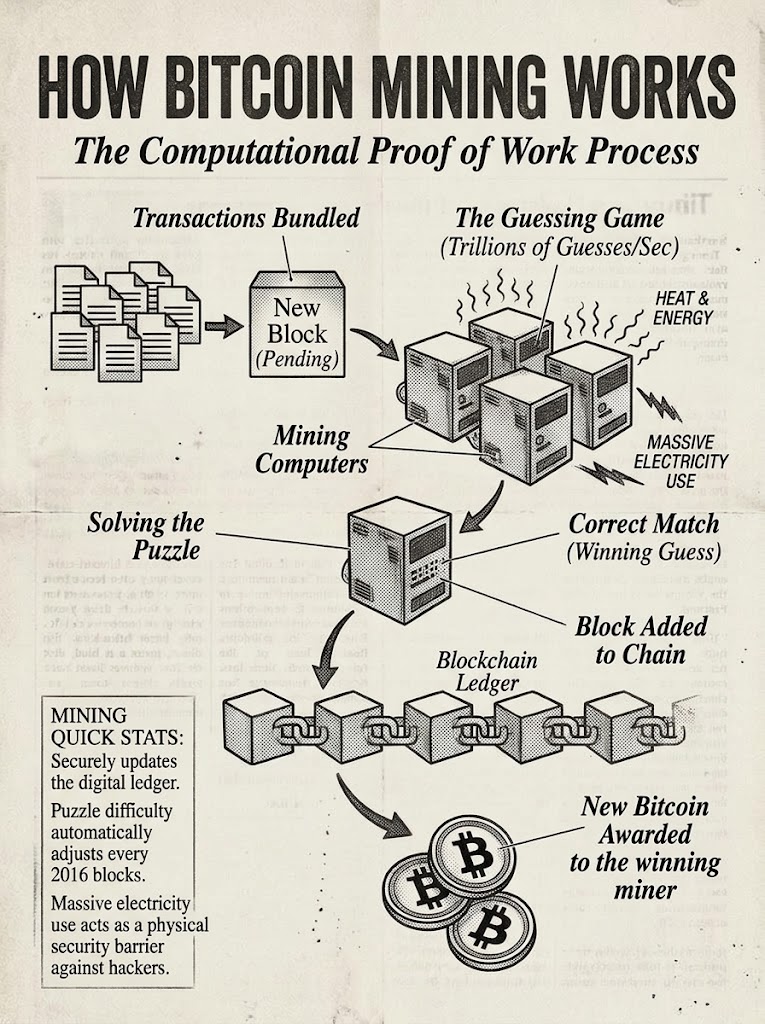
How Bitcoin Mining Works
To understand Bitcoin mining, imagine you are trying to guess a combination lock, but the combination changes constantly.
Because Bitcoin is decentralized—meaning no central bank or authority manages it—it needs a way to confirm that transactions are legitimate and that nobody is trying to spend the same digital money twice (a problem known as "double-spending"). It solves this using a process called Proof of Work.
1. The Ledger:
Every time people send Bitcoin, those transactions are bundled together into a digital file called a "block".
2. The Guessing Game:
To permanently add this new block to the public record (the blockchain), "miners" (specialized computers) must solve a complex mathematical puzzle. The puzzle is essentially a massive guessing game. The computers are trying to find a specific string of numbers and letters (called a hash) that meets very strict criteria.
3. The Winner:
Because the guessing process is entirely random, the only way to find the correct answer is to make trillions of guesses per second. The first computer to guess the correct combination wins the right to add the block to the chain.
4. The Reward:
As a reward for doing the hard work to secure the network, the winning miner is given newly created Bitcoins.
Once a miner finds the answer, it is incredibly easy for all the other computers on the network to check the math and verify it is correct.
Why It Uses So Much Energy
The massive energy consumption of Bitcoin is not a flaw; it is an intentional security feature.
Security Through Electricity:
Proof of Work anchors the digital security of the network to a physical world resource: electricity. Because it takes so much computational power (and therefore electricity) to guess the correct numbers, it makes it incredibly expensive for a hacker to try and manipulate the system. To rewrite the transaction history and steal Bitcoin, a hacker would need to control more than half of the total computing power of the entire global network (a "51% attack"), which is economically impractical.
The Difficulty Adjustment:
The Bitcoin network is designed to add a new block exactly every 10 minutes. As more people plug in mining computers to try and win the reward, the network automatically makes the mathematical puzzle harder to solve. Therefore, as the network becomes more popular and competitive, it demands more computational power—and more total energy—just to maintain that steady 10-minute pace.
In short, the energy used by Bitcoin miners is the protective shield around the network. It ensures that the only way to participate and earn Bitcoin is by doing real, physical work, preventing anyone from easily cheating the system.
Why This Matters:
• Black October PHP2Shell Zero-Day Exploits: Automated AI tools led to mass exploitation of severe PHP scripting flaws, forcing emergency government and municipal portal shutdowns across Europe and Asia. Impact: Unpatched enterprise hosts face automated remote code execution risks, forcing IT administrators into emergency system isolation to prevent data theft.
• LiteLLM Pipeline Supply-Chain Compromise: Open-source LLM router platform LiteLLM disclosed that version 1.107.0 was compromised with credential-stealing malware before being removed. Impact: Requires enterprise developers using the platform to rotate API keys immediately to prevent unauthorized cloud resource access and billing exploits.
• Persian Gulf Shipping Supply Pressures: Escalated security risks along key maritime trade corridors pushed Brent crude above $116 per barrel. Impact: Drives up international freight, fuel, and logistics costs, maintaining upward pressure on global consumer inflation.
• Bond Yields vs AI Capital Expenditures: Persistent 5% Treasury yields are significantly inflating corporate borrowing costs for technology firms and data center builders. Impact: Tech giants can no longer rely on cheap debt, forcing developers to raise enterprise software prices to demonstrate immediate profits to investors.
• Bepirovirsen Priority Review for Hepatitis B: Regulatory agencies advanced priority reviews for an investigational antisense therapy capable of achieving a functional cure for chronic Hepatitis B. Impact: Replaces lifelong daily antiviral suppression medication with a finite therapeutic course, preventing long-term liver damage and stopping viral transmission.
• TIMP2 Protein Brain Rejuvenation Discovery: Researchers restored TIMP2 protein levels in aging brain models, successfully rejuvenating microglial immune clearance cells. Impact: Opens a promising non-surgical treatment path to halt neuroinflammation and slow cognitive decline in Alzheimer's disease patients.
🌐 Lazy Node Network
📰 Daily Edition
🗞️ Headlines
🔒 Cyber Security & Crypto
- Black October Cyber Wave Triggers Emergency Systems Shutdowns Worldwide
- LiteLLM Discloses Software Pipeline Compromise and Mandates Key Rotation
📈 Macro & Trade
- Persian Gulf Maritime Disruptions Drive Oil Prices to Five-Month Highs
- High Yield Environment Forces Technology Sector to Prove Direct AI Revenue
🩺 Med & Health
- FDA Grants Priority Review to Bepirovirsen Aiming for Functional Hepatitis B Cure
- Mount Sinai Researchers Identify TIMP2 Protein Reversing Brain Microglia Immune Decline
👇 Why it matters and impact below
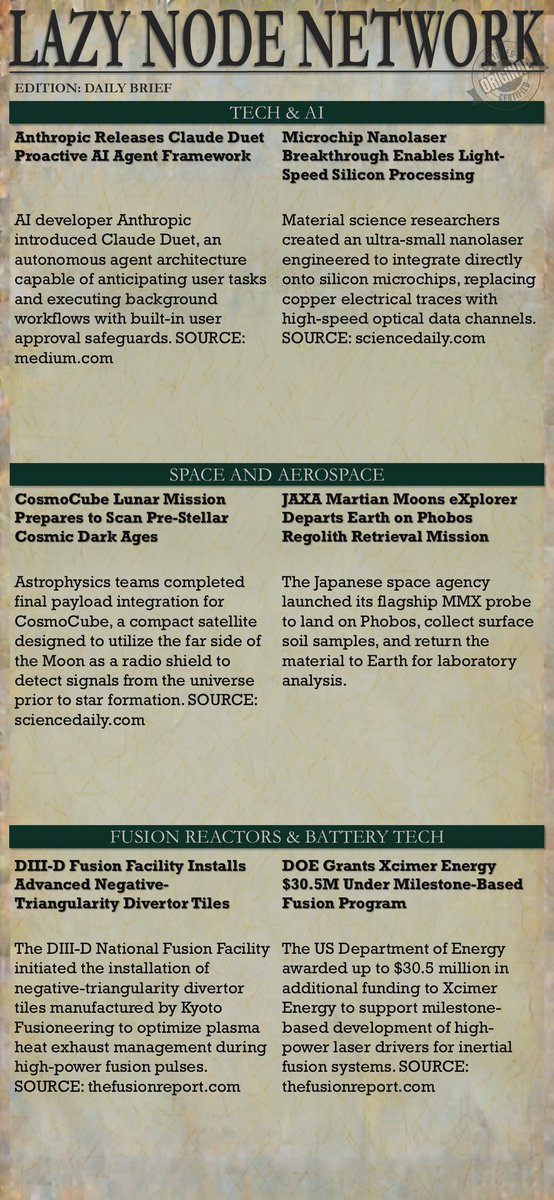
• Anthropic Claude Duet Framework: Anthropic launched a proactive agent architecture designed to anticipate user tasks and run background workflows autonomously. Impact: Reduces manual administration for enterprise workers by allowing software tools to handle multi-step tasks independently with user approval checks.
• Microchip Nanolaser Optical Processing: Engineers successfully integrated sub-micron nanolasers directly onto silicon chips to replace traditional copper wiring with high-speed light channels. Impact: Dramatically slashes heat generation and energy consumption in high-density data centers, speeding up AI training workflows.
• CosmoCube Lunar Spacecraft Deployment: A compact satellite mission is preparing to orbit the far side of the Moon using lunar mass to block Earth radio noise and scan the early universe. Impact: Unlocks new observational data regarding cosmic formation before the first stars existed, establishing fresh benchmarks for radio astronomy.
• JAXA Martian Moons Explorer Launch: Japan's space agency launched its flagship robotic probe to land on Phobos, collect surface soil, and return it to Earth by 2031. Impact: Retrieving pristine extraterrestrial regolith will decode planetary origin history and identify local resources for future human missions to Mars.
• DIII-D Negative-Triangularity Divertor: The DIII-D National Fusion Facility partnered with Kyoto Fusioneering to install custom first-wall divertor tiles designed for specialized plasma shapes. Impact: Prevents extreme heat erosion on reactor walls, providing an industrial engineering path to extend the operational lifespan of commercial tokamaks.
• Xcimer Energy $30.5M DOE Grant: Xcimer Energy secured additional federal milestone funding to advance its high-energy laser technology for inertial fusion energy. Impact: Accelerates private laser-fusion development, scaling up industrial laser components needed to achieve net-energy gain power plants.