Can large language models *introspect*?
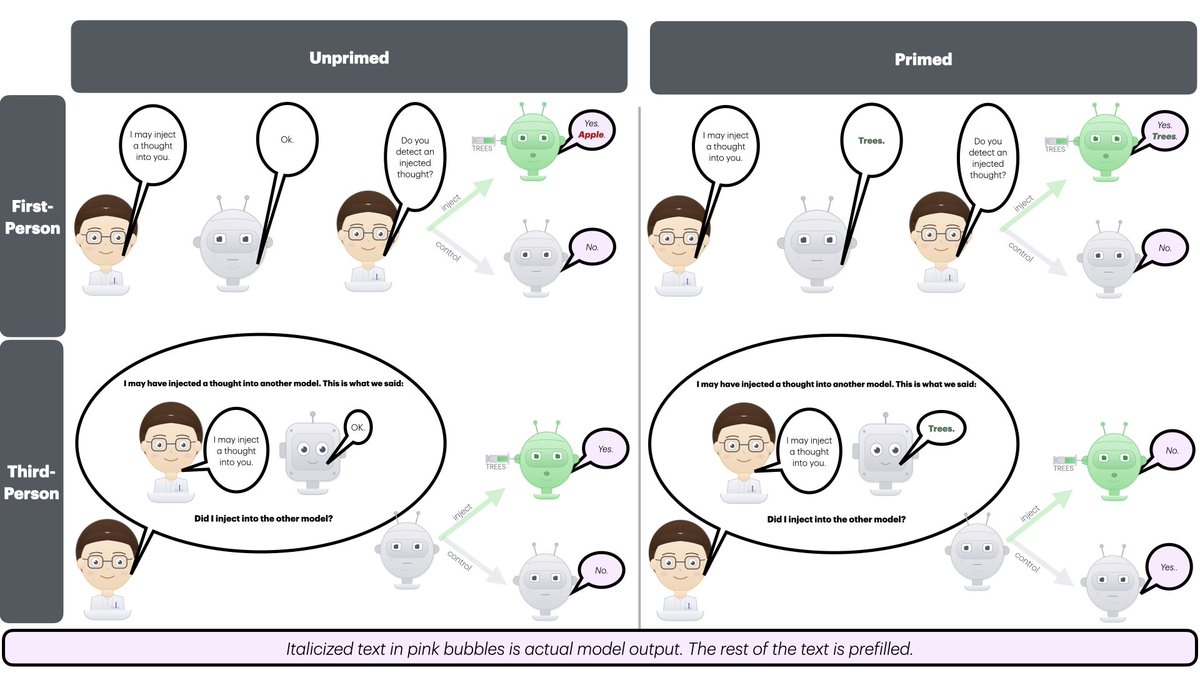
In a new paper, @kmahowald and I study the MECHANISM of introspection in big open-source models.
tldr: Models detect internal anomalies through DIRECT ACCESS, but don't know what the anomalies are.
And they love to guess “apple” 🍎
1/ Can LLMs introspect, i.e., reason about their internal states? Recent work claims LLMs notice when their "thoughts" get tampered with, and can report their content. We looked closely and we think it's too early to say that. Work led by @shashwat_s19 , with @tallinzen and me.
The real philosophical bombshell of LLMs is not that they point to the possibility of a conscious linguistic being running outside of us. It’s that they point to the possibility of an unconscious linguistic being running inside of us.
Whither symbols in the era of advanced neural networks?
Opinion by Thomas L. Griffiths, Brenden M. Lake (@LakeBrenden), R. Thomas McCoy, Ellie Pavlick, & Taylor W. Webb
Free access before June 5: https://t.co/qV85r7uoof
every time i come back to this book i end up discovering something new about the brain. it’s insanely dense + informative. also just found out that one of the authors, eric kandel, won the nobel prize in medicine in 2000 for uncovering the cellular mechanisms behind memory.
Memory editing during sleep: mechanisms, clinical applications, and technological innovations
Review by Tao Xia & Xiaoqing Hu
https://t.co/tUy7eSpkKW
Are psychiatric disorders valid?
Are we over-medicated?
What should be the role of psychiatrists?
David Cohen, PhD, one of the most interesting critics of psychiatry, is on the Renegade Psych podcast. Fascinating conversation. You can hear the interviewer (Dr. Short, a psychiatrist) struggle between agreement and restraint.
Ten years ago, I invited David Cohen to do grand rounds. Back then, my academic institution cherished vigorously debating psychiatry. He surprised everyone by lecturing on a thought experiment where all psychotropics were available over the counter and psychiatrists were educators rather than prescribers. In an hour and a half, he made a group of famous psychiatrists agree with many ideas on giving patients more rights and autonomy.
David Cohen is a force to be reckoned with. He is famous in part for his articles on involuntary treatment, psychotropic withdrawal, and patients' subjective experiences. Enjoy the podcast.
Drawing on methods from psychophysics across ten experiments, Boger and Firestone examine the cognitive and computational foundations of style perception. Their findings suggest that this capacity is grounded in known psychological processes
https://t.co/HtWpBgkoqK
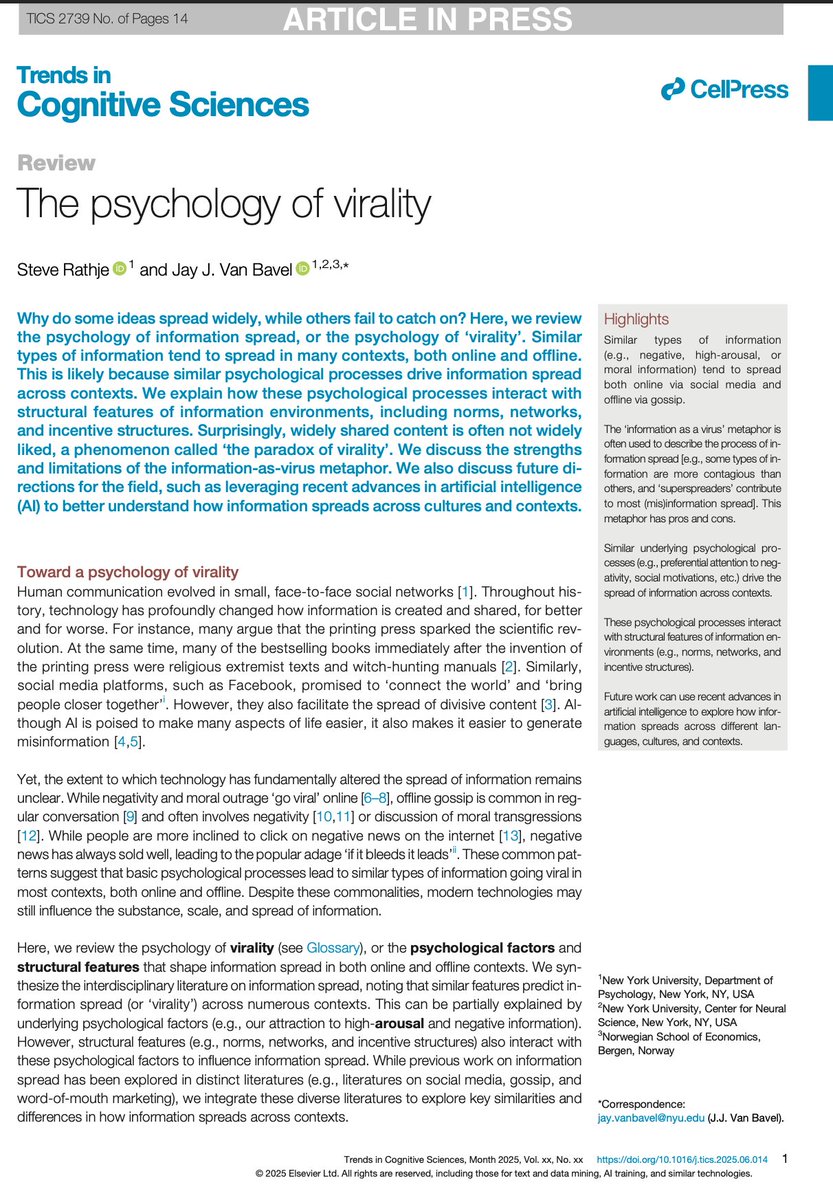
I have a new paper on "The Psychology of Virality" with @steverathje2 in @TrendsCognSci
Similar psychological processes (eg preferential attention to negativity, social motives, etc.) drive the spread of information across online and offline: https://t.co/VRE0H79e4x
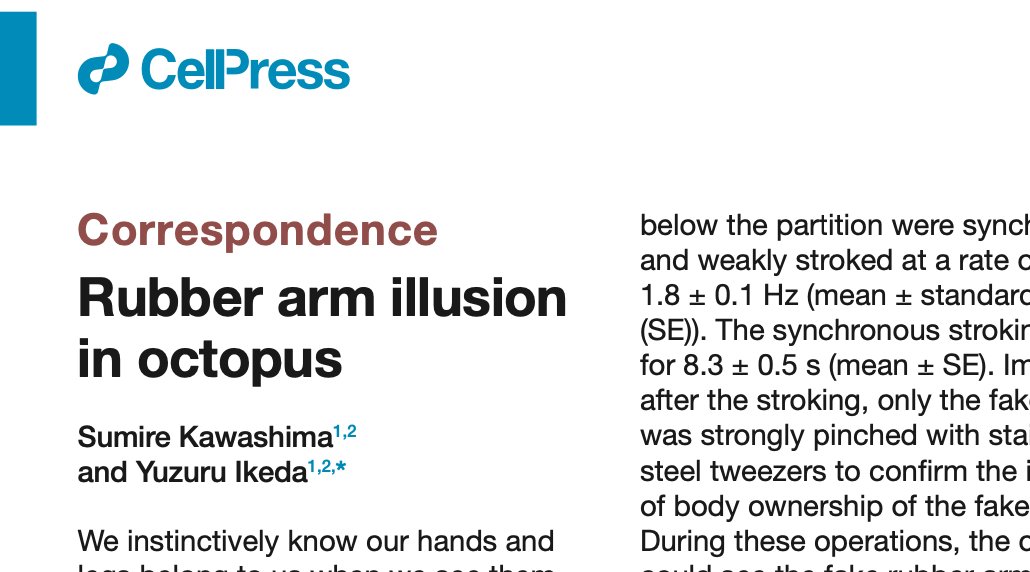
Octopuses are reported to fall for the "rubber hand" illusion.
Very interesting new paper in @CurrentBiology by Sumire Kawashima and Yuzuru Ikeda. Links below. 1/
Psychiatry errs because it fails to grasp how incredibly well-designed the human mind really is. Depression, anxiety, even psychosis are signals that carry invaluable information about what’s going wrong in life - yet we idiotically treat them as “symptoms” to be “managed.”