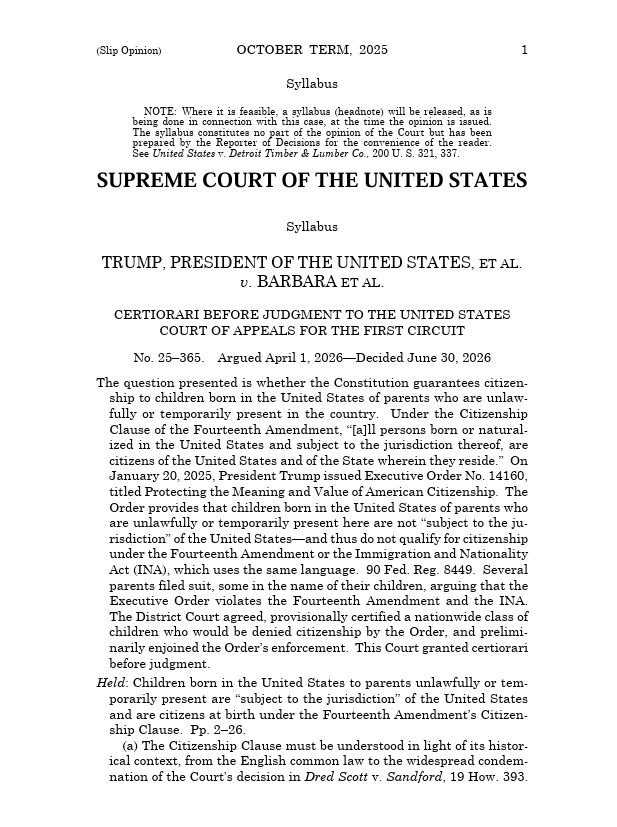
🚨 The Supreme Court ruled that the Fourteenth Amendment guarantees birthright citizenship to children born in the United States, including those whose parents are in the country unlawfully or only temporarily, striking down President Trump's executive order.
I'm a cardiologist. A woman loses her husband. Two days later she's on my cath lab table — chest pain, EKG changes, enzymes elevated. Everything says heart attack.
I thread the catheter. Her arteries are pristine.
Her heart didn't clog. It shattered. From grief.
Takotsubo — broken heart syndrome. Stress hormones stun the ventricle so severely it balloons and stops pumping. 90% of cases are women. Your heart can literally break. Not a metaphor. Physiology.
But this is just one blind spot in a system built for men's hearts.
Women get microvascular disease — plaque in vessels too small for angiograms to see. Heart attacks with "clean" arteries.
Women get SCAD — leading cause of heart attack under 50. Most doctors have never diagnosed one.
Women present with fatigue, jaw pain, nausea, back pain. Medicine called these "atypical" for decades. They're not atypical. They're female-typical.
Half of humanity is not a variant.
Heart disease kills more women than every cancer combined. Fewer than half know.
Three things every woman needs to hear:
Say these exact words to your doctor: "I am concerned this could be my heart." That sentence changes everything. Don't soften it.
If tests are "normal" but symptoms persist — demand CT angiography or cardiac MRI.
If you had preeclampsia — your cardiac surveillance starts now. Not at 65.
Your heart can break from grief, from stress, from a system that wasn't built to see you.
It can also heal. If someone finally looks.
Share this with every woman you love.
The FCC wants to kill burner phones by forcing telecoms to verify every customer’s government ID.
Sold as “anti‑fraud,” but it kills anonymity.
Burner phones? Gone.
Anonymous calls? Gone.
Surveillance expands. Freedom shrinks.
Some may argue that Stargate’s audience was built 20 years ago and that a new series would need to attract younger viewers to succeed.
@JeffBezos@AmazonMGMStudio if you take a moment to read , you’ll see
that argument overlooks what is happening right now.
The #SaveStargate movement is not being driven by nostalgia alone.
It is being driven by long-time fans, new fans, content creators, convention communities, YouTube channels, podcasts and viewers discovering the franchise through streaming services every day.
Many of the people supporting Stargate today were children when SG-1 first aired.
Some were not even born.
The continued growth of this campaign proves that Stargate’s appeal extends beyond its original audience.
And we have seen this before.
When Doctor Who returned in 2005 after years off the air, it didn’t survive on nostalgia alone. It introduced an iconic franchise to an entirely new generation and went on to thrive for the next two decades.
Great science fiction doesn’t belong to one generation.
It evolves and finds new audiences.
Others may say there is no urgency because Amazon already owns the franchise and can simply wait.
But waiting is not without cost.
Every year without Stargate is a year without new subscribers, merchandise revenue, licensing opportunities, international sales, gaming partnerships and franchise expansion.
Momentum matters.
Right now fans, creators, writers, producers, cast members and community leaders are all speaking with one voice.
That kind of organic engagement cannot be manufactured.
It has to be earned.
Amazon already owns one of the most recognised science-fiction franchises in the world.
The audience exists.
The demand exists.
The goodwill exists.
The proof is in front of us.
Tens of thousands of petition signatures.
Millions of fans worldwide.
Cast members, creators and communities rallying together.
The cost of doing nothing is invisible.
#SaveStargate
#WeShallNotGoQuietlyIntoTheNight
here's Barack Obama's entire speech commemorating the Obama Presidential Center. He reflected on his administration's successes and failures, critiqued the moral rot of contemporary America, and outlined a positive vision of the future -- all without ever mentioning Trump
Dear @AmazonMGMStudio & @PrimeVideo
Understand this clearly:
The Stargate audience does not want a reboot. We do not want a reimagining. We do not want a franchise “evolution.” We do not want a product engineered for focus groups and marketed as being for “modern audiences.”
We want Martin Gero’s Stargate. Nothing more. Nothing less.
For decades, fans kept this franchise alive while studios ignored it. We bought the DVDs. We watched the reruns. We kept the conversations going long after the gates went silent.
Now you stand at a crossroads.
One path leads back to the Stargate people actually love, the world built by the creators who made it matter in the first place.
The other leads to another hollow corporate imitation wearing a familiar name like a stolen uniform.
Choose the second path, and do not expect our support.
We will not celebrate it. We will not promote it. We will not reward it for borrowing a title it did not earn.
The audience you are chasing does not belong to you. The audience you already have does.
Ignore us, and you may discover too late that the people who carried Stargate for twenty years were the only people still willing to carry it at all.
The answer is already sitting in front of you.
The creators are there.
The fanbase is there.
The demand is there.
The blueprint exists.
The groundwork is finished.
The money has already been spent.
The choice is yours.
But so is the outcome.
#SaveStargate
Here’s one of the most important intelligence reforms, stated as plainly as possible:
No American gets surveilled without a real warrant from a real court.
Not the secret FISA court that currently rubber-stamps over 99% of government requests.
We’re talking about an actual adversarial courtroom: a real judge, and the same probable-cause standard the Fourth Amendment has always required - the one intelligence agencies have spent decades dodging.
All the loopholes get closed, permanently:
-No more buying Americans’ data from brokers to dodge the warrant.
-No more asking a foreign partner to spy on us and hand over the results.
-No more “incidental collection” that vacuums up millions of innocent Americans’ communications and pretends it was an accident.
One simple, ironclad rule with zero exceptions: If the target is an American, get a warrant - or stand down.
Constitution requires two-thirds vote from the Senate to bind us to another country.
They hid it in the bill because they knew it was unconstitutional.
It’s treasonous as far as I’m concerned.
Every single person who voted for this needs removed from office.
Stargate Command has a message for you.
HAVE YOU SIGNED THE STARGATE REVIVAL PETITION?
No? Well then here's the link.
That's an order SGC personnel.
https://t.co/M5cAurmUh5
Here’s a link for those wondering where I saw this.
“For MIT to be closing three of its four major libraries, demonstrates a significant retreat from that commitment to truth and knowledge…”
https://t.co/jIXpwfp6iB
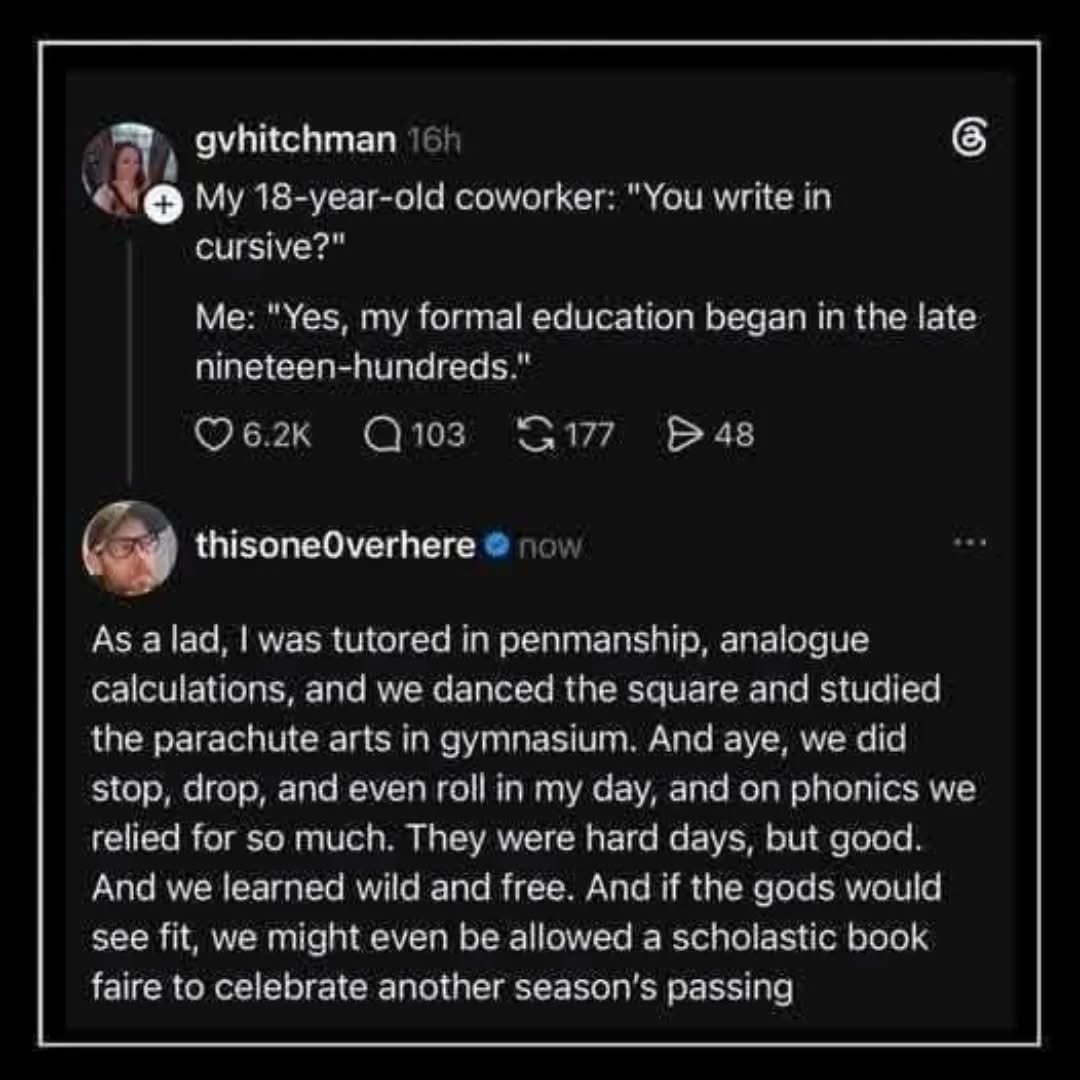
Some of you have forgotten that only three years ago you were perfectly capable of writing an essay, writing a eulogy, telling a bedtime story to a child, and it should worry you that powerful companies have convinced us we can’t do things we’ve been doing for 5,000 years.
This is the final CBS News Radio broadcast, aired between 11 p.m. (the top of the hour is first) and 11:30 p.m. (the final special report).
After 99 years on the air, CBS Radio News has ended.
(Captured by @TheDeskDotNet)
The committee for the first amendment has been created.
“If they come for one of us, they’d better come for all of us.”
We will miss you, Stephen Colbert, you are an American. Thank you.
Courage is contagious.
The American president is stealing from the American people in broad daylight. It is corrupt. It is criminal. It is reprehensible.
But just as disturbing is the silence — the obsequious surrender of Republicans in Congress. They see it. They know it. And still they kneel before power like contemptible sycophants, placing loyalty to one man above loyalty to the Constitution and the country.
A democracy cannot survive when corruption is normalized, truth is discarded, and those entrusted to defend the republic refuse to act. Our democracy, our way of life, is in grave danger.
These AI graduation speeches getting booed are a big deal.
It’s deeply revealing.
The people making AI have no clue how the people they are making it do really feel about it all.
They are dangerously deluded by their Bay Area echo chamber.
But they’re about to learn.
You cannot take our futures without our consent.
The rejection of runaway AI has begun in America.
And our young people leading the way is a great thing.
Hear them. The volume is about to get much louder.
I love voting here in CA
Election office notifies me by text when my Ballot is sent to me
Post office notifies me by text when its picked up
Elections office notifies me by text when they've received it
Elections office notifies me by text when it's counted
There's a reason Republicans hate CA, and this is one of them. Ease of voting should be this way all over the country. But republicans know if it was this easy everywhere, they'd never win another election
A Norwegian neuroscientist spent 20 years proving that the act of writing by hand changes the human brain in ways typing physically cannot, and almost nobody outside her field has read the paper.
Her name is Audrey van der Meer.
She runs a brain research lab in Trondheim, and the paper that closed the argument was published in 2024 in a journal called Frontiers in Psychology. The finding is brutal enough that it should have changed every classroom on Earth.
The experiment was simple. She recruited 36 university students and put each one in a cap with 256 sensors pressed against their scalp to record brain activity. Words flashed on a screen one at a time.
Sometimes the students wrote the word by hand on a touchscreen using a digital pen, and sometimes they typed the same word on a keyboard. Every neural response was recorded for the full five seconds the word stayed on screen.
Then her team looked at the part of the data most researchers had ignored for years, which is how different parts of the brain were communicating with each other during the task.
When the students wrote by hand, the brain lit up everywhere at once.
The regions responsible for memory, sensory integration, and the encoding of new information were all firing together in a coordinated pattern that spread across the entire cortex. The whole network was awake and connected.
When the same students typed the same word, that pattern collapsed almost completely.
Most of the brain went quiet, and the connections between regions that had been alive seconds earlier were nowhere to be found on the EEG.
Same word, same brain, same person, and two completely different neurological events.
The reason turned out to be something nobody had really paid attention to before her work. Writing by hand is not one motion but a sequence of thousands of tiny micro-movements coordinated with your eyes in real time, where each letter is a different shape that requires the brain to solve a slightly different spatial problem.
Your fingers, wrist, vision, and the parts of your brain that track position in space are all working together to produce one letter, then the next, then the next.
Typing throws all of that away. Every key on a keyboard requires the exact same finger motion regardless of which letter you are pressing, which means the brain has almost nothing to integrate and almost no problem to solve.
Van der Meer said it plainly in her interviews.
Pressing the same key with the same finger over and over does not stimulate the brain in any meaningful way, and she pointed out something that should scare every parent who handed their kid an iPad.
Children who learn to read and write on tablets often cannot tell letters like b and d apart, because they have never physically felt with their bodies what it takes to actually produce those letters on a page.
A decade before her, two researchers at Princeton ran the same fight using a completely different method and ended up at the same answer. Pam Mueller and Daniel Oppenheimer tested 327 students across three experiments, where half took notes on laptops with the internet disabled and half took notes by hand, before testing everyone on what they actually understood from the lectures they had watched.
The handwriting group won by a wide margin on every question that required real understanding rather than surface recall.
The reason was hiding in the transcripts of what the two groups had actually written down.
The laptop students typed almost word for word, capturing more total content but processing almost none of it as they went, while the handwriting students physically could not write fast enough to transcribe a lecture in real time, which forced them to listen carefully, decide what actually mattered, and put it in their own words on the page.
That single act of choosing what to keep was the learning itself, and the keyboard had quietly skipped the choosing and skipped the learning along with it.
Two studies. Two countries. Same answer.
Handwriting makes the brain work. Typing lets it coast.
Every note you have ever typed instead of written went into your brain through a thinner pipe. Every meeting, every book highlight, every idea you captured on your phone instead of on paper was processed at half depth.
You did not forget those things because your memory is bad. You forgot them because typing never woke the part of the brain that would have made them stick.
The fix is the thing your grandmother already knew.
Pick up a pen. Write the thing down. The slower road is the faster one.
On May 18, 1939, Professor Tolkien gave his famous lecture “On Fairy Stories” at the University of St Andrews.
There he argued that fairy tales and myths are deeply human stories, not childish distractions. He believed fantasy allows people to experience wonder again, recover a sense of beauty in ordinary things, and find hope.
One of Tolkien’s most famous points was his defence of “escape” in storytelling. He argued there is nothing shameful about wanting to escape darkness, famously asking: “Why should a man be scorned if, finding himself in prison, he tries to get out and go home?”
Here is an excerpt:
“The realm of fairy-story is wide and deep and high and filled with many things: all manner of beasts and birds are found there; shoreless seas and stars uncounted; beauty that is an enchantment, and an ever-present peril; both joy and sorrow sharp as swords. In that realm a man may, perhaps, count himself fortunate to have wandered, but its very richness and strangeness tie the tongue of the traveller who would report them. And while he is there it is dangerous for him to ask too many questions, lest the gate should be shut and the keys be lost.”