Elon Musk literally sat down for a 45-minute talk with Y Combinator that explains how to build world-changing companies better than any business school on earth. This is the advice he gave a room full of young founders:
1. Don't try to build something great. Try to build something useful.
Everyone obsesses over greatness. Musk says that's the wrong target. "I didn't originally think I would build something great. I wanted to try to build something useful. I didn't think I would build anything particularly great. Seemed unlikely, but I wanted to at least try." Aim for useful first. Greatness, if it comes, is a byproduct.
2. When you can't get in the front door, build your own door.
Before Musk started his first company, he tried to get a job at Netscape. "I sent my resume into Netscape and nobody responded. I tried hanging out in the lobby to see if I could bump into someone, but I was too shy to talk to anyone. So I'm like, this is ridiculous, I'll just write software myself." He didn't set out to be a founder. He became one because no one would hire him.
3. He slept in the office and showered at the YMCA.
The origin of his first company was not glamorous. "We couldn't even afford a place to stay. The office was 500 bucks a month, so we just slept in the office and showered at the YMCA." He couldn't afford proper internet either, so he drilled a hole through the office floor and ran a cable to the internet provider downstairs. That was the founder of the future richest man on earth.
4. Keep the chips on the table.
When Musk sold his first company, he received a $20 million cheque. His bank balance went from $10,000 to $20 million overnight. Most people would have stopped. He put almost all of it straight back into his next company. "I kept the chips on the table." He did the same thing decades later, over and over. He hates money sitting idle. Money is fuel for the next mission.
5. Start with the mission, then work backwards to make it a business.
Musk didn't start SpaceX to make money. He went on the NASA website to find out when humans were going to Mars, and there was no plan. So he decided to build one. "There had been no prior example of a rocket startup succeeding. A small chance of success is better than no chance of success." The mission came first. The business model came later.
6. He started SpaceX expecting to fail.
He is brutally honest about the odds. "SpaceX started in mid-2002 expecting to fail. Probably 90% chance of failing. When recruiting people, I said, we're probably going to die, but small chance we might not die." The first three launches failed. The fourth one worked with no money left. "If the fourth launch hadn't worked, it would have been curtains. We made it by the skin of our teeth."
7. Break every problem down to physics.
This is the core of how Musk thinks. "First principles means break things down to the fundamental elements that are most likely to be true, then reason up from there, as opposed to reasoning by analogy." His example is rockets. Everyone priced them based on what old rockets cost. Musk asked what a rocket is actually made of, priced the raw metals, and found the materials were only 1-2% of the historical price. The rest was inefficiency he could attack.
8. When told something takes 24 months, break it down and do it in six.
Last year xAI needed a giant computer to train its AI. Suppliers said it would take 18 to 24 months. "It's like, well, we need to get that done in six months or we won't be competitive." So he broke it into parts. Needed a building, so he found an old factory. Needed power, so he rented generators. Needed cooling, so he rented a quarter of America's mobile cooling capacity. He slept in the data centre and ran cabling himself. It got done.
9. Watch your ego-to-ability ratio.
Musk's single sharpest piece of advice for young founders is about staying honest with yourself. "A major failure mode is when your ego-to-ability ratio gets too high. Then you break the feedback loop to reality." Keep the ego small, internalise responsibility for everything, and stay ruthlessly connected to what's actually true. "You want to close the loop on reality hard. That's a super big deal."
10. Chase work, not glory.
His closing philosophy ties it all together. "It's so hard to be useful. The area under the curve of total utility is how useful you've been to your fellow human beings times how many people. If you aspire to do true work, your probability of success is much higher. Don't aspire to glory, aspire to work."
He was ridiculed for years. The press called him "internet guy attempting to build a rocket company." He agreed it sounded absurd. He did it anyway, because a small chance of doing something useful beat no chance at all.
Here's the thing though....
Musk became the most followed founder alive because everything he does happens in public. The launches, the failures, the talks like this one. The companies made him powerful. The personal brand made his every word travel around the world before he finishes saying it.
We build massive distribution and grow personal brands on X and beyond without our clients lifting a finger.
If you're a founder or VC looking for that kind of exposure, book a call below.
We average 1.5M views a week.
https://t.co/UoXuYlkBQq
This 45 minute Stanford lecture will teach you more about building companies than every startup book combined.
Bookmark & give it 45 minutes today, no matter what.
Mr President, on behalf of the people of Pakistan, Field Marshal Syed Asim Munir, and on my behalf, I express my deep and profound appreciation for your kind and gracious words.
@realDonaldTrump
CHINA:
"The US is a war addict. Throughout its over 240-year history, it has been at war for all but 16 years.
The US has 800 overseas military bases in over 80 countries and regions.
The US is the main cause of international disorder, global turbulence, and regional instability."
List of industries that will produce the most valuable SaaS companies of the next decade:
• HVAC
• Roofing
• Painting
• Recycling
• Plumbing
• Electrical
• Warehousing
• Laundromats
• Car washes
• Construction
• Pest control
• Landscaping
• Property services
• Cleaning services
• Handyman services
• Waste management
• 3PL / cross-docking
• Maritime operations
• Facilities maintenance
• Freight (trucking, SMB fleets)
• Garment care (dry cleaning)
• Middle market back-office and ops software
• Ports, drayage, and container logistics
• Field services (dispatch, scheduling, quoting, fleet, compliance)
From today, Artificial Intelligence education is being launched in all government schools of Punjab.
Every child, without discrimination, will be equipped with modern digital and analytical tools and skills essential for competing with the modern world.
This is Punjab’s historic digital leap:
• AI teacher in every public school
• 1,000 teachers trained as AI Master Trainers
• AI formally integrated into the curriculum within 60 days, Insha’Allah!
Punjab leads. The future follows.
🚨New Episode: Andrew Carnegie (Part 1): The rise of Andrew Carnegie from a poor Scottish weaver's boy to becoming an American millionaire.
00:00 Introduction
03:00 Carnegie's Early Life and Inspirations
07:50 Coming to America
12:00 The Power of Self-Education
28:15 Becoming a Capitalist: The Adams Express Investment
36:30 Rapid Rise in the Railroad Industry
42:15 Carnegie's Role in the Civil War
50:30 Carnegie's Business Philosophy and Networking
56:15 Final Reflections and Takeaways
Links are in the comments below
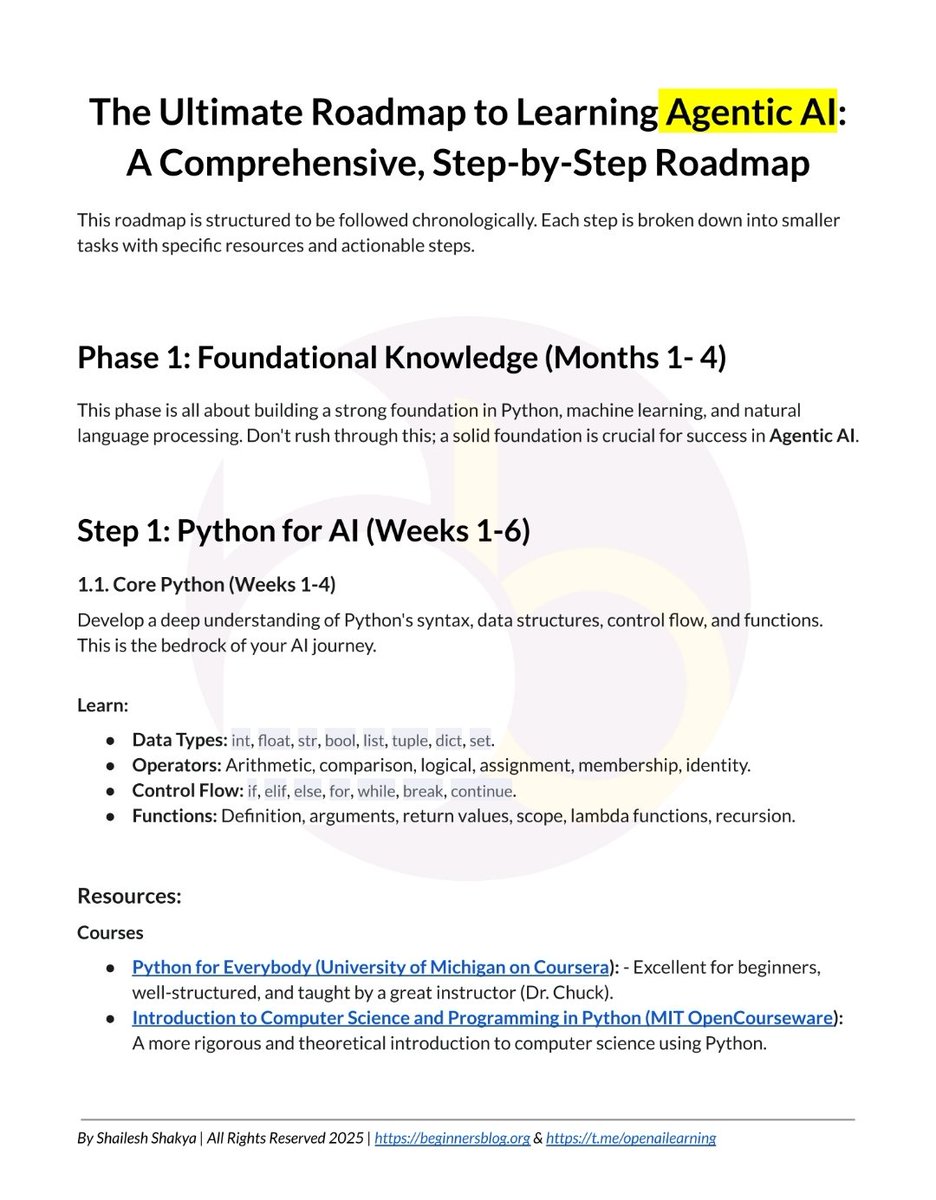
Agentic AI is an emerging career that you can start to make up to $130,000 per year.
You can learn Agentic AI.
I have a detailed ROADMAP that cover everything from steps, resources and courses you need to take to get started.
It's 100% FREE for 24 hours To get this, Follow
@beginnersblog1
Like & RT Comment "Agentic AI"
I'll send you the link to the PDF...
Read More below👇👇👇
.
.
.
The best returns on $ I've gotten in order:
1) Fastest internet connection possible
2) Multiple computer screens
3) Multiple chargers around house
4) Ear plugs, black out curtains, cooling mattress
5) Room temp control
6) Best chair & working desk
7) Fastest computer for needs
8) Air filters
9) Pre-made meals
10) Laundry Service
11) House cleaning
12) Lawn care
13) Rideshare
14) Neighborhood off highway with good stuff & people in walking distance
15) Home gym setup
16) Flying Semi-private
Today we are launching my favorite feature of ChatGPT so far, called Pulse. It is initially available to Pro subscribers.
Pulse works for you overnight, and keeps thinking about your interests, your connected data, your recent chats, and more. Every morning, you get a custom-generated set of stuff you might be interested in.
It performs super well if you tell ChatGPT more about what's important to you. In regular chat, you could mention “I’d like to go visit Bora Bora someday” or “My kid is 6 months old and I’m interested in developmental milestones” and in the future you might get useful updates.
Think of treating ChatGPT like a super-competent personal assistant: sometimes you ask for things you need in the moment, but if you share general preferences, it will do a good job for you proactively.
This also points to what I believe is the future of ChatGPT: a shift from being all reactive to being significantly proactive, and extremely personalized.
This is an early look, and right now only available to Pro subscribers. We will work hard to improve the quality over time and to find a way to bring it to Plus subscribers too.
Huge congrats to @ChristinaHartW, @_samirism, and the team for building this.