Founder @TradoraAI | AI + data to make owning and financing cars smarter, faster, and more transparent. Building the future of auto intelligence. 🇺🇸🇫🇷🇨🇫
🚗 The trade-in experience is broken.
Most dealer website trade tools are static lead forms pretending to be strategy.
They capture a customer once, return a generic value range, and then hand the dealer another cold follow-up task.
That is not enough anymore.
Consumers are checking values everywhere — KBB, Carvana, CarMax, marketplaces, competing dealers — and by the time the dealership sees real intent, the customer is often already in motion.
Tradora is being built around a different thesis:
��� The trade tool should not be a one-time lead form.
It should be the entry point into a full ownership lifecycle.
The video below shows the consumer-facing side of Tradora: value, service, maintenance, warranty, insurance, refinance, vehicle health, and future shopping in one environment.
At the center of this is Axia, our AI agent.
For consumers, Axia helps simplify vehicle ownership by surfacing what matters: when to service, when to protect, when to refinance, when to shop, and when it may be the right time to trade.
For dealers, Axia helps turn ownership data into action: trade alerts, service opportunities, retention triggers, and better timing before the customer defects to a third-party marketplace.
And for dealer-acquired customers, the experience is designed to keep the relationship protected: the consumer environment can prioritize the home dealer’s inventory, offers, service lane, and trade opportunities instead of pushing that customer back into a marketplace full of competing rooftops.
For dealers, the wedge is simple:
✅ Replace static trade widgets
✅ Capture higher-intent trade opportunities
✅ Give the selling dealer first right of refusal
✅ Prioritize the home dealer’s inventory, offers, and service lane
✅ Keep dealer-acquired customers out of third-party marketplaces
✅ Reduce leakage to competing rooftops after the dealer already paid to acquire the customer
✅ Keep customers engaged before they are actively shopping
✅ Source vehicles earlier and more intelligently
✅ Turn ownership data into inventory acquisition
✅ Use Axia to surface trade alerts, service opportunities, and retention triggers
✅ Expand from trade capture into service, warranty, insurance, refinance, and retention
The trade is not the end of the customer lifecycle.
It is the signal.
And dealers who act on that signal first will win more inventory.
https://t.co/lLqhqgSqU8
Lisbon bound 🇵🇹
Pretty surreal.
I’m proud of how far Tradora has come, humbled to have been invited, and definitely a little nervous.
Mostly, I’m excited to listen, learn, share what we’re building and see where the conversation leads.
A good reminder that sometimes an idea can take you places you never expected. ✈️
Early product metrics without implementation context can be incredibly misleading.
Our current Tradora cohort starts August 27.
One of the participating stores, Claremont, had a lead-syndication issue that wasn’t fixed until September 8.
During the same period:
sales follow-up wasn’t fully active
post-sale lifecycle automation wasn’t live
service cadence wasn’t live
Despite that:
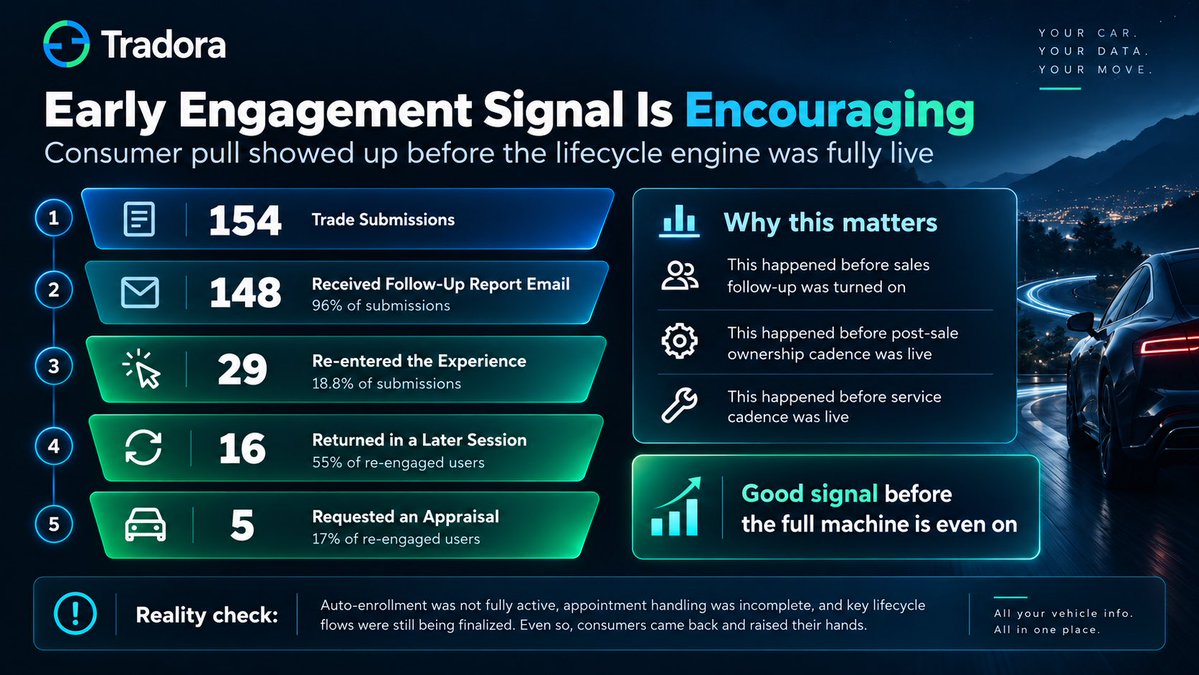
154 submissions
29 users re-entered
16 returned in a later session
5 requested an appraisal
Too early for big conclusions.
But the signal I’m watching isn’t conversion optimization yet.
It’s unprompted return behavior before the system was fully functioning.
Now we get to measure what happens when the infrastructure catches up with the product.
https://t.co/lLqhqgSqU8
@TradoraAi
Exactly. That’s the next cohort I want to follow closely.
The 16 later-session returns tell us there’s real curiosity/intent. Once sales follow-up, service and post-sale ownership loops are live, the important question becomes whether that return behavior converts into an ownership action — appraisal, service, protection, refinance or eventually a vehicle transaction.
That’s where this gets much more interesting: not just tracking engagement, but learning which signals actually precede action.
Some important context behind these early Tradora numbers.
This data starts August 27.
At Claremont, the lead-syndication issue wasn’t corrected until September 8 — meaning much of this measurement period happened before that flow was functioning properly.
At the same time, our full sales follow-up, post-sale ownership cadence and service cadence were not yet live.
And yet:
154 trade submissions
29 consumers re-entered the experience
16 returned in a later session
5 requested an appraisal
I’m not calling this scale or product-market fit yet.
What has my attention is the behavior:
consumers came back while significant parts of the machine were still offline.
Now we’re fixing the plumbing and turning the rest of the lifecycle on.
That’s what makes the next few weeks interesting.
https://t.co/lLqhqgSqU8
@TradoraAi@boardyai
A lesson I’m relearning as a founder:
Never judge an early funnel without understanding what was actually working during the measurement window.
We started tracking this Tradora cohort on August 27.
A major lead-syndication issue at one store wasn’t corrected until September 8, and our sales, service and post-sale lifecycle cadences were still not fully active.
Yet consumers still came back:
29 re-entered the experience.
16 returned again in a later session.
5 raised their hand for an appraisal.
That’s why I’m encouraged.
Not because the numbers are huge yet.
Because user pull appeared before the machine was fully working.
Now the job is to remove the friction and see whether that behavior compounds.
https://t.co/lLqhqgSqU8
@TradoraAi
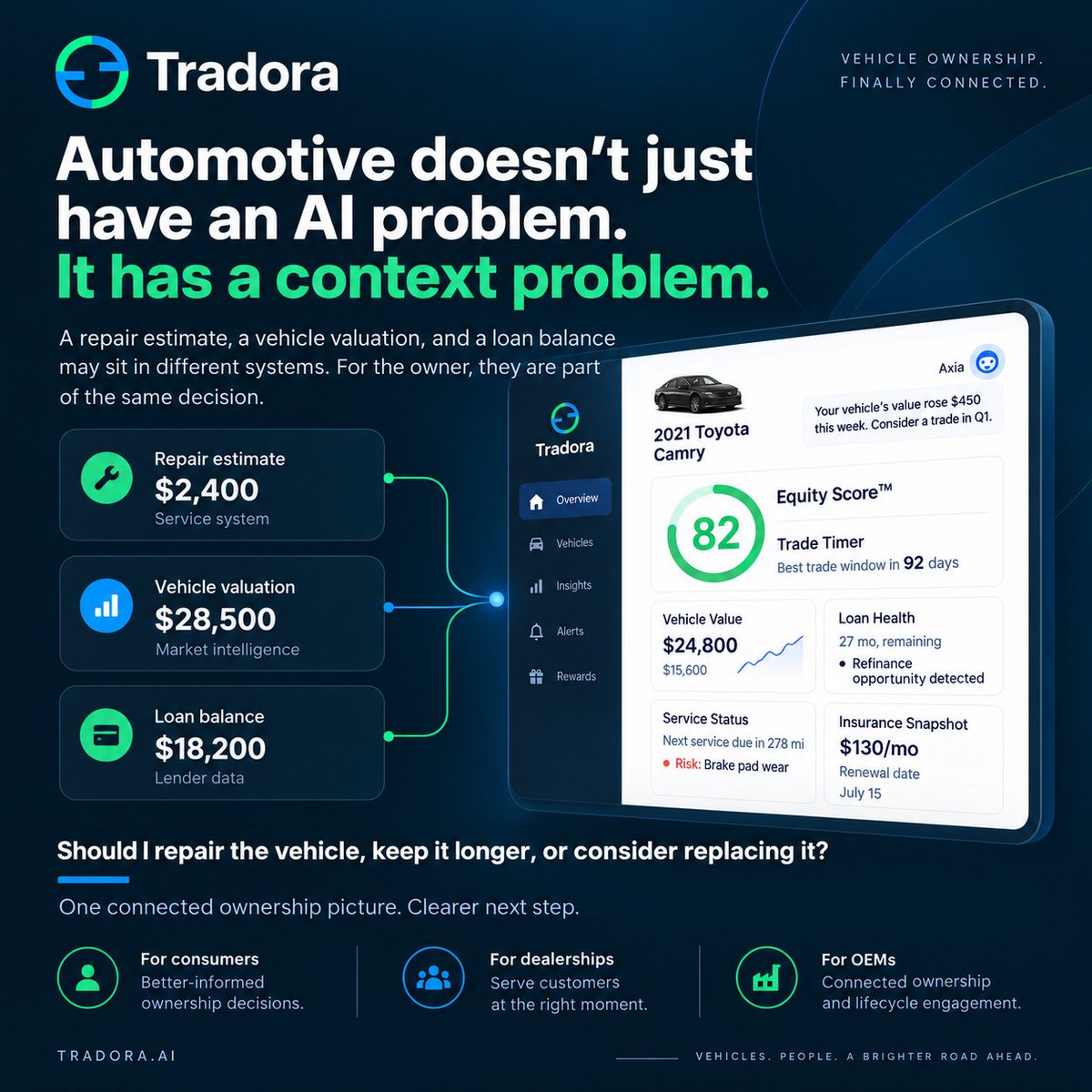
Automotive doesn’t just have an AI problem. It has a context problem.
Value. Equity. Service. Warranty. Financing. Trade timing.
Different systems. One ownership decision.
That’s what we’re building Tradora + Axia to solve: connect the ownership picture and make the next move clearer.
https://t.co/lLqhqgSqU8
@TradoraAi
Founders obsess over lowering CAC.
The more interesting question is whether you can design distribution so someone else pays you to acquire the customer.
The market rarely rewards you for protecting the first version of the idea.
It rewards you for recognizing when the problem is bigger than you thought.
That’s been Tradora’s journey.
@TradoraAi
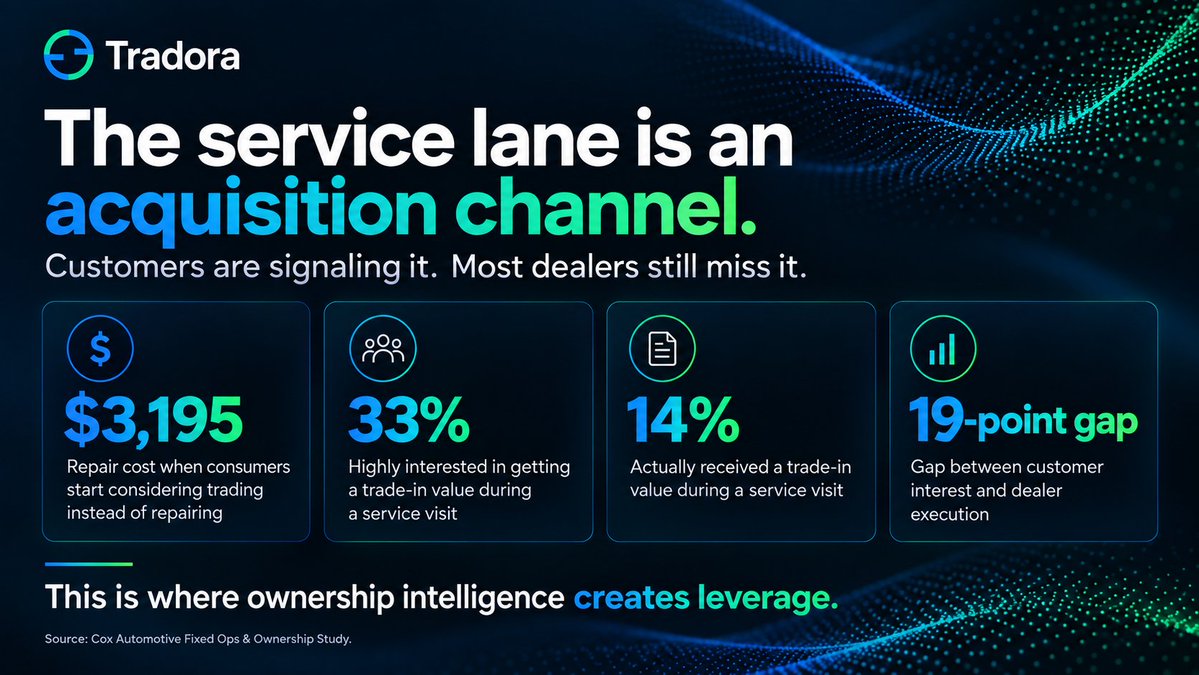
One number stuck with me today: $3,195.
Cox Automotive found that’s roughly the repair cost where consumers start considering trading their vehicle instead of repairing it.
Yet only 14% of service customers have been offered a trade value, while 33% say they’re highly interested.
That gap is bigger than a sales opportunity.
It’s an intelligence problem.
The consumer shouldn’t have to know the exact moment to ask:
Should I repair this? Protect it? Refinance it? Trade it?
Their vehicle data should recognize that moment, understand the economics, and show them the options before they’re forced to figure it out alone.
That’s the ownership layer we’re building at Tradora.
The next transaction starts long before the customer walks into a showroom.
Source: Cox Automotive 2025 Service Industry Study
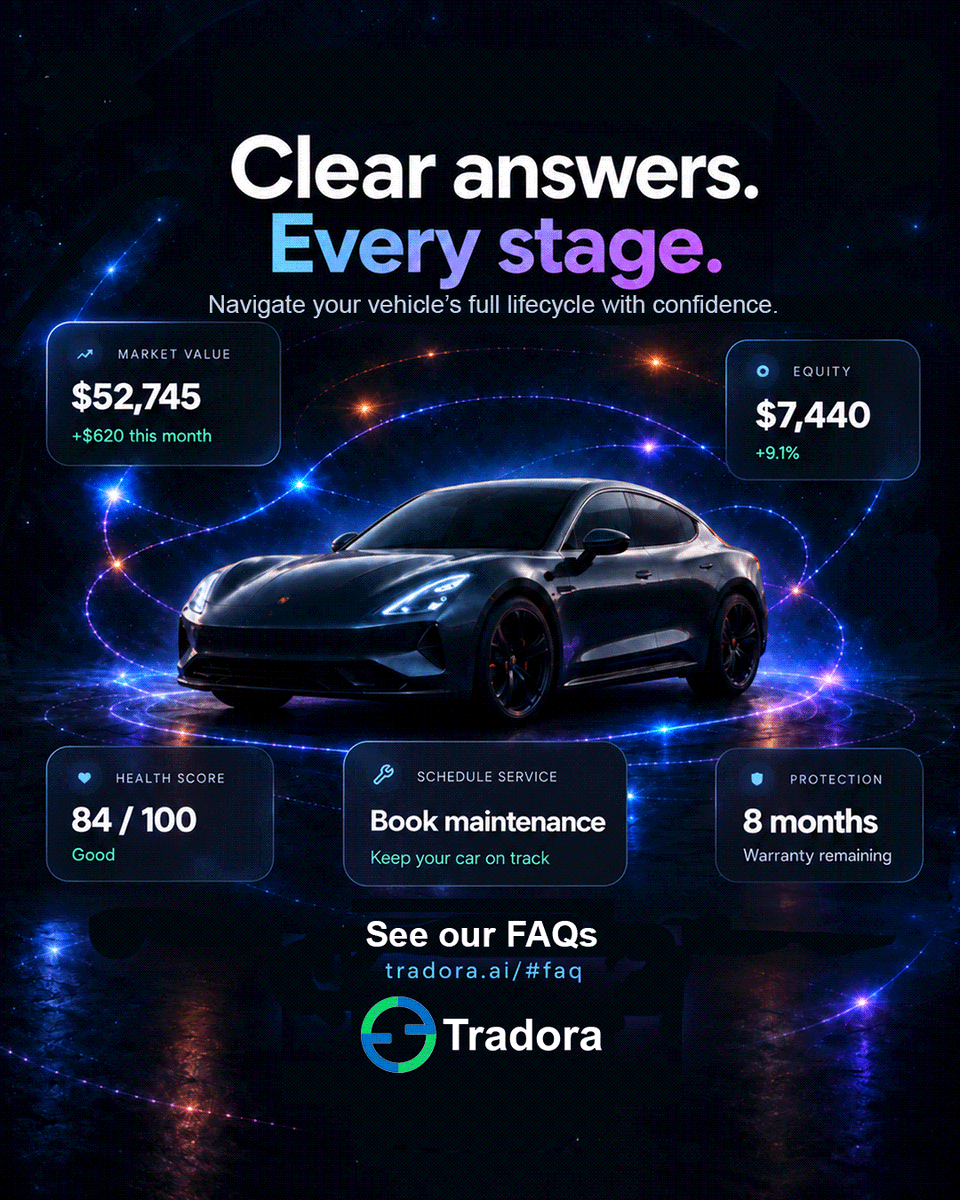
Clear answers. Every stage. 🚘
Vehicle value, equity, maintenance, protection—car ownership comes with questions. Get to know Tradora and navigate what’s next with confidence.
See our FAQs: https://t.co/PR44fZS0iH