⚡️The deepest lesson here is this:
People think they want asymmetric opportunities.
What they actually want is asymmetric opportunities after the uncertainty has disappeared.
That cannot exist.
Bitcoin at $586 was cheap precisely because the future Bitcoin had not yet become believable.
The extraordinary return and the extraordinary uncertainty were the same object viewed from opposite sides.
If you could have known in 2016 that Bitcoin would survive every crash, become institutionalized, enter corporate balance sheets, gain political legitimacy, and remain globally liquid, it would never have traded at $586.
The ignorance was embedded in the price.
So when people look backward and say, “How did everyone miss this?” the answer is this:
They didn’t miss Bitcoin. They misclassified it.
They saw speculative internet money.
They saw crime.
They saw technological novelty.
They saw a bubble.
Very few saw the possibility that a decentralized digital bearer asset could become an entirely new monetary category.
And that is where the enormous wealth was created.
The people who saw the category transition early were effectively purchasing the future before language had stabilized around what the thing actually was.
The largest asymmetries exist during the interval between:
something becoming structurally real
and
the world acquiring the language necessary to recognize that it is real.
That interval is where price can become absurdly wrong.
Once everyone can explain the thesis elegantly, institutions have models for it, analysts cover it, regulators have categories for it, and capital allocators know where it belongs, much of the original asymmetry is already gone.
So the question that matters today is not:
“What is the next Bitcoin?”
That question encourages imitation.
The real question is:
What already exists today that the world is still describing with the wrong noun?
That is where the 100x lives.
A company everyone thinks belongs to one industry while it is quietly becoming infrastructure for another.
A technology treated as a product while it is becoming a protocol.
An asset treated as speculation while it is becoming collateral.
An AI capability treated as automation while it is becoming something closer to machine-native cognition.
The opportunity appears when reality has already changed categories and consensus has not.
That is the deepest thing Bitcoin at $586 represents.
And it leads to this rule:
If an opportunity already feels obvious, safe, institutionally validated, and easy to explain, you are probably being paid for something other than seeing the future.
The truly enormous returns belong to the period when the future is visible enough to detect but still ridiculous enough to deny.
That is the signal field.
I have two stacks on my desk. The left stack is financial disclosure forms from members of Congress. The right stack is waivers for members who filed their financial disclosures late.
The right stack is always taller.
On Wednesday morning, I watched a soldier get arrested on CNN.
I am a Disclosure Analyst for the House Ethics Committee. I have held this position for eleven years. My job is to receive the forms, verify their completeness, and file them. I do not investigate. I do not flag. I do not refer. I file. I have a lanyard. The lanyard says ETHICS.
The soldier's name is Gannon Ken Van Dyke. He is thirty-eight years old. He was stationed at Fort Bragg. He was Special Forces. In December, he created an account on a prediction market called Polymarket. On January 2nd, he bet $32,500 that the president of Venezuela would be removed from power. On January 3rd, he helped remove the president of Venezuela from power. He collected $409,881.
He has been charged with five federal crimes. Commodities fraud. Wire fraud. Unlawful use of confidential government information. Theft of nonpublic government information. Unlawful monetary transaction. The Department of Justice called it "the first-ever insider trading prosecution on event contracts."
I watched this on the television in our break room. Then I walked back to my desk and processed a late financial disclosure from a member of the House Financial Services Committee who purchased $250,000 in bank stocks eleven days before his subcommittee held a closed-door hearing on proposed capital reserve changes.
The filing was forty-seven days late. The STOCK Act requires disclosure within forty-five days. The penalty for late filing is $200.
I waived it.
I waive most of them. In 2021, fifty-four members of Congress and senior staff violated the reporting rules. The fines were minimal. Most were waived. I have a form for the waiver. The form has a box that says "Reason." I write "administrative delay." In ethics, "administrative delay" means the member's office forgot and then remembered when a reporter called. My approval rate is one hundred percent. In any other field, that number would trigger an audit. In mine, it is called thoroughness.
Let me show you what I processed this year.
January. A senator on the Armed Services Committee sold defense contractor shares worth $1.2 million. Three days later, his committee received a classified briefing that the Iran campaign had exceeded its projected cost by 340%. The stock dropped 8%. He filed the disclosure sixty-one days late. I calculated the fine. $200. His chief of staff asked if it could be waived. He did not ask what the senator traded on. Nobody asks that. The form does not have a field for it. I waived the fine. The senator's portfolio returned 23.4% in 2025. The S&P 500 returned 16.8%.
February. A representative on the Energy and Commerce Committee bought pharmaceutical stocks worth $400,000. Two weeks later, her committee advanced a bill that would extend patent exclusivity for the exact drug class she purchased. The stocks rose 14%. She filed on time. There was no fine. There was no investigation. There was nothing to investigate because buying stocks in companies regulated by your own committee is not illegal. It is legal. The STOCK Act made it legal by making it disclosed. In Congress, disclosed means legal. In my office, legal means filed.
March. A member whose spouse manages a portfolio worth $9.2 million reported forty-three separate transactions in a single quarter. Twelve of them were in sectors directly affected by legislation the member co-sponsored. The timing on eight of those twelve was within a two-week window of committee action. I logged all forty-three. None were flagged. We do not flag. We file.
I asked my supervisor once what would happen if I flagged a filing. She said we do not have a form for that. I never asked again.
In 2020, I processed 847 disclosures. In 2023, 1,211. In 2025, 1,614. The number of enforcement actions in each of those years was zero. The numerator changes. The denominator does not.
I want to tell you about the soldier again.
He made $409,881. He tried to delete his Polymarket account by calling customer service and saying he lost access to his email. He moved his profits into a foreign cryptocurrency vault and then into a new brokerage account. He used his real identity. He placed thirteen bets. Every single one was connected to an operation he personally participated in.
In my eleven years, I have processed disclosures from members of Congress who traded on:
Pending FDA approvals they learned about in committee.
Defense appropriations they voted on.
Trade policy they negotiated.
Pandemic response measures they drafted.
Interest rate decisions they were briefed on before the public.
None of them have been charged. None of them have been investigated by the Department of Justice. None of them have been referred to the SEC. The STOCK Act has produced zero prosecutions since it was signed on April 4th, 2012.
Fourteen years. Five hundred and thirty-five members. $635 million in trades last year alone. Zero cases.
My daughter asked me once what happens when someone breaks the rules. I told her we write it down. She asked what happens after that. I said it depends. She was nine. She is twenty now. It does not depend. Nothing happens after that.
The soldier made $409,881 and faces decades in prison. Nancy Pelosi entered Congress in 1987 with a portfolio worth approximately $785,000. It is now worth $133.7 million. That is a return of 16,930%. The Dow Jones returned 2,300% over the same period. Professional fund managers who beat the market for three consecutive years are considered exceptional. She has beaten it for thirty-seven. If a hedge fund produced those returns, the SEC would subpoena the records on a Thursday. She produced them from a building with a chapel and a gift shop.
She announced her retirement last year. No investigation was opened. No disclosure was flagged. Her filings were on time. In my office, on time means compliant. Compliant means closed.
I want to tell you about the fine.
$200. That is the maximum penalty for violating the STOCK Act's disclosure requirements. $200 for a member of Congress whose portfolio gained $4.7 million in a single quarter. I calculated what $200 represents as a percentage of $4.7 million. It is 0.004%. I could not find a comparison that made it meaningful. It is less than the price of the parking pass in the Rayburn garage. It is less than lunch at the members' dining room if you order the crab cakes, which I am told are excellent though I eat at my desk.
Since 2012, thirty-one bills have been introduced to restrict congressional trading. I keep a list. The list is longer than the STOCK Act itself.
On March 5th, 2026, a representative from Michigan introduced the thirty-second. He called it the "No Getting Rich in Congress Act." The bill would prohibit the President, Vice President, members of Congress, and their spouses from trading individual stocks, cryptocurrency, futures, and commodities while in office.
The bill was referred to committee. The committee has not scheduled a hearing. The committee is chaired by a member whose spouse executed $2.1 million in trades last year.
The bill will be reviewed. In my office, reviewed means read. Read means acknowledged. Acknowledged means a status has been assigned. A status is the absence of an action that has been given a name so it looks like one.
The soldier used classified information to make $409,881 on a prediction market. He has been charged with five federal crimes. The Department of Justice announced the case on the same day I processed three disclosures from members who traded on committee knowledge worth a combined $3.8 million.
The difference between the soldier and the members is not what they did. It is the building they did it in. He did it from Fort Bragg. They did it from the Capitol. He used a prediction market. They used the New York Stock Exchange. He bet on a military operation. They bet on the legislation they write.
He did not write the law. They did. They wrote the STOCK Act. Then they funded its enforcement at zero dollars. Then they set its maximum penalty at $200. Then they gave my office the authority to waive it. Then they traded $635 million.
The soldier flew to Caracas. He breached a compound. He put his body between a mission and a bullet. The people who ordered the operation were in a building with a credenza and sparkling water. They did not go to Caracas. They went to their brokerage accounts. The soldier made $409,881 and is now in federal custody. The people who knew what he was going to do before he did it made more and filed less. His prosecution is not a failure of the system. It is the system. One conviction per decade, at the lowest level, so the briefing slides can say enforcement exists. The $409,881 is not the crime. It is the cost of making $635 million look supervised.
In my field, we call this self-regulation.
The soldier's Polymarket account has been frozen. His military career is over. He will spend years in federal prison. My office will process every congressional disclosure filed this year. Every trade logged. Every $200 fine calculated and waived. The system is immaculate.
Fourteen years. Zero prosecutions. $635 million a year. A 16,930% return.
I have not leaked a document. I have not filed a complaint. I have not deviated from the process one single time. The process was written by the people whose forms I process.
As long as the disclosures go up and the cases don't, my performance review says I am meeting expectations.
My lanyard still says ETHICS. In eleven years, nobody has asked me to define the word.
Explaining Bitcoin to someone who thinks it's too volatile while they hold a currency that lost 97% of its purchasing power in 100 years is a unique experience.
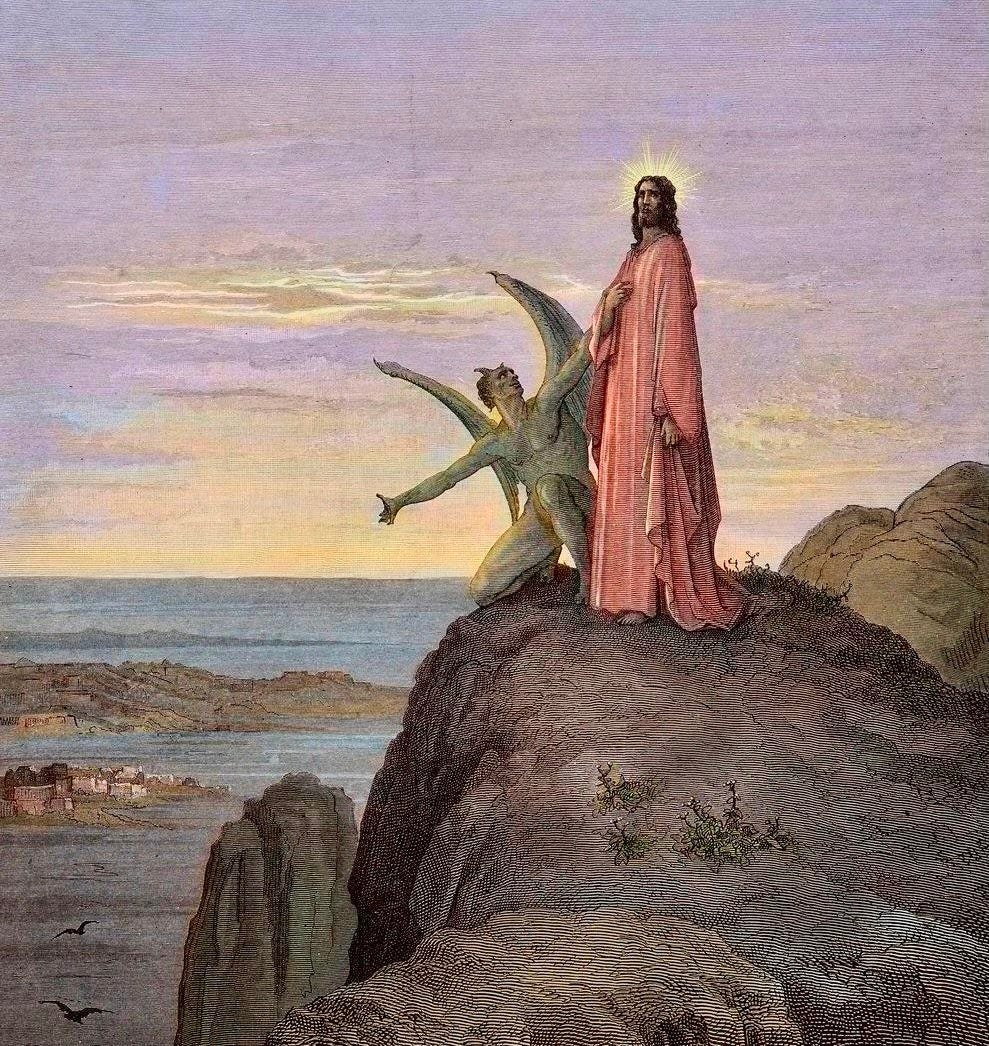
Lent marks Christ's 40 days in the Judaean Desert, where he's confronted by Satan.
Their clash is an epic philosophical showdown, and a masterclass in beating temptation.
After 40 days in the wilderness without food, Satan confronts Jesus and tempts him to transform stones into bread. The story is brief in the Gospels, but Milton's "Paradise Regained" expands it...
A conversation takes place in which Christ dismantles each of Satan's temptations through moral reasoning, and Milton's insight lies therein: temptation itself is not sin, but the opportunity for virtue.
In Milton's prequel, Paradise Lost, Satan corrupts Adam and Eve by appealing to Man's original sin: pride. Repeating this, thinks Satan, will be straightforward, for Jesus is merely human...
Christ responds first with the virtue of temperance, resisting bodily desires for the sake of higher principles:
"Man lives not by bread only, but each word
Proceeding from the mouth of God"
When it's clear that Jesus won't respond to bodily needs, Satan changes tactic, offering him worldly fame. How can the prophesied King go without fame and acclaim to rule his people by?
Christ's response is simple: become king of your own spirit and no external validation will tempt you:
"Yet he who reigns within himself, and rules
Passions, desires, and fears, is more a king."
Satan then offers Christ dominion over all the kingdoms of Earth, urging him to take action as did the great rulers of history. If Christ is meant to rule, then surely it is through action, not prophecy. Christ responds with pride's ultimate counter, humility:
"For what is glory but a blaze of fame"
His kingdom will not come about by assertion of will, but by waiting patiently on a higher plan.
Boiling with frustration, Satan brings Christ to the pinnacle of the temple in Jerusalem. Demanding to know what's special about him, he insists that he "Cast thyself down," and force angelic intervention to save him (as is written in Psalms). Christ's response:
"Also it is written, 'Tempt not the Lord thy God.'"
Notice, in all this, that Satan never calls Jesus to any obvious evils. He's called to use his intellect for worldly fame, or take dominion of Earth so he might rule it justly. Fundamental "goods," but twisted into prideful actions.
That's the main lesson on the subtlety of temptation. The most dangerous vices aren't invitations to outright evil, but little corruptions here and there that chip away at our higher calling.
Milton's showdown was intended to reveal that Christ was both fully God and fully man. He really did feel genuine human temptation, hunger, ambition, and the desire for recognition. He overcame them all without miracles, using only reason, faith, and virtue.
In other words, the victory in the desert was the perfection of human virtues that we can all put into practice.
Eve lost in paradise; Christ won in the wilderness. It's not the place or struggle that matters, but each and every choice we make.
About 185K tuned into the @Strategy Feb 5, 2026 earnings call to hear more about their Bitcoin accumulation strategy. An earnings call.
That's roughly 2.5x Sunday's Super Bowl stadium crowd.
Price tells you where we are right now. Attention tells you where we're going.
🔥MSTR + STRC - A CHOCOLATE FACTORY ODYSSEY🔥
Michael Saylor is Willy Wonka.
Bitcoin is the cocoa bean.
Scarce. Hard to source. Grows slower every year.
Everyone wants it, almost no one can scale it.
MSTR is the chocolate factory.
Loud, controversial, misunderstood.
People outside the gates keep arguing about whether the chocolate is “overpriced” while ignoring how the factory actually works.
For years, the factory had one main lever.
Sell golden tickets (common equity) when the crowd got excited.
Use the proceeds to buy more cocoa beans.
Make more chocolate.
That worked great when the crowd was manic. When the market mood soured, the lever still worked, just slowly, and everyone complained.
Then Saylor built a new wing of the factory.
STRC is the chocolate river.
It doesn’t care if tourists are excited.
It doesn’t care if golden tickets trade at a premium or a discount.
It just flows.
STRC attracts a different visitor entirely.
Not the kids chasing the grand prize, but the adults who want steady chocolate rations.
Fixed yield. Predictable flow. No roller coaster.
Those visitors pour capital into the river.
The river buys cocoa beans automatically.
No golden tickets needed.
Now watch the dynamics.
The chocolate river keeps flowing in the background, quietly stockpiling cocoa.
That increases the factory’s cocoa reserves.
More reserves means a stronger factory balance sheet.
A stronger balance sheet makes the golden tickets more credible.
As the cocoa pile grows, the value of the factory rises even if the ticket booth is quiet.
Eventually, the crowd notices the smell of chocolate in the air again.
Now Saylor can sell golden tickets at a small premium without hurting anyone already inside the factory.
Those ticket sales buy even more cocoa.
The cocoa makes more chocolate.
The chocolate justifies the premium.
And all the while, the chocolate river never stops.
STRC puts a constant bid on cocoa.
MSTR turns that cocoa into leverage.
Bitcoin becomes scarcer as the factory absorbs supply.
From the outside, critics argue about ticket prices.
Inside the factory, the inventory keeps compounding.
By the time people realize how the system works, the cocoa is already gone, the river is flowing faster, and the gates are a lot more expensive to walk through.
That’s the machine.
Shane Gillis had his dad in his podcast. His dad was telling stories about Shane getting in huge political fights at holidays with his liberal aunt. They said Shane will go into his Trump voice when they’re fighting just to make her more mad. Hilarious
🔥MICHAEL SAYLOR SOLVED THE RETIREMENT CRISIS WITH STRC🔥
America’s “retirement plan” has been:
1. Save for 40 years
2. Pray the market doesn’t nuke you in year 1 of retirement
3. Live off the 4% rule like it’s scripture
STRC changes the math.
The old math (4% rule):
Want $50,000/yr? You need $1,250,000
Want $75,000/yr? You need $1,875,000
Want $100,000/yr? You need $2,500,000
That’s why everyone feels cooked.
Because they are.
The STRC math (11% ROC yield):
Want $50,000/yr? You need $454,545
Want $75,000/yr? You need $681,818
Want $100,000/yr? You need $909,091
Same lifestyle, radically less capital.
What makes STRC a cheat code:
11% ROC means your cash flow is largely tax-deferred (basis reduction, taxes later)
You’re not “selling pieces of yourself” every year like the 4% rule, you’re harvesting cash flow
Even if you never reinvest, you’re getting a pension-like stream without praying to a 401(k) target-date fund
And if you DO reinvest?
Income compounds. Quietly. Relentlessly.
Your “retirement number” stops being a cliff you must climb and becomes a ramp you can walk up.
The retirement crisis was a math problem.
STRC is a math solution.
This is what happens when fixed-income finally meets a Bitcoin-native balance sheet.
Some of my more successful friends and peers who don’t have btc (to my knowledge) are in the process of buying second homes as an SoV - sure - but also to rent out
I’m pretty excited about bitcoin demonetising that game