Tired of seeing benchmarks saying we are at AGI but models still can't understand a 3D protein view or a floor plan? When a visual model gets something wrong, is it failing to see or failing to reason about what it sees?
We've built two benchmarks that answers these questions. Explore DecoyCount and ScienceVision here: https://t.co/sFbUIbWAbN and https://t.co/hWX0lVMVot
And thank you @mercor and @UniPat_AI for your partnership in building these!
We’re sharing how our biology research team worked with Claude to map the first 3D structure of a vault particle from bacterial life.
Vault particles are a longstanding mystery. They are barrel-shaped objects, among the largest protein structures found in our cells. They were first discovered by Leonard Rome and Nancy Kedersha in 1986, but their function remains unknown.
With Claude, we’ve found results that might bring us closer to solving that mystery.
Until now, vaults were only known in the cells of complex things like animals and plants. We have shown that similar proteins from bacteria (and the viruses that infect them) can also assemble into vaults. Finding the structures in these simpler forms of life may make it easier to investigate their function in our own cells.
For our life sciences team, the project was also a demonstration of the potential (and the limitations) of using AI to accelerate science.
In our full piece, we discuss how Claude was able to dramatically speed up some stages—manually determining the vault particle’s structure would have taken weeks to months of painstaking work, but here it took days. We also discuss how Claude made some simple mistakes along the way, and how we collaborated with our machine learning researchers to address them.
Read more: https://t.co/KowVVCSPp8
We're proud to have collaborated on a new benchmark built by @GoogleAI: Physical-Engineering's Last Exam (PLE).
Physical engineers design the skyscrapers, power grids, and chip fabs we rely on, yet no existing benchmark tested whether AI agents could do that work end to end.
Together with Google and practicing engineers, we built 85 long-horizon tasks across mechanical, electrical, civil, and structural engineering. On the private test set, all frontier models score below 50%:
1. Claude Opus 5.5: 48.3%
2. GPT 6 Astra: 45.8%
3. Claude Sonnet 5.5: 43.5%
4. Gemini 4 Argon: 40.6%
5. Claude Opus 5: 40.0%
On the tasks we co-authored, the top agent satisfied 91% of individual constraints, but only 41.3% of its deliverable items passed every hard safety check.
Learning how AI fails at physical engineering can help us improve future models and build a safer world.
This benchmark is also an open competition. Bring your own agent setup and submit it for evaluation on our private test set at https://t.co/nOTWOUaV5v
We asked GPT-6 Astra to edit Qwen3.5-0.8B weights to improve math.
It directly changed only 0.016% of weights, fixing 0.8B's reasoning loops & improving math up to 6x and even instruction following 3x, without gradients or training.
We call this Weight-Space Programming: frontier LLMs can now natively read/write neural network weights! 🧵
Blog: https://t.co/bOWCcFhCVq
We’ve acquired Orchestra Bio, a platform that helps biopharma teams coordinate the complex process of drug development.
Together, we’ll build on Rosalind, our AI models and tools for life sciences research, to streamline those operations and help new treatments reach patients sooner.
Welcome @ashokaraj_ and team!
https://t.co/vi51OhznQn
花费16天,我用 Opus 5.5 将小王子的故事制作成了3D剧情游戏
结合Tripo+Blender,Opus 5.5 将小王子故事中的每一个星球变成了可探索的3D场景
希望大家能支持一手,后续会开源整个游戏,以及详细制作流程
Welcome to The Little Prince: Across the Stars✨:https://t.co/qr4wR0jLu3
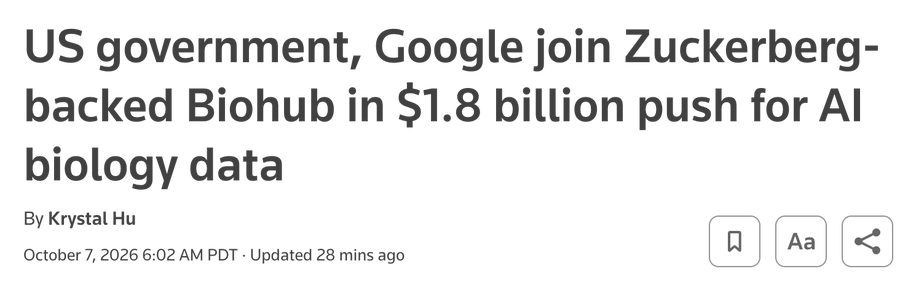
BREAKING: The US government, Google, Meta and Biohub are launching a $1.8B push to build the data layer for AI biology.
The goal: create the largest open, AI-ready biological dataset ever assembled, giving models better data to predict, understand and engineer biology.
The discussion above is absolutely good and little too focused on biology. If we step back and ask how LLMs can ultimately support the entire pipeline, I see five main entry points:
1.LLMs are particularly well suited to summarizing data and uncovering insights.
2.LLMs are well suited to maintaining verifiable experimental records and feeding results back into the workflow, enabling end-to-end observability.
3. As a “brain,” an LLM can use tools to orchestrate different protein-folding models in dry-lab experiments, control instruments in wet labs, and even coordinate human researchers.
4.From a systems engineering perspective, LLM-as-a-judge is a better design choice.
5.LLMs can break down silos between different stages of a workflow and between departments.
nobody sees the true bottleneck to AI drug discovery's growth (capital allocation view)
here is the chain of thought:
-> ~90% of drugs fail in trials, mostly because we fail to understand how disease works (efficacy).
-> drugs with human genetic support are ~2x more likely to get approved.
-> LLMs excel at reasoning across a massive corpus of data, so they can improve our understanding of disease.
-> LLMs enable hypothesis generation at scale and move the bottleneck to wet labs and data.
for capital allocation, this means tracking what shapes wet-lab demand:
-> target and disease biology
-> target types (which point to modality, and so to manufacturing needs)
-> trial design
-> why trials were discontinued
-> etc.
to track that, we need large-scale standardization of existing biological and financial data.
interestingly, this is not a trivial task to accomplish at scale ($/tokens spent to achieve X% data extraction accuracy).
the edge goes to whoever has properly structured data that an LLM can reason from.
to accomplish this, i built self-improving agents that extract intelligence at scale on:
-> target and disease biology
-> clinical trials and human readouts
-> chemistry data
if you invest in biotech institutionally or run a biotech, i would love to chat!!
We just raised $7.7M to kill every subscription for agents.
Introducing https://t.co/uBBT6t7hyZ, the openrouter for agent tools.
Your agents can now:
> discover, run, and pay for tools at runtime
> use 2,500 APIs through one connection: leads, SEO, marketing, search, ecommerce, stocks, video/image/music/3D gen, agent email & phone
> pay per call, 0 subscriptions
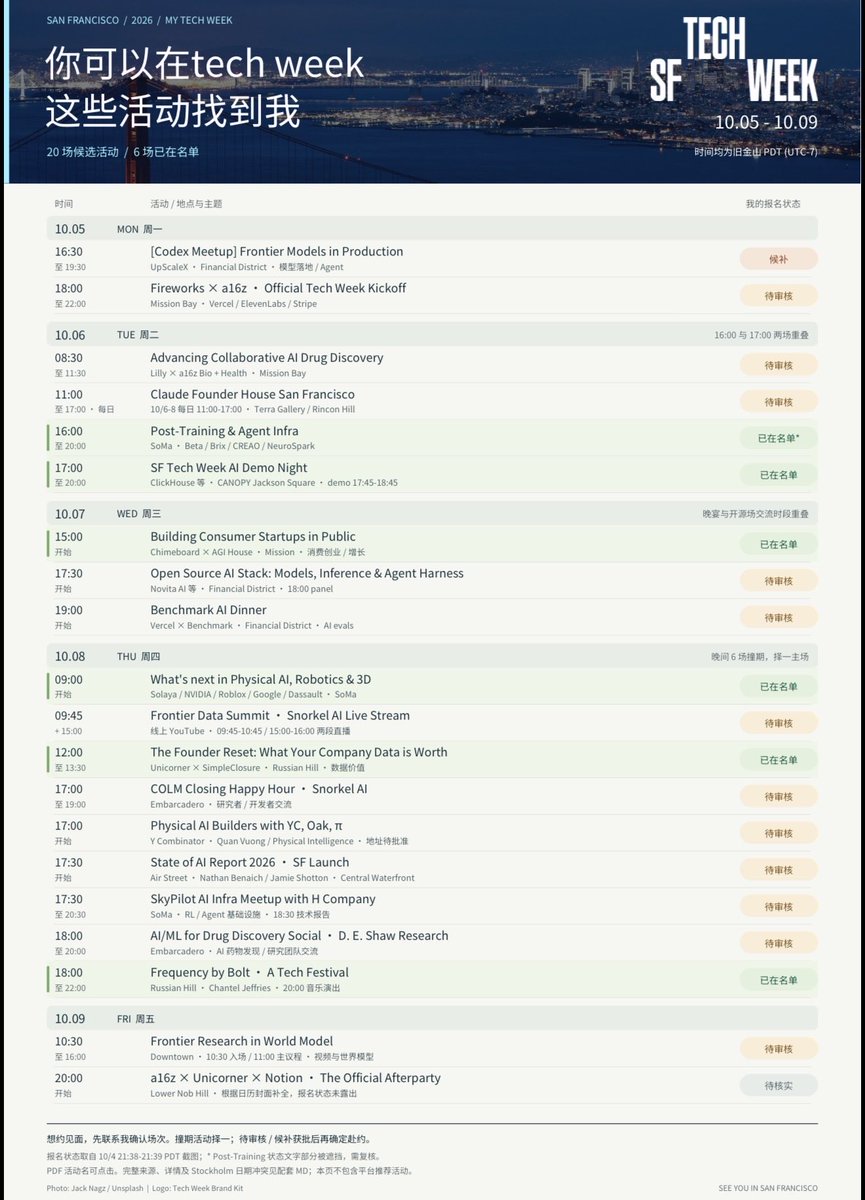
最近在tech week听了一些小型的分享和二三手的消息。但始终,让人觉得insightful的前沿工作者只给人一种启发:
面对LLM driven的科技浪潮
应该更积极,应该更实践
Be more proactive. Be more hands-on.
#sf#techweek#AI#LLM#frontier#drug#SanFrancisco https://t.co/Nunb2ifDKZ
Project Prometheus has $6.2 billion in funding and will focus on AI design in aerospace, computers and cars. The co-CEO is Vik Bajaj. Project Prometheus already has nearly 100 employees, some of them hired away from OpenAI, DeepMind and Meta. No word yet where they will be based.
We're taking over a coffee shop on Union st. for 3 days of SF @Techweek_ by @a16z .
The goal is to make it the busiest pop-up in the city this week.
Mon to Wed, 9am to 4pm, franko & friends in the marina (next to the equinox): https://t.co/c9oSxrzpxV
Coffee and matcha on us.
What's there: our agent running live on android, the smart glasses checkout steve and i did on stage at snapdragon summit (look at a thing on the shelf, the agent buys it, confirmation on your watch), and our merch in the new branding.
two parties.
monday 4 to 6pm is the private opening: dj, drinks, friends, family, partners, VCs. invite only, dm me.
wednesday 4 to 6pm we close it out with a happy hour.
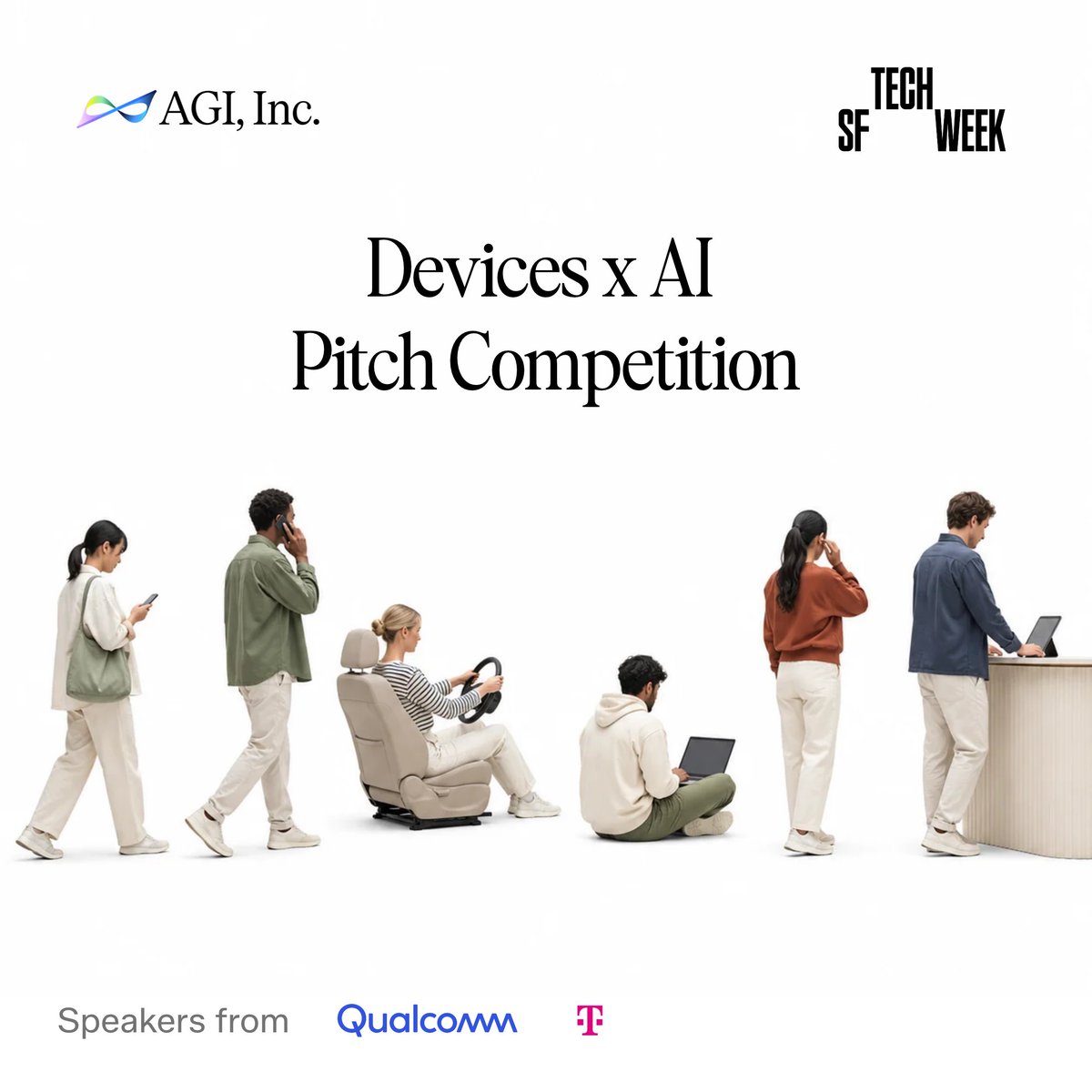
and some more serious stuff on thursday: devices x ai pitch night, 5 to 8pm. speakers from @Qualcomm, @deutschetelekom and @docomo, then founders building for phones, glasses, cars and robots pitch live.
rsvp here: https://t.co/Neil7GpiTt
we're hiring engineers and researchers, and we want to meet device makers.
come say hi, bring a +1.
it is genuinely insane how much progress biology has made in 2026 alone
we've got:
- obesity drugs pushing 20–30%+ weight loss
- gene therapy that can restore hearing
- genetically engineered viruses approved to attack cancer
- targeted drugs that can nearly double survival in late-stage pancreatic cancer
- personalized gene-editing therapies built for a single patient
- immune cells genetically reprogrammed to hunt tumors
- AI designing proteins and biological systems humans didn't know how to make
- robots running thousands of biological experiments autonomously
the frontier is moving faster than most people realize.
bio/acc