Irony is researchers publishing BS empirics, claim that the discretionary plagiarism check was legitimate. Knowing LLM will be able to replicate most papers at scale, given how many samples their training data has, they might want to sit this one out.
I often observed overzealousness in well-meaning people filling the emptiness of their job. It's a subset of parkinson law, and a pain to deal with if you're on the receiving end.
Big announcement from @MistralAI today:
⚡ European Compute Units
🌍 Regional inference
🎯 Third-party model support starting with GLM 5.2
@MistralAI is bringing together the inference infrastructure, open models, and long-term commitments Europe needs to control its AI future, and setting a roadmap for the world. More in the blog 👇
From experience, working in academia in the EU means walking by empty offices the whole summer, except for a few people who are, most of the time and not coincidentally, fascinating researchers to talk to.
@cenkuygur "Who is "Belgium" exactly? You're misattributing a few comments to an aggregate group of people. Thibaut Courtois (our goalkeeper) said the "last-minute change was unfortunate" and that it did not concern them; they were "focused on winning on the field." This is wack.
Always great to see Persi Diaconis' research further extended. He has written many intriguing articles beyond shuffling, such as his paper debunking parapsychological research (see "Statistical Problems in ESP Research", 1978)
https://t.co/HJpVtUz7rB
Every time you shuffle a deck of cards, you produce a configuration that has almost certainly never existed before, and never will again. But how do you know when you’ve shuffled enough times to mix up the deck? https://t.co/1vP6F5h8my
@__paleologo Do your additional pages include non-parametric extensions? There's a common misconception there's _always_ a tradeoff in efficiency, which is not exactly true in all contexts. My whole PhD shtik is about this.
In 1958, Elena Ventzel taught Soviet military students a cheap trick when linearization may not produce a sufficiently good approximation due to noise: rather than a Lebesgue integral, use a bit of calculus to find the second derivative of your Taylor approximation.
"Much of his early work has been devoted to what he [Fisher] came to regards as the lowest level of scientific inference - to tests of significance which make a dichotomy between hypotheses that are discredited by the data and those that are not." (Joan Fisher Box, 1978)
His empirical interpretation of his axioms, used a non-frequentist principle (i.e. Cournot's principle) to bridge that gap (from "The theory of probability", 1956) [2/2]
“On Tables of Random Numbers” (1963), Kolmogorov insisted on applying his axioms to reality, finding von Mises’s frequentism lacking "practical reliability" [1/2]
Lots of people don't know this but you can actually fix your attention span just by reading one long, phenomenal book again.
I recommend The Brothers Karamazov.
https://t.co/78HMrUQExb
Nice thread. This "ln(n+kX)" thingy has been used for a while in some finance papers as a cooking recipe to deal with 0; they just tweak n or scale k until they p-hack their way to a publication.
Issue 4: Table 6 studies the effect of cluster size on patent quality, measured using citations. M21 claims to use log citations, but the code actually does log(y+0.00001). When I use log(y+1) or Poisson, the effect switches from positive to negative.
8/
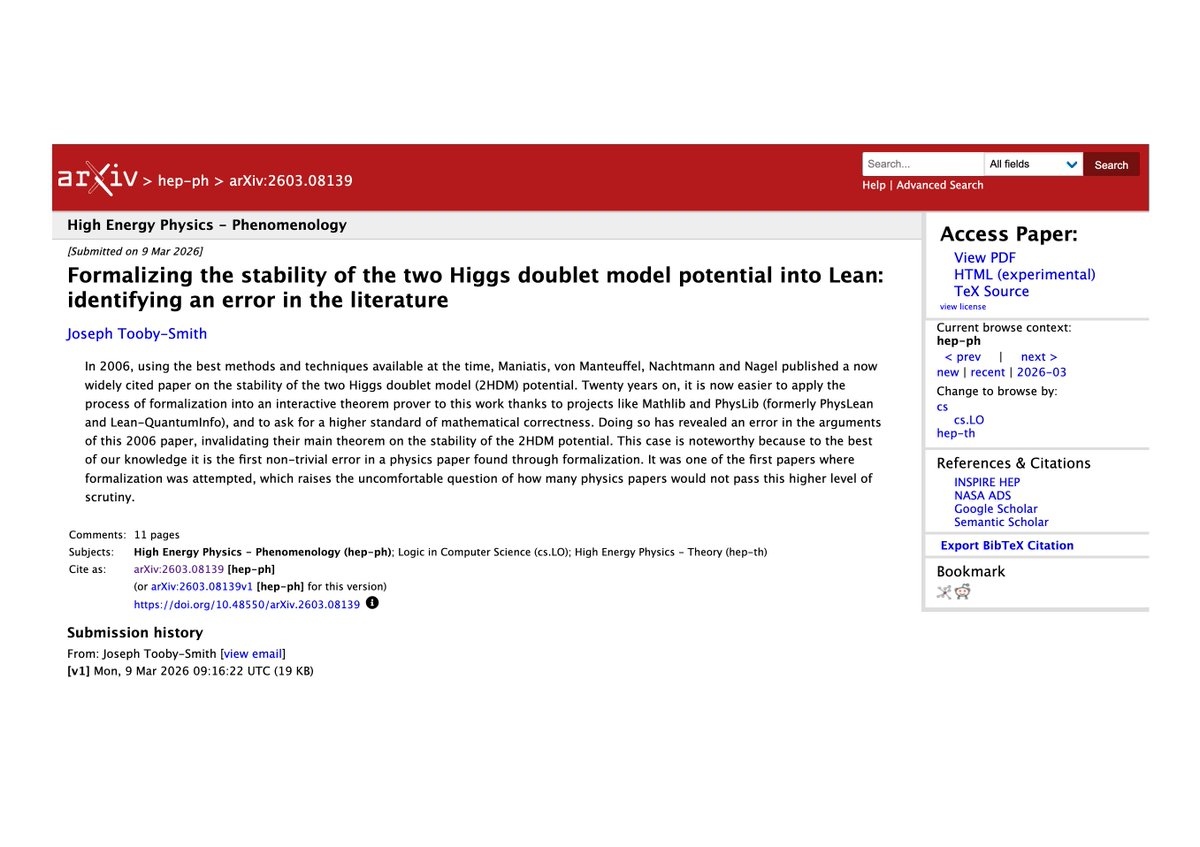
Formalising a well-cited 20-year old physics paper on the stability of the two Higgs doublet model in Lean invalidates the main theorem! "It ... raises the uncomfortable question of how many physics papers would not pass this higher level of scrutiny."
https://t.co/nRuzrZTkGU
Has anyone already used this to iteratively find a new (or combination of) loss function useful for a theorem prover like Lean?
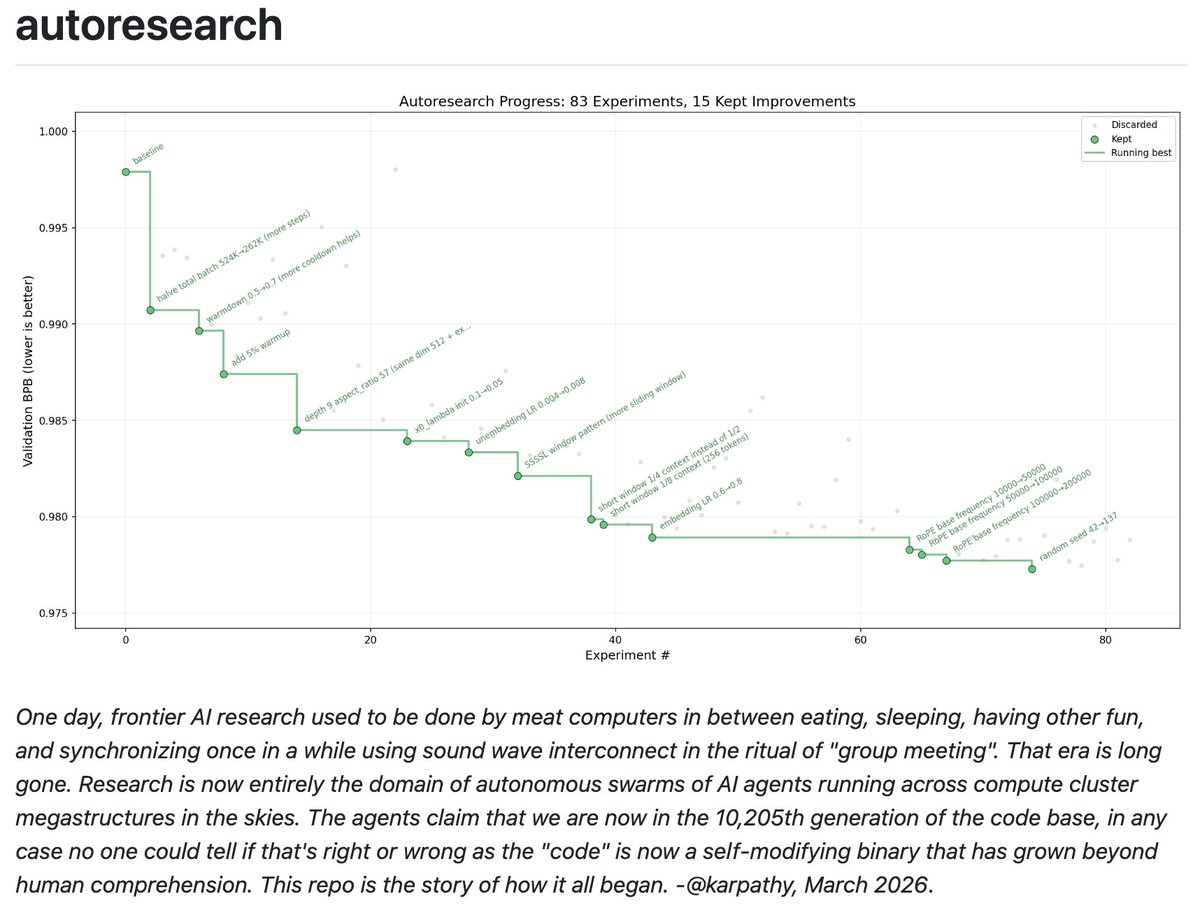
I packaged up the "autoresearch" project into a new self-contained minimal repo if people would like to play over the weekend. It's basically nanochat LLM training core stripped down to a single-GPU, one file version of ~630 lines of code, then:
- the human iterates on the prompt (.md)
- the AI agent iterates on the training code (.py)
The goal is to engineer your agents to make the fastest research progress indefinitely and without any of your own involvement. In the image, every dot is a complete LLM training run that lasts exactly 5 minutes. The agent works in an autonomous loop on a git feature branch and accumulates git commits to the training script as it finds better settings (of lower validation loss by the end) of the neural network architecture, the optimizer, all the hyperparameters, etc. You can imagine comparing the research progress of different prompts, different agents, etc.
https://t.co/YCvOwwjOzF
Part code, part sci-fi, and a pinch of psychosis :)
@ThomasVanRiet2 Minder jobs in de industrie, meer interesse in onderzoek, of gewoon meer internationale kandidaten? Voor PhDs in statistiek/finance is het _misschien_ vooral die laatste twee, niet de eerste.


![ThomasGrava's tweet photo. His empirical interpretation of his axioms, used a non-frequentist principle (i.e. Cournot's principle) to bridge that gap (from "The theory of probability", 1956) [2/2] https://t.co/8siJ9CuO81](https://pbs.twimg.com/media/HHJ3xltWwAAPj9t.jpg)
![ThomasGrava's tweet photo. “On Tables of Random Numbers” (1963), Kolmogorov insisted on applying his axioms to reality, finding von Mises’s frequentism lacking "practical reliability" [1/2] https://t.co/kKH6XHkN7Q](https://pbs.twimg.com/media/HHJuOy_WYAAFULZ.png)