Liam Cooper status confirmed after he received a bloody head on Saturday - plus admission made on the decisions around an enforced Sheffield Wednesday defensive juggle over the next weeks👇
https://t.co/b0PzKkMnqn
#SWFC🦉
A shockingly corrupted trial that exposes the British state’s weaponization of censorship and secrecy laws has just begun.
The Grayzone's @MaxBlumenthal details how six activists from the direct action protest group Palestine Action face terrorism charges and the possibility of long prison terms – but the jury in the case is forbidden from knowing this.
The UK media is similarly banned from reporting on these facts, while the defendants in the case are blocked by court order from explaining their motives for damaging and occupying Israeli weapons factories on British soil.
Blumenthal explains why Palestine Action is being targeted with such a draconian prosecution: because they are effective.
Having caused the closure of Israeli factories, they have provided activists around the world with a workable model for raising the cost of occupation and genocide.
Now, he argues, the British state is so determined to prevent their acquittal before a potentially sympathetic jury that it rigging the trial and perverting whatever's left of democracy, all to preserve its special relationship with Israel.
@pearsonjohn10 Come on Wednesday! Can you wish Leo Pollard a happy 12th birthday for Tues. We are watching in The Hague desperately hoping for a win (as we have been every game for the last few months) Some promising moments and Yates has looked sharp up top. WAWAW!!!
#WATCH Jeffrey Sachs Blasts US Power Grab Over Venezuela, Maduro Capture at Historic UN Meeting
🇺🇸 US military interventions in foreign countries since WWII (incomplete list):
🇮🇷 Iran: 1946
🇨🇳 China: 1946 - 1949
🇬🇷 Greece: 1947 - 1949
🇮🇹 Italy: 1948
🇵🇭 Philippines: 1948 - 1954
🇰🇵 Korea: 1950 - 1953
🇮🇷 Iran: 1953
🇻🇳 Vietnam: 1954
🇬🇹 Guatemala: 1954
🇱🇧 Lebanon: 1958
🇵🇦 Panama: 1958
🇭🇹 Haiti: 1959
🇨🇩 Congo: 1960
🇻🇳 Vietnam: 1960 - 1964
🇨🇺 Cuba: 1961
🇨🇺 Cuba: 1962
🇱🇦 Laos: 1962
🇪🇨 Ecuador: 1963
🇵🇦 Panama: 1964
🇧🇷 Brazil: 1964
🇻🇳 Vietnam: 1965 - 1975
🇮🇩 Indonesia: 1965
🇨🇩 Congo: 1965
🇩🇴 Dominican Republic: 1965
🇱🇦 Laos: 1965 - 1973
🇬🇭 Ghana: 1966
🇬🇹 Guatemala: 1966 - 1967
🇰🇭 Cambodia: 1969 - 1975
🇴🇲 Oman: 1970
🇱🇦 Laos: 1971 - 1973
🇨🇱 Chile: 1973
🇰🇭 Cambodia: 1975
🇦🇴 Angola: 1976 - 1992
🇮🇷 Iran: 1980
🇱🇾 Libya: 1981
🇸🇻 El Salvador: 1981 - 1992
🇳🇮 Nicaragua: 1981 - 1990
🇱🇧 Lebanon: 1982 - 1984
🇬🇩 Grenada: 1983
🇭🇳 Honduras: 1983 - 1989
🇮🇷 Iran: 1984
🇱🇾 Libya: 1986
🇧🇴 Bolivia: 1986
🇮🇷 Iran: 1987 - 1988
🇱🇾 Libya: 1989
🇵🇭 Philippines: 1989
🇵🇦 Panama: 1989 - 1990
🇱🇷 Liberia: 1990
🇮🇶 Iraq: 1990 - 1991
🇮🇶 Iraq: 1991 - 2003
🇭🇹 Haiti: 1991
🇸🇴 Somalia: 1992 - 1994
Yugoslavia: 1992 - 1994
🇧🇦 Bosnia: 1993 - 1995
🇭🇹 Haiti: 1994 - 1996
🇭🇷 Croatia: 1995
🇨🇩 Zaire (Congo): 1996 - 1997
🇱🇷 Liberia: 1997
🇸🇩 Sudan: 1998
🇦🇫 Afghanistan: 1998
🇮🇶 Iraq: 1998
Yugoslavia: 1999
🇲🇰 Macedonia: 2001
🇦🇫 Afghanistan: 2001
🇮🇶 Iraq: 2003
🇮🇶 Iraq: 2003-present
🇭🇹 Haiti: 2004
🇸🇾 Syria: 2011-present
🇺🇦 Ukraine: 2014-present
🇻🇪 Venezuela: 2026
The UN Security Council witnessed a rare, explosive intervention as economist Jeffrey Sachs delivered a sweeping warning on Venezuela. Speaking during an emergency session, Sachs framed the crisis as a test of international law itself, not leadership politics. He traced decades of U.S. regime-change actions, questioned the legality of force and sanctions, and warned of catastrophic consequences if UN rules collapse in a nuclear age.
Since 1947, United States foreign policy has repeatedly employed force, covert action, and political manipulation to bring about regime change in other countries. This is a matter of carefully documented historical record. In her book Covert Regime Change (2018), political scientist Lindsey O’Rourke documents 70 attempted US regime-change operations between 1947 and 1989 alone.
These practices did not end with the Cold War. Since 1989, major United States regime-change operations undertaken without authorization by the Security Council have included, among the most consequential: Iraq (2003), Libya (2011), Syria (from 2011), Honduras (2009), Ukraine (2014), and Venezuela (from 2002 onward).
The methods employed are well established and well documented. They include open warfare; covert intelligence operations; instigation of unrest; support for armed groups; manipulation of mass and social media; bribery of military and civilian officials; targeted assassinations; false-flag operations; and economic warfare aimed at collapsing civilian life.
These measures are illegal under the UN Charter, and they typically result is ongoing violence, lethal conflict, political instability, and deep suffering of the civilian population.
The case of Venezuela
The recent United States record with respect to Venezuela is clear.
In April 2002, the United States knew of and approved an attempted coup against the Venezuelan government.
In the 2010s, the United States funded civil society groups actively engaged in anti-government protests, notably in 2014. When the government cracked down on the protests, the US followed with a series of sanctions. In 2015, President Barrack Obama declared Venezuela to be “an unusual and extraordinary threat to the national security and foreign policy of the United States.”
In 2017, at a dinner with Latin American leaders on the margins of the UN General Assembly, President Trump openly discussed the option of the US invading Venezuela to overthrow the government.
During 2017 to 2020, the US imposed sweeping sanctions on the state oil company. Oil production fell by 75 percent from 2016 to 2020, and real GDP per capita (PPP) declined by 62 percent.
The UN General Assembly has repeatedly voted overwhelmingly against such unilateral coercive measures. Under international law, only the Security Council has the authority to impose such sanctions.
On 23 January 2019, the United States unilaterally recognized Juan Guaidó as “interim president” of Venezuela and on 28 January 2019 froze approximately $7 billion of Venezuelan sovereign assets held abroad and gave Guaidó authority over certain assets.
These actions form part of a continuous United States regime-change effort spanning more than two decades.
Recent United States global escalation
In the past year, the United States has carried out bombing operations in seven countries, none of which were authorized by the Security Council and none of which were undertaken in lawful self-defense under the Charter. The targeted countries include Iran, Iraq, Nigeria, Somalia, Syria, Yemen, and now Venezuela.
In the past month, President Trump has issued direct threats against at least six UN member states, including Colombia, Denmark, Iran, Mexico, Nigeria and of course Venezuela. These threats are summarized in Annex I to this statement.
What is at stake today
Members of the Council are not called upon to judge Nicolás Maduro.
They are not called upon to assess whether the recent United States attack and ongoing naval quarantine of Venezuela result in freedom or in subjugation.
Members of the Council are called upon to defend international law, and specifically the United Nations Charter.
The realist school of international relations, articulated most brilliantly by John Mearsheimer, accurately describes the condition of international anarchy as “the tragedy of great power politics.” Realism is therefore a description of geopolitics, not a solution for peace. Its own conclusion is that international anarchy leads to tragedy.
In the aftermath of World War I, the League of Nations was created to end the tragedy through the application of international law. Yet the world’s leading nations failed to defend international law in the 1930s, leading to renewed global war.
The United Nations emerged from that catastrophe as humanity’s second great effort to place international law above anarchy. In the words of the Charter, the UN was created “to save succeeding generations from the scourge of war, which twice in our lifetime has brought untold sorrow to mankind.”
Given that we are in the nuclear age, failure cannot be repeated. Humanity would perish. There would be no third chance.
Measures required of the Security Council
To fulfill its responsibilities under the Charter, the Security Council should immediately affirm the following actions:
The United States shall immediately cease and desist from all explicit and implicit threats or use of force against Venezuela.
The United States shall terminate its naval quarantine and all related coercive military measures undertaken in the absence of authorization by the Security Council.
The United States shall immediately withdraw its military forces from within and along the perimeter of Venezuela, including intelligence, naval, air, and other forward-deployed assets positioned for coercive purposes.
Venezuela shall adhere to the UN Charter and to the human rights protected in the Universal Declaration of Human Rights.
The Secretary-General shall immediately appoint a Special Envoy, mandated to engage relevant Venezuelan and international stakeholders and to report back to the Security Council within fourteen days with recommendations consistent with the Charter of the United Nations, and the Security Council shall remain urgently seized of this matter.
All Member States shall refrain from unilateral threats, coercive measures, or armed actions undertaken outside the authority of the Security Council, in strict conformity with the Charter.
In Closing
Mr. President, Distinguished Members,
Peace and the survival of humanity depend on whether the United Nations Charter remains a living instrument of international law or is allowed to wither into irrelevance.
That is the choice before this Council today.
Thank you.
Disappointed by the failure of the Prime Minister to clearly state that our closest ally has violated Article 2(4) of the United Nations Charter. Why have a lawyer as your leader if they are unwilling to uphold international law?
Dear @MarkGoldfeder are there other books you would like to ban or authors you would like to punish? A list would be extremely useful, preferably with Amazon links.
Thank you in advance for the help.
@Peter4235887089@swfc FFS! Give the guy a break. Every single member of staff still in the building is a Wednesday legend. They could have all walked & could not have been blamed if they had. We have a threadbare squad and you can see every player is giving their all. What more do you want them to do?
Believe it or not, I had an old school friend on today’s marches in London. He sent me some photos from the crowd.
We went to middle school together and grew up on the same Eastern District council estate in Northampton.
I asked him why he was there. He gave me two answers:
1.“The government doesn’t listen to us.”
2.“I want to feel proud of my country again.”
He wore a Union Jack, not a St George’s Cross as he said that one had been hijacked by racists.
He wasn’t there for Hopkins, Musk, or any of the professional ‘grifters’ as he put it. He was there to feel part of something bigger, though he admitted there were a lot of, in his words, “assholes” there.
He’s an electrician. He’s smart. He’s not racist, but he’s not “PC” either. He’s not a fan of Keir Starmer but he also believes Farage would be a disaster.
Oh yes, he’s a bundle of contradictions! But aren’t we all?
I don’t know what ‘box’ we put him or the millions like him in. And I think pretending they’re all racists or fascists would be a massive mistake.
Some were. But not all.
This is about something bigger than immigration slogans or GDP numbers. For decades we’ve hollowed out our national life, underfunding and undermining the very institutions that once brought us together.
Karl Polanyi, writing in The Great Transformation, argued that when markets are “disembodied” from society, when land, labour, and life itself are treated as commodities
society pushes back. He called this the “double movement”: people seeking to protect themselves, to reclaim dignity and meaning when everything solid seems to melt into air.
That’s what I saw in my friend’s photos. Not just anger, but a demand for belonging.
We’ve replaced collective experience with atomisation. Without getting too nostalgic, programmes like the BBC’s Generation Game once pulled in millions every Saturday night, giving us something we could all talk about on Monday morning. Now we watch Netflix, Disney+, Prime, or Paramount, alone, in algorithmic silos.
Football used to be affordable and rooted in community; now it’s millionaires playing for the profitability of billionaires. The NHS, the post office, the railways - all chipped away, run down, sold off or centralised, leaving people feeling powerless and disconnected.
And don’t get me wrong: some kind of “Hovis Labour” nostalgia for the 1950s isn’t the answer. The country back then was often intolerant, grey, and deeply unequal. But what we’ve built since is a society that gives people little to hold in common, no collective story about who we are or what we’re for.
I reckon that’s partly why my mate marched. Not because he wants to turn back the clock. But because he wants to feel pride again. Pride in a country that is inclusive, fair, and offers a role for everyone. Pride in a nation that has a respected place in the world, tackles grotesque inequality, and gives people something real to believe in.
Polanyi warned that when democracies fail to provide a humane alternative, the backlash can turn authoritarian. This is how fascism grew in the 1930s, not because everyone became a true believer, but because millions felt abandoned and looked for strength, identity, and meaning wherever they could find it.
If Labour and progressives don’t offer that story of renewal, if we don’t rebuild our national institutions, restore collective pride, and re-embed markets within society, the far right will do it for us, in their own image.
And by then, it will be too late.
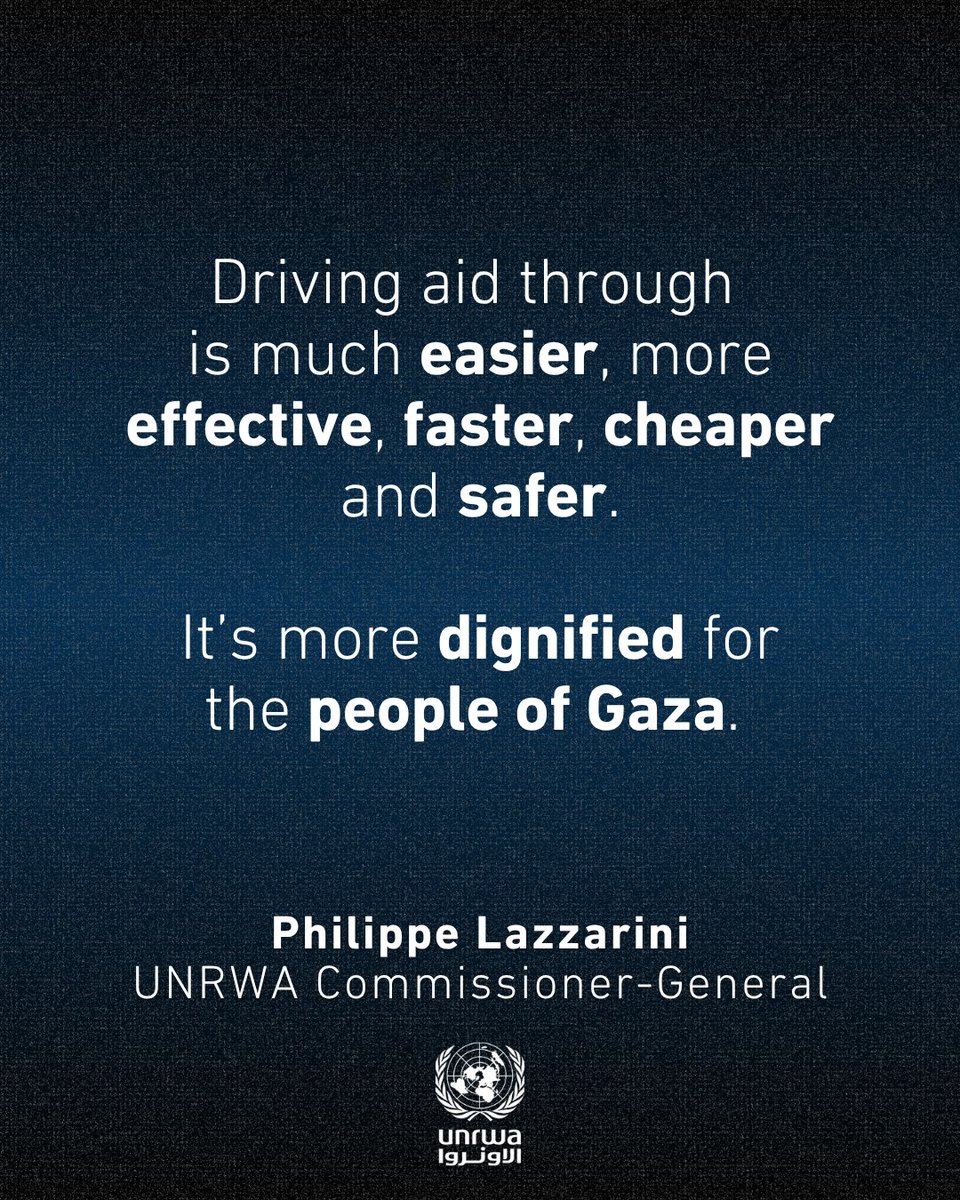
"Gaza: airdrops will not reverse the deepening starvation. They are expensive, inefficient and can even kill starving civilians.
It is a distraction and screensmoke.
A manmade hunger can only be addressed by political will.
Lift the siege, open the gates and guarantee safe movements and dignified access to people in need.
Allow the U.N. including UNRWA and our partners to operate at scale and without bureaucratic or political hurdles.
At UNRWA, we have the equivalent of 6,000 trucks in Jordan and Egypt waiting for the green light to get into Gaza.
Driving aid through is much easier, more effective, faster, cheaper & safer. It’s more dignified for the people of Gaza.
Finally, airdrops will not prevent aid diversion, principled humanitarian assistance will. It reaches those in need.
The latest USAID report confirms that there is no “so called” systemic diversion of aid provided by the humanitarian community in Gaza."
— @UNLazzarini
I urge my colleagues in the media to join us in writing to the Attorney General seeking clarity on how the ban will be enforced for journalists.
There is a strong public interest case in reporting on Palestine Action - but the sweeping and opaque nature of the legislation leaves us worried that journalists could be at risk.
We urgently seek reassurance that all media workers will have guaranteed protection to do their work legally and safely.
https://t.co/lIdxpLX0Zc
We need 1,000 new regular supporters to join us and help build a new media for a different politics. Can you help us reach our target?
Help us shift the public conversation and take on the vested interests that have corrupted mainstream media.