AI has helped resolve an important question in statistics. In the area of multiple hypothesis testing, the goal of controlling the false discovery rate (FDR) has been introduced in a seminal paper by Benjamini and Hochberg (1995). They also introduced a method (the Benjamini-Hochberg or BH method) and proved it controls the FDR. This method has been widely adopted in modern high-throughput science, including in genomics, astronomy, economics, etc. The paper has has garnered more than 130,000 citations to date.
However Benjamini and Hochberg showed FDR control only when the data for the individual tests are *independent*. In practice, these data are often dependent; a good example is data on genetic variants due to linkage disequilibrium. Later work has focused on extending the validity of the BH procedure, e.g., to a form of positive dependence by Benjamini and Yekutieli (2001).
The question of when the BH procedure controls the FDR has remained open. Over the last twenty years, many authors, including Reiner-Benaim (2007), Kim and van de Wiel (2008), Benjamini (2010), Sarkar (2023), Sarkar and Zhang (2025), have conjectured that the BH procedure controls the FDR for two-sided tests using any correlated Gaussian data. These authors have presented both theoretical and empirical evidence supporting, but not directly showing, the conjecture.
With the help of AI (specifically GPT-5.6 Sol Pro), I have settled the question in the negative: The Benjamini-Hochberg procedure does *not* generally control the false discovery rate at the desired level for correlated two-sided Gaussian tests. This was done by exhibiting a Gaussian factor model for which, at a nominal level alpha=0.01, the false discovery rate is proved to be FDR>0.0104.
There is a lot of interesting commentary to be made:
1. This result should be of interest to everybody in the field of statistics. Emmanuel Candes of Stanford University once called the false discovery rate and the Benjamini-Hochberg procedure "one of the two most important developments in statistics after 1950" (the other being James-Stein shrinkage). The present conjecture is probably the most central question about FDR/BH that was unresolved to date.
2. GPT-5.6 one-shot the problem after 90 minutes of reasoning, whereas with 5.5 I was not able to solve it even after iterating with multiple parallel agents for perhaps 20 hours. So the capability improvement is quite real. Exciting times to live in!
3. The argument is not especially surprising, but it does combine an asymptotic approach (standard for FDR analysis, see e.g., Genovese and Wasserman, Efron, etc) with a numerical certificate in a way that would be pretty non-standard in the field. Once we have the specific example, then straightforward simulations also support that the false discovery rate is indeed higher than the nominal value (see attached fig).
4. The current degree of violation over the nominal level is relatively small (0.104 vs 0.1). So the importance of this result is mainly conceptual. The practical implications remain to be determined.
Overall, an exciting development! Preprint is available here (https://t.co/YgiwgDF2qr) and will be on arxiv tonight; supporting code is here (https://t.co/KZhj15qDXC).
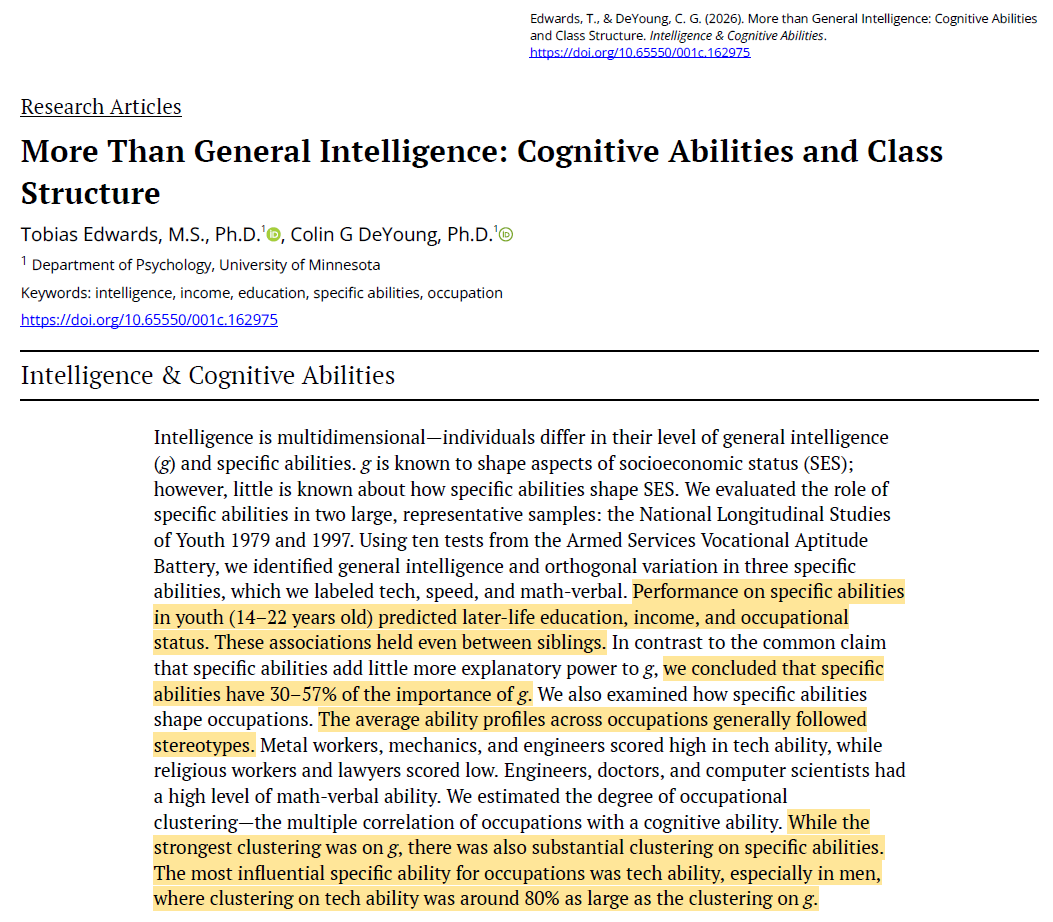
A banger article in @ICAJournal reports the impact of intelligence and specific cognitive abilities on education level, socioeconomic status, and occupational prestige. Using data from the NLSY79 and NLSY97 samples, the authors replicated previous work showing that there is a hierarchy of jobs in which those with higher average IQs have greater prestige and pay.
What's new in this article is that that--after controlling for general intelligence--the authors did the same analysis for specific abilities: tech (mechanical knowledge), math-verbal abilities, and processing speed. The results are fascinating:
➡️Jobs with workers who have higher average math-verbal scores tended to also be the same jobs with higher IQ (2nd image).
➡️Tech/mechanical knowledge tends to predict lower prestige, pay, and IQ. But there are exceptions: engineers tend to have high IQ, high tech levels, greater pay, and high prestige.
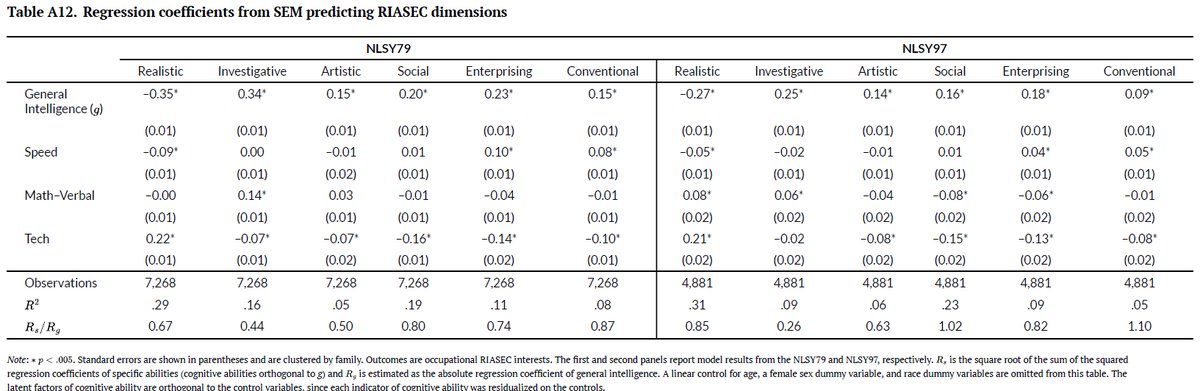
➡️Cognitive abilities and job interests are correlated. IQ is negatively correlated with realistic interests and most positively correlated with investigative interests (3rd image).
➡️The importance of different abilities fluctuates in the early 20s before stabilitizing. In early adulthood, high tech ability is associated with higher income, but that reverses after a few years (4th image). Apparently, a young person can enter a job with high tech ablity needs relatively quickly (e.g., electrician, factory work). But after a person with higher IQ or verbal-math ability gets some college training, they can ener a higher paying job in their mid 20s.
This is a strong article that builds on knowledge, replicates old findings, and pushes the field forward with information that both theoretically and practically useful.
Read the full article here:
https://t.co/1u2LMWD2Dz
New research in @ICAJournal investigates how the Flynn Effect manifests itself in older populations. 🧠📈👴
Using data from the Survey of Health, Ageing and Retirement in Europe (SHARE), the authors examined >128,000 people in 22 European countries who took cognitive tests between 2005 and 2022. Overall IQ increased between 0.9 and 4.0 IQ points per decade.
But that overall increase masks a LOT of heterogeneity. Verbal fluency performance increased the most consistently (with most countries between 2.25 and 13.5 IQ points). But the other tasks--working memory, free recall, and numeracy--showing a lot more variability. There was especially a lot of variability from country to country (see second image).
Controlling for age and education shrank many effects, many effects shrank, but some remained, especially in verbal fluency.
The authors also found that score gains did not cause the general factor to necessarily strengthen or weaken over time. The strength of the general factor appeared to fluctuate randomly across years and countries.
The results are still interesting, and the general pattern of findings line up with previous Flynn Effect studies. The authors believe that the environmental factors driving Flynn effects (e.g., better education, health, cognitively demanding environments) can improve particular cognitive skills in older adulthood without necessarily raising general intelligence.
Read the full open-access paper here: https://t.co/NZay5PKVgy
Not more probable. People do vary in verbal and spatial ability (g accounts for 50% of test variance, after all) - which people like Professor Thomas Coyle study (it’s called “tilt”).
The key takeaway is that there is no single test for g, g emerges as the latent trait driving all tests.
So, with 10 minutes to test, you might devote 3” to vocabulary, 3” to a paper folding test, and the rest to a math/logic test.
🧠 Is creativity mostly just high intelligence?
A new twin study in @ICAJournal says no. There’s a large genetically independent component.
@timothycbates analyzed intelligence test scores and creativity data in three domains: business, military, politics/leadership). Key findings:
➡️Creative achievement is highly heritable (h² ≈ .56), shared environment ≈ 0
➡️Latent creativity and general intelligence are genetically independent.
➡️g explains only ~10% of the genetic variance in creative achievement
These findings support a hybrid view: g helps in many domains, but creativity has substantial unique genetic architecture. As Bates explains, "the genetic architecture of real-world creative achievement is not merely a downstream consequence of general intelligence but reflects a separate, heritable system that operates across artistic, scientific, and enterprising domains" (p. 6).
Read the full open-access paper: https://t.co/OxFZ7d0h7y
New paper just published: Creative Achievement: Behavioral Genetic Evidence for Overlap with General Cognitive Ability and for Independent Latent Traits. https://t.co/WrNJeGLyta
The work being done at @ICAJournal is truly admirable. Reaching these numbers in such a short time is a testament to their hard work and commitment to open science. Congrats on the new issue!
The 1st issue in our 2nd year of publishing scientific research on human intelligence is now complete with 8 papers--all Open Access: https://t.co/BrESCuFJNr
In less than a year, we have over 21k unique visitors, and 1.6k downloads. If you do human intelligence research, please consider submitting your work.
This week, @ICAJournal published a major article by @Herasight scientists (@_twolfram et al.) on using "polygenic scores" (scores based on a person's DNA, abbreviated PGS) to predict intelligence, health diagnoses, and life outcomes. Here's a quick summary of their findings:
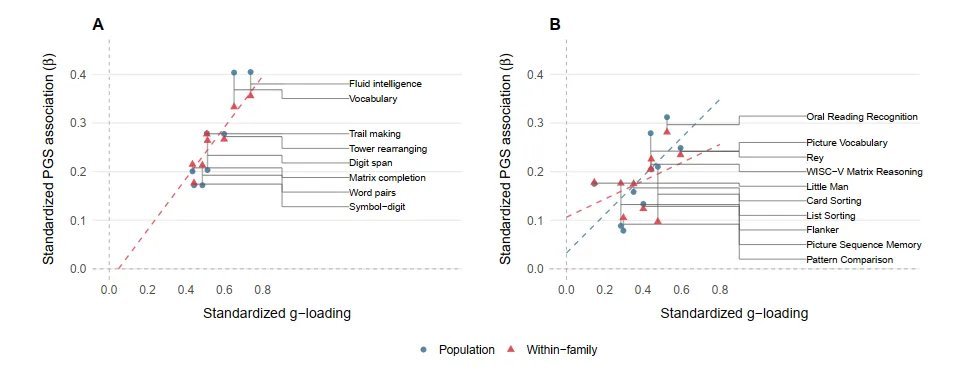
✅The PGS predicted intelligence pretty well: r = .45. (To put this in perspective, socioeconomic status usually predicts IQ at r ≈ .20 to .30).
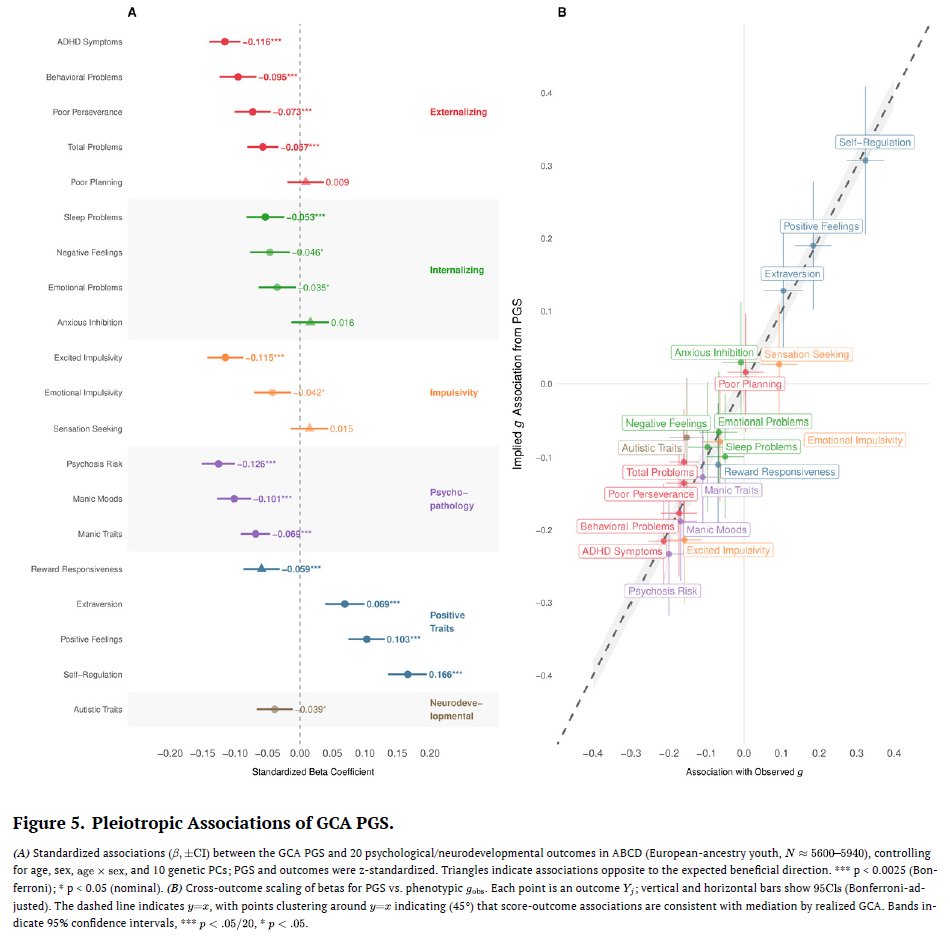
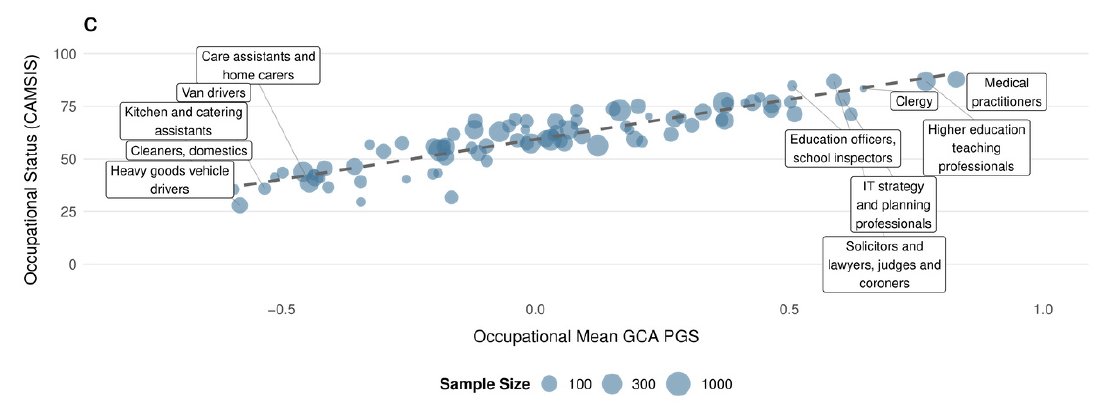
✅Higher PGSs for IQ also predicted better higher occupational prestige (2nd image) and better mental health outcomes (3rd image).
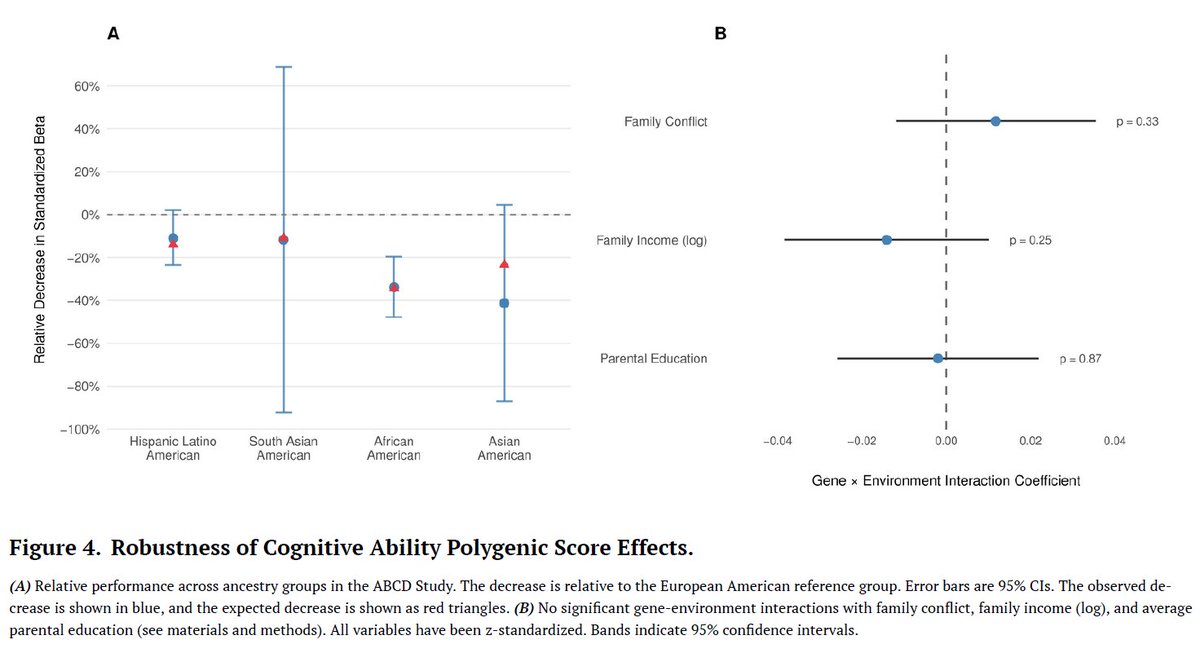
✅The PGSs were less predictive for people with non-European ancestry (especially African Americans), which is expected.
✅The PGSs were equally predictive across the range of socioeconomic statuses (4th image), which is evidence against the Scarr-Rowe effect that predicts that genes will have a weaker influence in low-SES individuals than middle- and upper-class individuals.
These findings have major practical and theoretical implications. From a practical perspective, Herasight is an embryo selection company. This study means that when their customers select the smartest embryo during in vitro fertilization, they are also generally picking a future child that has better mental health and a more prestigious occupation as an adult. It sounds like sci-fi, but it is reality today.
From a theoretical perspective, this study reveals a lot about the genetic architecture of the psychological traits: generally, the same genes that make a brain smarter also make it less susceptible to mental health diagnoses.
Read the full article (with no paywall) here:
https://t.co/jzHbbL2jnI
Two commentaries on our paper about a molecular biology of intelligence highlighted the complexities of polygenicity and GxE interactions. In our new paper we respond with optimism noting that complexity does not negate that there is a biology to discover. Rather it is a challenge that drives progress as new methods are created: https://t.co/Gns9gWZitK
"Relying on a newly constructed PGS using within-family designs... we demonstrate that direct genetic effects account for the large majority of PGS prediction... the within-family association with latent general ability is approximately 0.45."
https://t.co/z3Ji6Qkru2
This is an awesome piece of work. Pretty cool findings:
- Genetic predictors of IQ work within families and do so strongly
- Spearman's hypothesis replicates with polygenic scores
- The Scarr-Rowe hypothesis doesn't replicate with polygenic scores
Herasight's polygenic predictor of IQ, CogPGT, is published in Intelligence and Cognitive Abilities.
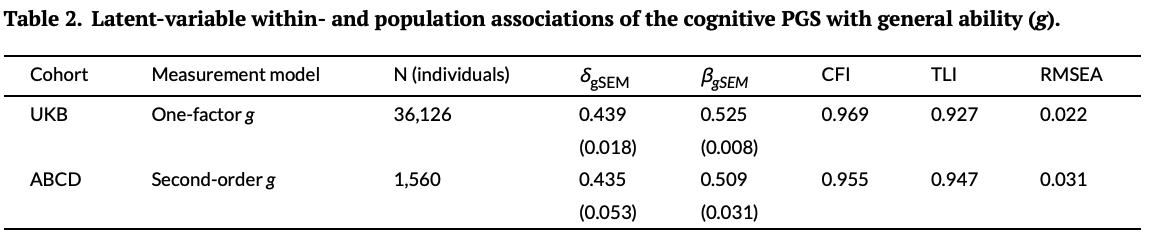
Full latent variable modeling of g shows within family correlations of 0.439 in UKB and 0.435 in ABCD. Powerful within family prediction translates to substantial gains in IVF.
One concern raised about the initial preprint was that CogPGT’s estimated correlation with g diverged more than expected between cohorts (β = 0.521 in UKB vs. 0.425 in ABCD). As several people suggested, moving from classical test theory corrections to full latent variable modeling helped address this discrepancy.












![SteveStuWill's tweet photo. Cognitive chicanery: Five ways that people downplay or dismiss scientific claims they find unpleasant.
[Link below.] https://t.co/HuMrEFK9SP](https://pbs.twimg.com/media/G_gajiCbEAAbXUz.png)