Read a few interesting posts on the Faroe Islands recently. My trip report from a very brief visit a few months ago.
--
The landscape is improbably three-dimensional and rough-hewn: rugged, jutted, serrated, cragged. In being fully denuded – the peaty soil, the Atlantic winds, the centuries of overgrazing – it feels like an exaggerated, hyperreal version of the west of Ireland. It also reminds of a Patagonia stripped of the Andean backdrop.
Torshavn now boasts numerous excellent restaurants. It is a town of only 14,000 people: what’s going on? As far as I can tell, this is fully a story of cultural contingency: in 2011, “chef Leif Sørensen ended up essentially inventing Faroese haute cuisine all by himself”, opening the restaurant Koks. This is in a tradition of Norsemen defining new gastronomic cultures through force of will. In 2004, Claus Meyer and Rene Redzepi organized the Nordic Kitchen Symposium (supported by the government, it is interesting to note) and put forth the Nordic Kitchen Manifesto, setting in motion the forces that rendered Copenhagen the culinary capital it is today.
Little of note grows in the Faroes. They raise sheep; most of the rest they scavenge from the sea. Fermented lamb is a specialty. I ate it. I would not call it bad, but I won't rush to consume it again.
Over dinner, I chatted with a young couple from Liechtenstein. (Liechtenstein being the only other comparably-sized country in Europe, this seemed appropriate.) The woman worked as a diplomat in Brussels. She told me that the city was often unsafe and that there were many places she couldn’t go. That concept felt a far cry from Torshavn. Her boyfriend mentioned the heatwave back home; I asked about their thoughts on air conditioning. “It’s too energy intensive… one has to consider the greater good.” I point out that California’s abundant air conditioning is mainly powered by solar. “Yes, but still… it’s not good to use so much energy.” My optimism about Europe was not enhanced.
There are a lot of undersea tunnels in the Faroes, connecting the islands, with plenty of additional projects underway. As a Californian, these are a mystical luxury. How can a nation of 55,000 people (Petaluma has more), and poorer per capita than my home state, possibly afford them? Per-unit length costs appear to be almost 30x lower than California’s. For example, the 11km Eysturoyartunnilin opened in 2020, and was evidently constructed for $14M per km.
The bookstore contains many Faroese-language works. Approximately 200 new books are published each year; one for every 275 people. Ireland’s annual production is one for every 2,000 people or so.
What does one learn from the Faroes? It feels clearly to the betterment of the world that they exist. Some of this is in the natural splendor, but some is also in seeing what a micro-nation is capable of. Are the Faroes an example of how clearly-defined polities are a bottleneck for the advancement of the world? To the extent that cultures establish the preconditions for anything, and to the extent that appreciation for and consumption of humanity’s creations are among the most durable sources of welfare, should we want more Faroes? Do the Faroes, with isolation enforced by maritime tyranny, hint at what is lost in global integration? Did Patrick Leigh Fermor encounter a new Faroe Islands every day? There were around 27 different languages spoken in France in 1900. How does one like the Faroes and like globalization?
Out of all the billionaires in the arena it is @sama I respect (fear) the most.
Going from practically a nobody to climbing the hierarchy to head YC and basically making it the brand it is today. Then bowing out to run OpenAI before there was much proof it was going to work out & building without a doubt one of the most valuable companies on earth. If OpenAI was public we would’ve bid it to 3 trillion easy and then lost our shirts when GPT5 came out.
He’s been the chief architect of this bubble to the point that some of the phrases and words we use today would literally not be in our vernacular. Scaling Laws, AGI, infinite growth, sentience it’s all him peddling this to us. Working the capital markets like the shrewdest banker on earth, two fundraises at different valuations at the same time… WHO THE FUCK CAN PULL THAT OFF?!
To baiting Zuck with FOMO by getting his chief lieutenants to feed poison to his brain. To then rugging him by going to the press to spoof the order book on AI Researcher salaries and at the same time saying everyone who joined his Super Intelligence team was mediocre. The GPT5 failure to the dumping of shares to anesthesiologists in San Francisco… it’s all him.
Then finally, he calls it a bubble. He admits he was exuberant. But yet, he can’t be saying OpenAI is a bubble. It’s the other guys who’s models are just slightly worst and don’t have the distribution the infrastructure we do. See it’s not AGI 2027 it’s we own the railroads we own the oil wells. Do you really care about where your token comes from? You just care that it’s cheap and gets you to where you need to be.
His next move if I had any guess is vertical integration. The new metric isn’t ARC AGI retards its Profit per Token (PPT).
Write it up @SemiAnalysis_ there is a new AI race and it’s not going to be won in a Jupyter Notebook.
Bare minimum for holding a conversation: Paul Skallas, Landshark, Roon, The Last Psychiatrist, Sighswoon, Honor Levy, Tao Lin, Donald Boat, Bronze Age Pervert, Radfem Hitler, Rayne Fisher-Quann, Joe Weisenthal, Aella Girl
It's interesting how both robinhood and coinbase have killed it for the past 2 years when all the founders of both cos are working on side projects:
- vlad: harmonic
- baiju: aetherflux
- brian: newlimit, researchhub
- fred: paradigm, nudge
It's underrated how high output S-tier competent people are:
- Palmer Luckey has written unpublished short novels
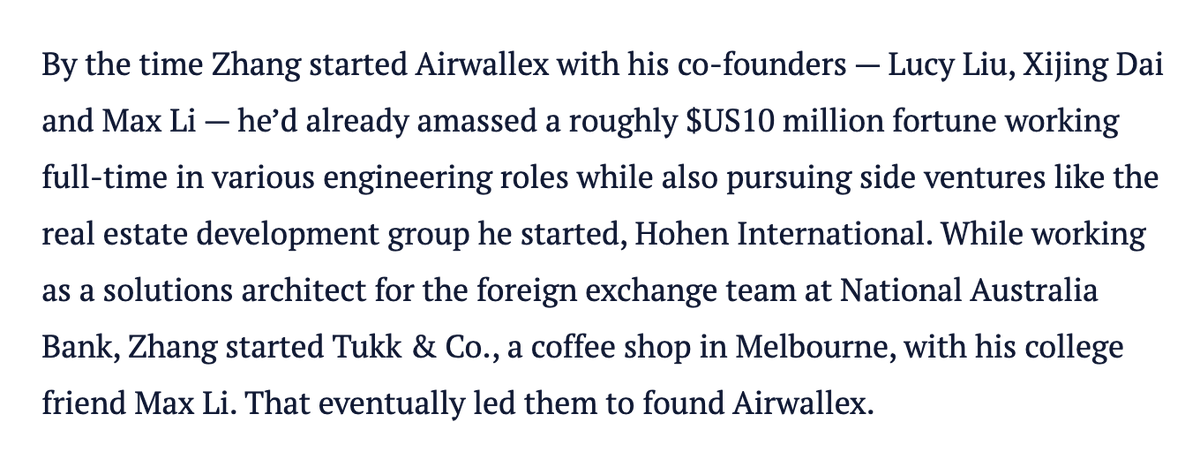
- Airwallex founder made $10M from side businesses while working a day job in banking
- Crimson founder got 6 college degrees as a sidequest while running his co
It's weird that even though I'm reliant on o3 for search and Claude for coding, my natty coding skills haven't deteriorated much compared to my natty Google search skills
GPT-5 thinking/pro is just not there yet. One "skill" that took me 2+ months to learn with o3 is being able to sus out when its hallucinating (or just not reading a website correctly)
I basically feel blind when using GPT-5 now
To be fair, I haven't used GPT-5 Pro that much. It might actually be really good, but I just don't have that many questions that require >5 mins of research time
o3 was perfect in terms of time to finish research + depth/quality of responses (vs something like Deep Research)
When using Cursor/Claude Code, after a certain point the model fuses with your brain resulting in human <> machine symbiosis
Your thoughts & LLM prompts subtly morph to give the best results and you can intuit if the model can actually solve a given task & how long it'll take
GPT-5 thinking/pro is just not there yet. One "skill" that took me 2+ months to learn with o3 is being able to sus out when its hallucinating (or just not reading a website correctly)
I basically feel blind when using GPT-5 now