Note to anyone angry that Trump's name was taken off the Kennedy Center, don't you worry. You can still find his name in the Epstein files over 38,000 times.
If this ad has made you curious about Team Paltrow’s politics, I refer you Gwyneth’s other major intervention this week: reputation laundering an AI missile manufacturer on her podcast show
In 1942, C.S. Lewis predicted a future dystopia where:
-Education is leveled to a mediocre state to avoid hurt feelings
-The middle class is hollowed out, removing the primary champions of private excellence
-"Avoiding trauma" becomes the excuse to stop pushing students to their full potential
The obsession with perfect equality ends up destroying human greatness — and it’s fueled by state education, where schools become more like nurseries than academic institutions.
Seems like Lewis’s dystopia is already here.
What is wrong with Ireland?
PM lies about massive alumina export to Russia, used to make Shahed drones against Ukraine,
Wont discuss EU common defence,
Let’s in huge numbers of Russian with a 90% visa approval rate, i.e. no real vetting.
Every day, ships leave this russian owned factory in Ireland straight for St Petersburg carrying thousands of tonnes of raw alumina for the war machine.
There’s corruption everywhere. Locals tell me politicians are bought by oligarchs.
Ireland is no longer militarily neutral.
Tony Blair is the living embodiment of what happens when political office becomes a down payment on future plunder. Ejected in 2007 by his own MPs as a massive liability, he bequeathed Britain a wild casino economy primed for the 2008 crash. And when the British economy crashed and burned, Mr Blair kept quiet while honing his skills at securing power by other means.
His first job, after his ejection from 10 Downing Street, was as the West’s Middle East envoy, with a supposed emphasis on Gaza. It took six painful years for Mr Blair’s tenure to prove a failure so profound it amounted to active complicity in Israel’s ethnic cleansing, in Palestinian erasure, and in paving the ground for the ongoing genocide.
Soon after, the Chilcot Inquiry demolished Blair’s Iraq lies, exposing him as a liar, a chancer and a war criminal responsible for countless corpses of Iraqis, but also of British soldiers.
Then came Blair’s real innovation: the financialisation of the ex-premiership itself. The Tony Blair Institute, fuelled by £130 million from Oracle's Larry Ellison—coincidentally, the largest individual donor to the Friends of the IDF—became a shadow state, brokering governance contracts for autocrats and companies like Palantir that weaponise AI to produce mega-death abroad and full-on surveillance of Western populations.
Now, in May 2026, this corporate fixer issues a 5700 word tantrum demanding that Labour embrace Trump even more than Starmer already has, denounce what is left of Labour’s betrayed Green New Deal, and trash the remnants of workers' rights. This is not the wisdom of an aging statesman. It is the frantic squirming of a man fearing his grip on oligarchic power might soon wane and whose entire post-10 Downing Street existence depends on preventing the many from ever reclaiming what the few have plundered.
https://t.co/1Onlpx9Nkh
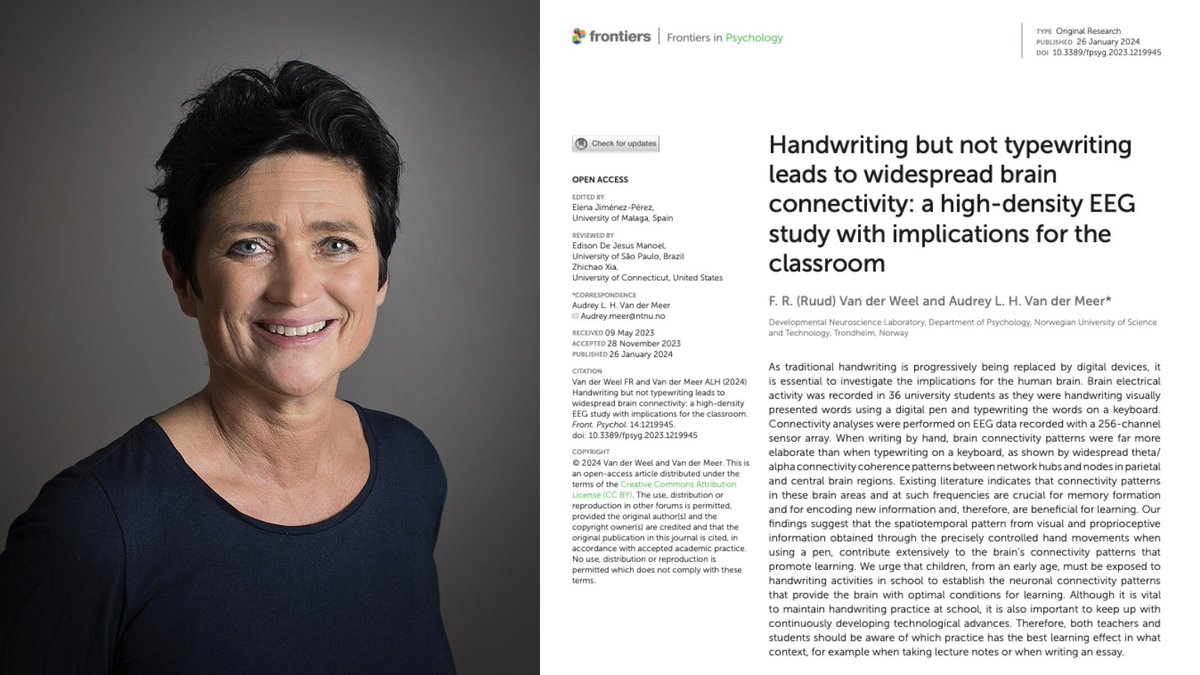
A Norwegian neuroscientist spent 20 years proving that the act of writing by hand changes the human brain in ways typing physically cannot, and almost nobody outside her field has read the paper.
Her name is Audrey van der Meer.
She runs a brain research lab in Trondheim, and the paper that closed the argument was published in 2024 in a journal called Frontiers in Psychology. The finding is brutal enough that it should have changed every classroom on Earth.
The experiment was simple. She recruited 36 university students and put each one in a cap with 256 sensors pressed against their scalp to record brain activity. Words flashed on a screen one at a time.
Sometimes the students wrote the word by hand on a touchscreen using a digital pen, and sometimes they typed the same word on a keyboard. Every neural response was recorded for the full five seconds the word stayed on screen.
Then her team looked at the part of the data most researchers had ignored for years, which is how different parts of the brain were communicating with each other during the task.
When the students wrote by hand, the brain lit up everywhere at once.
The regions responsible for memory, sensory integration, and the encoding of new information were all firing together in a coordinated pattern that spread across the entire cortex. The whole network was awake and connected.
When the same students typed the same word, that pattern collapsed almost completely.
Most of the brain went quiet, and the connections between regions that had been alive seconds earlier were nowhere to be found on the EEG.
Same word, same brain, same person, and two completely different neurological events.
The reason turned out to be something nobody had really paid attention to before her work. Writing by hand is not one motion but a sequence of thousands of tiny micro-movements coordinated with your eyes in real time, where each letter is a different shape that requires the brain to solve a slightly different spatial problem.
Your fingers, wrist, vision, and the parts of your brain that track position in space are all working together to produce one letter, then the next, then the next.
Typing throws all of that away. Every key on a keyboard requires the exact same finger motion regardless of which letter you are pressing, which means the brain has almost nothing to integrate and almost no problem to solve.
Van der Meer said it plainly in her interviews.
Pressing the same key with the same finger over and over does not stimulate the brain in any meaningful way, and she pointed out something that should scare every parent who handed their kid an iPad.
Children who learn to read and write on tablets often cannot tell letters like b and d apart, because they have never physically felt with their bodies what it takes to actually produce those letters on a page.
A decade before her, two researchers at Princeton ran the same fight using a completely different method and ended up at the same answer. Pam Mueller and Daniel Oppenheimer tested 327 students across three experiments, where half took notes on laptops with the internet disabled and half took notes by hand, before testing everyone on what they actually understood from the lectures they had watched.
The handwriting group won by a wide margin on every question that required real understanding rather than surface recall.
The reason was hiding in the transcripts of what the two groups had actually written down.
The laptop students typed almost word for word, capturing more total content but processing almost none of it as they went, while the handwriting students physically could not write fast enough to transcribe a lecture in real time, which forced them to listen carefully, decide what actually mattered, and put it in their own words on the page.
That single act of choosing what to keep was the learning itself, and the keyboard had quietly skipped the choosing and skipped the learning along with it.
Two studies. Two countries. Same answer.
Handwriting makes the brain work. Typing lets it coast.
Every note you have ever typed instead of written went into your brain through a thinner pipe. Every meeting, every book highlight, every idea you captured on your phone instead of on paper was processed at half depth.
You did not forget those things because your memory is bad. You forgot them because typing never woke the part of the brain that would have made them stick.
The fix is the thing your grandmother already knew.
Pick up a pen. Write the thing down. The slower road is the faster one.
In 2025, DeepMind CEO Demis Hassabis gave a 60-minute Cambridge lecture on AI as a discovery engine.
This is bigger than chatbots.
He explained:
- The "Move 37" method
- A billion years of PhD time
- Biology as an information system
12 lessons that will blow your mind: 🧵