Anthropic published a blog post one hour ago.
Cybersecurity stocks have lost $10B since.
CrowdStrike -6.5%. Cloudflare -6%. Okta -5.7%.
One blog post. One hour. $10B gone.
If you or someone you know is in a hostile/non-communicative co-parenting situation, i'd love to talk! Doing user testing on a product that aims to bring a solution to this problem and I'd love your feedback(paid)! #coparenting#coparents#parenting
Here's a common startup situation. A team busts their ass for months building the first version of their product. It's almost done. Now a big question emerges -- how do you get the first people to use your product? Hmm...
If you find yourself at this moment, then you are already in a bad place.
99% of startups are not differentiated on their underlying technology, and there is very little engineering risk involved. (I'm ignoring deep tech and foundational AI research companies, for the sake of this conversation). Because technology differentiation is no longer a real factor today start ups, it turns out that most products are succeeding or failing due to core product/market fit followed by the distribution strategy. There are over 9 million mobile apps. There are a billion websites. Figuring out distribution is key.
This is why I think startups end up needing both:
1) an insight about customers that gives them product/market fit
2) an insight about distribution that creates traction
People building products often have an easier time product/market fit because they are building for themselves, or a customer that they already know well. But the latter, about distribution, is often super difficult because once you onboard your friends and family, and look to expand the next set of hundreds of customers, you then dive into the world of growth marketing strategies and tactics which are its own very particular learned skill set.
Sometimes when there's a new breakthrough technology, as with what is happening in AI, or the Apple vision Pro, or Web3, it's simply enough that the product has a "it works" feature. By simply being there on the scene when adoption of a new platform is happening, distribution happens automatically. I think that's why we see that so many new great startups are launched right at the beginning of the platform.
But what happens when you are trying to launch the 9,000,001th mobile app? The first thing you do, naturally, is to try to read what's out there. The other counterintuitive thing, is that although most of the knowledge in writing out there pertains to channels like SEO or paid marketing or influencer campaigns, many of these tactics best fit already successful products that have money and aim to accelerate growth. Many of these tactics simply won't apply to you because they'll be too expensive, or they will use mature marketing channels that just won't be that effective. I often joke that by the time there's a case study about a new marketing tactic or channel, the advantage has already been arbitrage away, and probably no longer works.
So what should you do instead?
Ideally the product and the distribution hypotheses happen at the same time, and reinforce each other. The Dropbox founders describe to me at the inception of their product, that sharing folders was part of the vision and was built in quite quickly. And later years this drove a significant amount of growth. Uber has natural virality because you often ride in a car with other people, or you ride a car to see somebody, and naturally you'll mention the service. A product for creators, like Substack, will naturally encourage people on the platform to write and share content, attracting an audience who ultimately may also be writers themselves. Zoom, and other apps that help collaboration in the workplace, have natural features that cause you to bring in your coworkers as you use the product experience.
These are all examples of the best form of distribution, which are baked in to the product idea itself, rather than bolted on at the end.
Even once you have a basic theory for how your product will naturally distribute itself, you'll still need to identify the first generation of users to help iron out all the issues, and give you feedback on whether your hypotheses were correct. In my years of studying new product launches, I can confidently say that the early years are often very idiosyncratic, and constantly changing. The reason for this of course is that marketing channels change all the time, but subscale ones that help you get your first couple thousand users, change even more so.
A few years ago you saw a trend were products would launch a huge conferences like SXSW. These days you see more effort on getting influencers involved early. Or "building in public" which makes yourself into an influencer. Several years ago many consumer products (like dating sites, new photo apps, etc) would launch on college campuses via the Greek system, because they were organized ways to reach thousands of undergraduate students. These days the organizations are often inundated with start up requests, and it's become less effective. As a result all of these initial channels change all the time, and it's up to the founders to figure out how to take advantage of what might work today.
The problem with these initial channels is that they eventually tap out.
Thus starts the journey of startups to grow and expand their portfolio of distribution channels, beginning with small and highly relevant ones, into the biggest channels.
I sometimes imagine a X Y axis, where X is volume of the channel, and Y is responsiveness. Early channels are often very low volume. But you want that. The reason is that they are highly relevant and they are small enough that larger companies do not focus on them. As I mentioned influencers are often an example of this, but so are niche newsletters, or or event marketing. However if you find this channel to be successful, you'll also eventually one more scale. This involves you jumping onto the next set of channels, which will provide more volume but be much more competitive as a result.
Often times this is a period where you have one channel that kind of works, and you're testing a few other channels simultaneously. Your efforts here should be experimental and iterative. You can often look at direct competitors as well as adjacent products and see what they're doing, to inspire you on the right channel. The natural cadence of products will indicate to you the channels that are most likely to work. If you have episodic usage, you'll probably need to do SEO/SEM, affiliate, or referral -- something that helps you target high intent users. If you're product is social or helps with workplace collaboration, then you might lean into referral programs and viral growth. Products in commerce naturally lead you towards paid ads, contact creators, etc. You can often learn a lot by talking to other people in your industry or an adjacent industries to see what works.
This is where sometimes I'll see people working on episodic usage apps, like travel/health/etc asking the question, how do I make my product virally? I want free users! Of course the problem is, there's a natural fit between a product and it's distribution channels. Even though you might want free distribution, only very specific niches of networked products are able to grow freely. Generally everybody else must pay for their distribution, whether via referral or advertising.
Eventually you want to move on the XY axis towards volume. There are only about a dozen large scale distribution channels that can propel a product to scale. Advertising is on that list, SEO too, and so is viral growth. But these larger channels, by their nature, are both highly scaled but also have low responsiveness. As a result, you end up competing with some of the most famous brands in the industry as a result. Who wants to buy ads against the same audiences as major credit card or airlines? They have insanely high payback periods, and huge marketing budget, and are not that cost sensitive.
Ironically, this is where great products become to dominate. I started this discussion with the dual requirement of product/market fit, and distribution. But in the end, product/market fit actually dominates.
The reason is the following -- the ability for a company to operate out in these most expensive and highly scaled channels comes from having a great product that generates a ton of word of mouth. More natural usage, the less marketing that has to be done. And the marketing costs that do exist end up being blended in with the large number of organic users.
The journey of a new product is to move, from unscaled and relevant, to highly scaled. And at the end, great products win.
I took a while to respond to this because Eric’s answers were very good, and logical so it’s hard to refute. I also do respect Eric Ries a lot, he has lot of experience with different companies and his book Lean Startup was really influential to me when it first came out.
But… something bothers me about this whole MVP discussion. Is this all just a distraction?
Eric’s answer was basically “MVP can be anything you need to validate an idea or the customer demand in the market”. Later in the discussion Eric mentions that a brochure can be an MVP. I agree. Sometimes sales material is a good way to validate demand, but I’d say it’s not an MVP. There is no product for anyone to use.
What bothers me is that if anything can be MVP, it’s trying to bucket all kinds of activities and outputs into this one term, it kind of loses in meaning and becomes more confusing than it’s helpful. Anything you do to validate an idea or build a product is essentially MVPs.
If MVP is just a way to test or validate something, then why not say, “I’m validating the product demand by using a sales brochure”. Or if I’m showing an initial product to potential users, why not just call it that. Why do I need to talk about MVPs? People also like to argue what truly is or not is an MVP, which I find just a waste of time.
In my experience, people generally mean MVP is some kind of baseline or beta version of a feature or product. It’s functional and hopefully solves user needs but doesn’t have all the polish and features. It’s a state in the product development lifecycle. Almost every product probably starts as some kind of “baseline” product where the baseline is defined by the expectations of the users. Which is fine, you have to start from somewhere.
The problem I’ve seen in companies is that this MVP thinking promotes taking constant shortcuts and shipping shitty things in the name of the MVP. These often get abandoned or not fixed afterwards because the project is technically done and the team moved over. Then the whole product becomes half-assed and disjointed because it’s just a string of MVPs.
Now someone might argue, well you are doing it wrong. MVPs doesn’t mean you shouldn’t finish it. Yes but in practice how often it happens and is this whole method just encouraging the wrong things or distracting from what are actually doing?
The MVPs & Lean Startups remind me of agile/scrum where you create these terms for a show or doing some mental gymnastics for basic activities. Then when someone argues it’s a waste of time the answer is often “you’re doing it wrong” or “you just don’t get it”. Maybe so, but maybe there isn’t anything to get?
My way of thinking around product building is not about experiments or MVPs, it’s about how to make the product successful.
As a startup you often just have to build something that people want. Providing a great experience is a great way to do that. Purposefully building and launching half-assed things to me is just a waste of time.
It’s like you operate a restaurant and instead of fully cooking the food, you purposefully leave it raw and let users tell you it’s inedible and makes them sick. Anyone who has eaten or cooked food knows that. Next time you cook it fully, and behold, the consumer now can eat the food but they still don't like it. Experiment and MVP of fully cooking the food was validated. Yay! We can now move to the next variable...
Obviously, chefs don't operate this way. They have their skills and experience and they use that make a dish and people would enjoy. Sometimes they are wrong and sometimes they make something really great.
Sometimes you know more about the market or the problem, sometimes you know less. You should try to think about what you do know, and what you don’t know, and how critical that information is. To know more you can talk to users and customers, knowing that they can’t ever give you the vision of what to build, only input to that vision. The ultimate test is to have a product out there, and see if people buy it. I’d say you should have vision, not just throw random stuff at people and see what they say.
This is also not about fear of launching a product early. We launch early and get feedback early, but still care about the quality of the experience. We got our first few users for @linear about 1 month after we announced the company. But by that time we already had a product that was 10x faster than anything else there, and had a design people liked. And yes it was scoped down and didn't have all the features (common sense). We never considered it as a MVP or an experiment, it was a product stage and we wanted to get user feedback.
My problem with trying to make the product building into some kind of science which most of the time is not necessarily and likely just a distraction, especially for startups. Your only focus should be how do I make a product that is 10x better than anything else in the market. The fact is that if you enter any category that only has solid incumbents or existing products, then your product needs to be very different and higher quality than those products. You don’t need an experiment to know that.
If your product has no traction then it either is the wrong product or the execution is not good enough. You can try to validate the product idea with research but until you make the execution good then you never know for sure. Users won't tell you that, they just leave or don't use it.
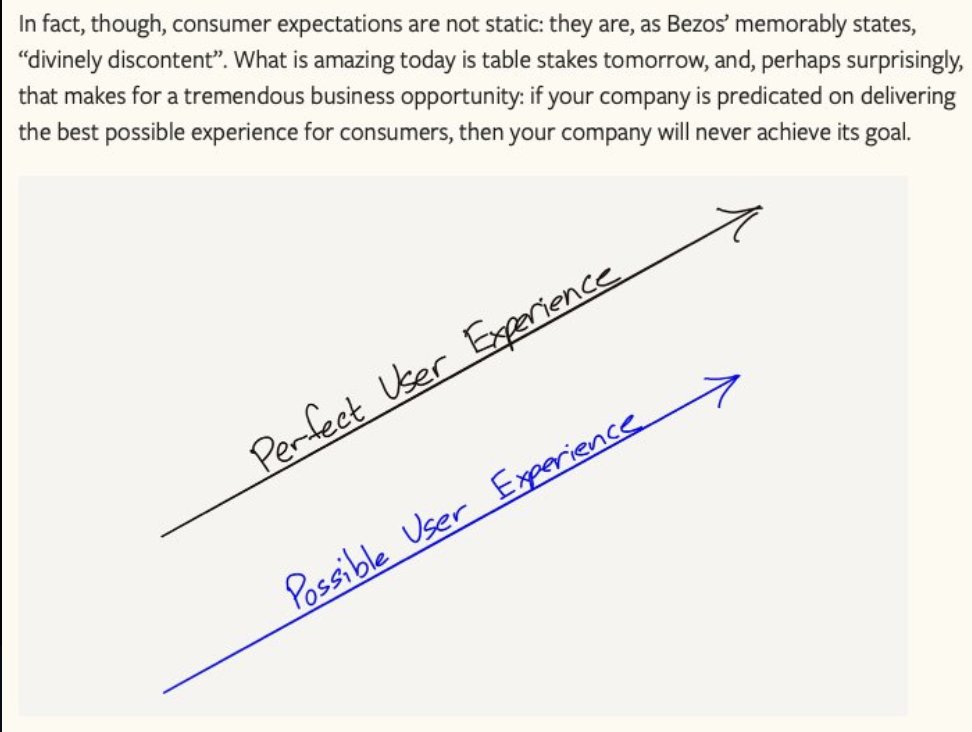
My point with this question was that today the user and customer expectations are high in many areas, and there are very few new novel markets like AI (crypto before that) that can be more of the wild west. But as those markets mature, you are again fighting against higher quality bars. As Bezos stated this, consumer expectations are ever increasing or “divinely discontent”,
So my advice would be to focus more on how you deliver a product that exceeds those expectations.
Don't spend your energy on running great experiments instead what would make the experience great.
Sidenote: On the iOS apps vs backup battery system also I disagree. Battery backup system buyers can have very high standards, but they are also rational buyers knowing what they want. Many consumer iOS apps only succeed in more irrational ways. There is no spec sheet for social apps you can pull out from teenagers. You can try to understand them and build something, but if it doesn’t engage them your app fails. These apps are not needed, they are wanted. Most products are some kind of mix of rational and irrational needs. Logic and emotion.