Excited to share our new @Nature paper: “Satellite imagery reveals increasing volatility in human night-time activity." Over the past decade, nightlights are surprisingly dynamic, with locations repeatedly brightening and dimming. @GERSLab
A fully funded Master's or Ph.D. position is available at GERS Lab working on an exciting NASA-funded project using Landsat and ECOSTRESS time series for studying water-use and land-cover change. Please submit your CV, transcript, & research statement to [email protected]
Please RT
📰The first review for synopsizing the detection and characterization of land change as a five-facet task in a systematic manner. Be careful of the multifaceted nature of land change, as it can be confusing. Please RT! #OpenAccess#Review#LandChange
1/n
https://t.co/RgXQ8y4Olj
When the sun goes down, the lights come on – and UConn researchers worked with @NASA and @UofMaryland to develop a method to observe these lights and better understand human activities at night. https://t.co/P9RgmziDYE
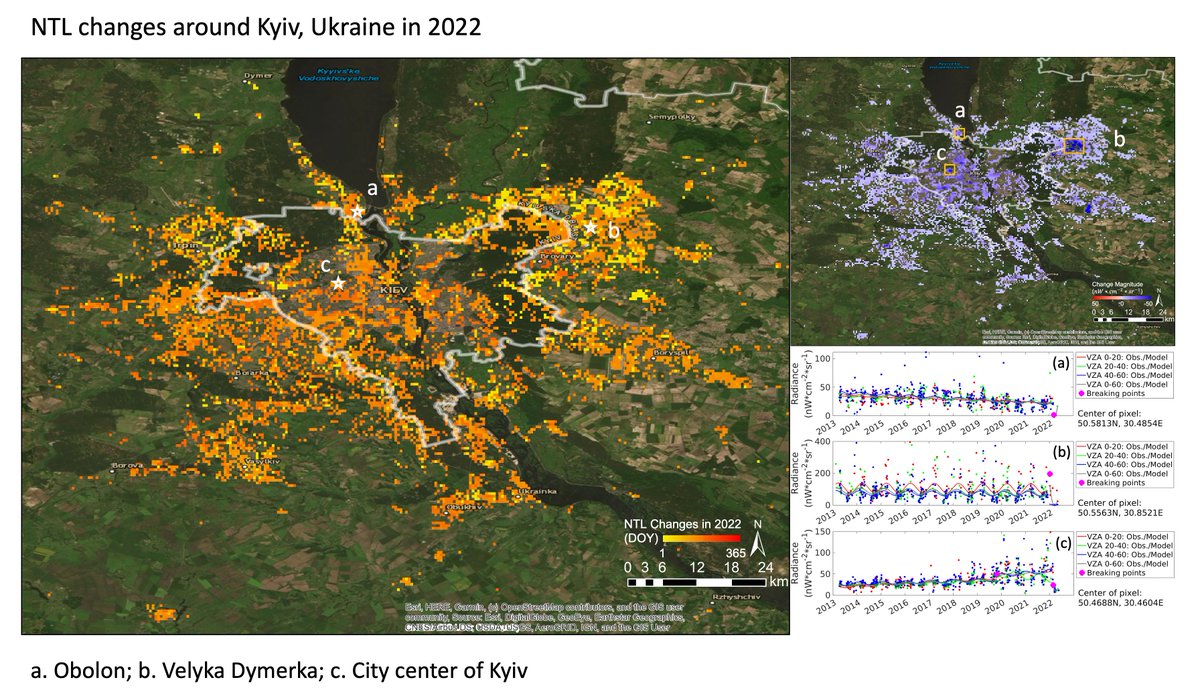
New near-real-time nighttime light change results from VZA-COLD for two cities (Mariupol and Kyiv) in Ukraine. The left image is the change date, the upper right image is the change magnitude and direction, and the lower right images show the time series plots. Horrible changes!
@bdipen@GERSLab @DrMiguelRoman Yes, you’re right. We obtained the corresponding viewing angle data from the raw Black Marble product and combined these two products together.
We developed the first algorithm that uses daily nighttime light data from NASA Balck Marble Product @DrMiguelRoman for accurate continuous monitoring of global nighttime light change. Global products will be released by NASA soon. Please help RT.
https://t.co/thQw4whJ4U