new post on harness engineering for AI self-improvement: https://t.co/ZYvGfVs61k
It is hard to forecast how much the future of RSI will rely on harnesses. Likely harness engineering will evolve in the direction of self-improvement and enable auto-research, and, in turn, smarter models keeps harnesses simple.
Even when many harness improvement get eventually internalized into core model, the need to specify goals and context will not disappear.
A man spends 50 years teaching at MIT.
He knows his time is running out.
So he records one last lecture—
everything he knows,
distilled into a single hour.
He died 5 months later.
This is that lecture.
The most important hour
you'll watch this week.
👇 Bookmark it for later
Anthropic pays $750,000+ a year for engineers who can build LLMs from scratch.
Not how to prompt them.
Not how to fine-tune them.
Not how to build RAG pipelines.
But how to build them from scratch.
This 2-hour Stanford lecture teaches you everything.
Scaling laws.
Data collection.
Architecture design.
Post-training alignment.
Free. From Stanford.
Watch first. Then read this.
The lecture is the theory.
full guide in the article below
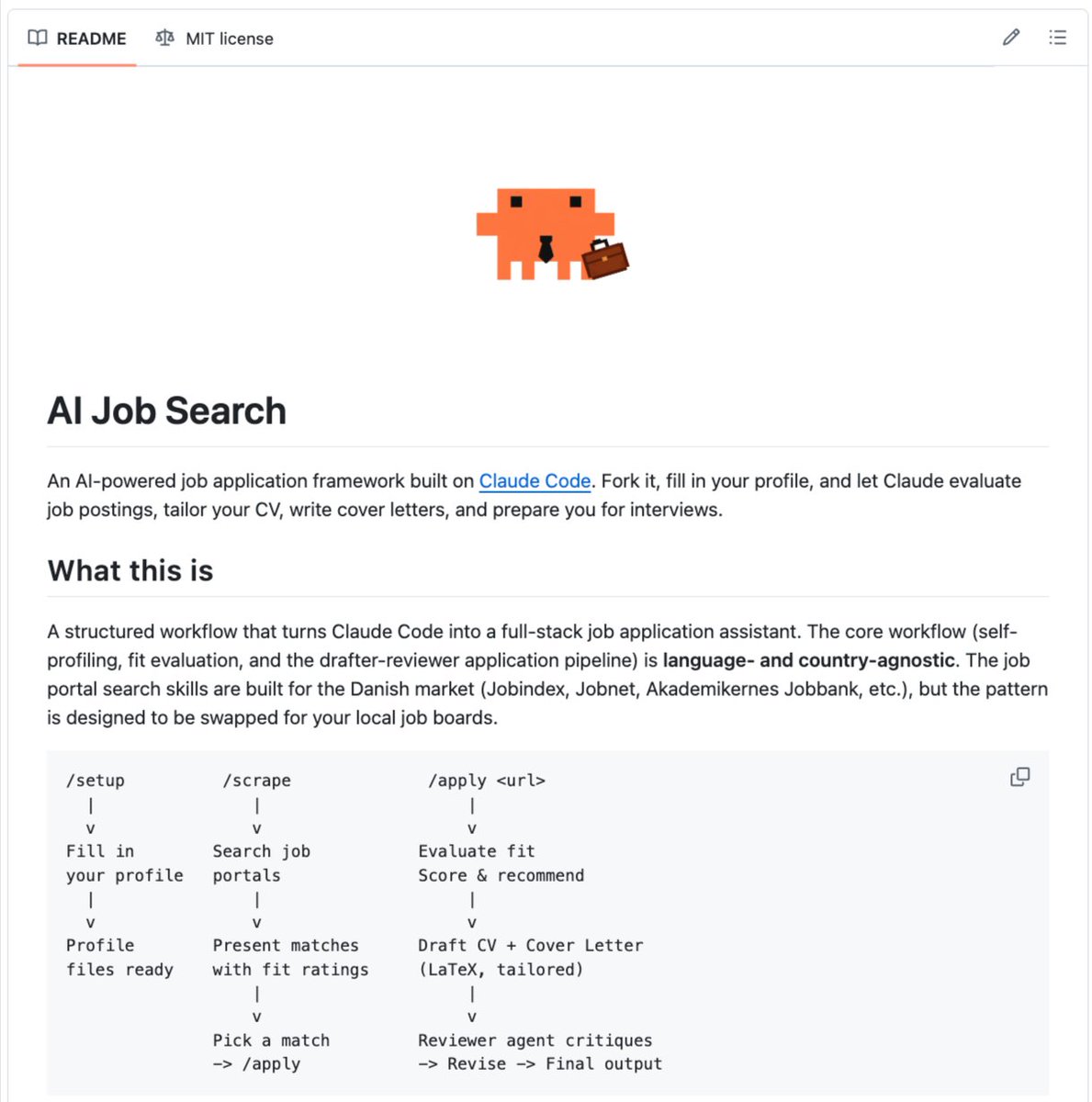
A scientist in Denmark figured out how to make Claude prepare his job applications. He open-sourced the whole thing.
His name is Mads Lorentzen. He is a PhD geophysicist. He built it on top of Claude Code and released it under MIT license.
Here is what it does. You fork the repo, fill in your background once, and it runs a five-step pipeline for every job you want to apply to.
Step 1. It reads the job posting and scores how well you fit.
Step 2. It drafts a tailored CV in LaTeX, picking only the experience that matches.
Step 3. It writes a cover letter framed around what you would bring to the role.
Step 4. A second AI agent reviews the first agent's work, points out weaknesses, and the first agent revises.
Step 5. It compiles both into clean PDFs you can send.
The whole thing is a folder of markdown files. The candidate profile, the writing style rules, the CV templates, the interview prep notes. Every step is plain text you can read and change.
The job portal search is built for Danish boards. The application workflow itself works for any country.
489 stars. 270 forks. A fork-to-star ratio that high means people are using it, not only bookmarking.
Mads is not a startup founder. He built this because he needed it for himself, then shared it.
This is the future of job hunting. Not a service you pay for. A workflow you own.
(Link in the comments)
Paul Scherer wants to create an AI that brings us closer to each other.
@paulscherer and @eigenhq are building a "mutual friend" for the world. Critically, the mutual part is more important than the friend part.
Imagine the best "connector" you know -- the person who is emotionally intelligent, thoughtful, and always bringing people together. What if they could be friends with a million people, rather than a few hundred? And what if they were entirely focused on creating more belonging in the world?
Modern social media--due to hyper-personalization and broken incentives--makes us feel more and more estranged from the people we care about. AI chatbots focus on engagement and can be anti-social.
Paul and Eigen are aiming for a pro-social AI friend who is more concerned with helping deepen and widen your relationships than getting you to talk to it for longer.
We discuss what all this might look like, the challenges of "growing" a new person that isn't a bad actor, and what it feels like to be a prodigious 22-year-old who Peter Fenton compared to the founders of last generation's great social media companies--all before he’s publicly launched a product.
Timestamps:
1:13 - Intro to Paul
3:28 - Start: 'Momo', Presence, Friendship, and Time
11:10 - How the Internet Connects Us and Isolates Us, and Conflating Social and Media
25:12 - A Future Where We Talk to AIs
33:55 - Paul and Eigen are Building a Mutual Friend to Help Us Connect with Other Humans
48:01 - Why Do We Need a Mutual Friend? And Making a Friend We Can Trust
1:16:53 - Belonging, Building the team at Eigen, and Inventor as Outlaw
1:25:38 - Managing the Psychology of Being a Promising Young Founder
1:36:53 - Maintaining a High Bar, Fighting Entropy, and Influences
1:53:50 - Self-belief, Authenticity, Seeing the Water
2:10:30 - Courage, and a Final Question from a Mutual Friend
2:16:27 - Eigen Office Tour with Paul
@DialecticPod 47: Paul Scherer - A Friend That Brings Us Closer - is out now on all platforms.
Instead of watching an hour of Netflix, watch this 2-hour Stanford lecture on AI careers. It will teach you more about winning in the AI race than all the AI content you’ve scrolled past this year.
Here are the full transcripts from all 320 of my podcast episodes.
It's been super fun for me to play with AI to extract insights from this data. Now you can to.
My only ask is that if you do something cool with it, just let me know.
I'll keep this folder updated with as each new episode comes out.
Have fun.
https://t.co/DwBhryFF7d
There is far more outrage from tech leaders over a wealth tax than masked ICE agents terrorizing communities and executing civilians in the streets.
Tells you what you need to know about the values of our industry.
Live from Palo Alto! "The Economics of Transformative AI" @nberpubs workshop. I will be trying to live tweet (mega jet lagged--flew from HKG--, so I really hope I can keep it up) the papers presented. Watch this thread
Here is the fantastic line up
https://t.co/w10NL1HgKF
Thrilled to finally share what we've been working on for months at @huggingface 🤝@pollenrobotics
Our first robot: Reachy Mini
A dream come true: cute and low priced, hackable yet easy to use, powered by open-source and the infinite community.
Tiny price, small size, huge possibilities. A robot built to code, learn, share with AI builders of all ages, all around the globe, using the latest vision, speech and text AI model. A first robot for today's and tomorrow's AI builders.
Read more and order now at https://t.co/UpjRipw5tP
First deliveries expected right after the summer.
+1 for "context engineering" over "prompt engineering".
People associate prompts with short task descriptions you'd give an LLM in your day-to-day use. When in every industrial-strength LLM app, context engineering is the delicate art and science of filling the context window with just the right information for the next step. Science because doing this right involves task descriptions and explanations, few shot examples, RAG, related (possibly multimodal) data, tools, state and history, compacting... Too little or of the wrong form and the LLM doesn't have the right context for optimal performance. Too much or too irrelevant and the LLM costs might go up and performance might come down. Doing this well is highly non-trivial. And art because of the guiding intuition around LLM psychology of people spirits.
On top of context engineering itself, an LLM app has to:
- break up problems just right into control flows
- pack the context windows just right
- dispatch calls to LLMs of the right kind and capability
- handle generation-verification UIUX flows
- a lot more - guardrails, security, evals, parallelism, prefetching, ...
So context engineering is just one small piece of an emerging thick layer of non-trivial software that coordinates individual LLM calls (and a lot more) into full LLM apps. The term "ChatGPT wrapper" is tired and really, really wrong.
Le problème réside dans la mécompréhension du « pacte social » inhérent à un système de retraite par répartition.
Dans un système par répartition, la société s’engage à consacrer un pourcentage fixe des salaires aux pensions des retraités. Toutes les règles relatives à l’âge de départ à la retraite et au calcul des pensions visent à organiser la répartition de cette somme.
Lorsqu’une génération prétend que le taux de cotisation doit s’ajuster — soit explicitement, soit en réaffectant des recettes fiscales aux pensions, ou en combinant les deux — pour garantir un certain niveau de rendement sur ses propres cotisations passées, c’est elle qui rompt ce pacte.
Pourquoi ? Prenons l’exemple d’une économie sur un « chemin de croissance stable », comme le disent les économistes, c’est-à-dire une économie où les taux de croissance économique et démographique restent constants. Dans ce cas, le taux de récupération des cotisations, ou rendement du système, est une constante à travers les générations, disons X. En rythme annualisé, elle correspondant à un rendement égal à la croissance économique par actif + la croissance démographique.
Pour qu’une génération obtienne un taux de récupération de 1,5X, elle devra augmenter le taux de cotisation de la génération suivante, par exemple de 20 % à 30 %. En effet, à taux de cotisation constant, les cotisations ne peuvent financer qu'un taux de récupération X. Cela est techniquement réalisable, et c’est plus ou moins ce qu'on a fait ces dernières décennies.
Cependant, si le taux de cotisation est ensuite maintenu à 30 %, le taux de récupération de la génération suivante retombera au rendement économique du système, soit X. Pour que cette génération obtienne à son tour un taux de récupération de 1,5X, elle devra, elle aussi, augmenter le taux de cotisation de la génération suivante d’un facteur de 1,5, passant ainsi de 30 % à 45 %. Dans ce système, le taux de rendement devient la somme de la croissance économique par habitant + croissance démographique + croissance du taux de cotisation.
Mais un taux de cotisation ne peut pas avoir un taux de croissance dans un système stable, sauf à ce qu'il dépasse un jour les 100%. Donc la capacité d'obtenir un rendement 1,5x supérieur à ce qu'implique la réalité économique et démographique du pays ne peut être que isolé à une ou deux cohortes privilégiées.