Fukuyama is the most misunderstood contemporary intellectual, and his detractors never read past the title of ‘The End of History.’
He absolutely did not predict we’d be living in some liberal post-Soviet utopia; in fact, he predicted backsliding to violent anti-liberalism.
This is utterly repulsive!
Trump and Vance just tried to humiliate Zelensky live on American TV, smugly demanding gratitude while openly mocking him like playground bullies counting favors. My respect for Zelensky—and my embarrassment as an American—just surged off the charts. I’m beyond disgusted!”
I get why nationalists and socialists oppose empire. Socialists think the US is exploiting the world, while nationalists think the US is exploited by the world.
And both actually have a point, on different dimensions, if you look through it from their respective lenses:
However, what's missing is the center-left and center-right defense of American Empire. In part this is because even the existence of this empire is not acknowledged. Despite having 750 military bases and the headquarters of the UN in New York, there is the pretense that this all somehow happened by accident.
But becoming global #1 in every category does not happen by accident. Wertheim's book documents exactly how and when the decision was made to seek empire: in 1940, after the fall of France, when the US realized that if they didn't build an empire then the Nazis (or, later, the Soviets) would.
However, unlike past empires, American Empire is a hidden empire — as Daniel Immerwahr points out. Unlike the British Empire, it's not referred to in explicitly imperial terms, even if countries are expected to obey DC and pay tribute by buying Treasuries.
Like the Soviet Empire, it's ideological yet invisible. And like the B2 Stealth Bomber, enormous resources were spent obscuring the empire of democracy, like they were for the empire of communism.
Anyway, this conversation is tricky because if you say "empire" then people instantly assume you're saying "empire is bad."
But it's not always bad. Sometimes it's almost self-defense. Because power abhors a vacuum — and if you do decide not to play for world domination, you may well be dominated by the one who does.
And that's the logic of empire.
This was understood generations ago. But today, neither left nor right fully appreciates what it took to build American empire. They just inherited it. They don't understand it.
Among other things, the far left doesn't realize that it required capitalism and trade. The nationalist right doesn't realize that it required democracy and allies.
Combining these was the only way to build the multibillion-person global trade union that underpins the US dollar. You couldn't do that with 77M Trump voters or 75M Democrats alone. You need trade partners, you need allies.
Otherwise, when you print $6T (as the US did from 2020-2022) it's spread not across 6B+ people worldwide but just ~330M Americans. Because inflation is taxation, that's a 95% drop in the effective tax base. You go from printing $1000/head to $20000/head, with all the obvious consequences.
Anyway, I completely understand why many US factions are tired of these abstractions. Because this concrete empire doesn't seem to be working for them. What isn't being considered is that things may get even worse, at least temporarily, if empire is retired.
I guess we'll see what happens.
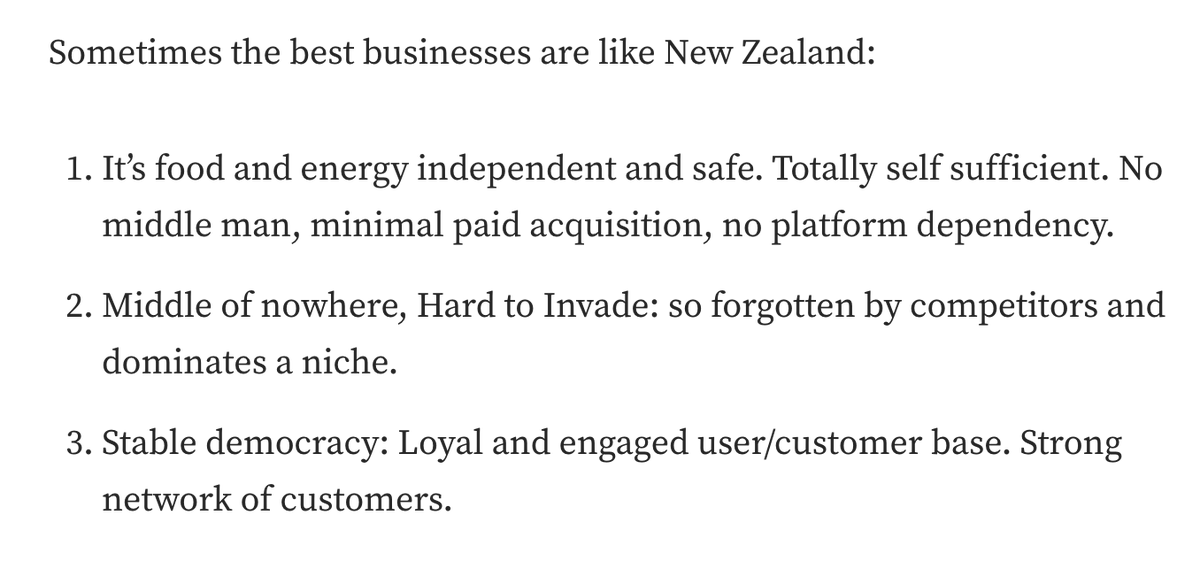
sometimes the best internet businesses are a lot like new zealand.
quiet. independent. protected by oceans of moats. valuable to the right people. zero interest in world domination.
a really cool concept i learned from @awilkinson
The reason I’m insanely bullish on AI is that since starting Box, we have never seen a bigger shift in how we can work with our enterprise information than today.
AI completely revolutionizes how we can work with enterprise information. Since the mainframe era, it’s been relatively trivial to work with our *structured* data in an enterprise. We could query, compute, synthesize, summarize, and analyze anything that could be structured in a database - i.e. the data sitting in our ERP, CRM, and HR systems.
But it turns out this is only a small fraction of our corporate information. If you were to “weigh” the amount of data inside of an enterprise (in the form of raw storage), roughly 10% of it would be structured data, and 90% of it would be unstructured data. And our content — things like our documents, contracts, product specs, financial records, marketing assets and videos — makes up the vast majority of this corporate data. Yet for essentially the entire history of computing, we haven’t *really* been able to make sense of this information unless a human is involved. Of course we can store it, send it, share it, and search for it — but deeply understanding what’s inside this information in a way that computers can interact with intelligently has been near-impossible.
Well, for the first time ever, generative AI actually lets us talk to our unstructured data. Multimodal models especially allow us to process this content using a computer and essentially perform any task that a human can, but at infinite scale and speed. This is utterly game-changing when working with information in the enterprise.
Instantly, our content goes from being digital artifacts that get touched once in a while, to a digital memory that anyone in the enterprise can tap into always. All of a sudden instead of the more information you have making things harder to find and make sense of, the opposite becomes true. And we enter a world where your digital information becomes one of your most valuable resources.
When we can turn our content into valuable knowledge, everything about how we work changes. A new employee instantly has access to the same expertise of someone who’s worked at a company for 15 years; when you can understand what’s inside of content — like contracts, invoices, or digital assets— and extract its structured data, you can automate nearly any workflow; and AI can let us classify and protect content with a level of precision that’s never been possible before to prevent threats and risks across the enterprise.
This is simply the biggest change we’ve ever seen with how we can work with our data, and this is what we’re building with Box AI.
In 1945, Vannevar Bush wrote a seminal article which outlined eerily insightful predictions, including the idea of the “Memex”, a new device “in which an individual stores all his books, records, and communications, and which is mechanized so that it may be consulted with exceeding speed and flexibility. It is an enlarged intimate supplement to his memory.”
The vision laid out imagined a future where the more knowledge and information your “computer” had, the smarter and more informed you would become. While many aspects of PCs, mobile devices, and the cloud eventually resembled this early vision, the seamlessness in how we could work with our information never quite played out.
Until today.
In his last 2 speeches, Vladimir Putin has told the world exactly why he invaded Ukraine and what he wants.
Here it is broken down in a 20 min podcast.
https://t.co/XbPszOBdVj?
Panic led to lockdowns. Lockdowns led to fiscal stimulus. Stimulus led to inflation. Inflation led to monetary tightening. Tightening leads to recession.
The panic wasn’t free - and the bill is coming due.
nothing would have stopped putin from invading bc ukraine is and will always be a critical strategic asset for russia — oil, food, the black sea, and a wide open front. ‘western meddling’ is just cover for your actual point which is you’re rooting for russia. just say that and go
I've thought of Covid mostly as a temporary interruption of life. But when I look back at pictures from the fall of 2019, my sons look like babies. Like it or not, this was a big chunk of their childhood.
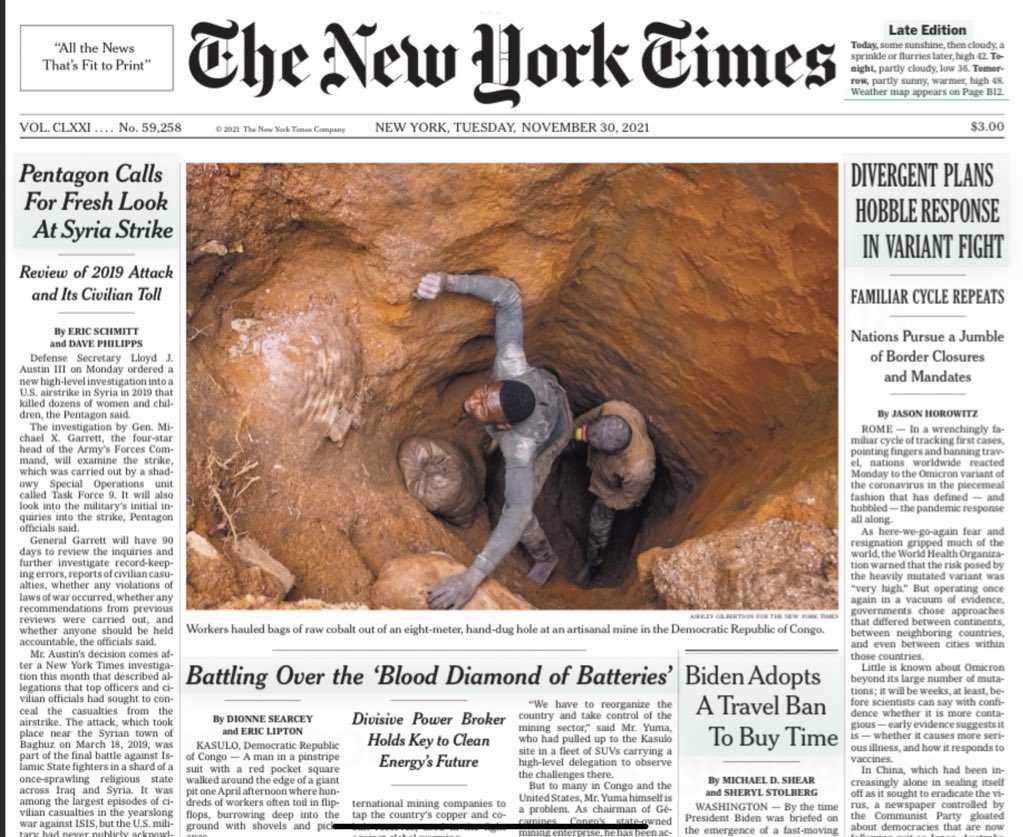
Thank goodness we’ve AVERTED ourselves away from dirty coal with all that unnecessary human suffering in mines so that we can—AVERT our eyes from new realities.
“Cleanse yourself with purity + that clean, clean EV energy…
…Accelerate y̶o̶u̶r̶ ̶ HUMANITY’S future TODAY!”
We should care as much about well-doing as well-being.
I want to live in a world that values purpose as much as pleasure, contribution as much as contentment, honesty as much as excitement, and justice as much as joy.
A happy life isn't necessarily an honorable life.
Most people f*ck up meetings.
We spend ~12 hours/wk in them.
We spend 3 years of our career in them.
Yet we don't do anything to make meetings better.
Here are 6 ways to fix them today 🧵
Today is the third day of profoundly stupid media coverage around the demise of the Trump blog. How should we assess Trump in this moment and specifically how do we gauge his relative power and influence? Some have posited that Trump’s loss, social media bans, and inability
@nikitabier Who gives a shit. Life is to be lived not measured to someone else’s idea of ‘when will I have enough for this to be ok’. Many many people spend their lives waiting to live only to find they have run out of runway