Founder and CEO, O'Reilly Media. Watching the alpha geeks, sharing their stories, helping the future unfold. Didn't pay for a blue check, cannot make it go away
I’m chatting live with @harper Reed tomorrow at 9 am PT if any of you are interested. It’s a text based Q&A; only Harper and I will be live, but would love to channel your questions. If you can’t join, ask them here and I’ll lob the best of them at him. https://t.co/IfMGlJQq0U
@VisualCap@VoronoiApp This visualization is clearly wrong in identifying Texas as the most forested state by area. Alaska is 2 and 1/2 times the size of Texas, so if it is 37% forested, it has more forest by area than the entire state of Texas, let alone 38% of Texas.
This is so true. And so obvious when you think about it. If AI were going to roll everything from scratch where does it stop? Does it write new programming languages and compilers? New operating systems? New firmware from scratch? Obviously, there are some things that you want to reinvent but mostly new technology lets you innovate further up the stack, solving problems that were either impossible or too expensive with the previous technology. It's not a new mistake. Netscape lost to Microsoft because they imagined that the web would become a new operating system. Google won because they went forward into new uncharted territory. The same is going to be true with AI
This is so true. What people fail to realize is that when new technology tools become available, they tend to be used to create new capabilities up the stack, while down the stack, archaeological layers of technology remain.
Token costs are why there will be no saas apocalypse / good dev tools are cached intelligence for agents!
The popular theory goes: agents can write code, so they'll just rebuild every tool from scratch and hit raw APIs. no more dev tools, no more CLIs, no more software layers. just agents and endpoints!
We just tested this and the data says the opposite. We benchmarked Claude Code and Codex on real Hugging Face Hub tasks (~1,000 graded runs), with two setups: the agent-optimized hf CLI vs the agent hand-rolling curl or SDK calls from scratch.
Hand-rolling burns up to 6x more tokens on multi-step tasks and fails more often (84% vs 94% task success).
And that's just dropping one abstraction layer. It would obviously be orders of magnitude more tokens and a dramatically higher failure rate if the agent tried to bypass HF altogether and rebuild model hosting, versioning, and distribution from scratch. Every time an agent re-derives a workflow from raw API calls, you pay for that reasoning in tokens. every single run. a good CLI compresses that entire chain into a few high-level commands the agent can't get wrong.
In a world where everyone is complaining tokens are too expensive, abstraction is leverage: thousands of hours of design decisions your agent doesn't have to re-reason about at inference time.
Good tools are cached intelligence for agents!
So no, agents won't rebuild everything from scratch. they'll gravitate to the most token-efficient tools, because that's what their owners pay for. The software that survives won't just be accessible to agents, it will be accurate and cheap for them to drive.
We're seeing it happen with HF, which is becoming the platform for agents to use AI: ~49M requests in just two months, and growing fast!
https://t.co/Y7q6yuxZrZ
This monthly feature from Mike Loukides at O'Reilly is getting better and better. It's a great way to keep up with the rapid pace of innovation in AI and software development. Capsule takeaways and links to the most important news.
https://t.co/jGxZMY3lde
Some ways my thinking has evolved recently:
1. I'm less concerned about those who are incurious about AI as I expect them to eventually see the value and impacts over time, and I think the 'wake up sheeple' vibe is often counterproductive. On the other hand I'm more concerned by what seems to be neither full 'AI psychosis' nor exactly Eliza effect, but some weird in-between. Also a lot of affirmation by models can probably warp one's sense of epistemic humility and lead to some sort of pathological over-trust.
2. Relatedly, I'm more annoyed at the 'this time it's totally different' vibe that a lot of people adopt as it frequently mimics Schmittian 'state of exception' logic and excuses all sorts of undesirable policies and rhetoric. It's also often just a group signalling exercise. To be clear I do think it's different in important ways, but "this is a marathon, not a sprint" seems closer to the right attitude than either "nothing has changed" or "all normal reasoning and empirical work to date is suspended".
3. I think the field is still fundamentally too 'singletonian' in how it imagines intelligence, markets, and governance - but I also think I've occasionally over-emphasized the 'multi-agent'/decentralization frames. I do think the future includes many models of all sizes and types, but also economies of scale and very large corporations too. I find the whole ecology more interesting than just the frontier model. A top down single 'perfect mind/personality', intended to work across all commercial contexts, seems both inflexible and inefficient.
4. I'm more interested in the harnesses, software, agent architectures, and stuff like RLMs than I was before. I feel like a lot of weaknesses that models have, or behavioural tendencies, can be addressed more effectively through that layer (rather than through model 'internal virtue' alone). For example stuff like: https://t.co/MHG4onCbDo and https://t.co/8ibuxKYFrA
5. I think some researchers are too quick to want to defer highly consequential decision-making to models, or to think of alignment as the models internalizing "I'm afraid I can't do this, Dave" as a core protection against all sorts of ills. I think we should think carefully about *actively* creating principal-agent problems with agents that will permeate society. Delegation is not a free lunch.
6. I'm concerned about how few people think about LMICs and building the technical/institutional infrastructure there for AGI diffusion. We need fewer vague essays about “distributing the benefits of AI” and more work on reducing barriers to trade, improving state capacity, rebuilding development institutions, and making something like USAID/IMF-for-the-AGI-era actually work.
7. I used to be slightly more sympathetic to the idea, directionally - but I now think the 'permanent underclass' meme is a bit dumb. The strongest versions often assume a zero-sum view of technology and labour, a too-static view of human adaptation, a weirdly fixed mapping between today’s skills and tomorrow’s opportunities, and ignore the possibility of catch-up growth (at the nation state level). Also, as a meme among extremely rich and mobile people, it has a slightly comic self-pitying quality.
8. I'm more concerned about the lack of intellectual diversity within the frontier AI commentariat/research world. This improved a lot over the last two years, but we're still far from a healthy ecosystem. New outsiders often feel some unnecessary pressure to 'choose a camp'. Many are too unwilling to engage with domain experts merely because they're insufficiently AI-pilled (though conversely, a lot of academic groups suffer from heavy status quo bias).
Good perspective on the barriers that libraries often put up to customers actually consuming their product. When late fees are eliminated, people actually return more books, and more people get library cards. https://t.co/EjnFEclfaf
Tomorrow morning at 9 am Pacific time, I'll be going live with @DJ44 to talk about how to build corporate data infrastructure that will allow AI agents to achieve their full potential. https://t.co/wbPpQRYIzw
I wrote this post (The Collaborative Exoskeleton of AI Science) a month or so ago and then forgot to publish it! It’s where I build on my “missing mechanisms of the agentic economy” theme and apply it to the infrastructure of AI for science. Would love to know what real working scientists think about this. I hope the AI companies working on science think about it too ;-) https://t.co/yS052njG8c
This suggests that if regulators are serious about AI enshittification, they would exploring what disclosures might be appropriate for the contents of the system prompt.
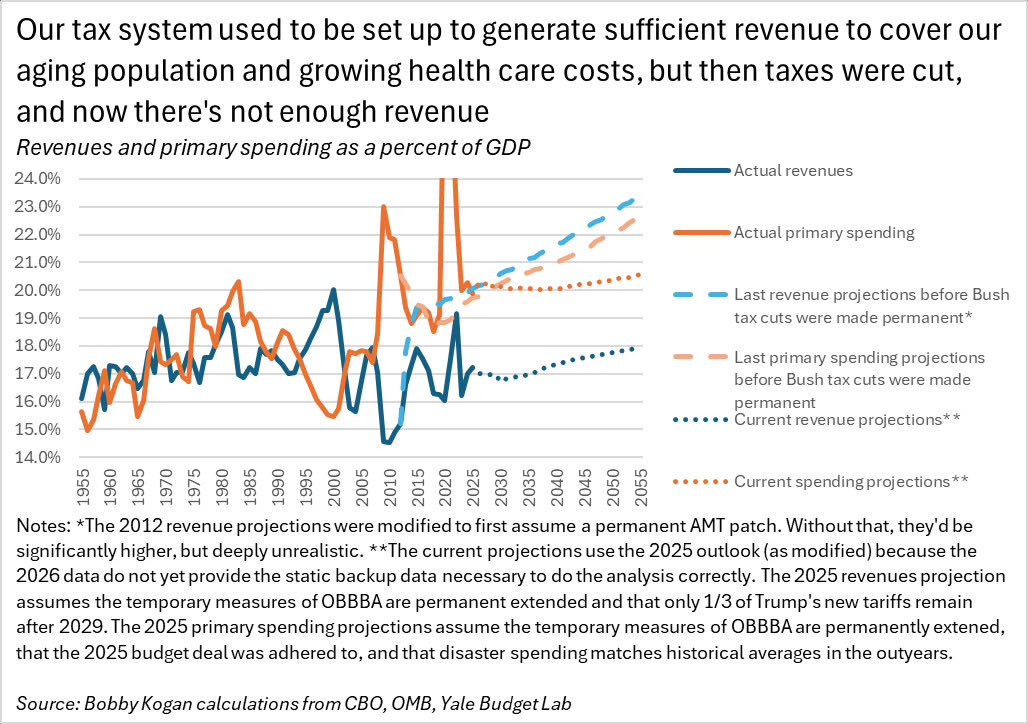
Your perennial reminder that, had the Bush and Trump tax cuts never been enacted, debt/GDP would be declining indefinitely instead of rising (dashed blue is above dashed orange).
Yes, this graph first assumes a patched AMT at Clinton tax code.
"Load bearing," "I keep coming back to," "Not X, but Y"
A curse of using AI a lot is that you realize how much of the writing around you is just AI, now
People who don't use AI have been unable to identify AI prose on sight, but those who use it a lot can spot the tells easily
"Load bearing," "I keep coming back to," "Not X, but Y"
A curse of using AI a lot is that you realize how much of the writing around you is just AI, now
People who don't use AI have been unable to identify AI prose on sight, but those who use it a lot can spot the tells easily
What Happens When a Globalized World Collapses: Archaeologist Eric Cline Explains How Bronze Age Civilizations Adapted, Survived or Vanished | Open Culture. (Hint: My historian friend says it all depends on the quality of the rulers. If so we are screwed.) https://t.co/ARYhhEqcis
Super interesting data point from Korea on the kinds of arguments about who gets to share the value of the AI boom. It makes clear the tension between employees and shareholder value, and also that profits are showing up in places that are very far from the ones with overheated stock market valuations.
https://t.co/Ypecb33A37