Founder and CEO, O'Reilly Media. Watching the alpha geeks, sharing their stories, helping the future unfold. Didn't pay for a blue check, cannot make it go away
Some ways my thinking has evolved recently:
1. I'm less concerned about those who are incurious about AI as I expect them to eventually see the value and impacts over time, and I think the 'wake up sheeple' vibe is often counterproductive. On the other hand I'm more concerned by what seems to be neither full 'AI psychosis' nor exactly Eliza effect, but some weird in-between. Also a lot of affirmation by models can probably warp one's sense of epistemic humility and lead to some sort of pathological over-trust.
2. Relatedly, I'm more annoyed at the 'this time it's totally different' vibe that a lot of people adopt as it frequently mimics Schmittian 'state of exception' logic and excuses all sorts of undesirable policies and rhetoric. It's also often just a group signalling exercise. To be clear I do think it's different in important ways, but "this is a marathon, not a sprint" seems closer to the right attitude than either "nothing has changed" or "all normal reasoning and empirical work to date is suspended".
3. I think the field is still fundamentally too 'singletonian' in how it imagines intelligence, markets, and governance - but I also think I've occasionally over-emphasized the 'multi-agent'/decentralization frames. I do think the future includes many models of all sizes and types, but also economies of scale and very large corporations too. I find the whole ecology more interesting than just the frontier model. A top down single 'perfect mind/personality', intended to work across all commercial contexts, seems both inflexible and inefficient.
4. I'm more interested in the harnesses, software, agent architectures, and stuff like RLMs than I was before. I feel like a lot of weaknesses that models have, or behavioural tendencies, can be addressed more effectively through that layer (rather than through model 'internal virtue' alone). For example stuff like: https://t.co/MHG4onCbDo and https://t.co/8ibuxKYFrA
5. I think some researchers are too quick to want to defer highly consequential decision-making to models, or to think of alignment as the models internalizing "I'm afraid I can't do this, Dave" as a core protection against all sorts of ills. I think we should think carefully about *actively* creating principal-agent problems with agents that will permeate society. Delegation is not a free lunch.
6. I'm concerned about how few people think about LMICs and building the technical/institutional infrastructure there for AGI diffusion. We need fewer vague essays about “distributing the benefits of AI” and more work on reducing barriers to trade, improving state capacity, rebuilding development institutions, and making something like USAID/IMF-for-the-AGI-era actually work.
7. I used to be slightly more sympathetic to the idea, directionally - but I now think the 'permanent underclass' meme is a bit dumb. The strongest versions often assume a zero-sum view of technology and labour, a too-static view of human adaptation, a weirdly fixed mapping between today’s skills and tomorrow’s opportunities, and ignore the possibility of catch-up growth (at the nation state level). Also, as a meme among extremely rich and mobile people, it has a slightly comic self-pitying quality.
8. I'm more concerned about the lack of intellectual diversity within the frontier AI commentariat/research world. This improved a lot over the last two years, but we're still far from a healthy ecosystem. New outsiders often feel some unnecessary pressure to 'choose a camp'. Many are too unwilling to engage with domain experts merely because they're insufficiently AI-pilled (though conversely, a lot of academic groups suffer from heavy status quo bias).
Good perspective on the barriers that libraries often put up to customers actually consuming their product. When late fees are eliminated, people actually return more books, and more people get library cards. https://t.co/EjnFEclfaf
Tomorrow morning at 9 am Pacific time, I'll be going live with @DJ44 to talk about how to build corporate data infrastructure that will allow AI agents to achieve their full potential. https://t.co/wbPpQRYIzw
I wrote this post (The Collaborative Exoskeleton of AI Science) a month or so ago and then forgot to publish it! It’s where I build on my “missing mechanisms of the agentic economy” theme and apply it to the infrastructure of AI for science. Would love to know what real working scientists think about this. I hope the AI companies working on science think about it too ;-) https://t.co/yS052njG8c
This suggests that if regulators are serious about AI enshittification, they would exploring what disclosures might be appropriate for the contents of the system prompt.
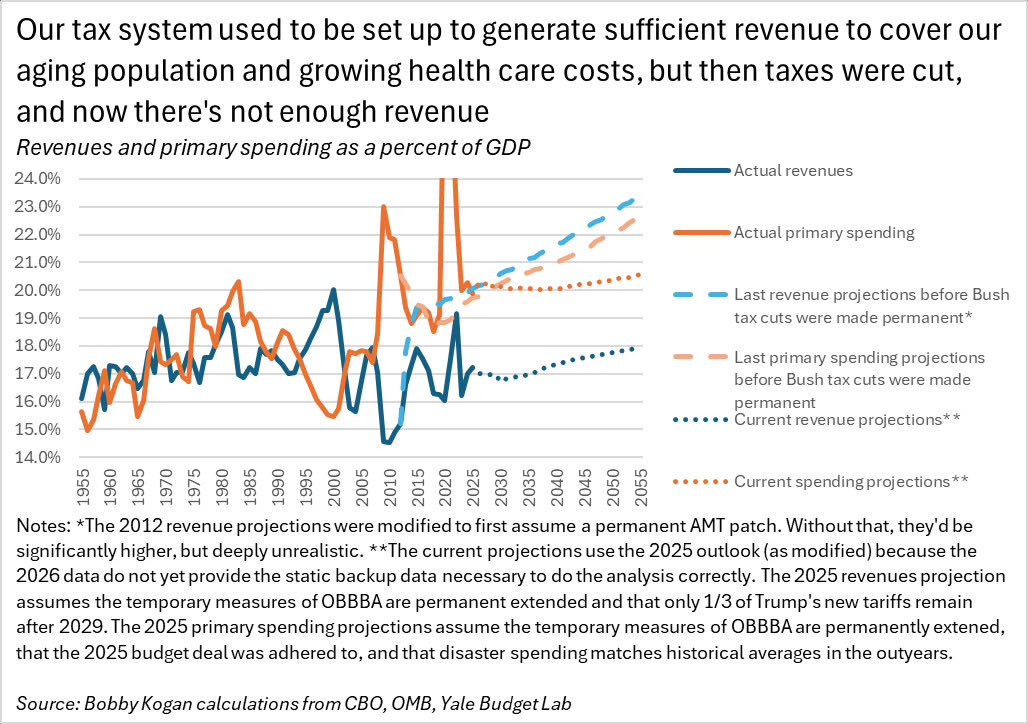
Your perennial reminder that, had the Bush and Trump tax cuts never been enacted, debt/GDP would be declining indefinitely instead of rising (dashed blue is above dashed orange).
Yes, this graph first assumes a patched AMT at Clinton tax code.
"Load bearing," "I keep coming back to," "Not X, but Y"
A curse of using AI a lot is that you realize how much of the writing around you is just AI, now
People who don't use AI have been unable to identify AI prose on sight, but those who use it a lot can spot the tells easily
"Load bearing," "I keep coming back to," "Not X, but Y"
A curse of using AI a lot is that you realize how much of the writing around you is just AI, now
People who don't use AI have been unable to identify AI prose on sight, but those who use it a lot can spot the tells easily
What Happens When a Globalized World Collapses: Archaeologist Eric Cline Explains How Bronze Age Civilizations Adapted, Survived or Vanished | Open Culture. (Hint: My historian friend says it all depends on the quality of the rulers. If so we are screwed.) https://t.co/ARYhhEqcis
Super interesting data point from Korea on the kinds of arguments about who gets to share the value of the AI boom. It makes clear the tension between employees and shareholder value, and also that profits are showing up in places that are very far from the ones with overheated stock market valuations.
https://t.co/Ypecb33A37
This is exceedingly obvious but for some reason there is a subset—some of them quite high-IQ—who cannot see this basic reality about the world. It’s a bizarre thing.
The greatest problem in healthcare ? Hospitals, even market dominant hospitals, won’t walk away from the big ins companies that underpay, late pay, clawback, deny claims, waste their time in denial appeals, and require them to pay up to 8 pct of revenue to RCM consultants so they think they are getting what they are owed.
Here is the crazy part. The ins companies ARE NOT THE ONES ACTUALLY PAYING THEM on commercial plans. Employers are.
60 pct of employees get their insurance from their self insured employers. The ins carrier is just a middleman that pretends to add value.
All the clinical “value” they add, the hospital could do better, for both medical and pharmacy.
Most hospitals have no idea whether they make or lose money with their big ins contracts. They are just afraid to lose patient flow.
But. They actually know which companies their patients are coming from. They actually know or can find out, how much more the employers are paying the ins company, than what the ins company pays them (the spread, just like in pharmacy )
And to make it worse, those ins companies negotiate their rates as a discount from the “charge master “, which is like WAC in pharmacy. Just a made up list price.
Because the hospitals are afraid or too uninformed to walk away from these deals, the hospitals use the inflated charge master prices as the basis to charge uninsured , or out of network , or insured but not covered for their care, at charge master rates. Which of course the patients can’t afford. And it crushes their finances or they go without care
I’ll summarize. Employers , and their members , are paying far more than they should to companies they don’t like working with , that effectively rip off both the employer and hospital , and they could eliminate the middlemen if they went directly to to the employer.
It’s so simple. Sell your services to the employers that use your services at a price that is less than what nine companies charge for your services and you will make MORE money and employers will save a ton
And if they did this, they could dump the chargemaster and reduce the price they bill patients when they are at their most vulnerable
But they don’t want to change. And don’t get me started on how much hospitals over pay for drugs and devices because of the GPO deals they do. It’s just stupid.
Which in turn leads to the hospital being a bad actor with 340b , facilities fees and afraid of their doctors who demand they pay more for things like glue and implants so they can get vacations.
If you are a politician and reading this. Now you know why this is so fucked up and it’s not about capping rates. The insurance companies are smarter than you. They will just move the money to other places. It’s not about giving money to patients. You can’t shop for care from hospitals that are too gutless to walk away from the ins companies that distort all of healthcare economics
Go to your local hospitals , particularly those at risk of closing and ask for their profitability by carrier. Fully burdened. Ask how much they spend on RCM and consultants. In many cases they could survive if they ran like a real business and hired execs that could do the work rather than just manage consultants. They could work out contracts in their communities rather than with ins companies and benefit everyone.
The middlemen are not needed. Get rid of them
OVERRATED: running tons of agents in parallel; working on too many things at once; perpetual context-switching; opening lots of low-quality PRs that may never land.
UNDERRATED: using one or two agents at a time; focusing on the task in front of you; thinking deeply; finishing stuff; making your code works in prod.
Dario is wrong.
He knows absolutely nothing about the effects of technological revolutions on the labor market.
Don't listen to him, Sam, Yoshua, Geoff, or me on this topic.
Listen to economists who have spent their career studying this, like @Ph_Aghion , @erikbryn , @DAcemogluMIT , @amcafee , @davidautor
What gets missed with AI productivity gains is that by and large, most roles will continue to be as sophisticated as the tools allow.
This is why also thinking through “today’s jobs will be replaced with AI” is a fallacy. Everyone thinks the market is static, but it’s not.
As a result of everyone having access to the same technology which augments our work, then users of the tools will increasingly raise their level of output to the point where the prior definition of the job is no longer relevant. Thus, those that understand their particular field and grow in their skills will continue to be differentiated vs. others.
If you can do far more, then you start to tackle bigger and harder problems. If you do that, then the expertise still is required to get the job done fully.
The engineer with AI is going to be far more productive and capable with AI than the non-engineer trying to build the same piece of software. Building a lightweight app is no longer the definition of getting by in software development. Reviewing a contract will no longer be the definition of a paralegal. Splicing a video won’t be the definition of a video editor. Providing basic financial research won��t be the job of the financial analyst in the future.
Simply put, AI will naturally cause most roles to actually grow in complexity rather than reduce in complexity, because we can do far more with the tools.