50 years ago American racehorses averaged ~30 career starts; the number today is 16. The breed to sell paradigm has greatly de-emphasized the value of durability.
Of course commercial breeders attempt to avoid producing notably crooked foals, but there is no possibility that mares are being matched as carefully today as they were back then.
Also, consider that surgical corrections are far more prevalent today, which is likely to distort even on-the-ground assessments.
‡
Stallion Marketing Angles
When a house is publicly listed for sale, the most flattering images possible are, for understandable reasons, typically produced and displayed. No seller would choose to emphasize mold on a wall, peeling paint, or a poor view through a window, etc. It's common sense, and is also one of the reason why it would be so risky to purchase something expensive without a personal inspection.
The same is true of racehorses or stallions, as those marketing them will always attempt to show them to their best advantages. But the difference is that it is far more difficult to hide flaws in horses than in houses, so rather than completely omitting an image that could reveal a flaw, the most effective approaches require nuance.
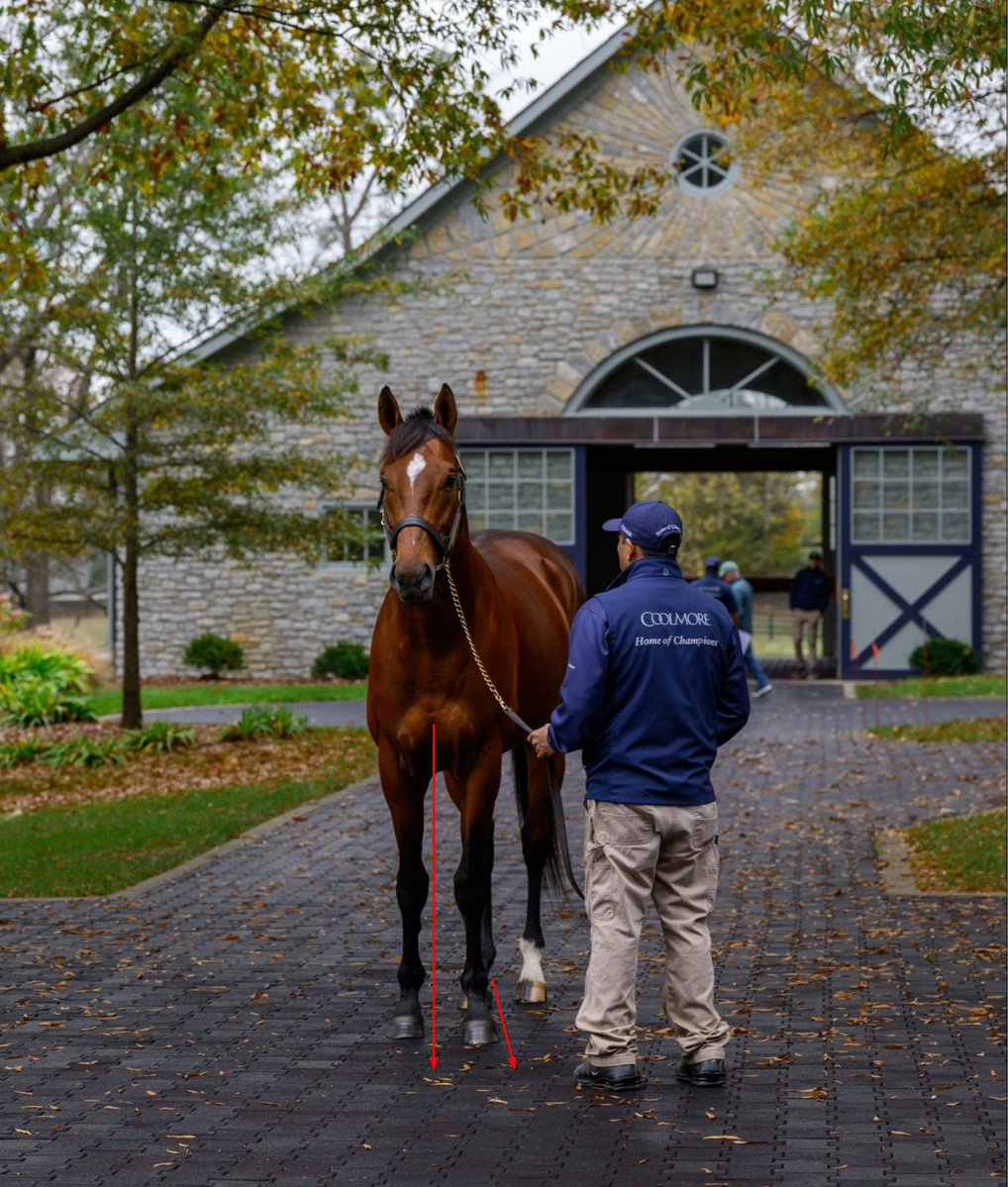
Along those lines, I give Ashford Stud (Coolmore America) credit for how they have attempted to manage perception in the first attached image. The horse is the recently retired stallion prospect Journalism, and the photo will likely appear pleasing to most at first, or even second glance. An attractive colt standing in a lovely setting, appearing healthy and alert, yet relaxed at the same time (note the slack in the lead shank). The pretty white star and near-hind "sock" balance nicely, and the blue Coolmore jacket worn by his handler provides contrast without distracting too much from the star of the show.
What immediately caught my eye, though, and no doubt those of others who have bought and sold horses professionally, is that the photographer is not standing head-on to the horse, but at a slight angle. And for good reasons.
It is more interesting and attractive to be able to see some of the horse's body, and less technical than a strictly head-on view. But what is particularly interesting about the choice is that the angle chosen produces the relatively subtle effect of making the colt appear more correct through his forelegs than he is in reality.
If you look at his legs from the (front) ankles down, and focus on the near-fore (right while viewing), you will be able to see, as highlighted in the second attached image, that he "turns out" noticeably. I've superimposed a plumb-line from his sternum down to the ground. That straight reference helps to highlight the flaw. But of course a direct head-on view would reveal an even more pronounced distortion, and Coolmore cleverly had the photographer stand at an angle that alters the perception, and helps to conceal the full extent of it.
The angle used also impacts the viewer's perception of another important aspect of horse conformation. It almost makes the colt appear as though he has only three legs, as his near-fore and off-hind overlap (see the third image). And because of that merging, which is accentuated due to the lighting, it is very difficult to judge with confidence whether or not his (poorly defined) near-fore knee is offset. I don't know whether it is, but if so (most likely to the inside), the angle chosen has the effect of masking the flaw.
What Coolmore has done with the subject image is in essence quite common. But the manner in which they have displayed an imperfect product, obscured its main flaw(s), and made it appear so natural, is unusually clever.
Setting aside your ignorant ad hominem attacks, Coolmore does occasionally produce head-on images of stallions.
The three* that I have attached are static images posted by them on official accounts. Yes, the stallions were walking rather than standing, but would they ever feature stallions that are offset, or turn-out notably in such images, unless they were able to mask the faults?
That's a rhetorical question, as just like the subject image, they were carefully chosen and composed in order to show them off to their best advantages.
* Little Big Bear,Order Of St George, So You Think
"lambasting"?
Ironically, what I described about the image, and the thought process that likely led to it, is almost certainly more accurate than your characterization of my post.
If my interpretations were off-base, and the horse's near-fore is correct, all that you would need to do is to provide a head-on shot to illustrate the point.
@PauloDoCarmo Thank you. I would broadly agree, though I certainly wouldn't be eager to breed a mare with a similar fault to him.
Offset knees do occasionally breed through with some regularity (see: Storm Cat).
@Luckismyfriend Yes, it is possible to mitigate such flaws, but it sure happens less frequently these days, and for damning (i.e. breed to sell) reasons.