In a newly published article in The Journal of Legislative Studies, I develop a novel account of national human rights institutions as emerging actors in strengthening the human rights compliance, quality, legitimacy, and accountability of law-making.
https://t.co/a1GQ1Z2NPA
🚨Call for Papers: African Solutions Journal (Volume 7, Issue 2)
The African Solutions Journal invites scholars and researchers to submit original manuscripts for the 2nd issue of its 7th Volume. We seek critical analyses focused on security studies, international and regional structures, and African peace operations.
This issue prioritizes research that examines emerging security challenges and highlight unique, African-led responses. Submissions should aim to address existing literature gaps, provide clear discussion of materials, and conclude with actionable policy implications.
📍Application deadline: 19th July, 2026
Follow the link for application guidelines and further information 👉🔗 https://t.co/fDVaS1HGW8
The rule of law that we all need to exist as a strong people is on its knees in Uganda. It is at the centre of the political economy and without it, our institutions cannot function well. Uganda is for us all but on many days it doesn’t feel like it. Is this when as @ug_lawsociety we can put differences aside and commit towards speaking as one voice ? We could use an EGM.
Law Students,
In addition to the 35 Court of Appeal decisions shared on Friday, I have compiled more decisions sourced from @MyKenyaLaw , for your ease of reading and research.
https://t.co/bZ13xYPLaT
The Wits School of Law was pleased to host the Minister of Justice and Constitutional Development, Mmamoloko Kubayi, today for a visit with staff and students marking the 50th anniversary of the Soweto Uprising and the 30th anniversary of the adoption of the Constitution
Karl Popper’s, ‘Open Society and Its Enemies’ remains one of the most compelling defences of open discourse as a civilisational mechanism of error correction.
For Popper, Truth is never possessed in its entirety. It can only be understood through a logical process of criticism, disagreement, and the continual testing of ideas. A society that is capable of correcting its mistakes entirely depends upon the freedom to question prevailing assumptions and to expose falsehood through reasoned debate.
It is therefore entirely regrettable that one of the more insidious realities of our age is that certain individuals and institutions invoke the language of the open society while inverting its essential principles. Under the banner of tolerance, safety, equity or consensus, group-think, they have deliberately narrowed the range of permissible inquiry and badly damaged the very processes through which truth is discovered.
Popper understood that certainty is the enemy of progress. Indeed, a civilisation that loses its capacity for honest discourse loses its principal means of self-correction.
Once criticism is treated as heresy and dissent as a threat rather than a necessity, the foundations of the open society begin to crumble from within.
beg you to read Popper. To read @DavidDeutschOxf. To listen to and absorb the work of @ToKTeacher@naval@ConjectureInst and the many other great critical rationalists.
We ought to understand the great peril we face.
Nearly 37 years ago, in July 1989, Justice Norbury Dugdale delivered a ruling that still haunts Kenya’s constitutional history. He held that the Bill of Rights in the old Constitution was effectively inoperative because the chief justice had not made procedural rules for its enforcement. It was a strange and troubling judicial moment: the Constitution had created a right, but the Judiciary, the very custodian of that right, allowed absence of procedure to defeat its substance. https://t.co/7hGQJbiRlD
Mukile & 92 others v Independent Electoral and Boundaries Commission & 8 others (Petition E218 of 2025) [2026] KEHC 8248 (KLR) (Constitutional and Human Rights) (11 June 2026) (Judgment) - https://t.co/DfSqm8Ds99
The integrity of our courts are challenged everyday...and on sound and weighty grounds...yet no one has the guts or confidence to address these troubling incidents.
The Judge Bench Gachagua Judgement is finally here with us. Importantly it is 286 pages & not 350 as we heard. Just take your Time & Rigorously engage with the Decision to ensure we do not see POSITIONS that do not reflect what is in there. I have attached it here for your sake:
https://t.co/d3IOQWmq7V
The 3 compromised High Court judges who agreed Riggy G lacked a fair hearing at the Senate but still upheld the impeachment have now started monkey business. They said the ruling had 350 pages, but now, after being asked to release the judgment for appeal, 64 pages are missing and there are no signatures in the documents
We said earlier that those Kangaroo Judges were given a ChatGPT ruling by the state, and their work was just to read... They will not believe. They must provide the 350 page judgement fully signed by them
For years, the Auditor-General has exposed billions lost through financial mismanagement and irregular expenditure. Yet accountability remains elusive.
I have formally sought a statement in @Senate_KE on the effectiveness of the @EACCKenya in acting on these findings. Kenyans deserve answers, action, and justice, not endless audit reports gathering dust.
Public money must serve the people, not the corrupt.
#Accountability
📖 New publication: What if corruption is embedded in institutional design?⚖️
Our latest research examines corruption in Kenya through a feminist institutional lens and explores how sextortion becomes normalized within bureaucratic systems.
🔗 Read: https://t.co/Zm84LK522z
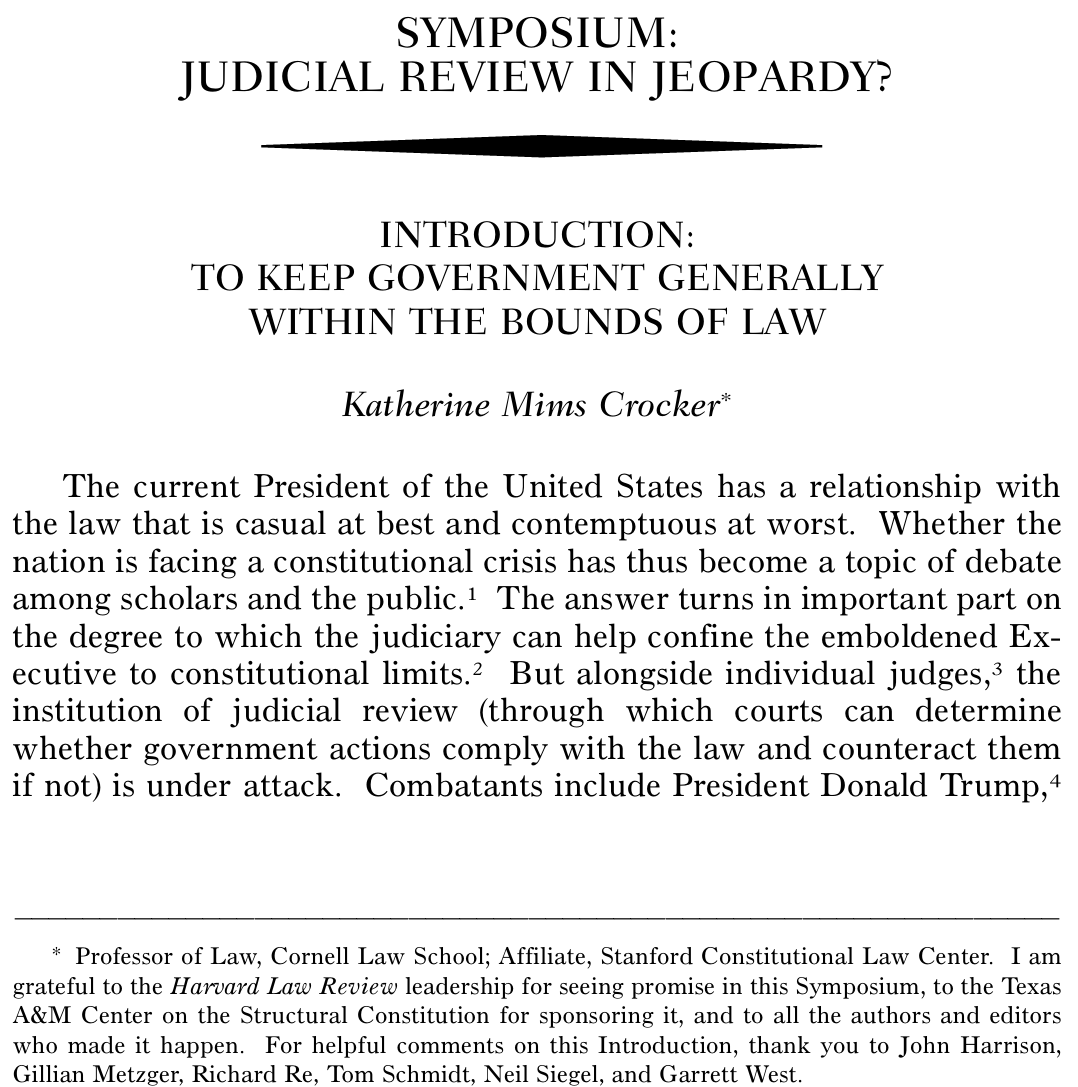
Just published! @HarvLRev's print symposium "Judicial Review in Jeopardy?"
It's been a highlight of my career to help lead this collaboration.
Here's the start of my intro, "To Keep Government Generally Within the Bounds of Law," an homage to Fallon. See the full issue🔗 below!
A powerful reminder from our latest report on the role of courts and lawyers in constitutional transition.
Women judges don't just fill seats, they shift conversations, shape reasoning, and bring lived experience into the courtroom.
🔗 Read the full report: https://t.co/8qFRQMtRmV
Katiba Institute Files Contempt of Court Application Over Secretive U.S. Ebola Facility, Condemns Continued Construction and Withholding of Documents:
We have filed an urgent contempt of court application at the High Court in Nairobi against the Kenyan government. The application addresses the blatant violation of existing conservatory and disclosure orders regarding the secretive U.S.-backed Ebola quarantine and treatment facility in Kenya.
Despite explicit court orders mandating the suspension of all plans to establish, operationalise, or approve the facility, construction and development have illegally continued. Furthermore, the authorities have defied court directives compelling the full disclosure of documents, agreements, and safety protocols regarding the facility to the public and the courts.
Read More via https://t.co/MMREraG9HR
.@NoraMbagathi .@joshuamalidzo
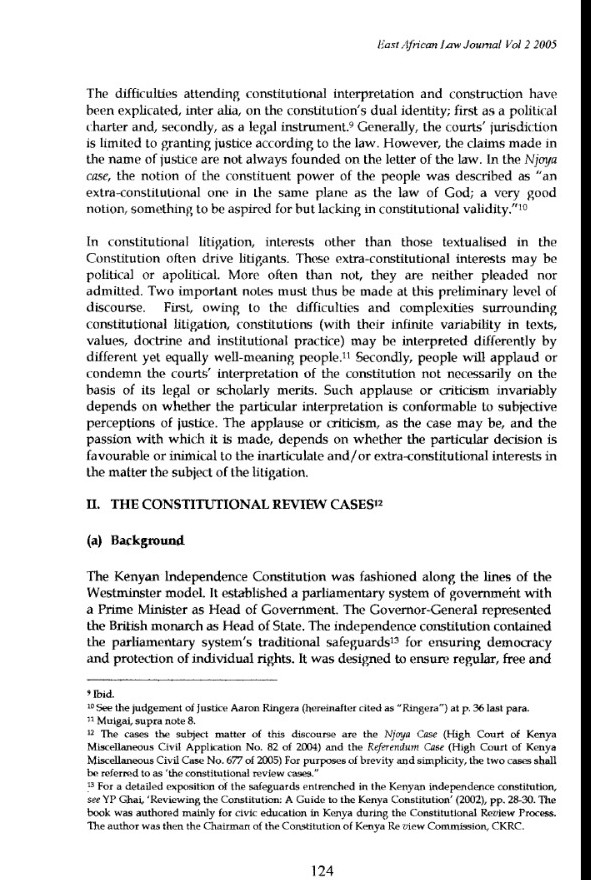
Owing to the difficulties and complexities surrounding constitutional litigation, constitutions (with their infinite variability in texts, values, doctrine and institutional practice) may be interpreted differently by different yet equally well-meaning people.