Chain-of-Agents
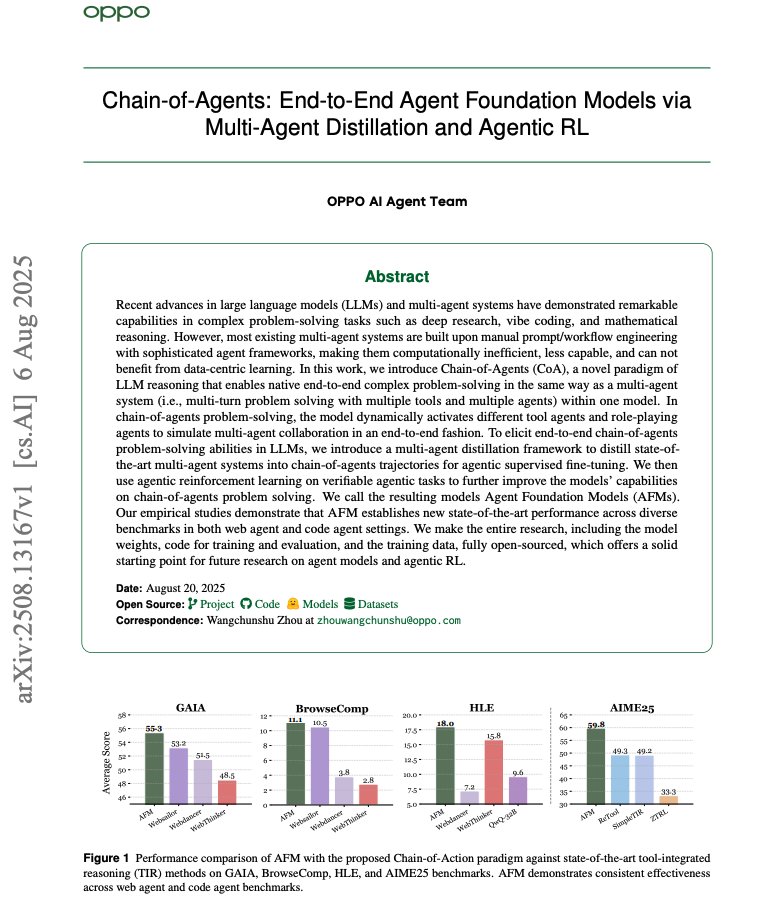
Interesting idea to train a single model with the capabilities of a multi-agent system.
84.6% reduction in inference cost!
Distillation and Agentic RL are no joke!
Here are my notes:
AI-PERSONA turns generic LLMs into personal assistants that evolve with user interactions.
The paper introduces a framework enabling LLMs to continuously learn and adapt to individual users through ongoing interactions, making AI assistants truly personalized.
-----
🤔 Original Problem:
Current LLMs lack the ability to understand and adapt to individual users' changing preferences and behaviors over time. Even with improved capabilities, they cannot effectively capture personal information needed for basic tasks like restaurant recommendations.
-----
🛠️ Solution in this Paper:
→ AI-PERSONA framework redefines user profiles as learnable dictionaries containing demographics, personality, usage patterns, and preferences
→ The system dynamically updates these profiles during user interactions without requiring model retraining
→ A Historical Session Manager stores conversation histories, while a Tool Executor handles API calls for real-world tasks
→ The Personalized Chatbot component generates responses based on evolving user profiles
-----
💡 Key Insights:
→ Updating persona every 3 conversations yields optimal results
→ More frequent updates don't necessarily improve performance
→ The framework achieves near-golden-persona performance without expensive model training
-----
📊 Results:
→ Achieves 8.29/10 in response helpfulness and 7.63/10 in personalization
→ Reduces required conversation turns by 37% compared to non-personalized baseline
→ Demonstrates consistent performance improvement across multiple LLM architectures
@DianboLiu Maybe nutrition is less efficient than electricity lol. We could verify the human brain scaling law when someday we could upload our consciousness.
ALLaVA: Harnessing GPT4V-synthesized Data for A Lite Vision-Language Model
Collects and open-sources the largest (4 mil) GPT-4V dataset for VLM training, which consists of fine-grained captions, complex instructions and detailed answers
https://t.co/cO4re0WYxx
AIWaves presents Weaver
Weaver is a family of foundation models for creative writing
Weaver Ultra surpasses GPT-4 on various writing scenarios, demonstrating the advantage of training specialized LLMs for writing purposes
https://t.co/hNC9DR5rE3
Weaver
Foundation Models for Creative Writing
paper page: https://t.co/LQunmRA35V
most-capable Weaver Ultra model surpasses GPT-4, a state-of-the-art generalist LLM, on various writing scenarios, demonstrating the advantage of training specialized LLMs for writing purposes.
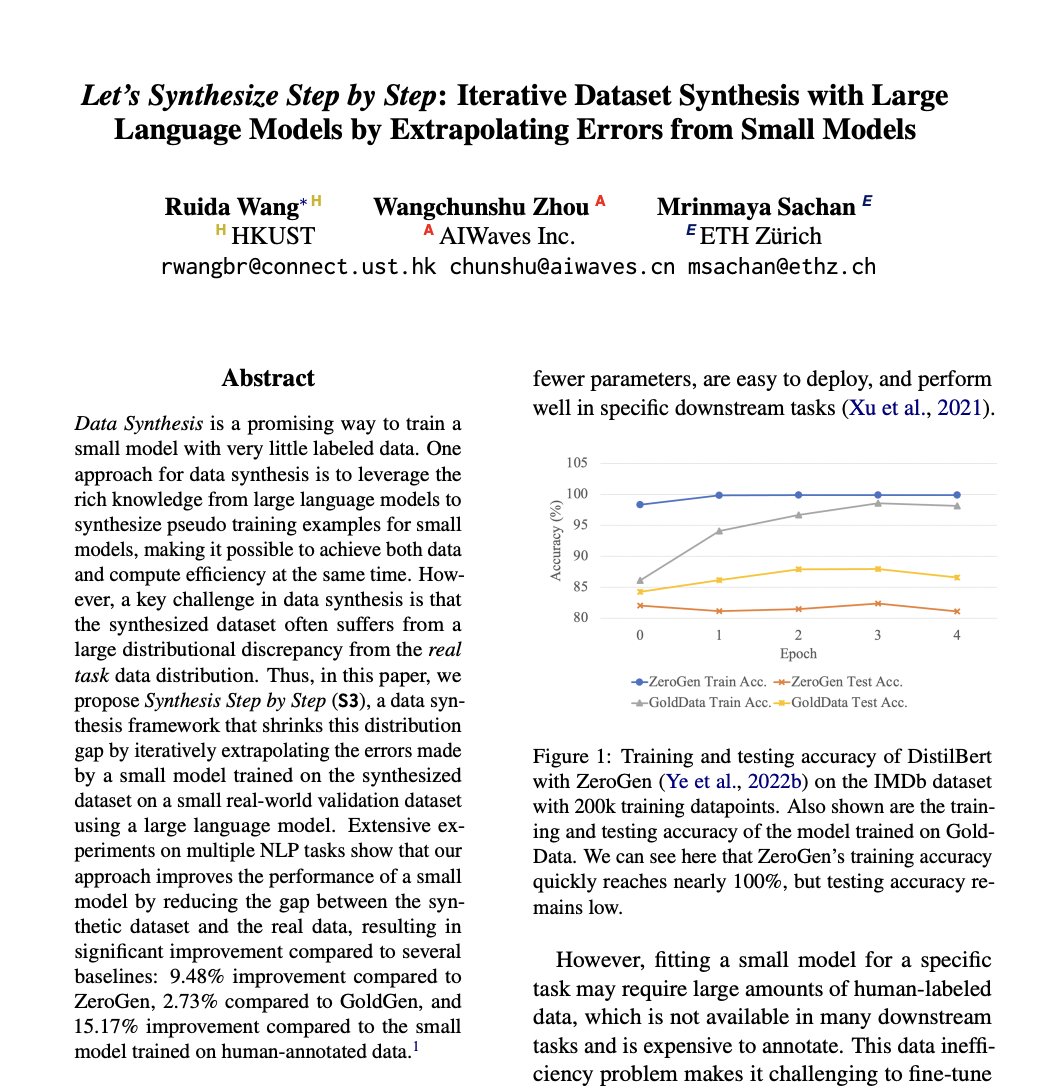
Let's Synthesize Step by Step: Iterative Dataset Synthesis with Large Language Models by Extrapolating Errors from Small Models
paper page: https://t.co/e5v70WJzKE
*Data Synthesis* is a promising way to train a small model with very little labeled data. One approach for data synthesis is to leverage the rich knowledge from large language models to synthesize pseudo training examples for small models, making it possible to achieve both data and compute efficiency at the same time. However, a key challenge in data synthesis is that the synthesized dataset often suffers from a large distributional discrepancy from the *real task* data distribution. Thus, in this paper, we propose *Synthesis Step by Step* (**S3**), a data synthesis framework that shrinks this distribution gap by iteratively extrapolating the errors made by a small model trained on the synthesized dataset on a small real-world validation dataset using a large language model. Extensive experiments on multiple NLP tasks show that our approach improves the performance of a small model by reducing the gap between the synthetic dataset and the real data, resulting in significant improvement compared to several baselines: 9.48% improvement compared to ZeroGen and 2.73% compared to GoldGen, and at most 15.17% improvement compared to the small model trained on human-annotated data.
I am diving into the LLM job market! 🚀
Actively seeking full-time industry jobs with my research on large foundation models.
Discover more about my work! ➡️https://t.co/fs3V2Z8Blx
#JobSearch#AIResearch#CareerOpportunities#OpenToWork
UPDATE:
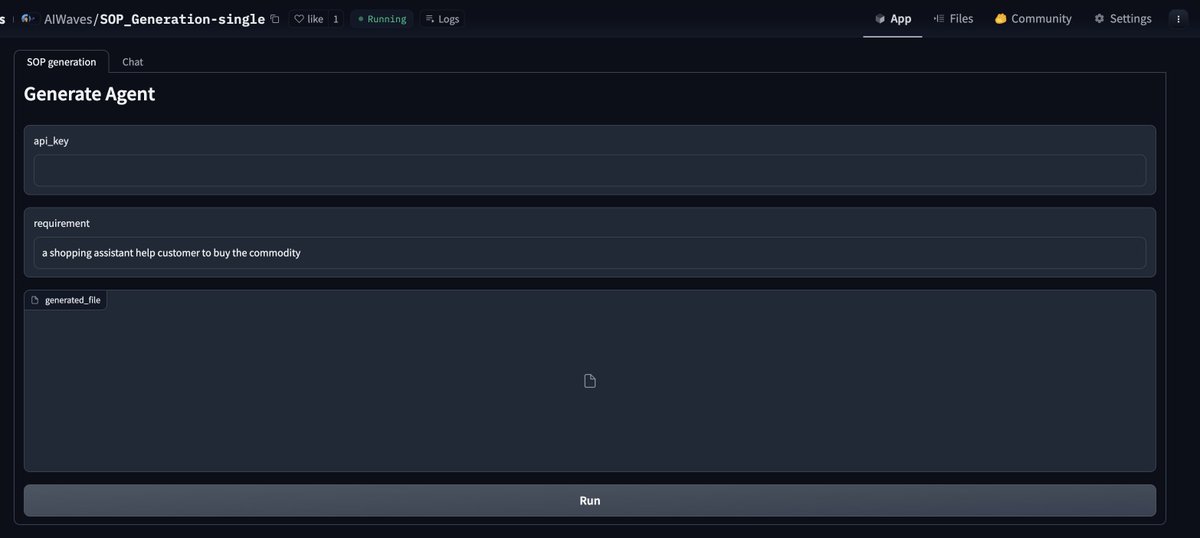
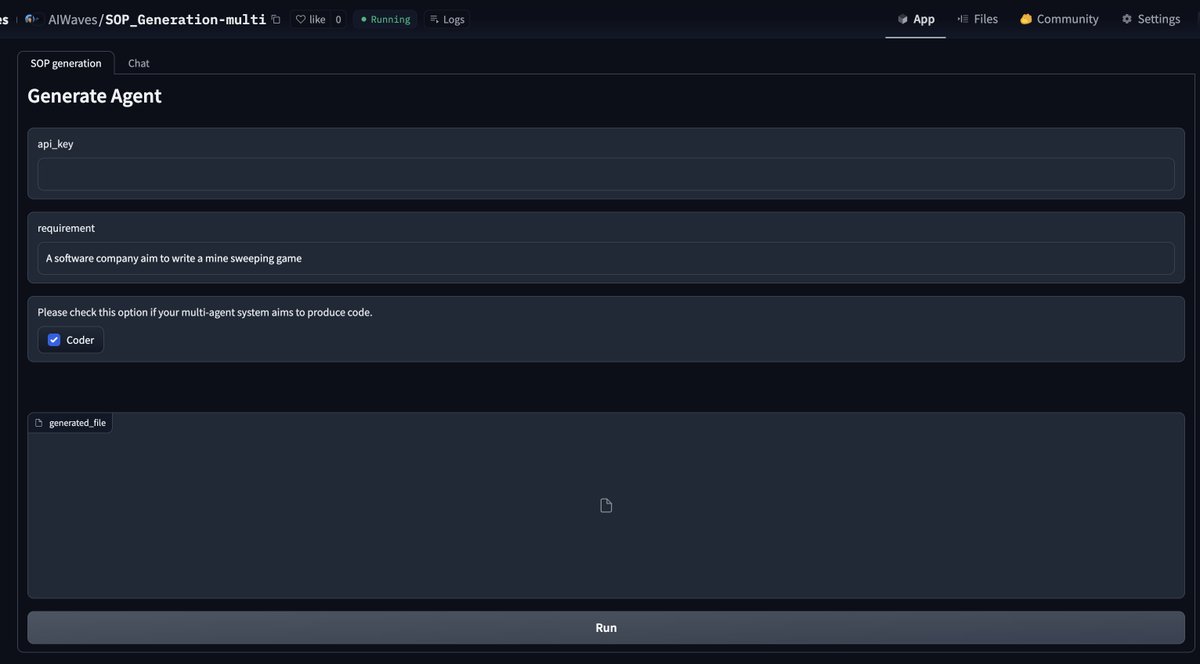
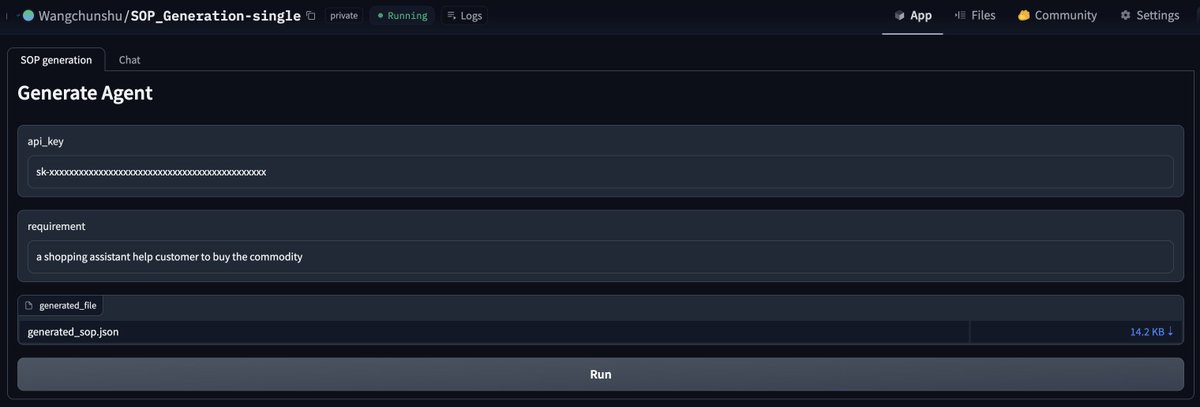
Our AIWaves Agents framework now supports automated generation of SOP (config file)!
A RAG-based"Meta" agent that follows an "agents creation" SOP is implemented and can produce a runnable config file for an agent system with only a short description!
Links Below!
here is dalle 3, which imo is quite amazing: https://t.co/UcPPehWxnQ
it will ramp to all chatgpt+ users over the next couple of weeks.
fantastic work by @model_mechanic (head of dall-e), @neobjb @gabeeeegoooh @jingli911 (the other lead dalle ICs), and the entire team.
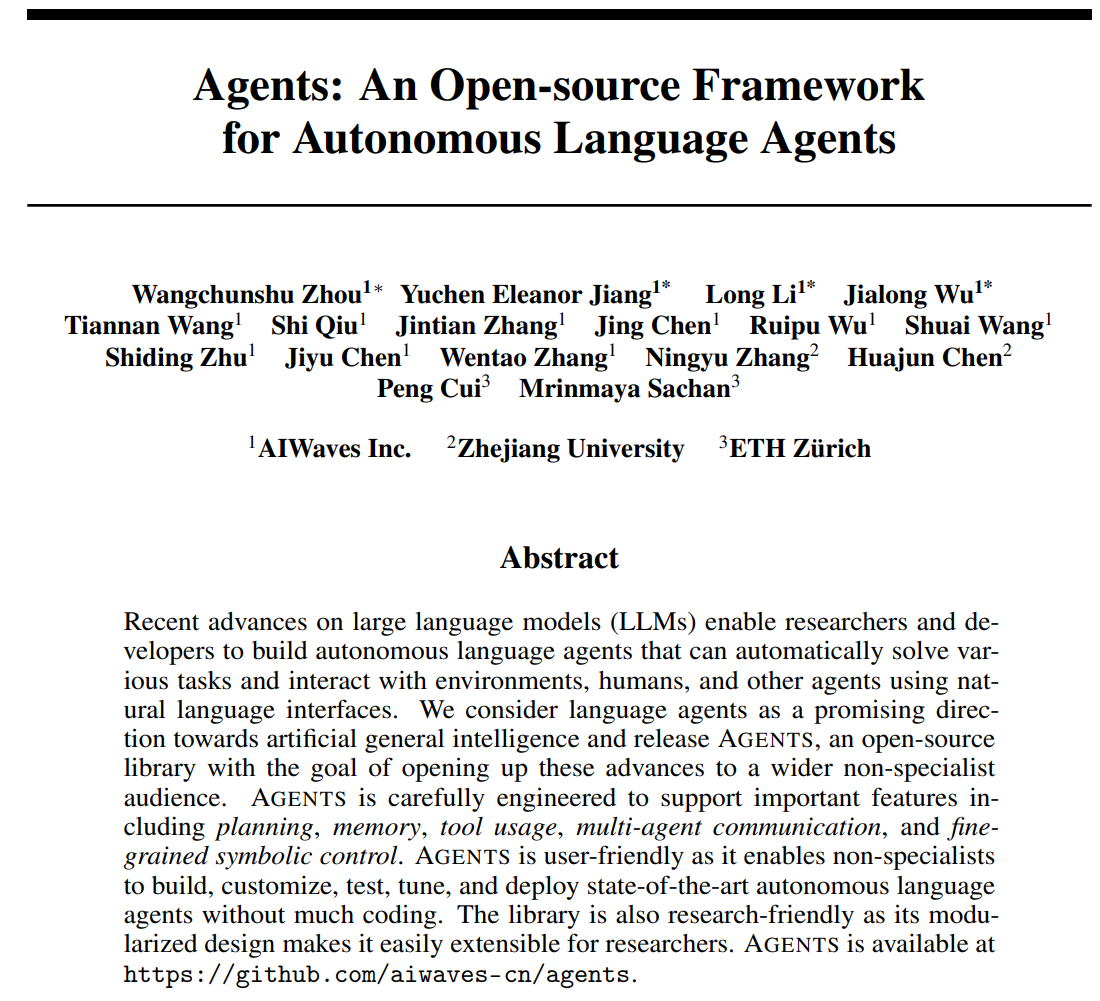
Agents: An Open-source Framework for Autonomous Language Agents
Releases an open-source library with the goal of opening up advances on LM agents to a wider non-specialist audience
repo: https://t.co/4eb6JWNuFF
abs: https://t.co/XwDyFIS6rk
Agents: An Open-source Framework for Autonomous Language Agents
paper page: https://t.co/vdOhqBaUUv
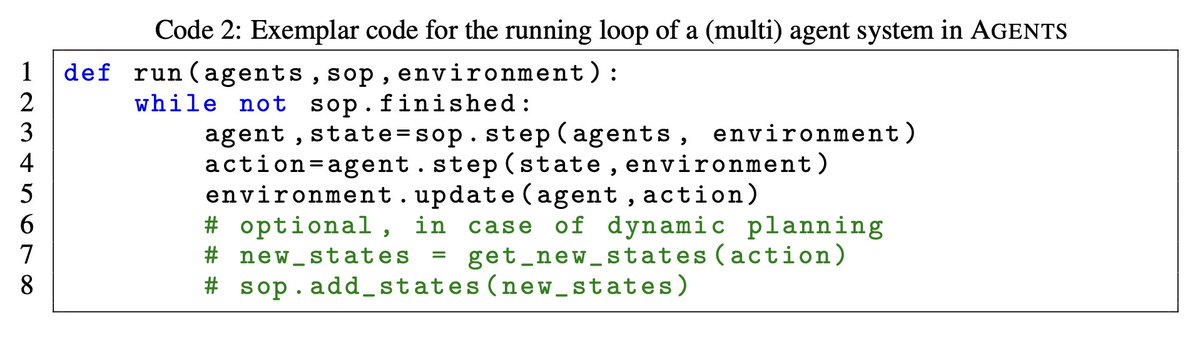
Recent advances on large language models (LLMs) enable researchers and developers to build autonomous language agents that can automatically solve various tasks and interact with environments, humans, and other agents using natural language interfaces. We consider language agents as a promising direction towards artificial general intelligence and release Agents, an open-source library with the goal of opening up these advances to a wider non-specialist audience. Agents is carefully engineered to support important features including planning, memory, tool usage, multi-agent communication, and fine-grained symbolic control. Agents is user-friendly as it enables non-specialists to build, customize, test, tune, and deploy state-of-the-art autonomous language agents without much coding. The library is also research-friendly as its modularized design makes it easily extensible for researchers.
Excited to introduce Agents, a Python framework for language agents that allows users to customize (multi-) controllable language agents with a single config file and interact with language agents! Checkout now at https://t.co/QrbZpELXB9
@WenhuChen I encountered the same problem tuning chatglm2-6b using alpaca deepspeed config on 4*A100 40G. I fixed it by setting use_ram_optimized_load to False before loading model. With zero stage-3 it works just fine with even bigger bsz.
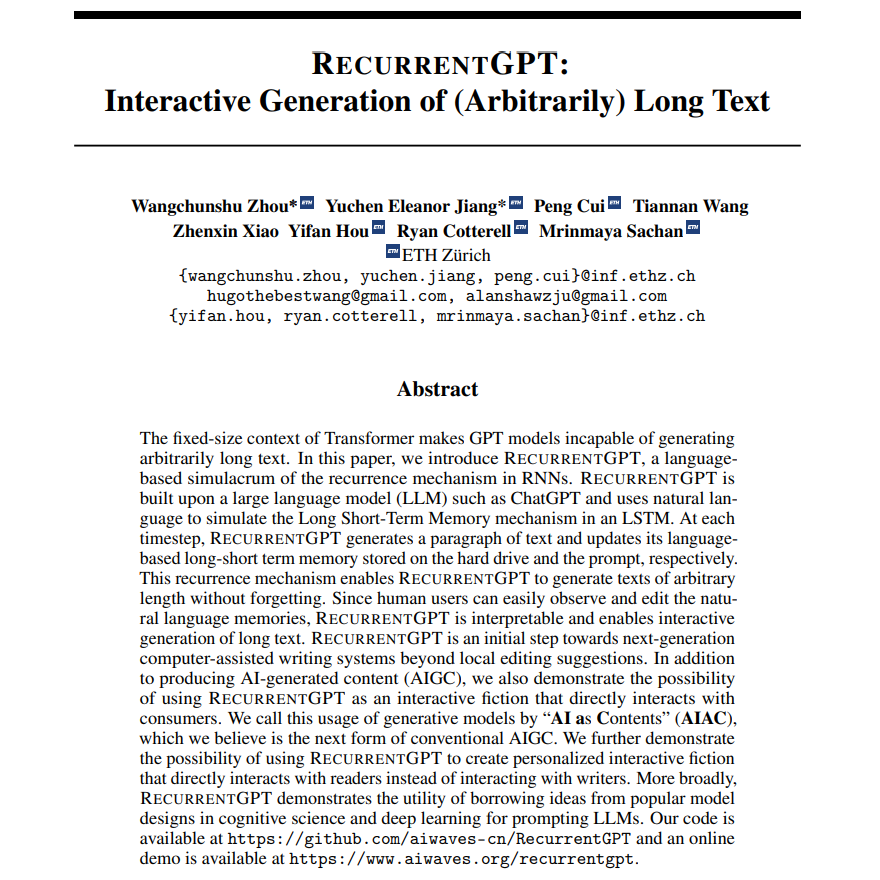
RecurrentGPT: Interactive Generation of (Arbitrarily) Long Text
Generates a paragraph at each timestep and updates its language-based long-short term memory stored on the hard drive and the prompt, respectively.
repo: https://t.co/VxP6hWJqJO
abs: https://t.co/DbP8TXhnYA