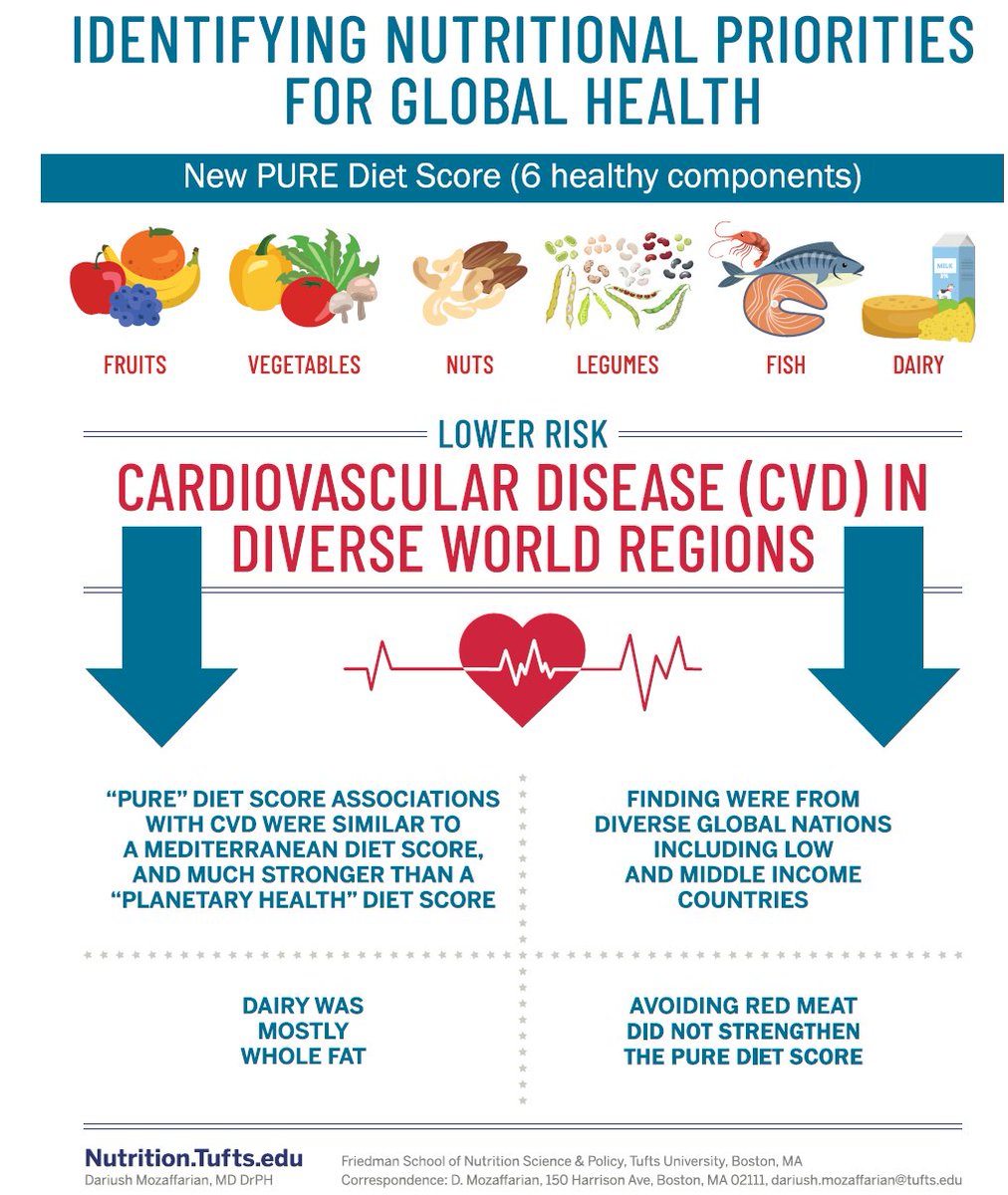
Introducing the PURE Healthy Diet Score.
Lower intake of these six healthy foods contributes to CVD globally: Study of 245,000 people in 80 countries.
Article: https://t.co/yROmIkgH16
Editorial: https://t.co/vkJoHlNcJW
Our new major paper on "Diet quality, CVD & mortality in 244,597 people from 80 countries", in Eur Heart J.
Biggest gains in avoiding premature CVD & deaths globally is expected to occur by increasing intake of healthy foods to a moderate degree, esp in poorer countries. 1/
I agree that dying while waiting is not necessarily the same as dying because of waiting. However, applying a crude population mortality rate to patients on waiting lists without accounting for person-time, age, underlying disease and disease severity is epidemiologically inappropriate. Your calculation neither establishes nor rules out excess mortality due to delayed care.
As for your figure, WHY are we comparing Canada only with the United States?
Australia, France, Sweden and Switzerland all have universal health care, allow varying degrees of private-sector participation, and have higher life expectancies than Canada.
Of course, life expectancy is determined by many factors beyond health care delivery, so neither comparison establishes causality.
My argument was never that Canada should adopt the American system. It was that Canada should be willing to learn from other countries that maintain universal coverage through different models of delivery.
The choice is not between the Canadian and American systems. That is a false dichotomy.
Universal health care is an objective, not a single model of delivery.
Canada is an outlier among countries with universal health care in largely prohibiting private insurance from covering medically necessary hospital and physician services already covered by the public system (with limited exceptions in Quebec).
The UK, Australia, Germany, France, Sweden, and New Zealand all maintain universal health care while allowing varying degrees of private insurance and private payment for faster access to specialists and elective surgeries. Many of these countries also allow physicians to divide their time between public and private practice.
Yet simply raising the possibility of similar reforms in Canada is often met with disapproval, as though universal health care and private-sector participation were mutually exclusive.
They are not.
Universal health care is an objective, not a single model of delivery. We should be willing to learn from other countries.
It's time to move beyond ideological resistance and have an open, evidence-based discussion about structural reform of what is clearly an ailing health care system.
Many people seem to have a hard time distinguishing between running and too much running. They are not the same.
This is strange, because we readily understand the difference between eating and overeating, drinking water and drinking too much, working and overworking, or taking medication and taking too much medication.
Yet when it comes to running, many people seem to assume that if some is good, more must necessarily be better. The reality is that, as with most things in physiology, the relationship between dose and benefit is not necessarily linear. For instance, this has been shown with essential nutrients like sodium (i.e. a "sweet spot"). You would similarly expect that there's point beyond which additional running provides diminishing benefits, and potentially even harm.
Sodium isn't tobacco. With smoking, less is always better. With sodium, the evidence points to a sweet spot: too much may be harmful, but too little may be too. Yet we keep treating salt like cigarettes.
One of our many papers.
https://t.co/UHj9QaR7Tf