This is the first step.
Together with NEOL, we’ve begun deploying SERV Reasoning into real government-grade AI workloads, already live with the UAE government.
NEOL uses AI agents to surface the right people, relationships, and institutional knowledge for governments and large institutions making high-stakes decisions.
For that to work, “usually right” isn’t enough.
The agent needs to be reliable, reproducible, and auditable.
SERV Reasoning enabled NEOL to move from brittle prompt-based agents to structured reasoning graphs their team can inspect, test, and improve systematically, reaching 100% accuracy on key production agents.
That matters because when a government client asks why a certain person was recommended, NEOL can now point to the reasoning structure behind the decision.
Not a black box.
Not a guess.
A traceable decision process.
This is the beginning of something much larger.
Every enterprise, government, and public institution trying to deploy AI into serious workflows will run into the same wall: agents that are too unreliable, too opaque, and too difficult to audit.
That is exactly the wall SERV Reasoning was built to break through.
Our aim is to keep expanding what we unlock with NEOL, deepen the relationship across more institutional use cases, and bring this same reasoning infrastructure to the enterprises and governments that need AI they can actually trust in production.
The future of institutional AI cannot run on todays infra, it needs specialized AI reasoning that can be tested, audited, reproduced, and trusted.
That is the institutional gap SERV is plugging.
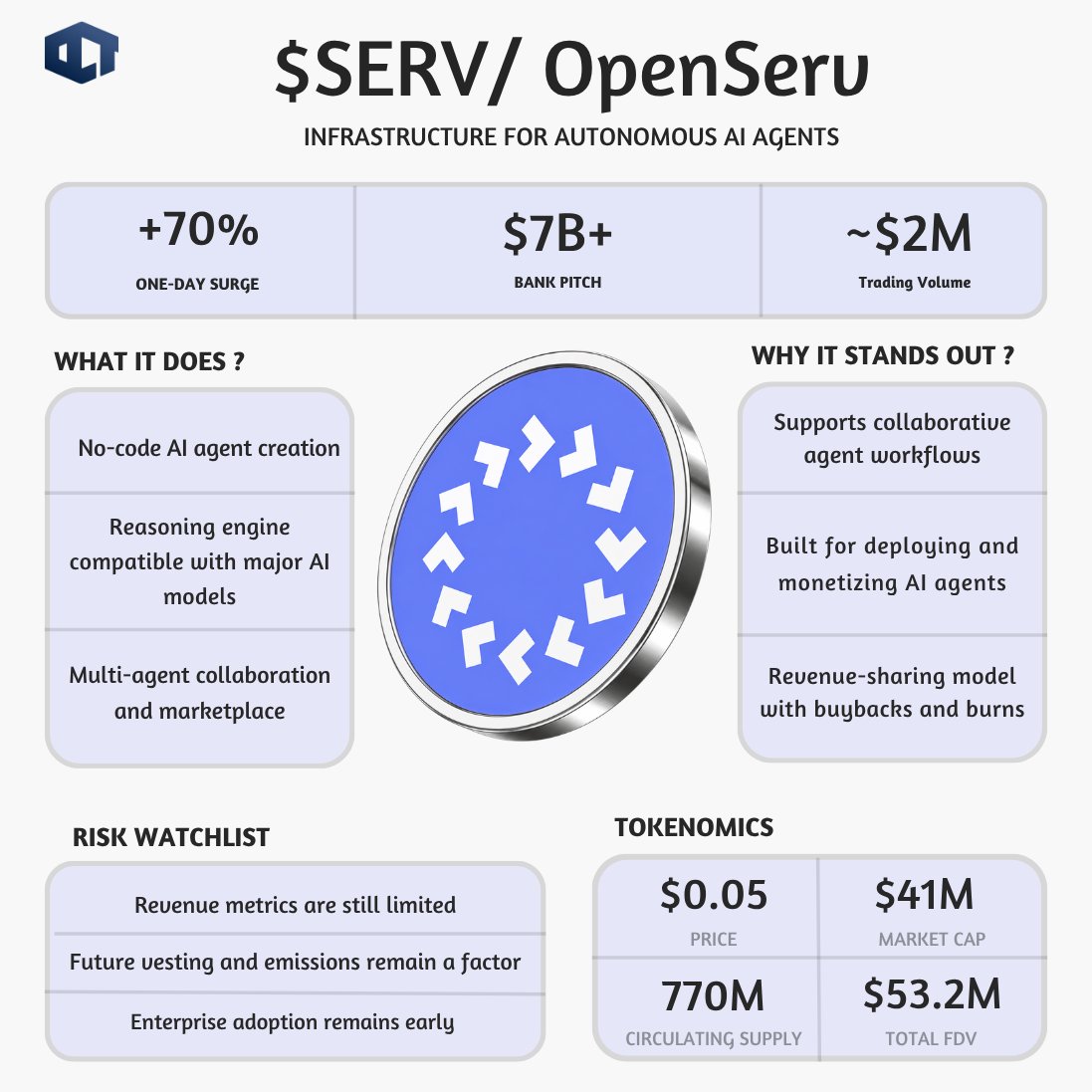
$SERV surged 70% after OpenServ claimed its reasoning engine outperformed Google Gemini at a fraction of the cost.
Days later, the team was pitching Tier-1 African banks managing $7B+ in assets.
$SERV still sits near a ~$40M market cap.
Is the market underestimating enterprise AI agents, or waiting for revenue to catch up with the narrative?
OpenServ is building infrastructure for autonomous AI agents.
The ecosystem includes:
• No-code agent creation
• Agent marketplace
• Multi-agent collaboration
• SERV Reasoning engine
• OpenAI and Anthropic compatibility
The goal is making AI agents easier to deploy, monetize, and integrate into existing workflows.
Instead of focusing on a single use case, OpenServ is building a broader platform where agents can collaborate, perform tasks, and generate economic activity inside one ecosystem.
$SERV powers payments, governance, and platform activity. The protocol also directs a portion of platform revenue toward buybacks and burns.
There are still important risks.
Enterprise adoption remains early, and public revenue metrics are still limited compared to the scale of the narrative.
Supply transparency is another consideration:
• Team allocation: 22.5%
• Treasury allocation: 18%
• Portions of both allocations remain vesting
• Significant supply remains less detailed in public schedules
That means future adoption will need to outpace ongoing token emissions.
At the same time:
• No major exploit history surfaced
• No public team misconduct emerged
• Enterprise outreach continues expanding beyond crypto-native users
Tokenomics
• Price: $0.05
• Market cap: $41M
• Circulating supply: 770M
• Total supply: 1B
Always take whatever you read on the internet with a pinch of salt, do your own research, NFA.
woah, sharding is coming to @openservai and it will honestly change everything 💯
think back to the invention of the printing press
before it existed books were hand-copied, full of errors, no two the same, then the press fixed it, set the plates once, print thousands of identical pages, reset plates, then create thousands more
sharding is the press of agentic workflows
currently, agentic workflows rely on the LLM for decision making, even simple tasks are run through a system prone to hallucinate,
@openservai sharding fixes this, here’s how
$SERV agents initially create a reasoning diagram, a structured, machine-readable flowchart mapping every step, branch, and verification check before execution begins
that initial diagram is then split up into distinct, deterministic, executable shards
the LLM defines the logic once, then the shards deliver the results, always perfect, consistent, reliable, zero variance or drift
plus, every node and every decision is logged, the agent becomes a verifiable, traceable record, no more black boxes
this enables the auditability, compliance, and repeatable production workflows that enterprises and governments need at scale
@openservai is building the deterministic infrastructure that the largest players in pivotal sectors have been waiting for
the release of sharding will be the printing press moment for the agentic economy and it’s being created by @openservai, no one else has the tech
imagine reading this and not feeling like the $SERV token was massively undervalued
might want to load up now, many will be sidelined when enterprise clients start rolling in, $SERV is not a quick flip, this is what generational opportunity looks like 🔮🔥
We just rolled out our fully updated SERV documentation, making it production-ready for all builders.
Everything is in one place:
• How the SERV Reasoning Engine works
• API documentation
• SDK setup guides
• Full Roadmap
Check it out below.
https://t.co/vqFIJb0f1d
Another team that decided to switch to SERV.
TRECC is an infra layer for the AI economy that handles credit allocation & risk decisions.
The benchmarks were clear:
→ ~0.5s inference speed
→ 100% reliability
→ 10x more efficient than their previous stack
SERV is inevitable.
@Okada_DeFi0x@rikimaaro GPS was first US military, Palantir was CIA and NSA then consumer, SpaceX was NASA then commercial launches and Starlink. It's a huge proof point for tech to be used in high-stakes environments first, and that really helps the adoption and scaling story
— Spaces with Greg, May 20
@Okada_DeFi0x@rikimaaro I haven't seen feedback like the kind coming from these early customers almost anywhere else - whose worlds are literally being changed by this. Really inspiring.
And these high-stakes environments matter - a lot of tech first went into them
@Okada_DeFi0x@rikimaaro You ask the wrong question Buddy
Quote from Greg (Ex-Google)
On scaling principles: you first have to do things that don't scale. Paul Graham told Brian Chesky you have to find 50 people who absolutely love your product, and that's way better than a million who kind of like it
All post I see on the TL regarding @openservai ethereum:0x40e3d1a4b2c47d9aa61261f5606136ef73e28042
are based on fundamentals/tech/breakdowns.
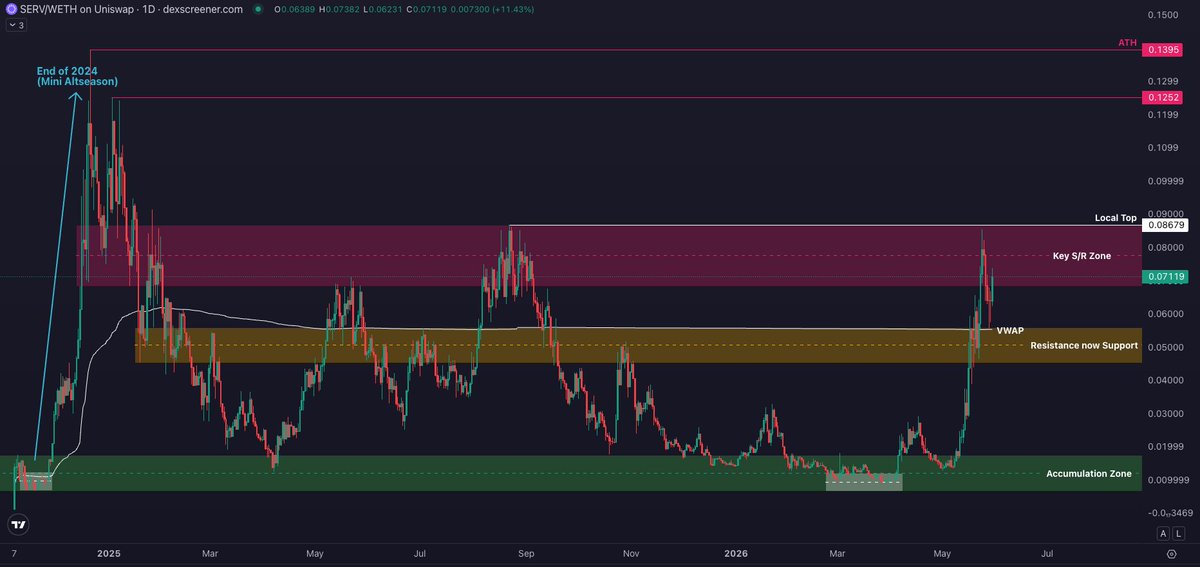
Let me be the TA SERV-er