Economist |Interested in trade, energy, tech. adoption & informality in LIC | @Oxford_CSAE Visiting Fellow ’26 | He/Him|Views are mine | Lil Pop culture
Happy to share that I’m visiting @UniofOxford again, this time as a @Oxford_CSAE Visiting Fellow. Looking forward to interact with the faculty @OxfordEconDept, @ODID_QEH and @BlavatnikSchool from January to March, 2025. I’m thankful to my referees and the selection committee.
🎂Happy anniversary to our Workshop on Political Economy.
🎓This year’s keynotes are by Tommaso Nannicini and Raphael Franck.
🔗Details at:
https://t.co/mYXvKND6xZ
Please spread!
📣 Join the growing world-class @youthimpactorg research team in South Africa and work on real-time evidence generation & use with the Department of Basic Education. Applications due June 14th
➡️ https://t.co/qYHJRH2alJ
The Centre for Geopolitics is taking applications for 3 new Postdoctoral Research Associate positions, with applications closing on 14th June 2026.
Visit our website for more information:
https://t.co/CbSyA5Q4zS
2nd Junior Workshop in Geoeconomics & Best Paper Award on June 10 in Milan! Jointly organized by IEP@BU, CEPR RPN in Geoeconomics & Security, & the Kiel Institute. Keynote by Massimo Morelli, + many great presentations by junior scholars 👉 https://t.co/ykGs8YC184
📢 Young Lives is recruiting!
Join our friendly, supportive team as a Quantitative Research Assistant & be part of a unique longitudinal study of poverty & inequality in Ethiopia, India, Peru & Vietnam, since 2002. Application link in the comments.
#job#vancancy#researcher
🚨 I'm recruiting 2 postdoctoral researchers for the @ldnsocmedobs, to be based at the @UniofOxford. These are both full-time positions for 2 years. Deadline for applications: June 23. Expected start date: September 2026. 🔁 Please share and help me spread the word! 🚀
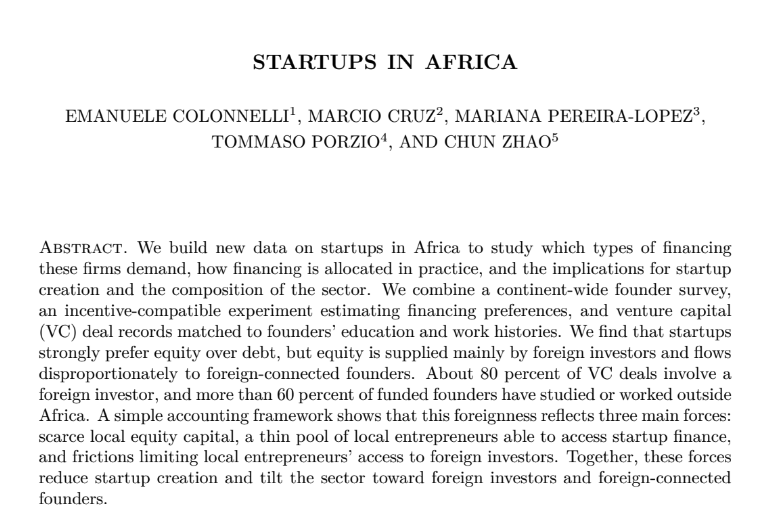
Tommaso Porzio and co-authors (Colonnelli, Cruz, Pereira-López, Zhao) have a new important paper on African startup financing that lands exactly where founders, GPs, and policy operators on the continent have been pointing for the better part of a decade.
Headline result: capital to African startups flows disproportionately to white, foreign-educated founders, primarily from foreign investors in rich countries, with strong homophily around common language and colonial linkages. And, from a survey experiment with IFC, African entrepreneurs don't actually care about the source of capital. What they want is equity from investors with local experience, and they don't want to give up control. They place near-zero value on the "non-financial support" foreign investors tout.
Because the result is consistent with what the African startup community has been saying out loud, referees will dissect the methodology in due course. I'll jump straight to what it means if you're building, funding, or regulating in this ecosystem.
For African innovators:
1. The pattern you've flagged anecdotally is now documented at scale. The homophily on language and colonial linkages is not in your head.
2. Your revealed preference, equity from locally experienced investors, and retaining control, needs no second-guessing. Optimize your cap table accordingly: a smaller check from a local fund with operational fluency often dominates a larger one from a foreign syndicate that will dilute your governance.
3. Non-financial support is priced at near-zero in the paper's elicitation. Use that in negotiation. Mentorship decks and platform value are not free options against your equity.
For policymakers:
4. The diagnosis is a missing local equity market; supply side, not founder quality. Build it. That means pension fund mandates that permit alternative assets, a regulatory perimeter that distinguishes VC from public-market intermediation, and tax treatment of carry that doesn't punish domiciled funds.
5. Stop indexing success on "$X billion raised by African startups." That metric is largely a foreign-influence variable. The right KPI is the share of capital intermediated by locally domiciled, locally managed GPs. UEMOA, EAC and AfCFTA harmonization on fund vehicles would move this faster than any single jurisdiction acting alone. Coordinate!
For DFIs:
6. Deploying more LP capital alongside the same foreign VC syndicates reinforces the homophily channel. The marginal dollar should crowd in local fund managers (first-loss tranches, anchor LP commitments, GP seeding), not match foreign GPs on standard terms.
7. The "non-financial support" finding should reset expectations on technical assistance programs (at least for startups). Founders are telling you that they value cash on equitable terms more than your advisory hours. Redirect that budget toward de-risking local fund formation.
8. The control-retention result has concrete design implications: revenue-based financing pilots, dilution through IPOs after proven success of the family business (cf. Dangote) and contract designs that don't reflexively replicate Silicon Valley defaults in markets where they don't fit.
I met with a lot of operators at the Africa CEO Forum last week who discussed building domestic institutional capital, shared-equity vehicles for cross-border African champions, and how DFIs should govern their relationships with local fund managers. I hope these insights are useful as research and practice continue to refine the playbook.
Great paper, Tommaso et al.
🧵on new paper “Startups in Africa”.
Draft here: https://t.co/ag9ni1IMoa!
In this project, we collect new data to study a small, but fast-growing, reality: the startup scene in Africa.
With Emanuele Colonnelli, Marcio Cruz, Mariana Pereira-Lopez, and Chun Zhao. 1/
Applications are now open for the fully funded FIAS Fellowship Programme 2027/2028 in France, offering outstanding international researchers a prestigious 10-month fellowship across seven French Institutes for Advanced Study with benefits including a monthly living allowance of approximately €2,200, social security coverage, accommodation support, relocation assistance, and dedicated research funding — apply now. https://t.co/v2TzeUwEdm
📢 Call for Papers | PSE Macro Days 2026
Submissions are open for the 2026 edition of the PSE Macro Days (September 17-18)
📧 To submit, please send a pdf of your paper at [email protected]
⏰ Deadline: May 30
Decisions will be made by June 10
https://t.co/ryCXPAVIya
RAIN Fellowship 2026
Calling mid-career African researchers! Partner with Oxford scholars to develop AI & emerging tech solutions for Energy, Agriculture, & Health.
Apply by: May 15, 2026
Apply now: https://t.co/A8OjtqsTGL
Research Africa Oxford Tech STEM GigsnMore
📣 We're hiring a postdoc to join us on education research projects at Oxford @OxfordEconDept@Oxford_CSAE. Join me @gamblingondev@roccozizzamia on multiple exciting projects! Applications due June 7th.
https://t.co/fI5sqHDF6r
Applications are now open for the Subir Chowdhury Visiting Fellowship!
This three-month fellowship is available to early career post-doctoral researchers with experience researching Bangladesh and/or India in the social sciences.
Apply by 30 June 2026 ⬇️
https://t.co/aP6lnwNYiV
📢Calling all young researchers! Don’t miss the chance to present your work at the @ecb Conference on Monetary Policy on 5-6 October 2026. Submit your paper by 15 May! https://t.co/BIaXloNJkM
Lots of discussion on here currently about what specifically the focus should be within the research on "development economics". My main priority if I could choose one: we need much *more* of all types of good economics research on low- and middle-income countries.
1/n