Postdoctoral researcher at @meta Fair and @uwnlp , Interested in going into the inner workings of neural networks, multilingualism, and fairer NLP (he/him)
We present Compute Optimal Tokenization! 🔡
Common in LLM scaling works stick to one tokenizer, sweeping data/model size.
But what happens when we control the tokenizer’s compression rate (bytes/token)?
Here we sweep tokenizers, params, and data across compute budgets: [1/N]
Meta's FAIR is one of the few labs that does projects like this and it saves a lot of time for everyone else.
shout out to their optimal compute tokenization paper that did similiar analysis to this one.
Super excited for Chutong Meng's new paper (in collaboration with Barron Associates): https://t.co/bpoCLUy8oL
We substantially improve translation for extremely low-resource languages by extracting parallel data from linguistic documentation materials.
Thread 👇
Domain adaptation.
Latent tokens align well with words/phrases in high-resource languages (English, Chinese).
Hierarchical models should adapt compression by domains to compute optimal value. E.g., non-latin script texts need more compression to counter utf8 inefficiency.
5/5
Amazing results! A great case for byte-based and latent-tokenized models like H-Net!
Still, most LLM research and all known frontier LLMs use subwords.
Here is my list of crucial research directions pushing us toward non-subword frontier models:
1/5
I've always believed that intelligence should come from simple, general building blocks that learn their own abstractions directly from raw data; in other words, the bitter lesson. I think we're finally seeing a real step towards AI that can learn from all data.
Language modeling on raw bytes is a microcosm of this ideal, and to me it's a central problem in AI: if we can't build LLMs that learn end-to-end from bytes, how will we handle the rest of the world's data that we understand even less?
Last year we introduced hierarchical networks (H-Nets) as a first step. Our new version finds up to 3-5x efficiency gains in controlled scaling law experiments, and at larger scale matches an open-source model trained on 11T tokens with ~10x less data and compute. The posts below walk through what we found and why we think it works.
RL is not my area, but there is some potential here for byte-based models (limiting the action space) and latent tokenization (adapting compute to prediction difficulty 👀 “Beyond the 80/20 Rule”).
4/5
I've always believed that intelligence should come from simple, general building blocks that learn their own abstractions directly from raw data; in other words, the bitter lesson. I think we're finally seeing a real step towards AI that can learn from all data.
Language modeling on raw bytes is a microcosm of this ideal, and to me it's a central problem in AI: if we can't build LLMs that learn end-to-end from bytes, how will we handle the rest of the world's data that we understand even less?
Last year we introduced hierarchical networks (H-Nets) as a first step. Our new version finds up to 3-5x efficiency gains in controlled scaling law experiments, and at larger scale matches an open-source model trained on 11T tokens with ~10x less data and compute. The posts below walk through what we found and why we think it works.
Domain adaptation.
Latent tokens align well with words/phrases in high-resource languages (English, Chinese).
Hierarchical models should adapt compression by domains to compute optimal value. E.g., many low resource languages should be compressed more due to utf8 inefficiencies
RL is not my area, but there is some potential here for byte-based models (limiting the action space) and latent tokenization (adapting compute to prediction difficulty 👀 “Beyond the 80/20 Rule”).
4/5
Looking for multiple emergency reviewers for #ICLR2027 for papers related to medical AI, LLM-judges, and audio LLMs. Please DM me if you are eligible and interested!
If you're at #EMNLP2026 you should stop by our ✨tokenization tutorial✨ happening in <2 hours, starting at 9AM CET!
Fun fact: I'm actually not at EMNLP... I'll be presenting remotely. But I'll be up from 1AM to 4AM PDT because that's how much I love tokenization 🫶😄
Szia 👋🇭🇺
Happy to be in Budapest for EMNLP.
I'll be sharing few lessons learned on byte language models, latent tokenization at tomorrow’s Tokenization Tutorial (in P2 from 9 -12:30).
https://t.co/ABMcUQCcyL
to prepare for an upcoming release (👀) we dug into the pretokenizer a little more. are people aware that hand-crafted regexes are part of every frontier LLM and doing some pretty heavy lifting?
some quick examples 🧵
Today we published a technical report on Muse Glimmer, our 30B open-weight model built for agentic tasks on consumer hardware.
It runs at practical speeds on a Mac or PC with a single consumer GPU at 4-bit precision, and leads comparably-sized open models on tool use and multi-step planning.
Read about the model architecture, distillation recipe, quantization and more: https://t.co/H7n9qeDhxn
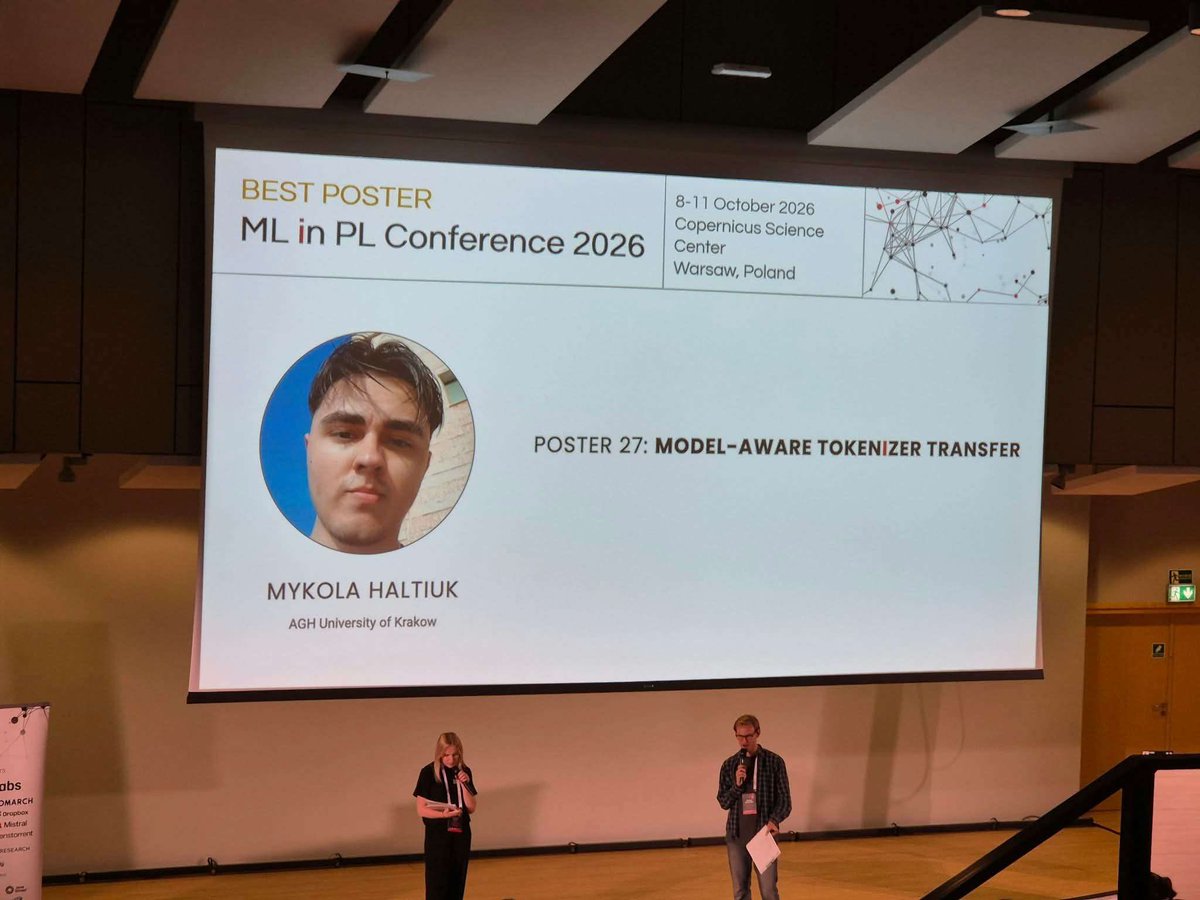
They say you can’t be at two conferences simultaneously. Well, our paper MATT won the Best Poster Award 🏆 at @MLinPL in Warsaw, while I presented it at @tokshopMeeting (@COLM_conf) in San Francisco. Kudos to Piotr Ludynia for showing it to the Polish audience!