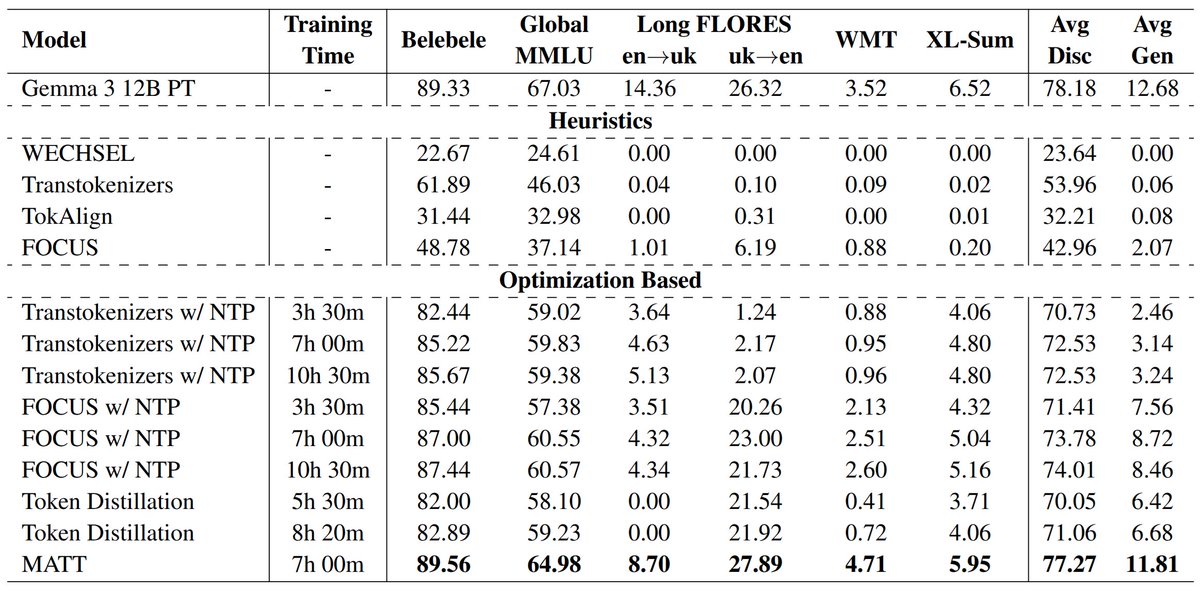
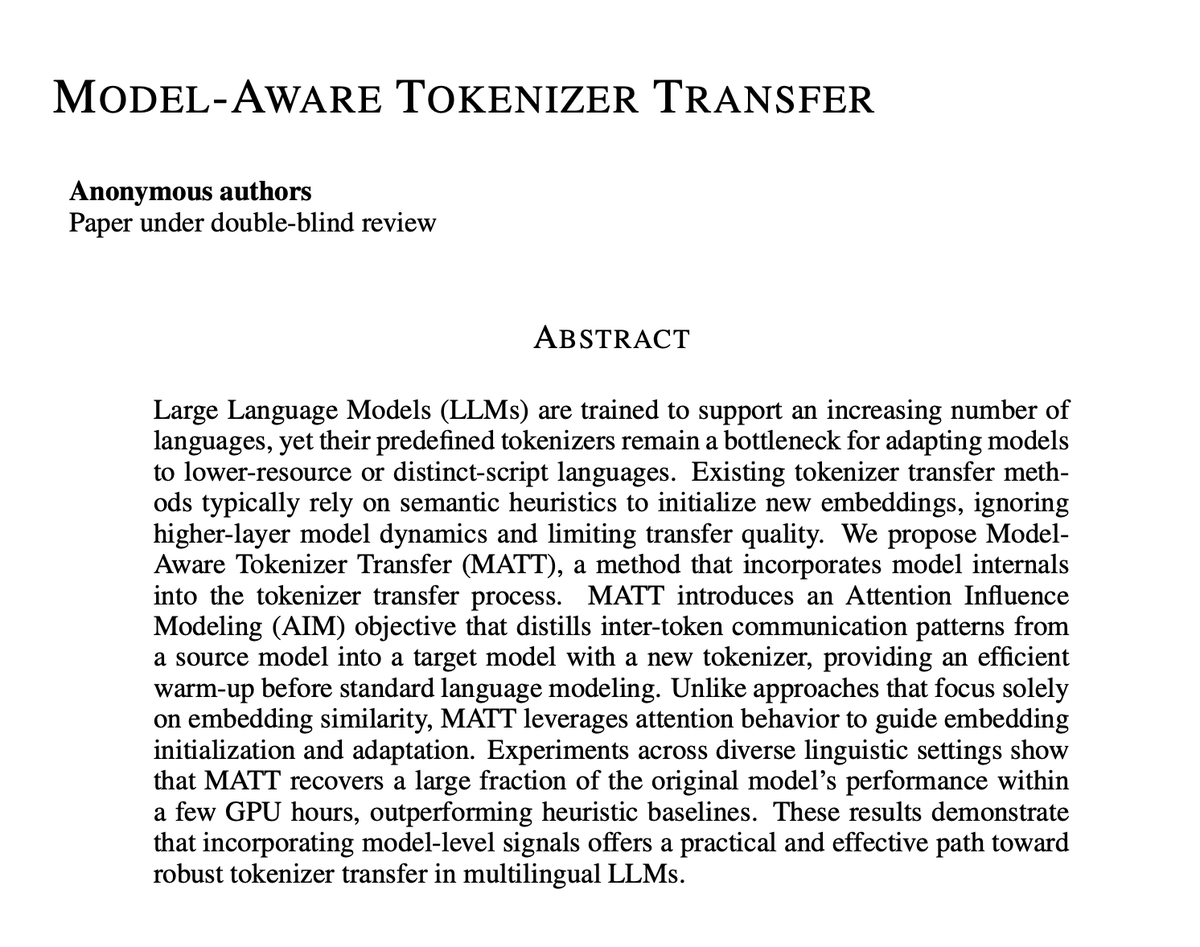
A year and plenty of work have passed since the original ICLR submission @vikhyatk posted about. Since then, MATT has been accepted to @NeurIPSConf, and now I'm heading to @COLM_conf to present it at the Tokenization Workshop.
Here's what Model-Aware Tokenizer Transfer does 🧵
Our team created a Codex/Claude skill based on "The Ultimate MoE Training Handbook", so your agent can become the expert in MoE training 🤩
The Github link is in the post below 👇
@Thom_Wolf@huggingface
This involves designing efficient systems that perform smart scheduling in large batch scenarios overcoming the heterogeneous structure of these networks.
Optimizing for single examples is important, but not enough for the widespread adoption of LTLMs.
Fast generation.
We NEED to generate multiple bytes at a time; otherwise, throughput will be too low to serve models in practice.
There is already evidence that parallel byte generation is feasible and can overcome its speed disadvantage relative to subwords. 👀FastBLT, MBP
2/5
Apertus 1.5 Technical Report is out!
134 pages of fully open multimodal reasoning model development from Swiss AI Initiative (ETH Zurich/EPFL) with data recipe, training experiments and many interesting insights 🇨🇭
Thread with my personal coverage ⬇️
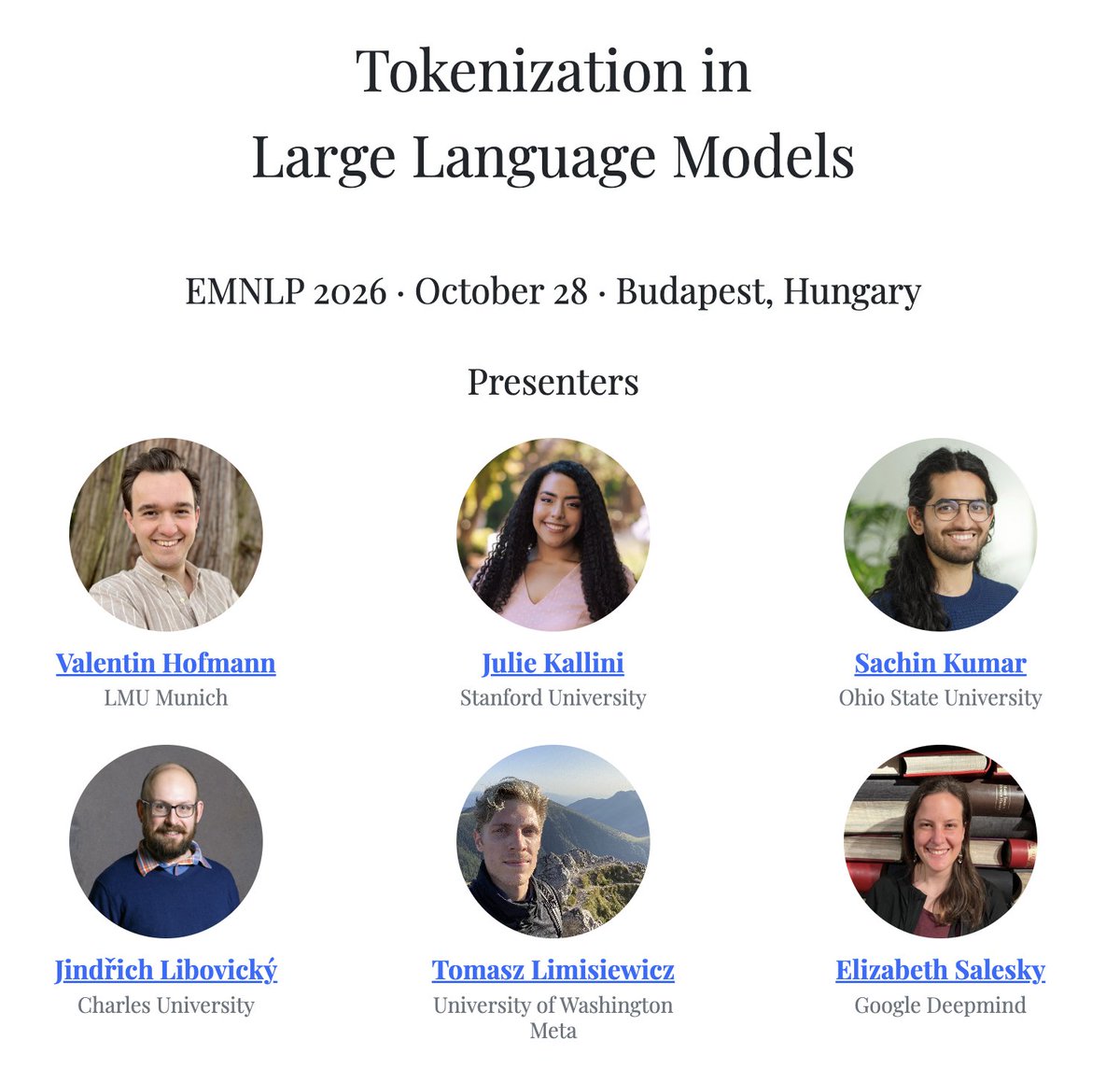
Headed to #EMNLP2026? Want to learn about the latest advances in tokenization research in LLMs?
Come check out our tutorial on October 28. We will cover everything from fundamentals and emerging approaches with plenty of hands on demos and exercises.
See you in Budapest!
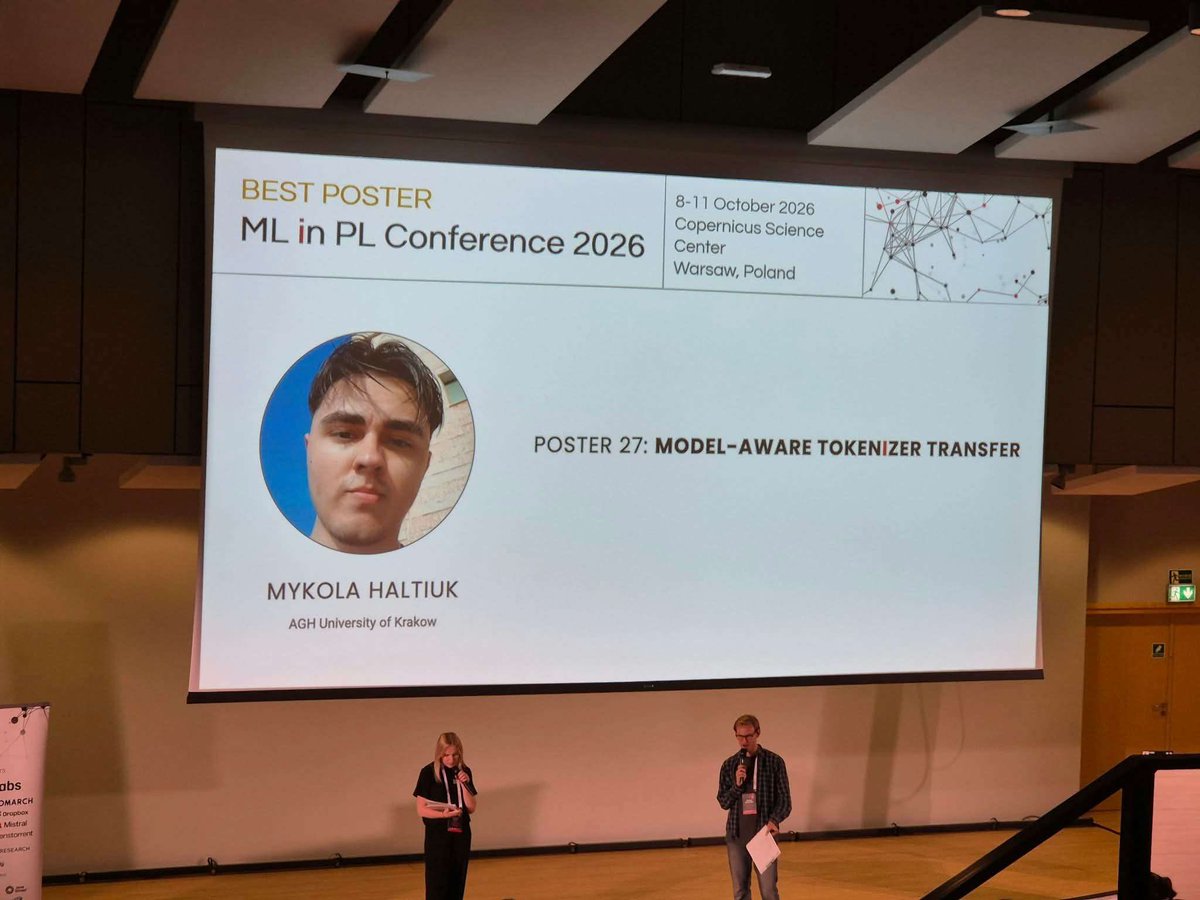
They say you can’t be at two conferences simultaneously. Well, our paper MATT won the Best Poster Award 🏆 at @MLinPL in Warsaw, while I presented it at @tokshopMeeting (@COLM_conf) in San Francisco. Kudos to Piotr Ludynia for showing it to the Polish audience!
A year and plenty of work have passed since the original ICLR submission @vikhyatk posted about. Since then, MATT has been accepted to @NeurIPSConf, and now I'm heading to @COLM_conf to present it at the Tokenization Workshop.
Here's what Model-Aware Tokenizer Transfer does 🧵
A year and plenty of work have passed since the original ICLR submission @vikhyatk posted about. Since then, MATT has been accepted to @NeurIPSConf, and now I'm heading to @COLM_conf to present it at the Tokenization Workshop.
Here's what Model-Aware Tokenizer Transfer does 🧵
At the same time, self-distillation can only restore what the model already knows. MATT won't teach a model a language it doesn't speak. It makes a language it already speaks cheaper to run. Making it stronger than it was is the job of CPT, SFT, and so on.
Lapa LLM, an open Ukrainian model built on Gemma 3 12B, used MATT to replace 80k of its tokens with Ukrainian ones. Ukrainian text now takes ~1.5x fewer tokens.
We are working on the next releases, so follow us at @lapallm
It's cheap. Only the new embeddings are trained, the rest stays frozen, and you align a single layer about a third of the way in. Going deeper costs more but barely helps, on both Gemma 3 and Qwen 3. A few GPU hours are enough.
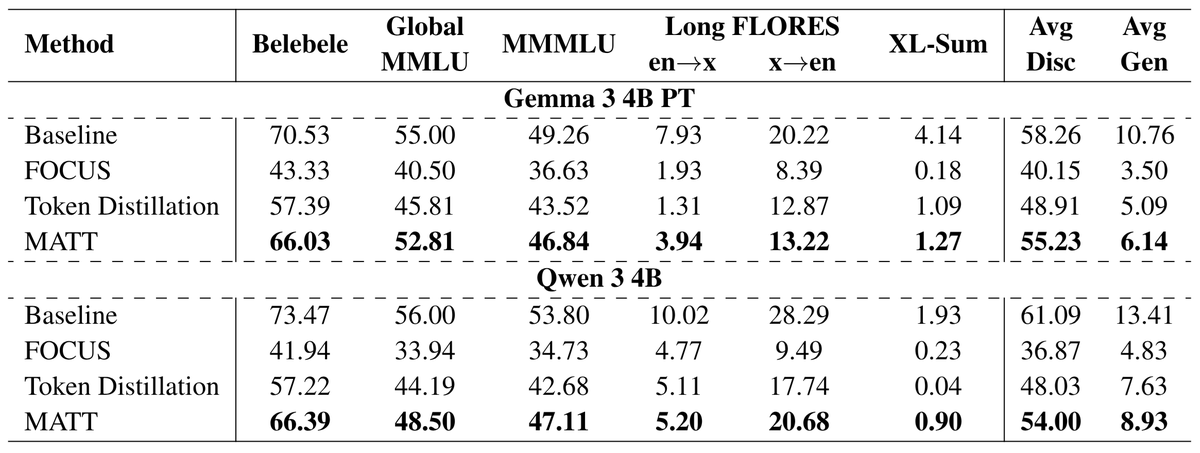
Tested on Gemma 3 12B in Ukrainian, plus Gemma 3 4B and Qwen 3 4B in Arabic, German, Japanese, and Swahili, against heuristic, next-token-prediction and distillation baselines.
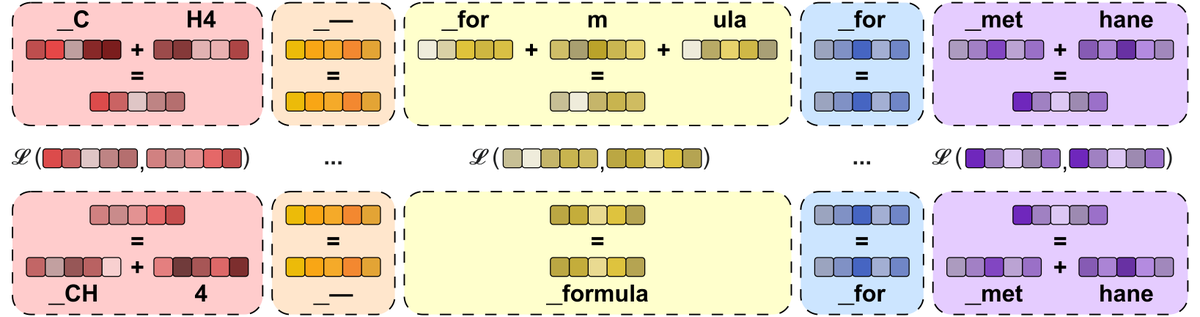
Attention Influence Modeling (AIM) splits text into segments both tokenizers agree on, then matches what each segment contributes to every other one (preserving causality), teacher vs student. Each pair of segments is a training signal, so even a short text teaches a lot.
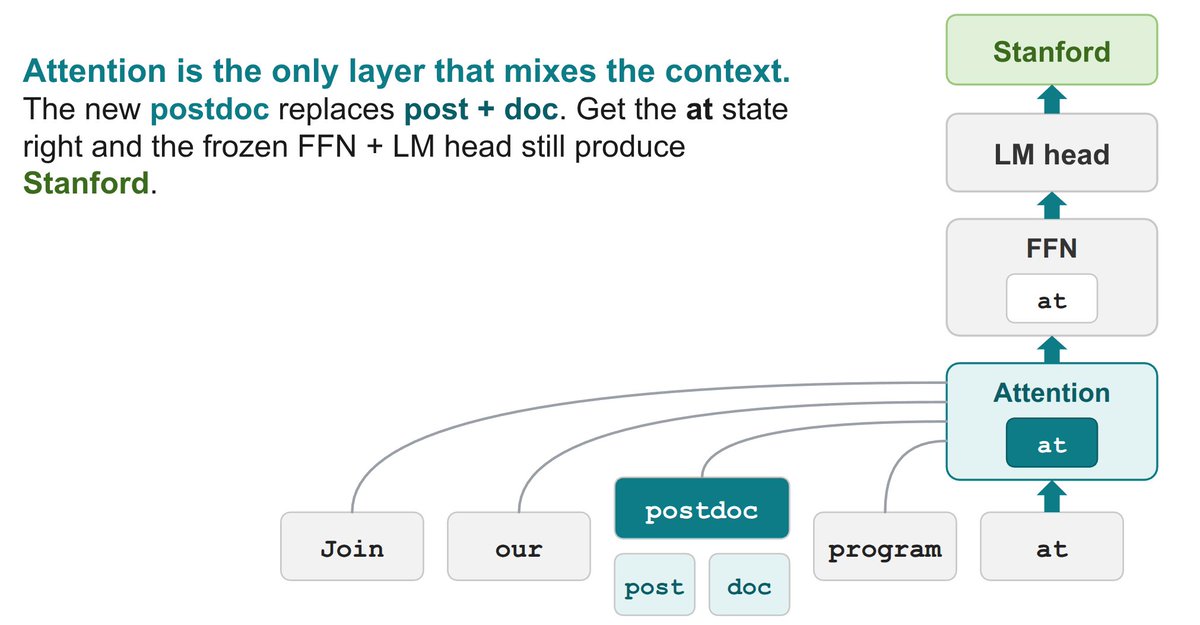
Why attention? It's the only layer that mixes context. If the new 𝚙𝚘𝚜𝚝𝚍𝚘𝚌 token influences 𝚊𝚝's hidden state the way 𝚙𝚘𝚜𝚝 + 𝚍𝚘𝚌 did, the context-agnostic FFN layers and LM head still predict 𝚂𝚝𝚊𝚗𝚏𝚘𝚛𝚍.
Since the model is already proficient in the target language, we should just let it teach itself to read the new tokens and view tokenizer transfer as self-distillation.
The problem: Gemma 3 understands Ukrainian pretty well. But its tokenizer splits it into ~1.5x more tokens than a Ukrainian tokenizer would. Swap the tokenizer, and the model can't read its new tokens. Retraining them the usual way is slow.
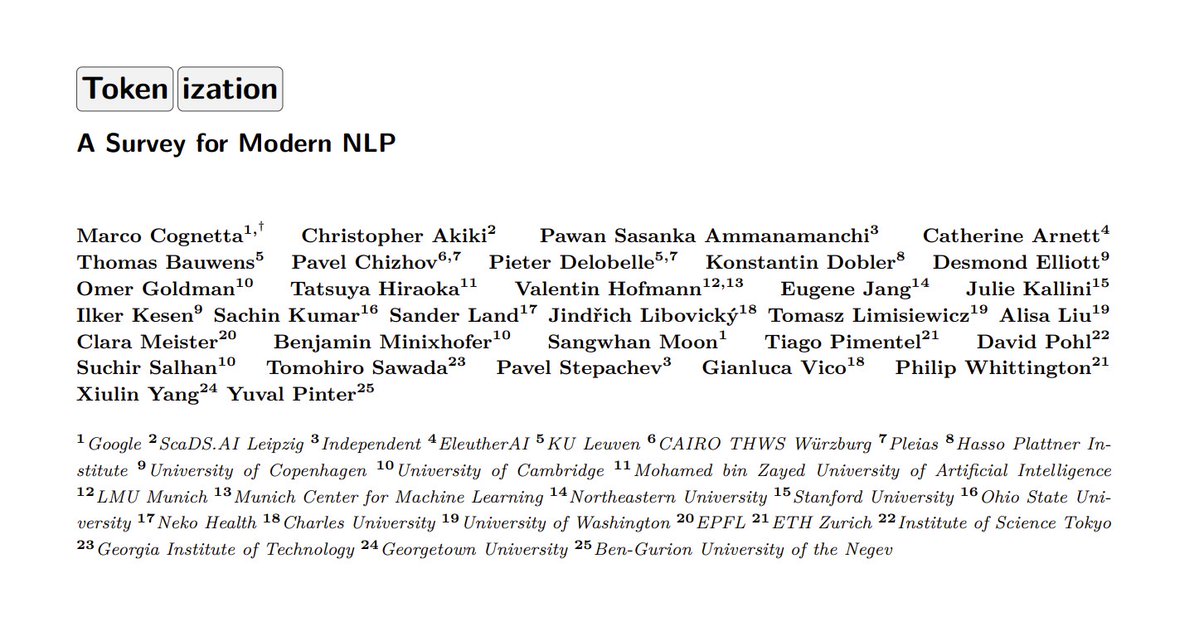
Another lovely surprise this week is MATT appearing in the new tokenization survey. If you want one map of the whole field, start there.
If you're going to COLM, come to the Tokenization Workshop on Oct 9. https://t.co/xsvlhmtTvw
https://t.co/e7X8mDcWFp
🚨 [Token][ization] Paper Alert 🚨
Tokenization is a wildly understudied area of language modeling despite it having effects across all of NLP. Over the past ~8 months, 32 (!) tokenizer researchers put together the most comprehensive survey of the field. Check it out!